BQ
Bonaire
Caribbean’s finest shore diving & 10,000 flamingos
Caribbean’s finest shore diving & 10,000 flamingos
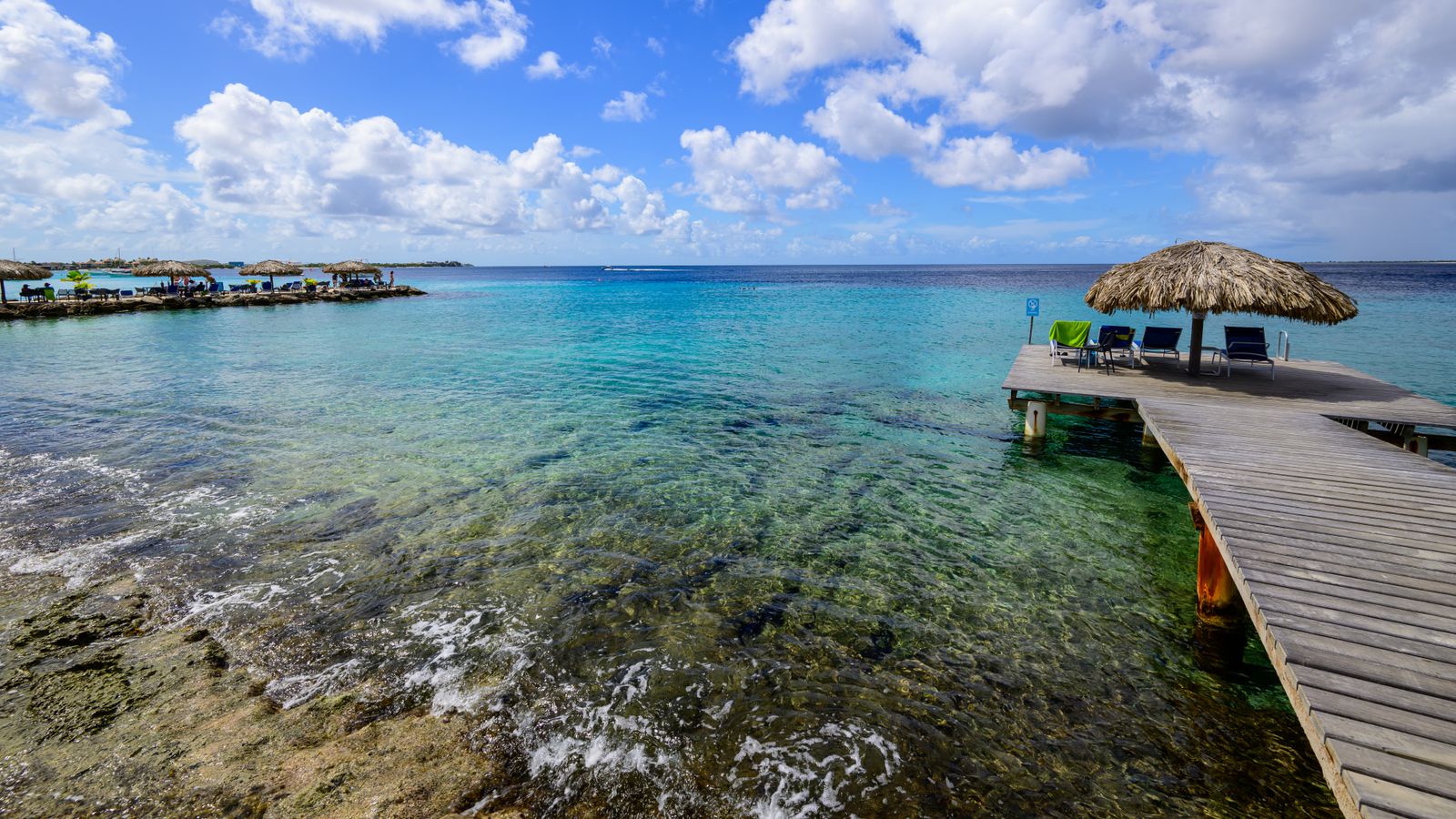
Bonaire is the Caribbean’s premier shore-diving destination — a small Dutch island off the coast of Venezuela where the entire coastline is a protected marine park and the coral reef begins a few fin-kicks from the beach. Shore diving is the norm: you drive your hire car to the yellow-painted stones marking entry points, kit up, and fin in to the reef. No boat, no schedule, no crowds. The Bonaire National Marine Park protects 2,700 hectares of the finest Caribbean coral reef, with visibility of 30+ metres, over 80 coral species, sea turtles, sea horses, reef sharks and the free-roaming donkeys wandering the island’s interior. Bonaire is also the world’s best flamingo destination outside Africa — the southern salt pans are home to a flamingo colony of 10,000 birds.
Over 100 named dive sites circling the island, all accessible directly from shore, with the finest Caribbean coral in an entirely protected reserve. The reef’s health — owing to Bonaire’s long tradition of marine conservation (the park has been protected since 1979) — is impressive. Favourite sites include the Town Pier (extraordinary night diving with seahorses and frogfish), Hilma Hooker wreck (a drug-running ship sunk in 1984 in 28m) and Red Slave (a quiet, intact southern shore site).
The southern salt flats of Bonaire — vivid pink in the afternoon light from crystallising salt — are home to up to 10,000 Caribbean flamingos in a breeding colony that makes Bonaire one of the Western Hemisphere’s most important flamingo sites. The slave huts (tiny stone shelters where enslaved workers lived during salt harvesting) are a sobering historical counterpoint.
The northern third of Bonaire is a protected wilderness of cacti, wild donkeys, parrots and dramatic rocky coastline — the Goto Lake flamingo lagoon, the Slagbaai salt lake and the Boca Chikitu blowhole are the highlights of a 4WD or cycling tour through this desert landscape.
Bonaire (Wikipedia) →A slow-cooked stew of goat, beef or fish with local spices and vegetables — the classic Bonairean home meal.
A round of Gouda or Edam filled with spiced chicken, olives, raisins and capers and baked — the signature dish of the Dutch Caribbean.
A local game fish caught off the west coast, served grilled or raw at waterfront restaurants.
Dorado (mahi-mahi) and other fresh fish from local boats are the island staples.
A light lager created for the Dutch Caribbean and the classic beach beer on Bonaire.
Flamingo International Airport (BON) has connections through the USA and Netherlands. KLM and United serve the main routes. For trip planning, see the official Bonaire tourism portal.
United Airlines operates direct Newark–Bonaire services. Most other US travellers connect through Aruba (AUA) or Sint Maarten (SXM).
KLM (9h30 direct from Amsterdam, multiple weekly) is the primary European connection, reflecting Bonaire’s status as a Dutch special municipality. From the ABC islands, Curaçao (30 min) is the closest hub.
Bonaire is a very small island (288km²) — the airport is 5 minutes from everything. Most dive lodges offer free airport pickup with a pre-booking. Rental trucks (essential for accessing the shore dive sites) can be picked up at the airport.
A pickup truck (US$35–65/day) is the standard Bonaire diver transport — the truck bed holds tanks, BCDs and wetsuits, and 4WD is useful for the Washington Slagbaai dirt tracks. The entire island is a 25-minute drive from end to end.
Year-round is true — Bonaire sits outside the hurricane belt, gets only 560mm rain and has constant Trade Winds (15–25 knots). January to June is slightly drier and calmer. Diving conditions are excellent all year; the flamingos are visible year-round at the salt pans.
Bonaire uses the US dollar (USD). Mid-range for the ABC islands; cheaper than Aruba due to lower hotel prices, but diving costs add up.
Bonaire’s shore diving is effectively free — the dive sites are road-accessible, no boat or guide is required, and the annual park fee (US$40) covers unlimited dives for a year.
Nitrox (enriched air diving — 32% or 36% oxygen instead of normal air’s 21%, allowing longer bottom times at depth and faster surface interval recovery) is widely available on Bonaire at US$6–8 per tank fill.
Buddy Dive Resort (the largest dive operation on Bonaire, with its own pier, air fills 24 hours, a full PADI dive school and packages including unlimited shore diving)
Kralendijk and shore diving for two days, Washington Slagbaai for one, salt flats for one, Klein Bonaire for one, Curaçao day trip for one, night diving for one. Bonaire — the world’s best shore diving destination — has the oldest and healthiest marine park in the Caribbean, 3,000 flamingos nesting at inland lakes and zero beach tourism.
Kralendijk — the capital of Bonaire (a Dutch special municipality in the southern Caribbean, 288km², population 23,000, part of the ABC islands with Aruba and Curaçao — but unlike its neighbours, Bonaire is purely a dive destination with virtually no beach tourism) with the Bonaire Marine Park (the entire coast of Bonaire is a protected marine reserve from the high water mark to 60m depth — the oldest marine park in the Caribbean, established 1979) and the famous yellow painted rocks marking dive sites.
The Bonaire National Marine Park (established 1979 — the first designated marine park in the Caribbean, covering the entire coastline from high-water mark to 60m depth, approximately 2,700 hectares of coral reef) has been continuously protected for 45+ years. The coral health at Bonaire is consistently ranked the best in the Caribbean in annual surveys by the Coral Reef Alliance; coverage and fish biomass are significantly higher than unprotected Caribbean reefs.
Bonaire shore diving — the signature experience: 60+ named dive sites are accessible directly from the road, without a boat, by driving to the yellow-painted rocks, kitting up and wading in. The 1,000 Steps dive site (so named because of the steep staircase down to the water), the Salt Pier (where tarpon and angelfish shelter beneath the pier legs) and Karpata (the finest wall dive from shore — a vertical drop from 10m to 40m+, with sea turtles, eagle rays and schooling fish).
Bonaire shore diving (the ability to drive to a marked site, walk into the water with scuba equipment and dive an undisturbed Caribbean reef without a boat or guide) is unique in the Caribbean — nowhere else combines the accessibility of self-guided shore diving with the marine park protection that maintains coral and fish populations at pre-exploitation levels. A Bonaire dive visitor can dive 4–6 times per day from shore for the cost of a single guided boat dive elsewhere.
Washington Slagbaai National Park (the northern third of Bonaire — a 5,643-hectare arid landscape of volcanic hills, salt lakes, cactus savannah and the most important flamingo nesting colony in the Caribbean, with 3,000+ American flamingos nesting at Goto Lake and Salina Slagbaai — the largest nesting colony in the southern Caribbean — and dive sites accessible from within the park at Playa Funchi and Wayaka).
The American flamingos (Phoenicopterus ruber) of Bonaire (3,000+ individuals — the largest nesting colony in the Caribbean) have been documented on the island since the 17th century. They feed in the salt works (the pink salt evaporation pans in the south of the island) and nest at the inland lakes. The pink colour of American flamingos derives from carotenoid pigments in the brine shrimp they filter; flamingos in captivity without the right diet turn white within 2 years.
The Bonaire salt flats (in the south of the island — the Pink Lake salt evaporation pans, intensely pink from halophytic algae producing beta-carotene, the salt pyramids and the historic slave huts — tiny stone structures just large enough for one person to lie down, used by enslaved workers in the 18th–19th century who were forced to work the salt pans and walk to Rincon village (8km) for food on Sunday — the most sobering historic site on the island).
The Bonaire slave huts (two rows of tiny stone structures near the salt pans — each approximately 1.5m x 1m, just large enough for one person to lie down — where enslaved workers from West Africa were housed 5 days per week during the salt harvest, returning on foot to Rincon village each Saturday and walking back each Monday) are UNESCO-tentative listed as part of the broader Dutch Caribbean slave heritage network.
Klein Bonaire (an uninhabited 6km² flat island 800m offshore from Kralendijk — completely undeveloped, with 24 named dive sites encircling the island, the finest concentration of dive sites in Bonaire, all accessible by boat in 5 minutes — no construction is permitted on the island: it was purchased by the Bonaire government in 2000 to prevent hotel development) — and the turtle nesting beaches (June to October).
Klein Bonaire was the subject of the most important conservation purchase in Bonaire’s history — in 2000, after a Dutch developer purchased the island with hotel development plans, the Bonaire government raised US$9 million from an international fund and bought the island back. It is now permanently protected as a nature reserve. Klein Bonaire’s coral is the best-maintained in the Bonaire Marine Park; its dive sites are consistently rated the finest in the Caribbean.
A day trip to Curaçao (40km east, 40 min by fast ferry — the largest and most culturally complex of the ABC islands, with Willemstad UNESCO World Heritage City — the most complete example of Dutch colonial architecture in the Caribbean, with the famous painted houses on Handelskade, the Floating Market and the Queen Emma Pontoon Bridge — the most photogenic capital city in the Dutch Caribbean).
Willemstad, Curaçao (UNESCO World Heritage — a colonial port city founded 1634 with a continuous Dutch, Portuguese-Jewish and West African cultural heritage — the famous colourful buildings of Handelskade were painted vivid colours by the Dutch in the 18th century when it was claimed the glare from white buildings gave the governor headaches; the story may be apocryphal but the tradition of brightly painted facades has continued for 300 years.
A Bonaire night dive (the reef at night is an entirely different experience from daytime diving — octopus hunting, sleeping parrotfish in mucus cocoons, bioluminescent plankton, the coral polyps extended for feeding, moray eels patrolling the reef — the night dive at Lac Bay (the mangrove lagoon on the east coast, also the best windsurfing in the Caribbean) is the most complete Bonaire experience). Fly from Bonaire (BON).
Bonaire’s Lac Bay (the protected lagoon on the windward east coast — the constant 20-knot Trade Wind combined with the shallow flat-water lagoon has made it one of the top three windsurfing and kiteboarding destinations in the world, rated alongside Tarifa and Maui) is the only site on Bonaire where the Atlantic-facing wind is accessible; the rest of the island is protected by the reef on the leeward Caribbean side.
Dutch Special Municipality — EU citizens enter freely; most nationalities enter visa-free. Separate from Aruba and Curaçao for entry purposes.
A Nature Fee (USD 40 at last check; confirm the current amount with STINAPA) is required to dive or snorkel in the Bonaire National Marine Park. Pay at the customs office on arrival or at the dive shops.
KLM serves Bonaire from Amsterdam (10h). Bonaire is a Dutch special municipality.
Bonaire is famous for shore diving directly from the road — designated numbered dive sites have parking spaces, and the reef starts at 1 metre. Rental tanks can be dropped at any site.
Yellow-painted rocks mark all dive entry points around the coast — pick up a dive site map from any dive shop in Kralendijk.
Quick answers to the questions people most often ask before visiting Bonaire.
Fly into Flamingo International Airport (BON). There are direct flights from Amsterdam (about 9h30) and from some US cities, such as Newark, plus connections via Aruba and Curaçao.
Any time. Bonaire sits outside the hurricane belt, gets little rain and has steady trade winds, so diving and windsurfing are excellent all year. January to June is slightly drier and calmer.
Yes. A nature fee is required to dive or snorkel in the Bonaire National Marine Park; it can be paid online or through dive shops. The fee funds reef protection.
Bonaire is famous for diving straight from the shore: numbered sites along the coast road are marked with yellow-painted stones, and you park, gear up and walk in. Dive shops rent tanks and give out site maps.
The US dollar. Expect around US$70–120 per day on a budget and US$180–300 mid-range, plus diving costs.
Point your camera at menus, signs or street text for instant translation. Download the language pack offline before you arrive for full use without data.
FreeReal-time and offline exchange rates for all world currencies — converts prices instantly so you always know what you are paying in your home currency.
FreeFind and book hotels, guesthouses and apartments with free cancellation on most rates — one of the widest selections of accommodation worldwide.
FreeBrowse millions of traveller reviews for restaurants, attractions and hotels — helps identify the best local spots and avoid tourist traps.
FreeBonaire sits within easy reach of several other destinations — each with a completely different character.
Bonaire is one of the world’s least-visited places. See all 90 in our guide to the world’s least-visited countries & territories.

