GG
Guernsey
Victor Hugo's island of smugglers and wild cliffs
Victor Hugo's island of smugglers and wild cliffs
An 800-year-old castle on a tidal island in St Peter Port harbour — visited by five English monarchs, besieged during the English Civil War and housing five museums including the Story of Castle Cornet. The noon gun ceremony fires daily; the castle is dramatically lit at night.
Victor Hugo’s extraordinary home, where he lived in exile for 15 years (1856–1870) and wrote “Les Misérables” and “Toilers of the Sea” — every room is decorated with Hugo’s own obsessive, bizarre and beautiful decor. One of the most remarkable writer’s houses in Europe.
A tiny island with no cars, no noise and roads lit only by stars — a 45-minute ferry from Guernsey. Sark’s 400 inhabitants get around by horse-drawn carriage and bicycle. The island has a designated Dark Sky sanctuary and is one of the most peaceful inhabited places in Europe.
The world’s smallest chapel — built in 1914 by a Catholic Brother who covered every surface with broken china, pebbles, seashells and fragments of mirror in an ongoing act of devotion. Completely encrusted in mosaic; only 5 people can fit inside at once.
Some of the finest cliff walking in the British Isles — the south and west coasts are spectacular, with prehistoric dolmens, natural arches, wildflower meadows, puffin sightings and views of the French coast. The path from Pleinmont to Portelet is particularly dramatic.
An island approximately 8km² in area just 10km from France — WWII German fortifications, puffins and gannets nesting on Les Etacs, Britain’s only living blonde hedgehog population and some of the fastest tidal waters in the world around the Alderney Race. Completely off the tourist trail.
Guernsey (Wikipedia) →The ormer is Guernsey’s most prized and protected shellfish — a species of abalone found in the Channel Islands, Brittany and parts of the Atlantic coast, now so rare that collecting is restricted to specific low tides in January-April. Cooked traditionally by braising in butter for hours; a taste unique to these islands.
A slow-cooked casserole of dried butter beans, pig’s trotters and smoked sausage — the traditional Saturday dish cooked overnight in the embers of the bakers’ ovens and collected on Sunday after church. Deeply flavoured and completely specific to Guernsey’s culinary culture.
A traditional Channel Islands bread-pudding apple cake with sultanas and butter — made on the same day as bread baking with leftover dough. The name means “mixed cake” in Guernsey French. Found at farm shops and bakeries throughout the island.
Guernsey’s own artisan cider, made from the heirloom apple varieties that have grown on the island for centuries — produced at the Domaine de l’Isle orchard and available in dry, medium and sparkling styles. One of the most characterful Channel Islands products.
Caught in pots around Guernsey’s rocky coast and sold live or dressed from fish boats at St Peter Port — the proximity of cold, clean English Channel water produces crab and lobster of exceptional quality. The fish market at St Peter Port is one of the finest in the British Isles.
Guernsey cattle produce milk with an extraordinarily high butterfat content — the thick cream and golden butter from the island’s dairies are recognised worldwide. The ice cream, clotted cream and double cream from Guernsey farms are among the finest dairy products in Britain.
Guernsey Airport (GCI) has good UK connections. Blue Islands, easyJet and British Airways serve the main routes. Condor Ferries connects to Poole, Portsmouth and St Malo. For trip planning, see the official Guernsey tourism portal.
💡 Guernsey is 1 hour from London, 50 min from the south coast. Blue Islands connects the most UK regional airports; easyJet and British Airways cover the high-frequency London routes.
💡 The Condor ferry from Poole is the best way to bring a car — essential for exploring Guernsey’s lanes and cliff walks. The Jersey + Guernsey + St Malo circuit (3 islands + Normandy/Brittany in one trip) is the classic Channel Islands itinerary.
💡 Sark and Herm ferries depart from the White Rock Pier in St Peter Port — the same harbour that Castle Cornet overlooks. Both day trips are easy and highly recommended.
💡 The Guernsey cliff path (40km around the entire island, passing through all the main bays and headlands) is the finest coastal walk in the Channel Islands and takes 2–3 days to complete in sections. The south and west coasts are the most dramatic.
May to September is best — warm (16–21°C), the cliffs and beaches accessible, the Liberation Day celebrations in May. July and August are peak. October to April is quiet and mild (9–14°C), with exceptional value and the island largely to yourself.
Guernsey uses pounds sterling (GBP) and Guernsey pounds (GGP, equal value locally). Broadly comparable to southern England, with lower income tax and no VAT.
Guernsey gâche (a rich fruit bread made with butter, eggs, mixed dried fruit and a small amount of rum or brandy — the most traditional bake in Guernsey, eaten sliced with butter at breakfast or afternoon tea) is the defining.
Guernsey crab bisque (a rich, cream-enriched soup made with the island’s brown shore crabs &mdash)
La Frégate Hotel (the finest hotel in Guernsey, clifftop above St Peter Port, with panoramic harbour views from every room and one of the finest seafood restaurants in the Channel Islands, from £150–350/night) is.
St Peter Port for two days, Occupation Museum for one, Little Chapel and inland for one, Sark day trip for one, Herm day trip for one, Hauteville House for one. Guernsey — the quietest and most literary of the Channel Islands — has Victor Hugo, feudal microstates and the finest harbourfront in northern Europe.
St Peter Port (the capital of Guernsey — a self-governing Crown dependency, population 66,000, not part of the UK or EU, with its own currency, tax system (income tax capped at 20%) and laws) with the Town Church (a 12th-century church rebuilt throughout the medieval period, the spiritual heart of St Peter Port since the 11th century) and the Guernsey Museum and Art Gallery (the finest collection of Guernsey history and Victor Hugo memorabilia).
💡 Victor Hugo lived in exile on Guernsey from 1855 to 1870 — he was exiled from France by Napoleon III for political opposition and chose Guernsey over Jersey because he found it more literary. He wrote Les Misérables (completed 1862) and Toilers of the Sea (1866, a novel set specifically on Guernsey) at Hauteville House, his self-decorated St Peter Port home, which he filled with an extraordinary accumulation of furniture, tapestry, china, ceramics and mirrors.
Castle Cornet (a castle built on a tidal islet connected to St Peter Port by a harbour wall, in continuous military occupation since the 12th century — the last castle in the British Isles to hold out for King Charles I in the Civil War, surrendering in 1651 — with daily cannon firing at noon, five museums within the castle walls and the finest view of St Peter Port harbour from the battlements).
💡 Castle Cornet was the scene of a dramatic accident in 1672 when a lightning bolt struck the castle’s powder magazine, causing an explosion that demolished the upper part of the castle and killed the Governor’s wife and mother. The rebuilt castle is the version visible today. The castle was also where Guernsey’s last public execution took place in 1854.
The German Occupation of Guernsey (1 July 1940–9 May 1945 — the Channel Islands were the only part of the British Isles occupied by Germany, a fact that is both the defining experience of 20th-century Guernsey history and a source of complex pride and shame) — with the German Occupation Museum (the finest private collection of occupation artefacts in the Channel Islands) and the Underground Military Hospital (the vast underground tunnel complex built by forced labour).
💡 The Guernsey Underground Hospital (excavated 1940–1944 by forced labourers including Spanish Republicans, North African workers and concentration camp prisoners) required 16 million cubic metres of rock to be removed by hand and compressed air tools. It was built to serve as a military hospital; it was never actually used as such, as the medical facilities were completed only weeks before the Liberation. The forced labourers who built it left inscriptions in the rock walls.
Les Vauxbelets (the Little Chapel — a miniature Roman Catholic chapel 5m long, built by Brother Deodat of the De La Salle Brothers from 1914 using broken china, sea shells, pebbles and coloured glass fragments — the third version, completed 1965, is the most elaborate, with every surface covered in a mosaic of broken pottery and glass from around the world, received as donations; it seats 6 people and is the smallest and most decorated chapel in the world).
💡 The Little Chapel was begun three times by Brother Deodat — the first version in 1914 was so small that the Bishop of Portsmouth had to crawl to enter, so it was demolished and rebuilt; the second was demolished by accident when the Bishop sat on the wall; the third (begun 1923) is the current version. Each rebuilding incorporated more elaborate mosaic decoration; the chapel has been continuously maintained and added to since 1923.
A day trip to Sark (one of the smallest inhabited islands in the Channel Islands, 15 min by ferry from St Peter Port — a feudal seigneury with no cars, no tarmac roads and no streetlights, still governed by the Seigneur of Sark under a system largely unchanged since 1565, with 600 residents, horse-drawn carriages and the finest unlit night skies in the Channel Islands, designated a Dark Sky Island in 2011).
💡 Sark was the last feudal state in Europe until 2008 when the first democratic elections were held — previously governed by the Seigneur (feudal lord) who held the island from the Crown under a system unchanged since 1565. The island has 40+ original feudal laws including the exclusive right of the Seigneur to keep doves and an unbroken brace of hounds. Cars were banned in 1900 and have never been reintroduced; even the island’s ambulance is horse-drawn.
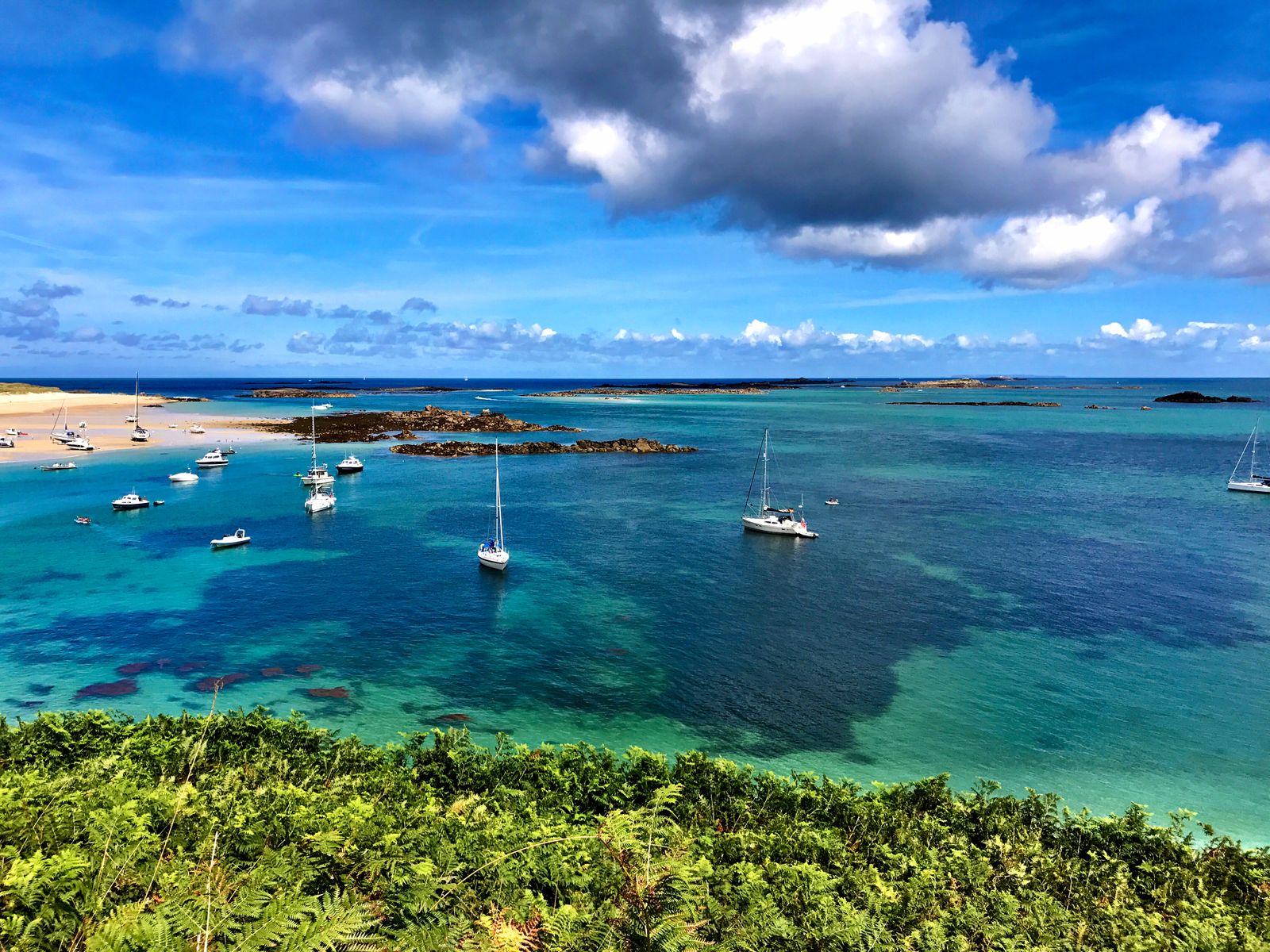
A day trip to Herm (3km long, 1.5km wide — the smallest inhabited island in the Channel Islands, leased from the Crown by a single tenant who manages the island as a sustainable holiday destination with one hotel, one pub, no cars and the finest shell beach in the Channel Islands — Shell Beach, a beach made entirely of millions of tiny shells rather than sand, the only shell-beach of its kind in northwest Europe).
💡 Shell Beach on Herm is composed entirely of shells rather than sand — millions of tiny cowrie shells, periwinkles, limpets and sea snails, the result of the island’s position at the confluence of two current systems that deposit shells from across the Channel. The beach is approximately 500m long; the shell layer is estimated to be several metres deep in places. It is unique in northwest Europe.
Hauteville House (the home of Victor Hugo during his 15-year Guernsey exile, decorated entirely by Hugo himself in an extraordinary accumulation of tapestries, antique furniture, carved wooden panels, Chinese lacquerware and ceramics — the finest example of 19th-century artistic interior design in the Channel Islands, open to the public from April to September) and a final St Peter Port harbour meal. Fly from Guernsey (GCI).
💡 Victor Hugo decorated Hauteville House entirely himself over 15 years — covering every surface with tapestry, china, carved wood and inscriptions, transforming the Georgian townhouse into a total work of art that reflects his extraordinary visual imagination. The motto of Guernsey (“Mon Droit”) is carved into the top of the house. Hugo gave the house to the City of Paris in 1927; it is now a French national monument managed by the City of Paris.
Aurigny (Guernsey’s own airline) flies from Guernsey Airport (GCI) to London Gatwick, Manchester, Bristol and other UK cities. Condor Ferries sail from Poole and St Malo, France.
Guernsey issues its own currency at 1:1 with GBP. UK sterling is accepted everywhere; Guernsey notes are not accepted in the UK, so spend or exchange before leaving.
Sark is 45 minutes by ferry — a car-free island with bicycle hire, cliffside walks and complete peace. A dawn departure from Guernsey gives a full day on Sark before an evening return.
Guernsey’s tax regime (20% flat income tax, no capital gains tax, no inheritance tax) makes it a significant financial centre — interesting context for understanding the island’s unusual wealth and high standard of living.
The cliff paths are lined with primroses, sea campion and thrift from March; migrant birds pass through in April-May. The gannet colony off Alderney is the most impressive seabird spectacle in the Channel Islands.
No adaptor needed for UK visitors. A standard UK Type G plug works throughout Guernsey; voltage is 230V.
Guernsey sits in the English Channel just 50km from the Cherbourg Peninsula and 121km from England — sister island Jersey, the UK mainland, France, Ireland and the Low Countries are all part of the same inter-connected maritime world.