JE
Jersey
The Channel Islands' sun-soaked crown jewel
The Channel Islands' sun-soaked crown jewel

A dramatic medieval fortress rising from the rock above Gorey Harbour — one of the best-preserved medieval castles in the British Isles, built in 1204. The views from the ramparts take in the entire east coast and the coast of Normandy on a clear day; beautiful at night when floodlit.
Photo: Man vyi, Public domain

A wide, sweeping bay with a beautiful sandy beach, clear water and the backdrop of the waterfront town of St Aubin — best at low tide when the sand stretches far out and Elizabeth Castle becomes accessible on foot. The seafood restaurants along the front are excellent.
Photo: Mailolstar, CC BY-SA 3.0

A vast network of tunnels built by slave labour under Nazi occupation (1940–1945) — now a compelling and sobering museum to the only British territory to be occupied in WWII. The personal stories of Channel Island civilians under occupation are deeply moving.
Photo: Bob Embleton, CC BY-SA 2.0

A 6,000-year-old Neolithic passage tomb covered by a medieval chapel — one of the most significant prehistoric monuments in Europe. The chamber inside is accessible and well-preserved; the atmosphere of standing in a Neolithic burial from 4000 BC is impressive.
Photo: Man vyi, Public domain

The wild north coast has some of the finest cliff walking in the Channel Islands — steep paths above dramatic headlands, sea caves, migrant birds and views of the French coast. The path from Plémont to Grève de Lecq is especially spectacular.
Photo: No machine-readable author provided. Man vyi assumed (bas…, Public domain

A lively, compact capital with an excellent market, the Jersey Museum, good restaurants and a waterfront transformed by contemporary architecture — smaller and friendlier than any equivalent British town, with the bonus of no VAT and cheaper shopping throughout.
Jersey (Wikipedia) →Photo: Danrok, CC BY-SA 3.0
The most famous potato variety in Britain — grown only on Jersey’s steep south-facing côtils (cliff fields) in the same traditional way for over 140 years. Available only in spring (April to July); their distinctive earthy sweetness from the vraic (seaweed) fertiliser cannot be replicated anywhere else.
Brown and spider crabs caught in Jersey’s waters are among the finest in the British Isles — dressed crab, crab bisque and dressed crab rolls are on virtually every menu in summer. The brown crab is at its best from April to November.
Atlantic lobster from the waters around Jersey — grilled or thermidor at the harbour restaurants. The close proximity to French Normandy also means superb moules marinière, which appears on almost every seafood menu.
Jersey has been making cider since the Normans — the apple orchards of the interior produce excellent traditional dry cider at La Mare Wine Estate and several smaller producers. The Jersey cider industry was once so large it competed with French wine.
A traditional Jersey dish of haricot beans slow-cooked overnight in a crock with pig trotters and belly pork — cooked in communal ovens for centuries and now served as a heritage dish at Jersey food festivals. Deeply warming and completely unique to the island.
La Mare Wine Estate produces Jersey’s own white wine, sparkling wine, cider and black butter (a dense apple preserve) — the vineyard and orchard open to visitors for guided tours and tastings. The creamy liqueur is particularly good.
Jersey Airport (JER) has excellent UK connections. British Airways, easyJet, Jet2 and Blue Islands serve most UK airports. DFDS ferries connect Jersey to Poole, Portsmouth and St Malo. For trip planning, see the official Jersey tourism portal.
Jersey is one of the most accessible island destinations from the UK — 1 hour from London, 1h10 from Manchester. Blue Islands connects most smaller UK regional airports.
The DFDS ferry from Poole (fares vary by season – book early for summer) is the classic Jersey arrival — the sea approach to St Helier shows the full scale of the island. St Malo (1h10) makes the Jersey + Normandy/Brittany combination easy.
LibertyBus (the Jersey public bus network) runs from 6am to midnight on most routes and covers the entire island. The day pass (£10) is the best option for a bus day.
Jersey’s Green Lane network (100km of minor roads with a 15mph speed limit, shared priority with cyclists and pedestrians) is the finest cycling infrastructure in the British Isles and makes the island accessible by bicycle without traffic pressure.
May to September is best — warm (17–22°C), the beaches accessible, the longest sunshine hours in the British Isles. July and August are peak. October to April is mild (9–14°C) and very quiet, with good value for accommodation.
📅 Jersey is in its best season in May, June, July, August, September. See where else is good to go in those months, or browse where to go by month.
Jersey uses pounds sterling (GBP) and Jersey pounds (JEP, equal value locally). Broadly comparable to southern England in cost, with lower income tax and some duty differences.
Jersey cream tea (scones with clotted Jersey cream and jam, from the island’s dairy herd)
Jersey lobster (brown lobster caught from the offshore reefs, available at harbour restaurants in summer from £)
Longueville Manor (a 14th-century manor house hotel near St Helier, the only Michelin-starred hotel in the Channel Islands, with a restaurant serving a menu almost entirely sourced from Jersey)
St Helier for one day, Elizabeth Castle and war tunnels for one, St Ouen’s Bay for one, Grouville and the north coast for one, St Brelade for one, Jersey Zoo for one. Jersey — the largest and sunniest of the Channel Islands — has more history, wildlife and coastal beauty per square kilometre than almost anywhere in the British Isles.
St Helier (the capital, population 35,000, on the south coast — named after a 6th-century hermit saint martyred by pirates) with the Jersey Museum (the finest Channel Islands history collection — Bronze Age and Iron Age Jersey, the French and English rivalry over the islands, the German Occupation 1940–1945, and Lil Langtry of Jersey who became the most celebrated actress of Victorian London) and the Central Market (an 1882 covered market).
Jersey was occupied by Germany from 1 July 1940 to 9 May 1945 — the only part of the British Isles occupied during WWII. The German occupation is the defining event of modern Jersey history; approximately 1,000 islanders were deported to internment camps in Germany, and thousands of forced labourers (mainly Soviet POWs and Jewish prisoners) were used to build the island’s fortifications. The occupation ended on 9 May 1945, still celebrated as Liberation Day.
Elizabeth Castle (a 16th-century fortress built on a tidal islet in St Aubin’s Bay, accessible on foot at low tide across the sand and by amphibious ferry at high tide, named after Queen Elizabeth I, the home of Sir Walter Raleigh when he was Governor of Jersey 1600–1603, used as a royal refuge by Charles II in 1646 during the English Civil War — the finest sea castle in the Channel Islands) and the Jersey War Tunnels (the underground German hospital and command complex).
Sir Walter Raleigh was Lieutenant Governor of Jersey from 1600 to 1603 — he named Elizabeth Castle (then being completed) and reputedly smoked the first pipe of tobacco in Jersey while sitting on the steps, prompting a servant to throw a bucket of ale over him thinking he was on fire. The story is likely apocryphal but has been attached to Jersey for 400 years.
St Ouen’s Bay (the 5km Atlantic-facing beach on the west coast — the finest surfing beach in the Channel Islands, with consistent Atlantic swell, a surf school and the freshwater wetland of La Mare au Seigneur — the only natural freshwater wetland in the Channel Islands, a reedbed of over 100 hectares supporting marsh harriers, bitterns and great reed warblers) and the Les Landes plateau above.
St Ouen’s Bay held the world land speed record attempt site — in 1924, Count Louis Zborowski (the racing driver who inspired Ian Fleming’s Chitty Chitty Bang Bang) drove his aero-engined racing car along the sands in an attempt on the record. The firm sand and 5km length made it ideal; Jersey’s speed record attempts predate the better-known Pendine Sands attempts in Wales.
The Grouville Common (the largest area of common land in Jersey, with traces of Bronze Age field systems and burial mounds — Jersey has some of the finest Bronze Age archaeology in northwest Europe, including the La Hougue Bie passage tomb: a Neolithic passage grave of 3500 BC, the finest in the Channel Islands and rivalling Newgrange in Ireland for its construction) and Gorey Castle (Mont Orgueil, a clifftop medieval castle).
La Hougue Bie (a Neolithic passage grave of approximately 3500 BC — a 12m-long stone-lined passage leading to a cruciform chamber covered by an earthen mound 18m high and 55m in diameter) is the finest megalithic monument in the Channel Islands and one of the most impressive passage graves in northwest Europe. Medieval Christians built two chapels on top of the mound; the site has been continuously used for religious purposes for 5,500 years.
The north coast cliff path (a 25km coastal walk from Grosnez Point to Rozel Bay along the finest coastal scenery in Jersey — purple heather on the clifftops, granite sea stacks, puffin and gannet colonies on the offshore rocks and the views to France 45km away on clear days) and Bonne Nuit Bay (the most attractive of the north coast’s small fishing harbours, with a crab and lobster restaurant directly on the harbour wall).
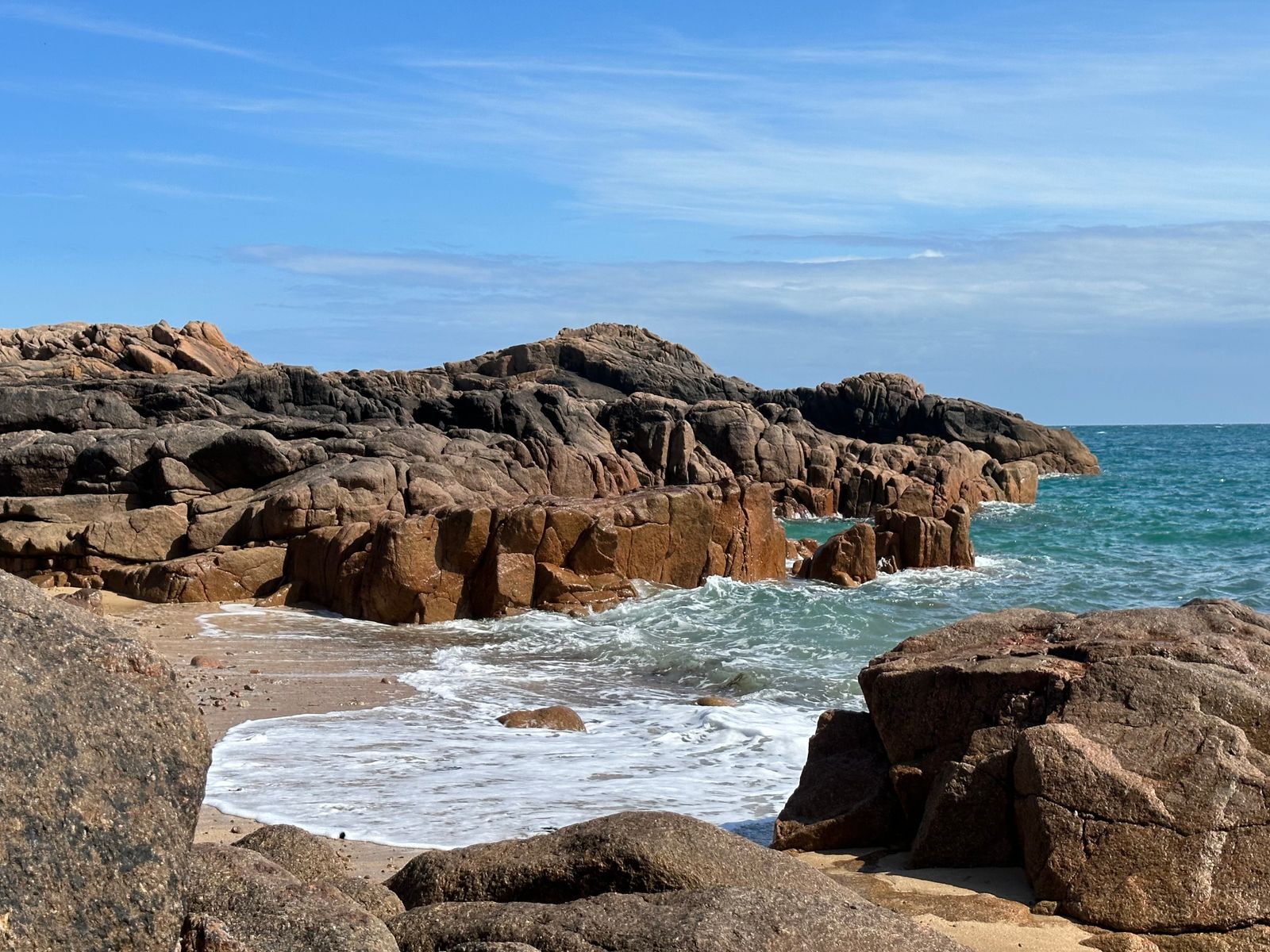
Jersey granite (the pinkish-grey granite quarried throughout the island and used for Jersey’s characteristic building style — including Elizabeth Castle and Mont Orgueil, and exported widely to London where Waterloo Bridge was built of it) is the defining building material of the island. The rock is approximately 580 million years old, formed during the Cadomian orogeny when what is now Jersey was part of the Armorican Massif.
St Brelade’s Bay (the finest beach in Jersey — a crescent of south-facing sand, the warmest water in the British Isles in summer, the 12th-century Fishermen’s Chapel directly on the beach with Romanesque wall paintings) and the Jersey Zoo (Durrell Wildlife Conservation Trust — Gerald Durrell’s 1959 conservation zoo, the leading zoo in Britain for breeding endangered species, with gorillas, orangutans and the Rodrigues fruit bat recovery programme).
Gerald Durrell founded the Jersey Zoo (now Durrell Wildlife Conservation Trust) in 1959 with the explicit mission of breeding endangered species for reintroduction — the world’s first zoo founded specifically for conservation rather than public display. The zoo has been instrumental in saving species from extinction including the pink pigeon of Mauritius, the Rodrigues fruit bat and the mountain chicken frog of Dominica.
The Jersey cow (a breed developed in isolation on the island for at least 200 years — Jersey’s immigration laws prevented the import of cattle since the 18th century to maintain the breed’s purity, and Jersey milk (the highest butterfat content of any dairy breed, producing a cream of great richness) and the Jersey Royal potato (a variety unique to the island, grown in the south-facing cliff-top fields called côtils, the first new potatoes of the British season, with a distinctively nutty flavour from the vraic seaweed fertiliser). Fly from Jersey (JER).
The Jersey Royal potato (a variety of the International Kidney potato developed in Jersey around 1880, now Protected Designation of Origin under UK law) is grown only on Jersey’s côtils — steep south-facing cliff-top fields that warm up early in spring and allow Jersey Royals to arrive in UK markets 4–6 weeks before mainland new potatoes. The vraic (seaweed) fertiliser used traditionally gives them a unique mineral flavour.
🛂 Entry rules: UK ETA now applies here
Since 23 April 2026, visitors who need a UK Electronic Travel Authorisation (ETA) to enter the UK also need one to travel to Jersey, including EU, US, Canadian and Australian citizens. It costs £20, lasts two years (or until your passport expires) and one ETA covers the UK, Jersey, Guernsey and the Isle of Man.
British and Irish citizens don’t need one. French citizens on same-day trips to the Channel Islands remain exempt and can travel on a national ID card.
Official information: GOV.UK: apply for an ETA · Reviewed September 2026
Blue Islands, easyJet and British Airways fly from UK airports in 45 minutes. DFDS ferries sail from Poole and Portsmouth and from St Malo, France (1 hr). The French connection makes Jersey-Normandy combinations excellent.
Jersey issues its own notes and coins that are legal tender only in Jersey (and accepted in Guernsey). UK sterling is accepted everywhere at 1:1 but Jersey notes are not accepted in the UK.
Jersey has its own tax system with 5% GST instead of UK’s 20% VAT. Electronics, spirits and luxury goods can be significantly cheaper than in the UK.
Jersey has a tidal range of up to 12 metres — the sea retreats enormous distances at low tide, exposing vast sandy flats and walking routes to offshore islands. Always check tide times before walking to any tidal feature.
English is universal but Jersey French (Jerriais) is occasionally spoken by older islanders. French is taught in schools and many residents are bilingual; the island’s Norman heritage is still felt in place names and local culture.
Jersey is on the Atlantic flyway; migrating warblers, flycatchers, rare vagrants and seabirds pass through in spring and autumn. L’Étacq and Plémont are the key hotspots.
Quick answers to the questions people most often ask before visiting Jersey.
Fly into Jersey Airport (JER) — about an hour from London and under an hour from southern England — or take the high-speed ferry from Poole. There are also ferries to St Malo in France.
Jersey is part of the Common Travel Area, so there are no routine passport checks from the UK, though airlines and ferries usually ask for photo ID. Arriving from France, you need the same documents as for entering the UK.
May to September, with warm weather (17–22°C) and some of the longest sunshine hours in the British Isles. October to April is mild and very quiet, with excellent value accommodation.
The pound sterling. Jersey issues its own notes and coins at the same value as UK money; UK pounds are accepted everywhere, but Jersey notes are only legal tender on the island, so spend them before you leave.
Costs are broadly similar to southern England, but Jersey charges 5% GST instead of 20% VAT, so some goods are cheaper. Expect around £55–90 per day on a budget and £130–220 mid-range.
Jersey sits just 22km from the Normandy coast of France and 137km from England, making it a natural gateway between Britain and France — Guernsey, the UK, Ireland, Belgium and the Netherlands are all within easy sailing or flying distance.
Jersey is one of the world’s least-visited places. See all 90 in our guide to the world’s least-visited countries & territories.


