GW
Guinea-Bissau
Atlantic archipelago and untouched island wilderness
Atlantic archipelago and untouched island wilderness

A UNESCO Biosphere Reserve of 88 islands and islets scattered across the Atlantic — one of the least disturbed marine ecosystems in West Africa, with saltwater hippos on the outer islands, nesting sea turtles, manatees, and virtually no tourism infrastructure.
Photo: European Space Agency / CNES, Attribution
Home to the world’s only known population of saltwater hippopotami — these animals swim between the islands and have adapted to drinking saltwater. The island is also home to the Bijagó people whose matriarchal society is unique in West Africa.

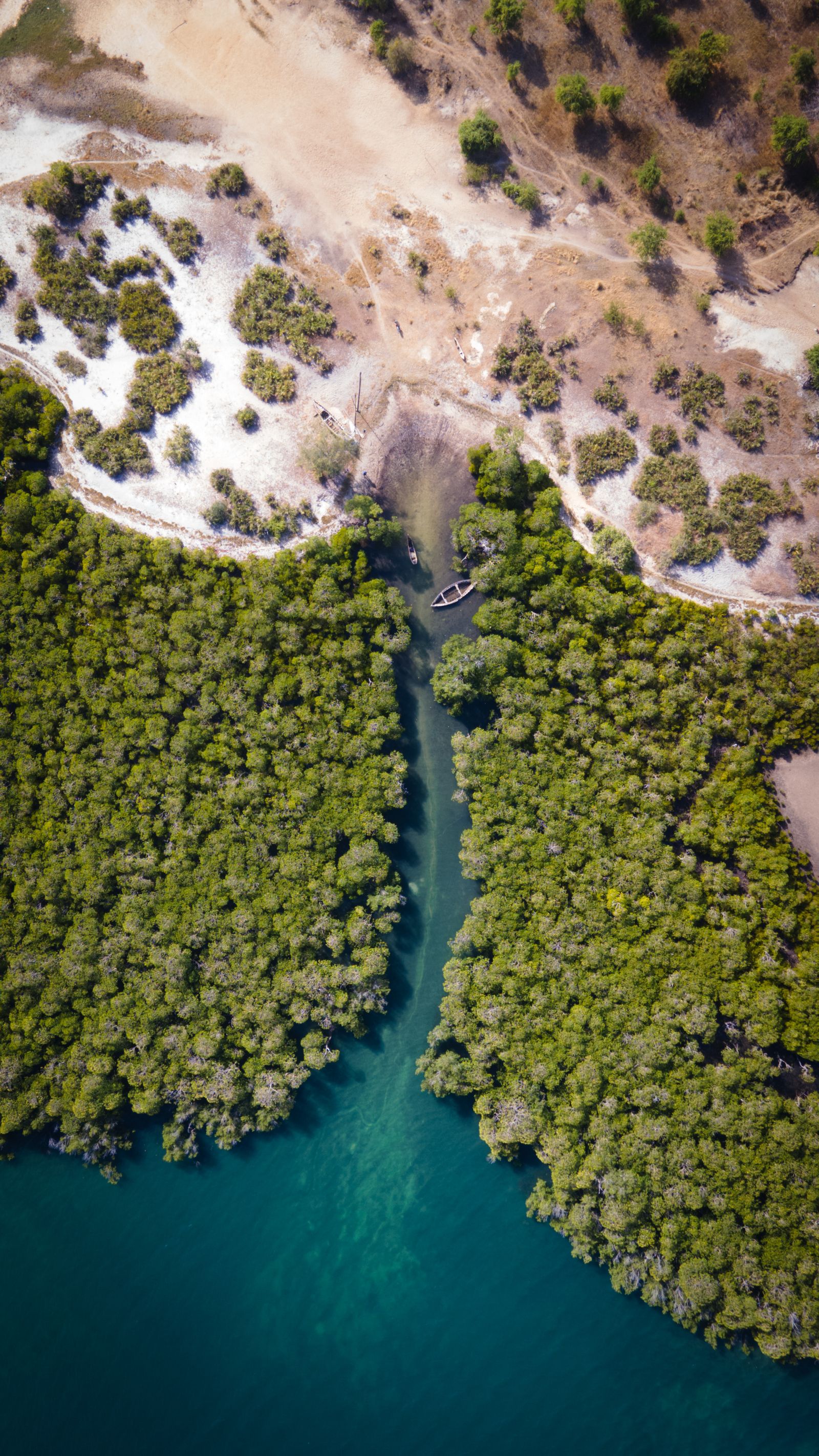
The most developed of the Bijagós islands (though still extremely quiet) — white-sand beaches, turquoise water, mangrove channels, excellent fishing and some of the cleanest oysters in West Africa. A handful of eco-lodges operate here with solar power.
Photo: Mooonswimmer, CC BY-SA 4.0

A colonial Portuguese city with faded charm — the ruined Presidential Palace (bombed in a 1998 civil war and never repaired) is haunting, the Piragui market is vivid and chaotic, and the waterfront has a melancholic beauty unique in West Africa.
Photo: Bnhamadjo, CC BY-SA 3.0

A 17th-century Portuguese fort on the Cacheu River — one of the most important staging posts of the Atlantic slave trade, now a well-preserved monument in a remote village. The river here is eerily beautiful in the early morning.
Photo: Jcornelius, CC BY-SA 4.0
A national marine park protecting the most important green sea turtle nesting site in West Africa — up to 10,000 females nest here each year on beaches without a single permanent resident. Accessible only by boat.
Guinea-Bissau (Wikipedia) →The national dish of Guinea-Bissau — a rich groundnut broth cooked with chicken or fish, palm oil, tomato and local spices. Eaten over rice or with pirão (cassava porridge) at every family table throughout the country.
Seafood rice with prawns, clams, crab and reef fish cooked in a tomato, garlic and palm oil sauce — a Portuguese-influenced dish that reflects Guinea-Bissau’s extraordinary Atlantic seafood quality. At its finest in the Bijagós lodges.
The mangrove oysters of the Bijagós Archipelago are some of the finest in the world — large, sweet and briny, grown in perfectly clean Atlantic water with no industrial contamination. Eaten raw or grilled with lemon at the island lodges.
Tapped from palm trees each morning — slightly sweet, milky and lightly fizzy when fresh, increasingly fermented by the afternoon. Shared from calabashes at village gatherings across the country; fundamental to Bijagó social life.
A cassava or fish-stock porridge cooked to varying consistencies — the universal starchy side dish of coastal Guinea-Bissau, eaten alongside grilled fish, caldo de mancarra or any sauce-based dish. More refined than ugali; more flavourful than plain rice.
The Portuguese colonial legacy lives on in Guinea-Bissau’s bar culture — Super Bock and Sagres are widely available alongside local cachaca-based spirits. Café culture with espresso is good in Bissau’s few cafés.
Osvaldo Vieira International Airport (OXB) in Bissau is the gateway. TAP Air Portugal, Air Senegal and TACV Cabo Verde Airlines serve the main routes.
Lisbon (5h, TAP) is the primary European gateway — the colonial connection between Portugal and Guinea-Bissau makes TAP the most frequent European carrier. Paris connects via Lisbon or Dakar.
Dakar (1h, Air Senegal) is the most practical African hub. Overland from Senegal (3–4h) via Ziguinchor is an alternative for travellers already in Senegambia.
Bissau centre is 15 minutes from the airport. The public pirogue to Bubaque (main Bijagos island) takes 3–4 hours; a faster speedboat charter cuts this to 2 hours.
Bush taxis cover all mainland routes; pirogues connect the Bijagos islands. A 4WD vehicle is recommended for inland roads, many of which become impassable in the wet season.
November to May is the dry season — the only practical time to visit (24–32°C). December to February is the best window: dry, clear, the Bijagos archipelago at its finest. June to October is the wet season with heavy rain; travel becomes difficult on dirt roads.
📅 Guinea-Bissau is in its best season in January, February, March, April, November, December. See where else is good to go in those months, or browse where to go by month.
The West African CFA franc (XOF) is the currency. One of the most affordable countries in West Africa.
Caldo de mancarra (groundnut stew — the national dish of Guinea-Bissau, a rich stew of ground peanuts cooked with fish or smoked meat, palm oil, okra and local spices — served with boiled rice at local cook shops for)
The Bijagos eco-lodges (small community-owned guesthouses and nature lodges on Bubaque, Uno and Orango islands)
Guinea-Bissau’s Atlantic coast fisheries (the waters of the Bijagos exclusive economic zone are among the most productive fishing grounds in West Africa)
Bissau for one day, Bijagos archipelago for two days, saltwater hippos for one, Cufada Lagoon for one, Gabu for one, Bissau farewell for one. Guinea-Bissau — one of the least-visited countries in Africa — has the only saltwater hippos in the world, the last matrilineal society in West Africa, millions of migratory waterbirds and the least disturbed marine environment on the West African coast.
Bissau — the capital of Guinea-Bissau (one of the smallest and least-visited countries in West Africa, population 2 million, a former Portuguese colony independent since 1974 after a 10-year independence war, among the 10 poorest countries in the world by GDP per capita) with the Bandim market (the biggest market in Bissau, selling kola nuts, palm oil, dried fish, batik cloth and local produce), the Fortaleza d’Amura (the Portuguese colonial fort, site of the 1998 civil war fighting) and the abandoned presidential palace.
Guinea-Bissau’s independence (24 September 1973 — declared unilaterally by the PAIGC independence movement under Amilcar Cabral, whose 1956–1974 guerrilla war is considered the most tactically sophisticated anti-colonial campaign in African history, described by Ernesto Che Guevara as a model for Third World liberation) came after 10 years of armed struggle that permanently altered Guinea-Bissau’s social fabric.
The Bijagos Archipelago (UNESCO Biosphere Reserve — 88 islands and islets in the Atlantic, 50km off the coast of Bissau, inhabited by the Bijago people, the only matrilineal society in West Africa, with the most intact traditional animist culture in the region — accessible by boat from Bissau, with the Orango Islands National Park containing the world’s only population of saltwater hippopotamuses (estimated 30–50 individuals, the only hippos known to habitually enter saltwater and the sea).
The saltwater hippopotamuses of the Bijagos (Hippopotamus amphibius — hippos are normally freshwater animals, but the Bijago island hippos regularly enter the sea between islands, swimming up to 5km in saltwater — first documented by European scientists in the 1990s, the population is the last surviving population of a once-widespread West African coastal hippo range. The hippos are sacred to the Bijago people and protected by traditional rules.
An overnight on one of the inhabited Bijagos islands (Bubaque or Uno — the most accessible of the 88 islands, with traditional Bijago villages, the distinctive Bijago ceremonial masks (the warthog helmet mask worn only by young men undergoing the fanado initiation rite), the traditional dugout canoe fishing and the birds of the archipelago — the most important waterbird staging area in West Africa, with millions of migratory waders).
The Bijago society (uniquely matrilineal in West Africa — land, property and social identity pass through the female line; marriage is arranged by women who choose their husbands; the spiritual authority of the islands is held by female elders — has maintained this social structure through Portuguese colonialism and post-independence political disruption. The Bijago islands were among the last areas of Guinea-Bissau to be brought under colonial control, due to the fierce resistance of the island communities.
The Orango Islands National Park (the most remote of the Bijagos, accessible by a 3–4 hour boat journey from Bubaque — with the saltwater hippo population in the mangrove channels, green and olive ridley sea turtles nesting on the beaches, and the intact estuary ecosystem of the park — one of the least disturbed marine environments in West Africa, with limited access preserving the ecosystem from fishing pressure).
The Orango Islands National Park (established 2000 as part of the Bijagos UNESCO Biosphere Reserve) is one of the few marine protected areas in West Africa with genuine enforcement — the park boundaries are respected through a combination of the traditional Bijago authority (the islands are sacred and access is controlled by village elders) and occasional patrols by park rangers. The combination has preserved reef and mangrove ecosystems in conditions rarely seen on the West African coast.
Cufada Lagoon Natural Park (a wetland on the Guinea-Bissau mainland — the most important wetland for migratory waterbirds in West Africa, with flamingos, pelicans, herons, ibis and ducks present in enormous numbers during the November–April season — with hippopotamuses in the river channels and the finest birdwatching in Guinea-Bissau accessible from the mainland) and the Fulani village communities of the interior.
Guinea-Bissau’s birdwatching (one of the most underrated birding destinations in Africa — the combination of the Bijagos archipelago, the Cufada Lagoon and the Guinea Forest belt contains 520+ recorded bird species, including the rare white-backed night heron and long-tailed hawk — with fewer than 500 tourists visiting per year, the birding is entirely without crowds).
Gabú (the largest city in the interior of Guinea-Bissau — the historic capital of the Gabu Kingdom of the Fula people, with the ruins of the Gabu fortress (the last independent Fula state in West Africa, which fell to a Fulani jihad in 1867), the traditional Fula cattle markets and the most authentic Sahelian-influenced culture in a country otherwise dominated by coastal Atlantic traditions).
The Gabu Kingdom (the Kaabu Kingdom — the most powerful state in the Senegambia region from the 16th to 19th century, controlling the trade routes between the Atlantic coast and the Sahel — was the last significant indigenous political entity in what is now Guinea-Bissau, falling after the Battle of Kansala in 1867 when Futa Jallon armies breached the fortress walls). The ruins of Kansala remain one of the few pre-colonial archaeological sites accessible in Guinea-Bissau.
A final morning in Bissau: the Mercado Bandim at dawn (the most atmospheric morning market in Bissau, with fishermen bringing the night’s catch from the estuary, women selling imported kola nuts from Nigeria and roasted groundnuts from the interior), a final bowl of caldo de mancarra (the national dish — groundnut stew with fish) and the boat to the Bijago ferry before flying from Osvaldo Vieira Airport (OXB).
Guinea-Bissau is one of the only countries in West Africa where the influence of Portuguese colonial language, culture and architecture exists alongside the most intact traditional animist culture in the region. The combination of the matrilineal Bijago, the Fula cattle nomads of the interior, the Mandinka groundnut farmers and the Balanta rice cultivators creates the most diverse cultural palette of any small West African nation.
TAP Air Portugal flies direct from Lisbon to Bissau (OXB) — the most reliable connection. TACV (Cape Verde Airlines) connects via Praia. The Bijagós islands require onward boat from Bissau’s Pidjiguiti port.
Most visitors need a visa; apply at Guinea-Bissau embassies in Lisbon, Dakar or Paris, or check current e-visa availability. Tour operators for Bijagós trips typically facilitate visas.
Guinea-Bissau Creole (Kriol) is the true lingua franca — a Portuguese-based creole spoken by 90% of the population. Portuguese is for formal contexts. Neither French nor English is widely understood.
The islands are reached by pirogue (motorised canoe) or chartered speedboat from Bissau’s port — journey times range from 1 hour (Bubaque) to 3+ hours for outer islands. Book through eco-lodges who arrange all logistics.
A valid yellow fever vaccination card is mandatory for entry — carry the original certificate as it is checked at the airport.
ATMs are unreliable in Bissau and non-existent in the Bijagós. Bring sufficient EUR or XOF cash for your entire stay. Eco-lodges accept bank transfers in advance but island expenses are cash-only.
Quick answers to the questions people most often ask before visiting Guinea-Bissau.
Fly into Osvaldo Vieira International Airport (OXB) in Bissau. The most reliable long-haul route is direct from Lisbon (about 5 hours), and there are short regional flights from Dakar (about 1 hour).
By boat from Bissau — either a motorised pirogue or a chartered speedboat. Journey times vary with the island and the tides, so most visitors arrange transfers through their lodge.
Most nationalities need a visa, obtained from an embassy or through the current e-visa process. A yellow fever vaccination certificate is also required for entry, so carry the original.
The dry season, November to May, is the only practical time; December to February is the best window, especially for the Bijagós. The June–October rains make dirt roads difficult.
The West African CFA franc (XOF). ATMs are unreliable in Bissau and absent in the Bijagós, so bring enough euros or CFA francs in cash. Daily costs are low — around US$30–55 on a budget.
Camera translation of signs and menus. Download language pack offline.
FreeHotels, guesthouses and apartments with free cancellation on most rates.
FreeMillions of traveller reviews for restaurants, attractions and hotels.
FreeThe most widely used messaging app worldwide for bookings and local contact.
FreeGuinea-Bissau sits between Senegal to the north and Guinea to the south, with the Gambia and Sierra Leone nearby — each country has a different colonial language and cultural blend along this stretch of the West African coast.
Guinea-Bissau is one of the world’s least-visited places. See all 90 in our guide to the world’s least-visited countries & territories.
