IL
Jerusalem
Sacred to Three Faiths
Sacred to Three Faiths
⚠️ Travel advisory: check before you go
Governments advise travellers to reconsider travel to Israel, and against travel to areas near Gaza, Lebanon and Syria, because of the ongoing regional conflict. Rocket and drone alerts and flight disruptions can occur at short notice.
Latest official advice: UK FCDO · US State Department · Reviewed September 2026
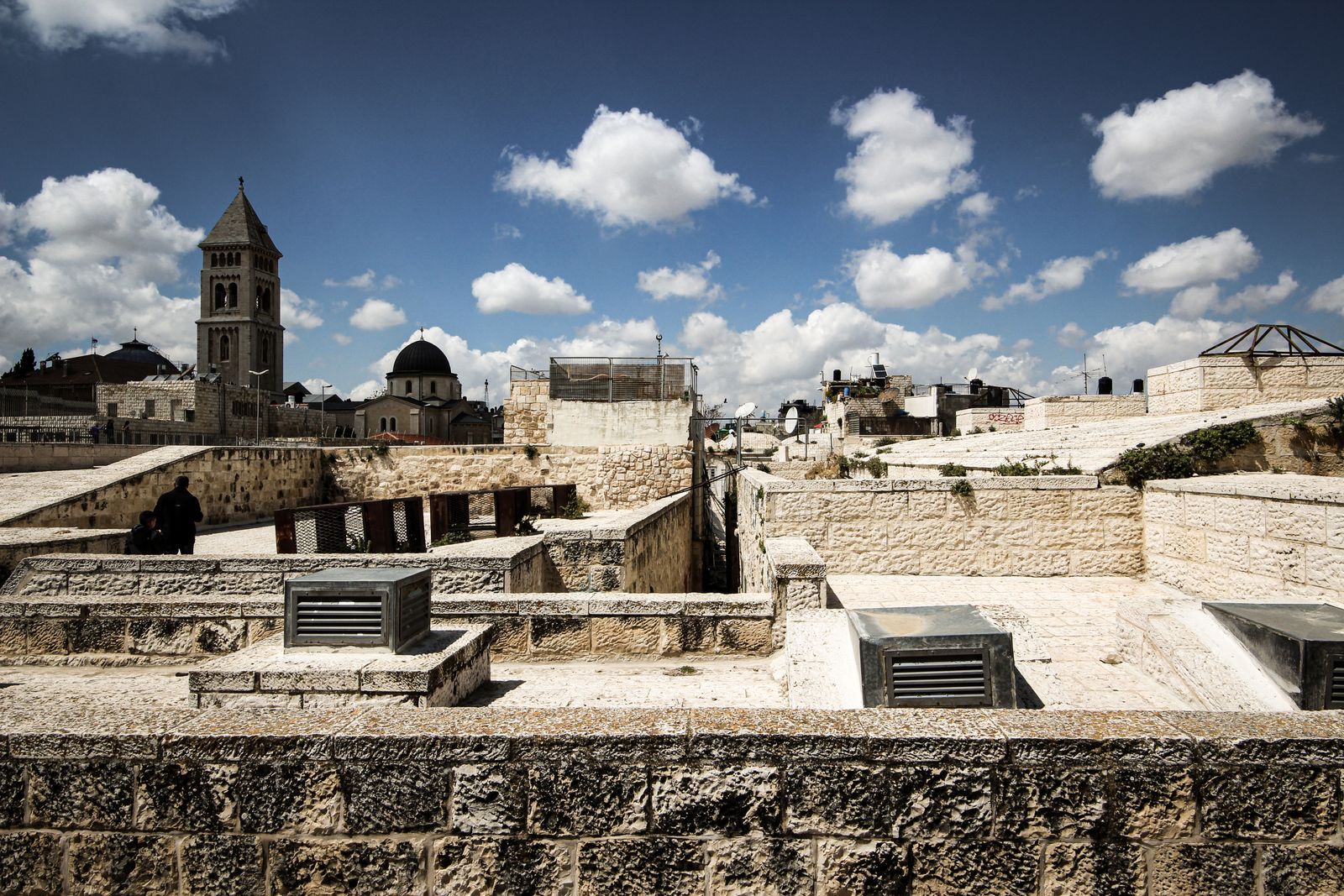
The Western Wall (HaKotel HaMa’aravi; free; open all hours; dress modestly; men and women separated sections; paper prayers placed in the cracks) is the last remaining exposed section of the retaining wall of Herod’s Second Temple complex (1st century BCE–CE), the holiest site in Judaism accessible to worshippers. The adjacent Jewish Quarter (largely rebuilt after 1967) contains the Cardo (a 6th-century Byzantine colonnaded street, partially excavated), the Burnt House (archaeological site of a 1st-century Jewish house destroyed in 70 CE; ₪18), and the finest views of the Temple Mount from below.
Visit the Western Wall before 8am for the most profound atmosphere: fewer visitors, morning prayers in progress, the stone glowing in early light. Shabbat (Friday sunset to Saturday sunset) at the Wall — with hundreds of worshippers singing in the plaza — is the most atmospheric time to visit if you can be quiet and respectful.

The Church of the Holy Sepulchre (Christian Quarter; free; open daily 5am–9pm; built by Emperor Constantine in 335 CE over the sites of the Crucifixion, Burial, and Resurrection of Jesus Christ) is the holiest site in Christianity and a functioning church shared by six different Christian denominations (Greek Orthodox, Roman Catholic, Armenian Apostolic, Coptic, Syriac, Ethiopian Orthodox) in a fragile cohabitation arrangement. The Edicule (the tomb of Christ; rebuilt 2017; ₪0 but long queue; or ₪200 for pre-dawn private entry) and the Rock of Golgotha (upstairs; the site of the Crucifixion) are the two most significant locations.
Visit the Church at 5:30am (opening; almost no visitors; the atmosphere of candle-lit prayer in the dark is extraordinary). The midday hours are the most crowded. The key to the Church is held by a Muslim family (the Joudeh family) — a 12th-century Saladin-era arrangement to prevent Christian denomination fights over control — and the door is opened and locked by the same family daily.
Photo: Diego Delso, CC BY-SA 3.0

The Temple Mount (Al-Haram Al-Sharif; the site of the First and Second Jewish Temples and now housing the Al-Aqsa Mosque and the Dome of the Rock) is the holiest site in Islam in Jerusalem and the most politically contested piece of ground in the world. Non-Muslim visitors may enter via the Mughrabi Gate (near the Western Wall; Sun–Thu 7:30–11am and 1:30–2:30pm; free; no entry fee; modest dress strictly required; no religious items). The Dome of the Rock (1691 exterior; golden dome; the finest example of early Islamic architecture in existence) is visitable externally; Al-Aqsa Mosque interior is for Muslims only.
Check the Temple Mount opening schedule before visiting — it closes without notice for prayers, Jewish and Islamic holidays, and security incidents. The best time to visit as a non-Muslim is 7:30am when it opens. Dress code is strictly enforced at the entrance gate: long trousers or skirt, covered shoulders, and no religious symbols or clothing.
Photo: Godot13, CC BY-SA 4.0

The Via Dolorosa (the Way of Suffering; the traditional route Jesus walked to the Crucifixion; 14 Stations marked through the Old City from the Lion’s Gate to the Church of the Holy Sepulchre; free; self-guided or guided tours ₪60–100) passes through the densely populated Muslim Quarter — one of the great markets of the Middle East, where the devotional atmosphere of the Stations of the Cross coexists with the commercial intensity of souvenir and spice stalls on either side.
Walk the Via Dolorosa on Friday morning (when the Franciscan procession departs from the Praetorium at 3pm) or on any early morning (7am) when the Muslim Quarter market has just opened and the lane is quiet enough to move at a reflective pace. A guided tour is strongly recommended for the first visit — the historical and devotional context transforms every Station.
Photo: Deror_avi, CC BY-SA 3.0
Jerusalem eating divides between the Jewish-Israeli restaurants of West Jerusalem (the Mahane Yehuda market area is the finest; the market by day for fresh produce and the bar/restaurant strip by night) and the Arab restaurants of the Muslim and Christian Quarters (shawarma, hummus, and falafel within the Old City walls; excellent value). The non-negotiables: hummus at Hummus Ben Sira (Ben Sira Street, West Jerusalem; ₪30–40; the finest hummus in the city; cash only; closes by early afternoon) and shawarma in the Muslim Quarter (the shawarma shops on the Via Dolorosa and the street running from Damascus Gate; ₪15–25 for a full pita). The Mahane Yehuda market (“The Shuk”; West Jerusalem; best at 9am for shopping and at 9pm on Thursdays and Fridays when the market stalls close and the bars between them open) is the social centre of modern Jerusalem.
5am: Church of the Holy Sepulchre (opening; near-empty; 45 mins). 7am: walk to Temple Mount Mughrabi Gate for 7:30am opening (non-Muslim visit; Dome of the Rock exterior; 1h). 9am: Western Wall plaza (allow 30 mins; enter the Wall; place a prayer note). Walk the Via Dolorosa Jewish Quarter section (Cardo; 30 mins; ₪18). Lunch: Muslim Quarter shawarma (Via Dolorosa area; ₪15–25). Afternoon: Armenian Quarter (St. James Cathedral; open briefly daily; extraordinary). Christian Quarter exploration. 7pm: Mahane Yehuda market (“The Shuk”; market bars open at night; the finest evening in West Jerusalem). Dinner at any market restaurant (₪60–100).
9am: Yad Vashem Holocaust Memorial (free; West Jerusalem; bus from city centre; 3h minimum; one of the most important museum experiences in the world). Lunch (museum cafe or nearby). 1pm: Israel Museum (₪54; Shrine of the Book housing the Dead Sea Scrolls; scale model of 2nd Temple Jerusalem; 2h). 4pm: taxi or bus to the Mount of Olives (the finest panoramic view of the Old City and Temple Mount; free; the descent through the Jewish Cemetery to Gethsemane; 1.5h). Return to city for dinner.
All major religious sites in Jerusalem (the Western Wall, Temple Mount, the Church of the Holy Sepulchre, Armenian and Syriac churches, mosques) require covered shoulders and knees.
The Western Wall at 5:30am, the Church of the Holy Sepulchre at 5am (opening), and the Temple Mount at 7:30am (opening for non-Muslim visitors) are each dramatically different experiences from the same sites at 10am when tour groups fill every space.
The full meaning of the Western Wall, the Temple Mount, the Via Dolorosa, and the Church of the Holy Sepulchre requires at minimum a basic knowledge of Jewish, Christian, and Islamic history and their intersections in Jerusalem.
The Old City is divided into four quarters (Jewish, Muslim, Christian, Armenian) each with distinct religious, commercial, and cultural character.
The Jerusalem Light Rail (₪5.50; runs 5:30am–midnight Sun–Thu; shorter hours Fri/Sat) is the most practical way to move between West Jerusalem (Mahane Yehuda, the central bus station) and the Old City.
The Temple Mount for non-Muslim visitors is open Sun–Thu 7:30–11am and 1:30–2:30pm, but closes without notice for prayers, Jewish and Islamic holidays, security incidents, and political decisions.
Israeli metered taxi app. Essential for the Mount of Olives and Yad Vashem which are not walkable from the Old City. Works throughout Jerusalem.
Free
Real-time Jerusalem Light Rail and bus tracker. Use for the Jaffa Gate Light Rail and for buses to Yad Vashem and the Israel Museum.
Free
Download Israel offline. The Old City lanes are confusing without GPS; offline navigation is essential, especially in the Muslim Quarter.
Free
Free audio guides for the Old City quarters, the Via Dolorosa, and Yad Vashem. Works offline once downloaded. Provides the historical context that transforms what you are seeing.
Free
Quick answers to the questions travellers most often ask before visiting Jerusalem.
Spring (March-May) and autumn (September-November) offer the most comfortable weather. Summers are hot and dry, and winters are cool and wet, with occasional snow.
Two to three days for the walled Old City and its quarters — the Western Wall, the Church of the Holy Sepulchre and the Temple Mount — plus the Mount of Olives, the markets and the Yad Vashem memorial.
The Old City is a maze of walkable, car-free lanes, while a light-rail line and buses serve the wider city. Modest dress and security checks apply at the religious sites.
One of the world’s oldest and most sacred cities, holy to Judaism, Christianity and Islam — the walled Old City with the Western Wall, the Church of the Holy Sepulchre and the Dome of the Rock, and an extraordinary depth of history and religious significance.
From Tel Aviv’s beaches to Jerusalem’s sacred sites and Eilat’s Red Sea reefs.
Planning a wider trip? Our Israel travel guide covers getting there, costs, when to go and more.