KG
Karakol
Mountain-trekking hub at the edge of Issyk-Kul
Mountain-trekking hub at the edge of Issyk-Kul

A remarkable wooden mosque built by Chinese Muslim Dungan craftsmen without a single nail, painted in bright colours and shaped like a Buddhist-style pagoda. It is one of Karakol’s great curiosities.
Dress modestly; the exterior and gardens are the highlight for non-worshippers.

A charming Russian Orthodox cathedral built entirely of wood, its green domes rising above the trees. Rebuilt after earthquakes, it reflects Karakol’s frontier Russian settler history.
Quietly step inside to see the icons; cover shoulders and heads as appropriate.

The Seven Bulls, a wall of dramatic red sandstone cliffs, guards a green valley of meadows, streams and yurt camps just outside town, a classic day trip and a gateway to longer treks.
Combine the red cliffs with the nearby Broken Heart rock and a valley walk.

Karakol is the launch point for the famous multi-day trek to Ala-Kul, a startlingly turquoise glacial lake ringed by peaks and reached over a high pass, one of Central Asia’s great hikes.
The full trek takes two to three days and needs proper gear and acclimatisation.

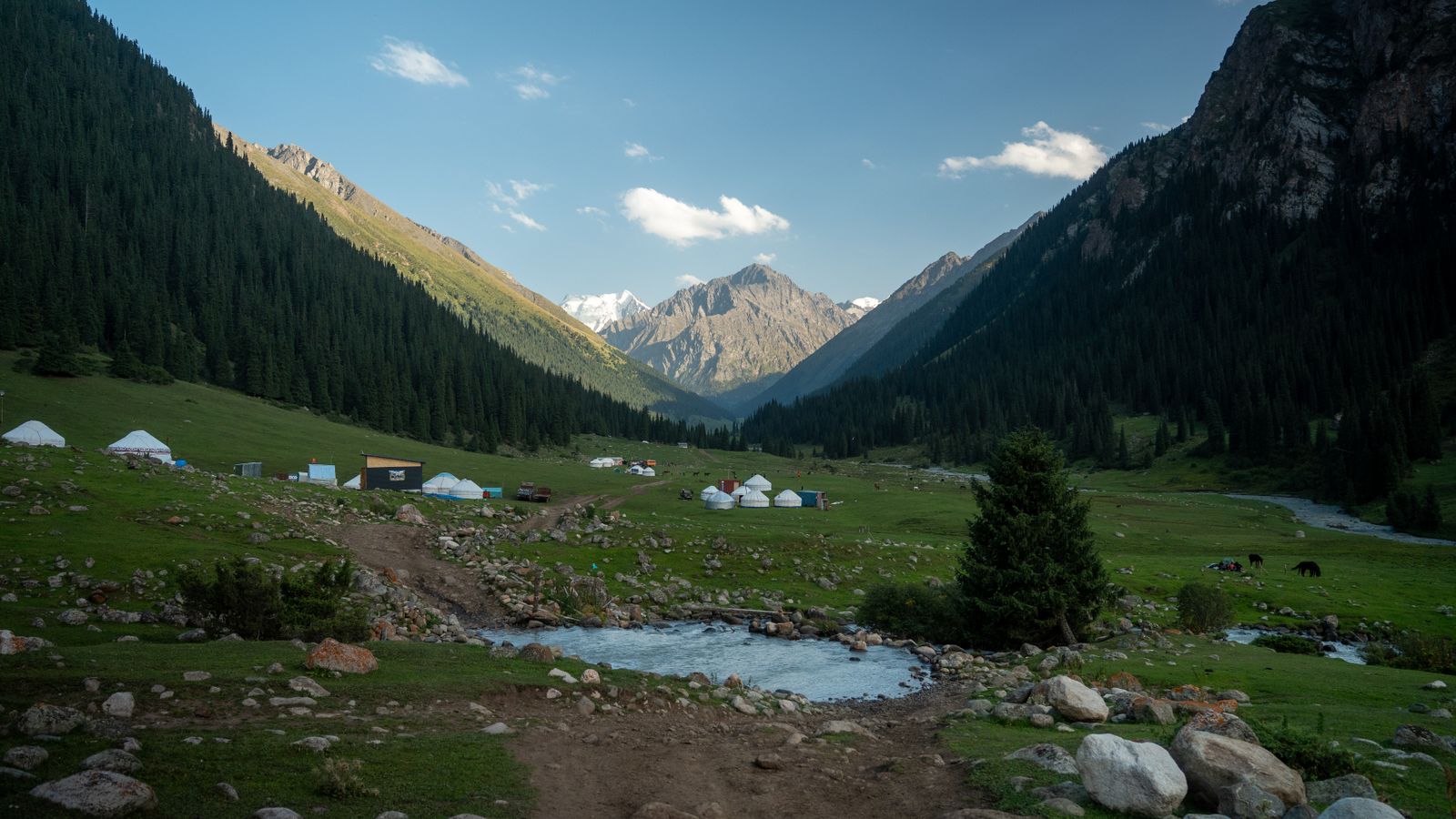
A rough jeep track climbs to Altyn Arashan, an alpine valley of hot springs and simple guesthouses beneath snowy peaks, a blissful soak after a day on the trails.
Reach it by shared 4×4 or on foot; stay overnight to enjoy the springs at dusk.
Karakol’s signature dish is ashlan-fu, a cold, spicy noodle soup with starch jelly, vinegar and chilli, brought by the Dungan (Hui Chinese Muslim) community. A whole lane of cafes near the bazaar serves little else, and a bowl with a fried pirozhki costs very little.
Elsewhere, guesthouse kitchens and cafes serve Kyrgyz and Central Asian standards: laghman noodles, manti dumplings, plov and shashlik. Trekkers’ breakfasts of porridge, eggs and bread are standard. Stock up on dried fruit, nuts and bread at the bazaar before heading into the mountains.
Karakol sits at the eastern end of Lake Issyk-Kul, about 380 km from Bishkek. Marshrutkas leave from Bishkek’s Western Bus Station when full and take six to seven hours; shared taxis are faster and cost roughly double. There is no train and no scheduled flight on this route. In town, trailheads like Jeti-Oguz and Altyn Arashan are reached by local minibus, taxi, or 4×4 for the rough final road to the hot springs.
Karakol is one of Central Asia’s best-value trekking bases. Estimates are per person per day in USD.
Three days gives you a feel for Karakol’s town sights, red-rock valleys and hot springs.
Visit the Dungan Mosque, built entirely of wood without nails, and the wooden Holy Trinity Cathedral. On Sunday morning, catch the animal market, then eat ashlan-fu for lunch.
The animal market starts at dawn and winds down by mid-morning.
Take a day trip to the red Seven Bulls cliffs and Broken Heart rock, then walk up the valley among yurts and summer pastures.
Carry cash; there are no card machines in the valley.
Head up to Altyn Arashan by 4×4 or on foot for a mountain hike and a soak in the natural hot springs.
Stay overnight at Altyn Arashan if you can.
Karakol is the base for Ala-Kul and Altyn Arashan; the season runs roughly June to September.
The livestock market is a spectacle; arrive at dawn for the full experience.
Mountain weather turns fast; bring warm and waterproof layers even in summer.
Carry som; ATMs exist in town but trailhead villages are cash-only.
Quick answers for visiting Karakol.
Its Dungan Mosque and wooden Holy Trinity Cathedral, ashlan-fu noodles, and as a base for treks to Ala-Kul Lake and Altyn Arashan.
June to September for trekking, or winter for skiing.
By marshrutka or shared taxi from Bishkek, which takes several hours along the shore of Issyk-Kul.
Three days covers the town, Jeti-Oguz and a short trek.
Download the Karakol area for offline navigation, walking directions and public transport routes.
Free
Download the Kyrgyz / Russian offline pack and use camera mode for menus and signs.
Free
The capital Bishkek, the trekking hub of Karakol, the high lake of Song-Kol, ancient Osh and the alpine Ala-Archa park — the best of Kyrgyzstan.
Planning a wider trip? Our Kyrgyzstan travel guide covers getting there, costs, when to go and more.