LS
Lesotho
Kingdom in the Sky — Drakensberg escarpment & Basotho ponies
Kingdom in the Sky — Drakensberg escarpment & Basotho ponies
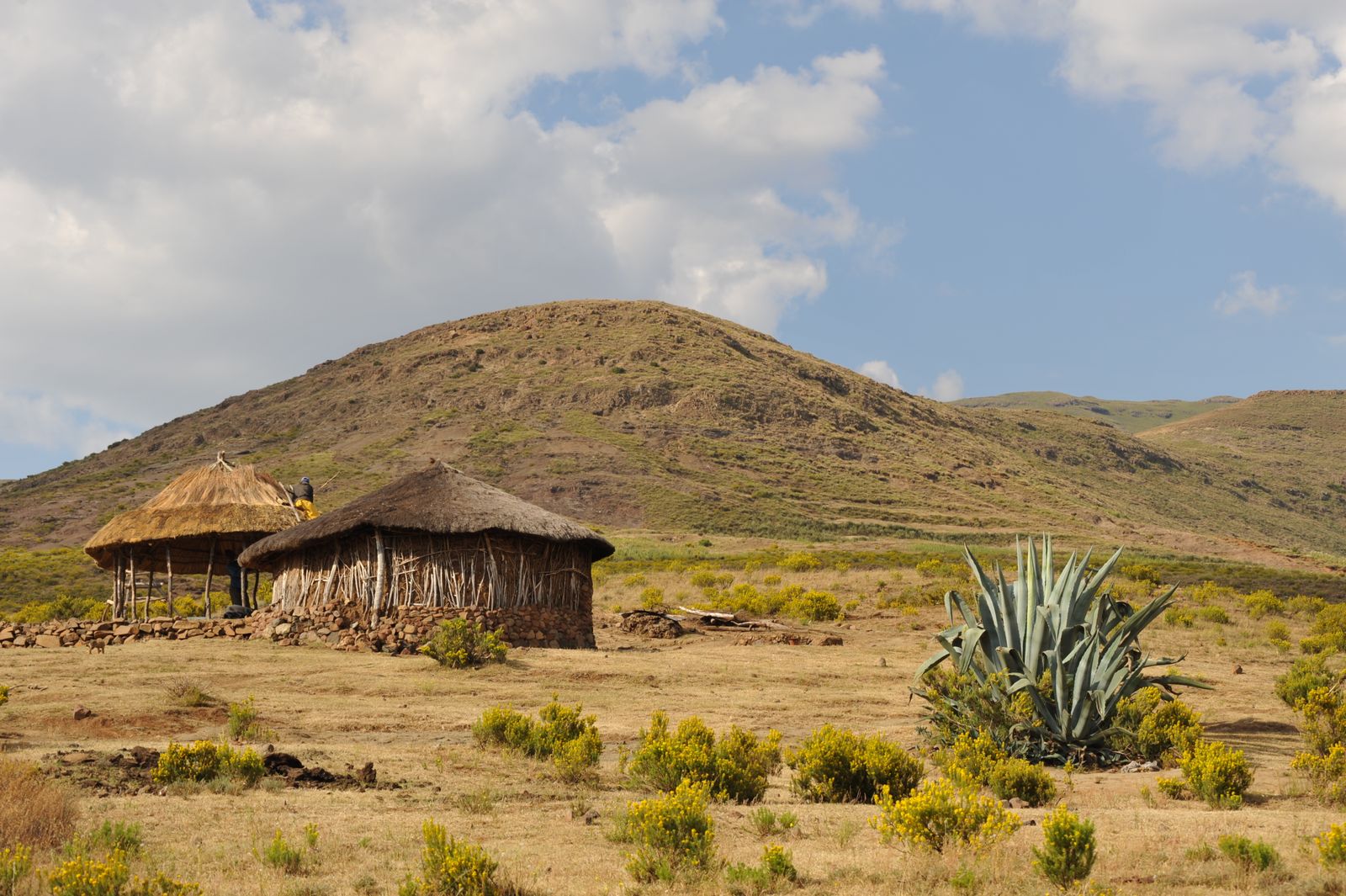
Lesotho is the only country on earth entirely above 1,400 metres — a mountain kingdom completely surrounded by South Africa and nicknamed the Kingdom in the Sky. The Maluti and Drakensberg ranges create a landscape of dramatic escarpments, highland plateaux, river gorges and isolated villages of round stone houses where Basotho horsemen in blankets and conical hats still move across the mountains as they have for centuries. Sani Pass — one of Africa’s most spectacular mountain roads — climbs from KwaZulu-Natal to 2,874 metres in a series of hairpin bends, and at its summit is Lesotho. The Ts’ehlanyane National Park and the Sehlabathebe National Park (UNESCO) offer extraordinary highland wilderness hiking and pony trekking.
The most dramatic mountain pass in southern Africa climbs from the South African border at 1,544 metres to the Lesotho plateau at 2,874 metres in only 9 kilometres of unpaved hairpin bends. 4WD or guided minibus required. At the top, the Sani Mountain Lodge — the highest pub in Africa — serves cold beer at the edge of the Drakensberg escarpment with staggering views.
The Basotho pony — a sturdy, sure-footed mountain breed descended from Cape horses — is the traditional transport of the highlands, and trekking by pony from village to village across the Maluti Mountains is the most authentic Lesotho experience. Mokhotlong and Semonkong are the best bases for multi-day pony treks into remote highland communities.
A 192-metre single-drop waterfall near Semonkong — Africa’s highest single-drop waterfall — plunges into a deep basalt gorge. The highest commercially operated abseil in the world (204m) descends beside the falls. The walk down to the base of the falls passes through extraordinary basalt canyon scenery.
Lesotho (Wikipedia) →sorghum beer fermented in clay pots, slightly sour and nutritious) is the traditional drink and social lubricant of Lesotho village life.
A thick, smooth maize porridge — the daily staple of Lesotho, eaten three times a day by most Basotho. Scooped by hand and dipped into moroko (spinach relish), beans or meat stew. Essentially the same as ugali, nshima or sadza across southern Africa.
wild leafy greens stewed with onion and tomato) is the daily meal.
Basotho sheep reared on the high-altitude grasslands of the Maloti Mountains produce exceptional lean, flavourful lamb — grilled over an open fire, stewed in a pot or roasted as a whole animal at village celebrations. Altitude and rough grazing produce meat with remarkable depth.
from highland flocks, grilled over open fires, are the festive centrepiece. South African wine and Castle Lager are widely available in Maseru.
Moshoeshoe I International Airport (MSU) near Maseru handles Airlink connections to Johannesburg. The main entry is overland from South Africa. For trip planning, see the official Lesotho tourism portal.
💡 Johannesburg (50 min) is the only practical air gateway. Airlink operates daily MSU services; book in advance as the aircraft are small (Embraer regional jets, ~37 seats).
💡 The Sani Pass entry (a rough mountain track requiring a 4WD, connecting the KwaZulu-Natal Drakensberg of South Africa to the Lesotho highlands at 2,873m) is the most dramatic overland entry into any country in Africa — the views from the top of the escarpment are extraordinary.
💡 Most highland destinations require a 4WD vehicle or a vehicle with good ground clearance. The main paved road (the A1 to Thaba-Tseka and the Katse Dam road) is in reasonable condition; the minor roads to highland lodges are typically rough tracks.
💡 A 4WD hire car (LSL 600–1200/day) is essential for highland Lesotho. The paved main roads are manageable in a saloon car; most highland lodges and all national parks require 4WD. The Sani Pass is strictly 4WD only.
May to September is best — dry season, clear mountain air, Lesotho’s ski season (June–August at Afriski), pony trekking accessible. October to April is the rainy season; November to February is summer (20–30°C in the lowlands), with dramatic thunderstorms and green highland plateaus but muddy mountain tracks.
Lesotho uses the Lesotho Loti (LSL, pegged 1:1 to the South African rand ZAR; both accepted everywhere). It is one of the cheapest destinations in southern Africa.
Papa (a stiff maize porridge — the staple food of Lesotho, eaten three times a day, broken with the hands into a firm ball and dipped into stew or morogo (wild greens boiled with onion) or maotwana (chicken stew)) is available.
Malealea Lodge (the most celebrated highland lodge in Lesotho, a family-run farm 70km from Maseru with pony trekking, village walks and traditional Basotho culture — from LSL 400–800/night) is the best base for highland Lesotho.
A 3–5 day pony trek through the Lesotho highlands (sleeping in village rondavels, riding mountain passes at 3,000m, crossing rivers by horse — from LSL 600–1200/day all-inclusive) is the finest way to experience.
Maseru for one day, Thaba Bosiu for one, Semonkong for one, Afriski for one, pony trek for one, Sehlabathebe for one, Katse Dam for one. Lesotho — the Kingdom in the Sky — is entirely above 1,000m, has Africa’s only ski resort, the world’s longest commercial abseil and the finest pony trekking in the continent.
Maseru — the capital of Lesotho (the Kingdom in the Sky — a landlocked country entirely surrounded by South Africa, the only country in the world situated entirely above 1,000m elevation, population 2.2 million — the highest minimum elevation of any country on earth) with the Maseru Craft Centre (the finest collection of Basotho traditional crafts — the distinctive woven hats and blankets that are the national dress) and the Royal Palace.
💡 Lesotho is the only country in the world entirely above 1,000m elevation — the lowest point is the Senqu (Orange) River valley at 1,400m, the highest is Thabana Ntlenyana at 3,482m. This extreme altitude is the result of the Lesotho Highlands — a plateau of ancient basalt lava flows that has been eroded into a complex of mountain peaks, gorges and valleys. The country sits on the highest point of the Great Escarpment.
Thaba Bosiu (the “Mountain at Night” — a flat-topped sandstone mesa 25km east of Maseru, the mountain fortress from which King Moshoeshoe I (1786–1870) forged the Basotho nation, repelling Zulu, Ndebele, Boer and British attacks from his impregnable plateau stronghold between 1820 and 1867 — the most important historical site in Lesotho and one of the most significant nation-founding sites in African history).
💡 Moshoeshoe I (1786–1870, the founding king of the Basotho nation) was one of the most diplomatically skilled African leaders of the 19th century — he forged a new nation from refugees fleeing the Mfecane (the wars caused by Zulu expansion), built an impregnable mountain fortress at Thaba Bosiu, defeated Zulu, Boer and British attacks, negotiated the protectorate relationship with Britain that saved Lesotho from annexation by South Africa, and died in 1870 leaving a nation that has survived intact to the present day.
Semonkong (“Place of Smoke”, a village in the highlands 120km from Maseru) — the Maletsunyane Falls (192m — the highest single-drop waterfall in southern Africa, a sheer plunge of the Maletsunyane River into a basalt gorge, the site of the world’s longest commercially operated abseil: 204m straight down the face of the falls, operated by Semonkong Lodge) and the surrounding highland plateau.
💡 The Maletsunyane Falls abseil (204m — the longest commercial single-drop abseil in the world, down the cliff face adjacent to the waterfall) has been operated by Semonkong Lodge since 1996. Participants descend by rope past the waterfall, arriving at the base of the gorge and then hiking out. The combination of the 192m waterfall and the 204m abseil makes Semonkong the most dramatic adventure destination in Lesotho.
Afriski (the only ski resort in southern Africa — at 3,222m on the Mahlasela Pass in the Maluti Mountains, operating June–August when Lesotho’s highlands receive reliable snowfall, with a 1km groomed ski run, snowboarding, snow tubing, an ice rink and the highest altitude pub in Africa — the Powder Room Bar at 3,222m — the only place in Africa outside of Kenya’s Mount Kenya where reliable natural snow falls on a regular basis).
💡 Afriski is the only ski resort in southern Africa and one of two in the entire continent (the other being Oukaïmeden in Morocco). The resort operates from June to August, when the Lesotho highlands receive reliable snowfall from cold fronts moving north from Antarctica. The snowfall is natural but variable; artificial snowmaking supplements it. At 3,222m, the access road is the second-highest paved road in Africa.
The Basotho pony trek (the most authentic way to experience the Lesotho highlands — the Basotho pony, a small, extremely hardy mountain horse descended from Persian and Cape Dutch stock introduced in the 19th century, is the primary transport in the roadless highland areas — 1–5 day treks from Malealea Lodge or the Semonkong area through highland villages, river crossings and mountain passes accessible only by horse or foot).
💡 The Basotho pony (an indigenous breed developed in Lesotho from the 1800s, extraordinarily hardy at altitude and on steep mountain terrain, the primary transport in the highlands of Lesotho where 70% of the country has no road) is one of the few genuinely functional horse cultures remaining in the modern world. Basotho men traditionally receive their first pony at puberty; the pony is essential for herding cattle, visiting family and accessing markets in the roadless highlands.
Sehlabathebe National Park (a remote plateau at 2,400m in the southeastern corner of Lesotho, on the border with South Africa’s Drakensberg — accessible only by 4WD or helicopter, with the finest trout fishing in Africa, prehistoric San rock paintings in caves, and a colony of bearded vultures (Gypaetus barbatus — the largest flying bird in Africa, with a wingspan of up to 2.8m) as the park’s most famous residents).
💡 The bearded vulture (Gypaetus barbatus — the Lammergeier) that nests in Sehlabathebe is one of the rarest raptors in Africa; the Lesotho population (part of the larger Drakensberg population) is estimated at 200–400 individuals. Bearded vultures are unique among birds in that their diet is 90% bone — they carry bones to height and drop them onto rocks to shatter them, then swallow the fragments. Stomach acid strong enough to dissolve bone in 24 hours is the adaptation that enables this.
The Lesotho Highlands Water Project — specifically the Katse Dam (185m high, the second-tallest dam in Africa, the first arch dam built on a fault line — an engineering challenge solved by building a double-arch structure — part of the largest water transfer project in Africa, supplying water to the Johannesburg industrial region of South Africa and providing 40% of Lesotho’s electricity) with the Katse Botanical Garden and the view into the 180m-deep gorge. Fly from Maseru (MSU).
💡 The Lesotho Highlands Water Project (LHWP — begun 1986, transferring water from the Lesotho highlands to the water-scarce Gauteng region of South Africa through 200km of tunnels bored through the Drakensberg — provides Lesotho with its primary source of foreign exchange: the water royalties paid by South Africa fund approximately 40% of the Lesotho government’s budget. Lesotho sells the one resource it has in abundance — water — to the wealthiest region of Africa.
Visa-free for most nationalities at all border crossings.
The Kingdom of Lesotho is an enclave within South Africa. Entry is most commonly overland from South Africa. No international airports with intercontinental flights.
Lesotho is the world’s highest country (lowest point 1,400m). Acclimatise before strenuous hiking. Temperatures drop sharply at night year-round.
The Basotho pony is a hardy mountain breed used for centuries to traverse the Maluti and Drakensberg. Multi-day pony trekking routes stay at village lodges (maluti) — one of the finest experiential travel activities in Africa.
Most highland roads are unpaved and require 4WD. The mountain passes are dramatic in dry season and challenging in winter snow.
Lesotho is cold, especially at night in winter (Jun–Aug) — temperatures can drop well below freezing at higher elevations.
Point your camera at menus, signs or street text for instant translation. Download the language pack offline before you arrive for full use without data.
FreeReal-time and offline exchange rates for all world currencies — converts prices instantly so you always know what you are paying in your home currency.
FreeFind and book hotels, guesthouses and apartments with free cancellation on most rates — one of the widest selections of accommodation worldwide.
FreeBrowse millions of traveller reviews for restaurants, attractions and hotels — helps identify the best local spots and avoid tourist traps.
FreeLesotho sits within easy reach of several other destinations — each with a completely different character.