PT
Madeira
Levada walks through laurel forest, espada & Madeira wine cellars
Levada walks through laurel forest, espada & Madeira wine cellars
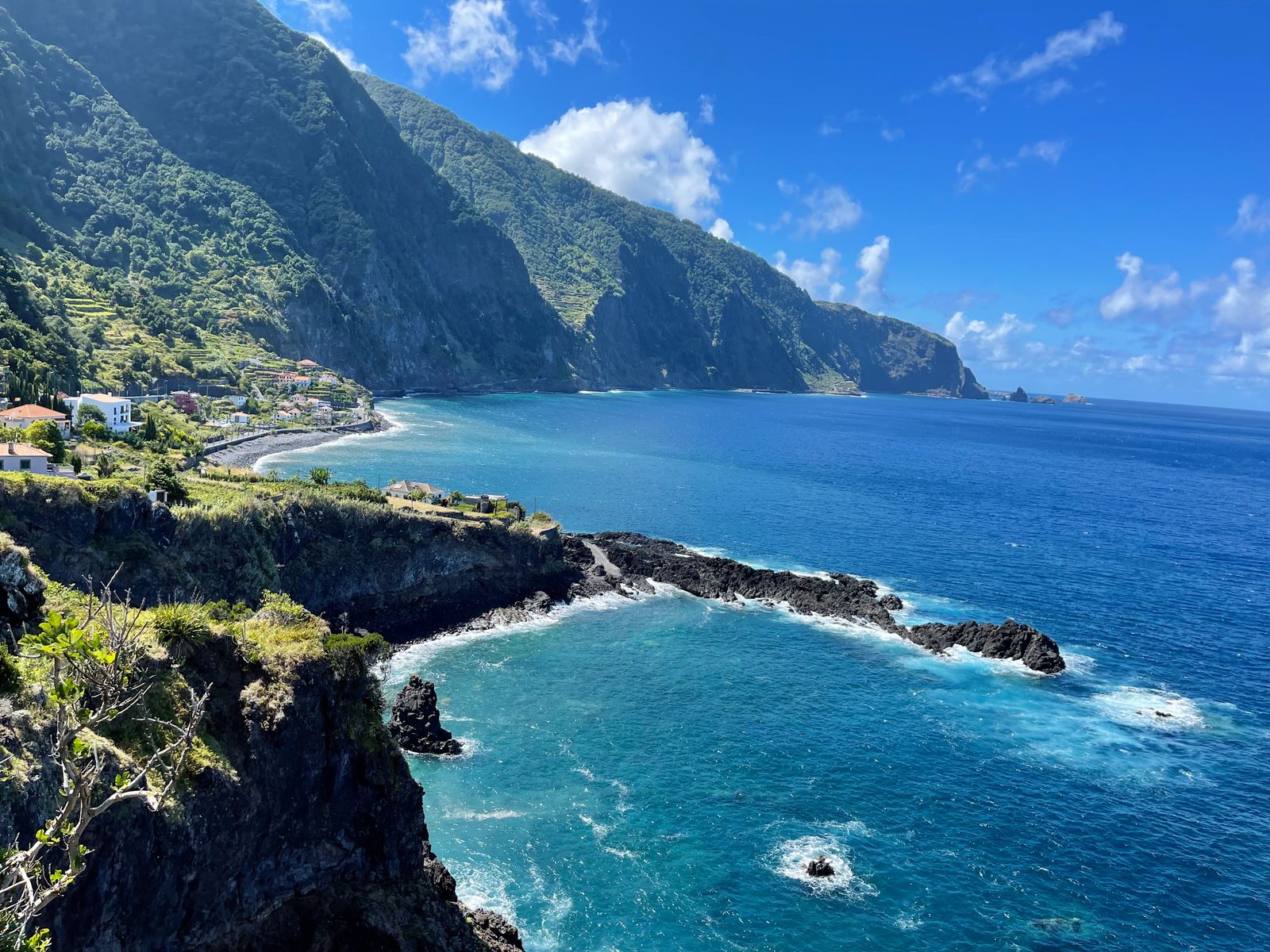
Madeira is Portugal’s subtropical island 900 kilometres southwest of Lisbon — a dramatic volcanic peak rising from the Atlantic, its interior carved by centuries of levada irrigation channels that now serve as the island’s hiking network. The levadas — narrow water channels dug along contour lines through the island’s forests and cliffsides — give walkers access to landscapes of beauty: ancient laurisilva forest (a UNESCO World Heritage Site, the last remnant of the subtropical forests that once covered southern Europe), sheer sea cliffs, valley viewpoints and a floral abundance that earned Madeira the name “the Floating Garden.” Funchal, the capital, is one of the Atlantic’s most welcoming cities, with its market hall, cable car to Monte and the extraordinary Blandy’s Wine Lodge where the island’s famous fortified Madeira wine has been maturing for over 200 years.
Madeira’s 2,500-kilometre network of levada (irrigation channel) paths is one of Europe’s finest walking systems — the channels run horizontally through the island’s topography at precise gradients, giving walkers access to places reachable no other way. The Levada das 25 Fontes, Levada do Caldeirão Verde (through Laurisilva UNESCO forest to a grotto waterfall) and the dramatic PR1 trail from Pico do Arieiro to Pico Ruivo across the central ridge are among Europe’s finest day walks.
Madeira’s two highest peaks (1,818m and 1,862m) are connected by the island’s most dramatic ridge walk — a 3-hour trail of tunnels, cliff-edge paths and panoramas above the clouds. Sunrise from Pico do Arieiro (accessible by car) with the island peaks protruding from a sea of clouds is one of the Atlantic’s most striking dawn experiences.
The island’s capital tumbles from the hills to the Atlantic in a cascade of red-roofed houses, bougainvillea and subtropical gardens. The Mercado dos Lavradores (flower and fruit market), the Blandy’s Wine Lodge (Madeira wine tasting in a 200-year-old cellar), the cable car to Monte and the toboggan run back down (wicker sleds steered by men in straw hats since 1850) are the essential Funchal experiences.
Madeira (Wikipedia) →Scabbard fish (black deep-sea espada) served with banana and passionfruit sauce — Madeira’s signature combination, seemingly odd but entirely harmonious, found on every restaurant menu.
Dense Madeiran “honey” cake made with molasses, spices and walnuts, traditionally baked once per year at Christmas and eaten in slices over many months.
Beef rubbed with garlic and bay leaf, grilled on bay-wood skewers over an open fire.
The national drink of Madeira — aguardente (sugarcane spirit) mixed with honey, orange or lemon juice and stirred with a wooden poncha stick until emulsified. Every poncheira (poncha bar) has its own secret recipe; the drink is stronger than it tastes and the cause of many long nights.
Fortified wine aged with heat, in four main styles from dry to sweet: Sercial, Verdelho, Boal and Malmsey.
Madeira Cristiano Ronaldo International (FNC) — named after the Funchal-born footballer — is well connected to Europe. Ryanair, easyJet, TAP and British Airways operate direct flights. For trip planning, see the official Madeira tourism portal.
easyJet, Ryanair and British Airways all operate direct services from London year-round. Madeira is 3h30 from the UK — one of the closest year-round warm destinations from Britain.
Lisbon (1h45, multiple daily) is the best connecting hub within Portugal. All major European capitals have direct connections — Madeira is one of the most connected Atlantic islands.
The Porto Santo ferry departs from Funchal port daily in summer and several times weekly in winter — the 2h30 crossing is most pleasant in calm weather (April–October). The 30-min flight is more reliable.
Car hire (€25–55/day) is strongly recommended — Madeira’s expressway tunnels (over 100km of tunnel, the highest tunnel density per km² in Europe) make all corners of the island accessible within 1h30 of Funchal. Drive on the right.
Madeira is a year-round destination — the subtropical climate keeps temperatures between 17°C and 28°C all year with the northeast trade winds moderating the heat. April to June and September to October are the most settled months. February to March brings the Carnival and the flower festival. July and August are the warmest months and busiest.
📅 Madeira is in its best season in April, May, June, July, August, September, October. See where else is good to go in those months, or browse where to go by month.
Madeira is a Portuguese autonomous region using the euro. It is mid-range to affordable by western European standards — significantly cheaper than the Azores or Canaries for accommodation, with good local food.
Espetada — chunks of Madeiran beef marinated in garlic and bay leaf, threaded on a bay-wood skewer and grilled over red-hot embers, hung on a metal hook at the table so the juices run down the skewer — is the most important.
Poncha — a cocktail of aguardente (sugarcane spirit), honey and lemon or orange juice, mixed in a wooden cup with a carved stick — is Madeira’s national drink.
Reid’s Palace (Funchal, opened 1891, the finest hotel in Madeira, where Winston Churchill came to paint and George Bernard Shaw to dance)
Funchal for two days, the Cabo Girão cliffs for one, levada hiking for one, Santana and the north coast for one, Pico do Arieiro for one, Porto Santo for one. Madeira — the floating garden of the Atlantic — is one of Europe’s finest year-round destinations.
Funchal — the capital of Madeira, a city of 112,000 arranged in an amphitheatre of hills above a natural harbour — with the Old Town (Zona Velha — a grid of cobbled alley streets, the doors painted by local and international artists in the annual Art of Open Doors project), the Mercado dos Lavradores (the finest covered market in the Atlantic islands, with tropical fruits unique to Madeira: anona, pitanga, tamarillo and the famous Madeira banana) and the cable car to Monte.
Funchal’s New Year’s Eve fireworks (December 31) are the most striking in Europe — the entire amphitheatre of Funchal’s hills simultaneously fires rockets and the harbour lights up for 8 minutes. The display has been listed in the Guinness Book of World Records as the world’s largest fireworks display. An estimated 1 million people watch from the hillsides, harbour and ships offshore.
The Monte Palace Tropical Garden (a 70,000m² park on the hillside above Funchal with tile panels (azulejos) depicting the history of Portugal, koi ponds, African sculpture and the most diverse collection of cycads and tree ferns in Europe) and the Monte Toboggan (a wicker sledge guided by two men in white suits and straw hats that slides 2km down the cobblestone road from Monte to Funchal at 48km/h — a tradition since 1850).
The Monte toboggan (carro de cesto) was originally a practical mode of transport for villagers descending the steep cobblestone roads to Funchal market in the 19th century — not a tourist attraction but a utility vehicle adapted to the terrain. The carreiros (the men who guide the sleds by pulling on ropes) are members of a guild that has trained this skill for over 150 years.
30 min west of Funchal. Cabo Girão — a 580m basalt sea cliff (the second-highest sea cliff in the world, the highest in Europe) with a glass platform cantilevered over the edge above vineyards (levada-irrigated smallholdings cut into the cliff face, farmed by families who have cultivated these terraces for centuries, accessible only by cable car from the cliff top) and the finest Atlantic horizon view in Madeira.
Cabo Girão’s poios (terraced smallholdings on the cliff face, farmed since the 15th century) are irrigated by a levada (a narrow irrigation channel) that was cut into the cliff face manually in the 16th century. The families that farm them descend in a cable car and work vineyards and vegetable plots 580m above the Atlantic, the most vertiginous smallholding system in Europe.
Madeira’s levada system (a 2,500km network of narrow irrigation channels built from the 15th century onward, threading along cliff faces, through tunnels and across ravines to distribute water from the wet north to the dry south of the island) has 150km of accessible walking paths alongside it. The Levada do Caldeiro Verde (north side, through laurisilva forest — UNESCO World Heritage ancient laurel forest — ending at a 100m waterfall in a moss-draped volcanic amphitheatre).
The laurisilva forest of Madeira (covering 150km² of the north and west slopes, UNESCO World Heritage since 1999) is the largest surviving fragment of the subtropical laurel forest that covered much of southern Europe and the Mediterranean before the ice ages. It has been continuously forested for over 20 million years; the trees — til, laurel, Madeira cedar — grow to 20m and create a closed canopy, the most intact ancient forest in the Atlantic.
1h30 from Funchal. Santaná — a north coast village famous for its palheiros (A-frame thatched houses, built in the 16th century to maximise interior space on a sloping site, with the thatched roof descending to within 1m of the ground — the most distinctive vernacular architecture in Madeira) and the Parque Tematico da Madeira (a theme park covering Madeiran history and culture) with the finest sea views on the north coast.
The palheiro A-frame houses of Santana have been built in this distinctive form since the 16th century — the steeply pitched thatched roof descends on three sides to near-ground level, with a small painted door at the front. The shape maximises floor space on a steep hillside while shedding the heavy north coast rainfall efficiently. Fewer than 20 original palheiros survive; they are protected as national monuments.
1h from Funchal. Pico do Arieiro (1,818m, the third-highest peak in Madeira, accessible by road to the summit, with a viewing platform above the cloud layer — the most accessible above-cloud mountain experience in Portugal) and the hike to Pico Ruivo (1,862m, the highest peak, 3h one-way trail along the central ridge with views of the entire island and, on clear days, of the neighbouring Desertas and Porto Santo islands).
Madeira’s central ridge is above the cloud inversion layer (typically at 1,200–1,400m) from May to October — visitors who drive to Pico do Arieiro (1,818m) emerge from cloud to find sunshine above a white sea of cloud stretching to the horizon, with only the highest peaks visible above it. The phenomenon is most reliable in summer.
30 min flight or 2h30 ferry. Porto Santo — a smaller, flatter, drier island 43km northeast of Madeira with a 9km golden sand beach (the only long sandy beach in the Madeira archipelago — the dark volcanic sand of Madeira contrasts completely with Porto Santo’s fine, pale sand, the result of millennia of ground shell and limestone deposition) and the Casa de Colombo (the house where Christopher Columbus lived before his first voyage, now a museum). Fly from Madeira Cristiano Ronaldo International (FNC).
Christopher Columbus lived on Porto Santo from 1478 to 1484 — his wife Filipa Moniz was the daughter of the island’s governor. The years on Porto Santo are considered crucial to Columbus’s development as a navigator: studying Atlantic wind patterns, ocean currents and the behaviour of the North Atlantic trade winds that he would use to sail west in 1492.
EU/Schengen territory of Portugal. UK, US, Australian citizens enter visa-free up to 90 days.
One of Europe’s most dramatic airport approaches — the runway extends on stilts over the sea. TAP, Ryanair, easyJet and many European carriers serve Madeira.
A network of 1,350km of irrigation channels (levadas) crisscrossing the mountains form the world’s most unusual walking trails — flat, narrow paths following water channels through cloud forest, tunnels and clifftop terraces.
The process of heating Madeira wine (estufagem) and its great longevity (bottles from the 1800s are still drinkable) make it a unique product. Blandy’s wine lodge in Funchal offers tours and tastings.
Essential for exploring the island’s mountain roads. Madeira’s driving is dramatic — tunnels, hairpins and seaside expressways require confidence.
Madeira’s subtropical climate means it rarely drops below 16°C even in winter — a reliable European sunshine escape.
Quick answers to the questions people most often ask before visiting Madeira.
Fly into Madeira Cristiano Ronaldo International Airport (FNC) near Funchal. Direct flights take about 3h30 from London and many other European cities, and about 1h45 from Lisbon.
Madeira is a year-round destination, with temperatures between about 17°C and 28°C. April to June and September to October are the most settled months for hiking.
Levadas are historic irrigation channels — over 1,000 km of them — that run through the mountains. The paths beside them are some of Europe's most unusual and walking routes.
A hire car is the easiest way to explore beyond Funchal and reach trailheads, though the mountain roads are steep and winding, with many tunnels. Buses and tours are alternatives.
It is mid-range to affordable by Western European standards — around €55–90 per day on a budget and €130–220 mid-range. Madeira is part of Portugal and uses the euro.
GPS trail maps for all levada walks and mountain trails.
FreeDownload offline maps before you travel so navigation works without mobile data — essential for walking, driving and finding local spots.
FreePoint your camera at menus, signs or street text for instant translation. Download the language pack offline before you arrive for full use without data.
FreeReal-time and offline exchange rates for all world currencies — converts prices instantly so you always know what you are paying in your home currency.
FreeFind and book hotels, guesthouses and apartments with free cancellation on most rates — one of the widest selections of accommodation worldwide.
FreeMadeira sits within easy reach of several other destinations — each with a completely different character.
Madeira is one of the world’s least-visited places. See all 90 in our guide to the world’s least-visited countries & territories.


