PT
Azores
Twin crater lakes, sperm whales & geothermally cooked stew in the mid-Atlantic
Twin crater lakes, sperm whales & geothermally cooked stew in the mid-Atlantic
The Azores is Portugal’s mid-Atlantic archipelago of nine volcanic islands, 1,500 kilometres west of Lisbon — Europe’s closest point to the Americas and one of the continent’s most striking adventure and nature destinations. The islands are geologically young and volatile — on São Miguel, you can boil eggs in geothermal hot springs and swim between blue and green volcanic crater lakes (Sête Cidades and Lagoa do Fogo) within an hour; on Faial, the Capelinhos volcano erupted in 1957 and added two square kilometres of new land; on Pico, a UNESCO-listed landscape of black lava vineyards produces some of the world’s most distinctive wines at the foot of Portugal’s highest mountain. The Azores has one of the world’s finest whale watching records — 26 cetacean species have been observed, and sperm whales are resident year-round.
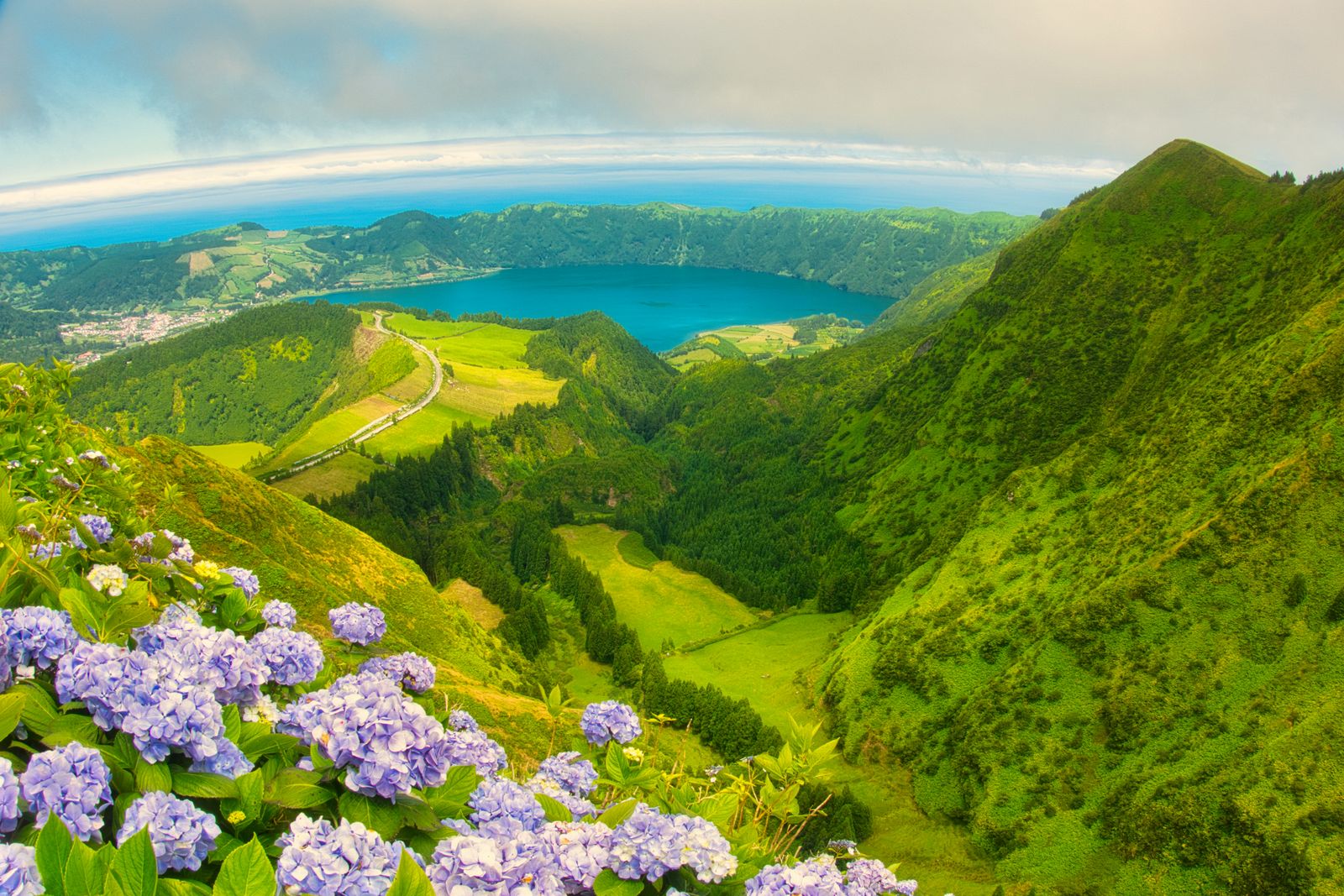
The twin crater lakes of Sête Cidades — one blue, one green, divided by a bridge, enclosed by 300-metre caldera walls — are the defining image of the Azores. The 10-kilometre rim trail around the caldera reveals the lakes from every angle. Lagoa do Fogo (Fire Lake) to the east is less visited and equally dramatic, its green water in an intact volcanic crater accessible by a short hike from the road.
The waters between Pico and Faial (a 20-minute ferry apart) are one of the world’s most reliable whale watching destinations — sperm whales are resident year-round, and blue whales, fin whales, pilot whales, sei whales, common dolphins and bottlenose dolphins are regularly encountered. The old whale-watching towers (vigias) on the hillsides above Lajes do Pico were the lookout points for the whaling industry that ended in 1987.
Pico Island’s 2,351-metre volcano (Portugal’s highest peak) rises from a UNESCO-listed landscape of black lava vineyards — small plots enclosed by stone walls built by hand over four centuries to protect vines from Atlantic wind and spray, producing the minerally, unique Pico wine (Verdélho). Climbing Pico in the dark and watching sunrise from the caldera rim is one of Portugal’s great experiences.
A valley of geothermal activity where hot springs, fumaroles and boiling mud pools cluster around a crater lake. The local speciality — cozido das Furnas, a stew of meat and vegetables slow-cooked for 8 hours in a pot buried in the geothermal ground — is collected at lunchtime by restaurant staff with shovels in one of the world’s most dramatic cooking processes.
Azores (Wikipedia) →A meat and vegetable stew cooked for several hours in hot volcanic ground at Furnas on São Miguel.
a slow-braised beef stew from Terceira, cooked in wine with allspice and cloves) is one of Portugal’s great forgotten dishes.
A soft, slightly salty cow’s-milk cheese from Pico; São Jorge cheese is the other famous Azorean cheese.
Butter, milk and cheese from pasture-fed cows are a big part of the islands’ economy and appear at every breakfast.
Passion-fruit liqueur from São Miguel and white wine from Pico’s UNESCO-listed vineyards.
Ponta Delgada Joao Paulo II (PDL) on São Miguel is the main international hub. Ryanair and easyJet connect from the UK; SATA connects inter-island. For trip planning, see the official Azores tourism portal.
easyJet and Ryanair both operate year-round Gatwick–Ponta Delgada services in under 3 hours, making the Azores one of the closest Atlantic island destinations from the UK.
The Azores are the closest point of Europe to North America — Boston is just 4 hours. SATA (Azores Airlines) and TAP operate the transatlantic routes, with frequent summer services.
SATA (Azores Airlines) is the only inter-island carrier; book ahead in summer. The central island triangle ferry (Faial–Pico–São Jorge) is the most scenic 30-minute crossing in the Atlantic.
Each Azorean island requires a car to explore fully — buses exist but are infrequent. São Miguel (65km long) can be seen in 2–3 days with a car.
April to October is best — São Miguel’s calderas accessible, the whale-watching season peak (April–October), Flores and Corvo lush and clear. June to August are warmest (21–25°C). November to March is the rainy season — dramatic but Atlantic storms can disrupt inter-island travel.
📅 Azores is in its best season in May, June, July, August, September, October. See where else is good to go in those months, or browse where to go by month.
The Azores are a Portuguese autonomous region using the euro, with prices roughly 20–30% below mainland Portugal. An excellent-value destination with unique volcanic food experiences.
Cozido das Furnãs — pork, sausage, chicken and root vegetables slow-cooked for 6–8 hours underground in volcanic steam at 97°C — costs €12–18 per person at a Furnãs restaurant and is the most.
Pico Verdelho — the off-dry white wine made from Verdelho grapes on the black lava fields of Pico island — was one of the most prized wines in 18th-century Europe.
Terra Nostra Garden Hotel (Furnãs, the finest hotel in the Azores, directly on the botanical garden and thermal pool, from €150–350/night) and the Furnas Boutique Hotel Thermal & Spa are the archipelago’s most atmospheric addresses.
São Miguel for two days, Faial for one, Pico for one, Flores for two, São Miguel for one. The Azores — nine volcanic islands in the mid-Atlantic — are the most geologically dramatic and least-visited Atlantic archipelago in Europe.
São Miguel — the largest Azorean island, 65km long, completely volcanic — with Sete Cidades (a twin-lake caldera in the northwest, the two lakes separated by a bridge — one blue, one green — surrounded by 300m crater walls) and Furnãs (a caldera village where hot springs and fumaroles boil from the ground in the park, and the local cozido (stew) is cooked underground in a volcanic pot).
The twin lakes of Sete Cidades (Lago Azul and Lago Verde) are the same body of water — they appear different colours due to differences in the angle of light reflection and the depth of the water at the point where they connect under the bridge. The caldera was formed 36,000 years ago by the collapse of a large volcanic complex.
A full day — the viewpoint walk around the Sete Cidades crater rim (6km circuit, 400m above the twin lakes) and Furnãs — where the cozido das Furnãs (pork, sausage, blood sausage, chicken and root vegetables slow-cooked for 6–8 hours in a clay pot lowered into the volcanic earth, the only geothermal restaurant cuisine in Europe) is served from the Vale das Furnãs every day.
Cozido das Furnãs — the stew cooked underground in volcanic heat (at 97°C, just below boiling) for 6–8 hours — is the defining dish of São Miguel and one of the most striking cooking methods in the world. The pots are lowered into the steaming ground at 6am and lifted at 12:30pm, serving hundreds of portions daily.
40 min flight. Faial — the island of blue hydrangeas (hortensia hedges line every road from June to October), with the Caldeira do Faial (a 2km-wide caldera at 1,043m — a forested rim walk with views into the 400m-deep bowl below) and Horta marina (the most important transatlantic yacht stop in the world — sailors have been painting their boat names and flags on the harbour wall since 1941).
Horta marina’s painted wall (a continuous 2km mural of yacht names, port emblems, flags and messages painted by sailors since 1941) is the most important sailors’ superstition in ocean racing — it is believed that any yacht that fails to paint their emblem on the Horta wall before departing will suffer misfortune on the next Atlantic crossing.
20 min ferry from Faial. Pico — dominated by Pico volcano (2,351m, the highest peak in Portugal, an almost perfectly conical stratovolcano rising from the sea) and the Pico vineyards (UNESCO World Heritage — a system of black lava-stone walls (currais) dividing the volcanic hillside into tiny vine plots, protecting each vine from Atlantic wind, producing Verdelho wine from the most striking viticulture landscape in Portugal).
The Pico vineyards (currais system) were created from the 15th century onward by building low lava-stone walls on bare volcanic rock to protect individual vines from Atlantic salt spray and wind. The Verdelho grape produces an off-dry white wine with mineral character that was one of the most prized wines in Europe in the 18th century, shipped to Russia, the UK and Brazil.
45 min from Faial. Flores — the westernmost island of the EU, with the most dramatic waterfall landscape in the Atlantic islands (seven major waterfalls including the Poco do Backelho — a series of turquoise volcanic pools connected by cascades in a lush canyon) and Faja Grande (a tiny coastal village backed by a 300m cliff wall, the most dramatic village setting in the Azores).
Flores is technically the westernmost point of the European Union — 39° 22′ W, further west than any point on the European continent. The island sits on the North American tectonic plate rather than the Eurasian plate that underlies the rest of the Azores.
A full day on Flores — diving the Ilheu de Maria Vaz (a tiny offshore rock with great clarity, black coral and large grouper) and a whale-watching boat (Flores is in the core of the Azores whale sanctuary — sperm whales are resident year-round, with fin, sei and blue whales passing April–October).
The Azores whale sanctuary is one of the most important cetacean habitats in the Atlantic — 28 of the world’s 90 whale and dolphin species have been recorded in Azorean waters. Sperm whales are year-round residents; the islands were the centre of the 19th-century American whaling industry before whale hunting was banned in 1984.
Return flight to São Miguel. The Terra Nostra Botanical Garden at Furnãs (a 12-hectare garden established in 1775, the oldest in the Azores, with a thermal pool of brown iron-rich volcanic water at 39°C — open for bathing — surrounded by a collection of tree ferns, camellias and 600 plant species from around the world). Fly from São Miguel Ponta Delgada (PDL).
Terra Nostra Garden’s thermal bathing pool (a large outdoor pool of naturally heated volcanic water at 39°C, coloured brown by dissolved iron and minerals) is the most unusual bathing experience in Europe. The iron-rich water stains swimwear — wearing an old swimsuit or renting one is strongly recommended.
EU/Schengen territory of Portugal. UK, US, Australian citizens enter visa-free up to 90 days.
SATA Air Açores and TAP Portugal connect the Azores to Lisbon, Porto, London, Boston, Toronto and other major cities. Inter-island connections by SATA.
The Azores receive weather from three directions — Atlantic, continental Europe and subtropical high. Four seasons in one day is typical. Pack layers regardless of season.
Sperm whales are resident year-round in the Azores — the deep water around the islands is one of the few places where sperm whales can be seen reliably on day trips. Blue whales pass through April-June.
SATA Air Azores flies between all nine islands; ferries connect the central group (Faial, Pico, São Jorge, Graciosa, Terceira) in summer.
São Miguel is the most accessible and has the most dramatic geothermal features; Pico for whale watching and wine; Flores for pure natural beauty.
Quick answers to the questions people most often ask before visiting the Azores.
Fly into Ponta Delgada (PDL) on São Miguel, the main hub — about 2 hours from Lisbon and around 3–4 hours from London. There are also direct flights from Boston. Inter-island flights and seasonal ferries connect the other islands.
April to October, with June to August the warmest (21–25°C). November to March is rainier and Atlantic storms can disrupt inter-island travel. The weather is changeable in any season.
Yes — the Azores are one of the world's best whale-watching destinations. Sperm whales are present year-round, and April to October is peak season for many species.
São Miguel is the easiest to reach and has the most dramatic volcanic scenery. Pico is best for whale watching and climbing Portugal's highest mountain, while Flores is famous for its waterfalls.
No — prices are typically below mainland Portugal. Expect around €50–85 per day on a budget and €120–200 mid-range. The currency is the euro.
Official tourism app with trail maps, whale watching calendars and island guides.
FreeDownload offline maps before you travel so navigation works without mobile data — essential for walking, driving and finding local spots.
FreePoint your camera at menus, signs or street text for instant translation. Download the language pack offline before you arrive for full use without data.
FreeReal-time and offline exchange rates for all world currencies — converts prices instantly so you always know what you are paying in your home currency.
FreeFind and book hotels, guesthouses and apartments with free cancellation on most rates — one of the widest selections of accommodation worldwide.
FreeAzores sits within easy reach of several other destinations — each with a completely different character.
Azores is one of the world’s least-visited places. See all 90 in our guide to the world’s least-visited countries & territories.

