GI
Gibraltar
The Rock at the gateway to the Mediterranean — macaques, WWII tunnels & dolphin pods
The Rock at the gateway to the Mediterranean — macaques, WWII tunnels & dolphin pods
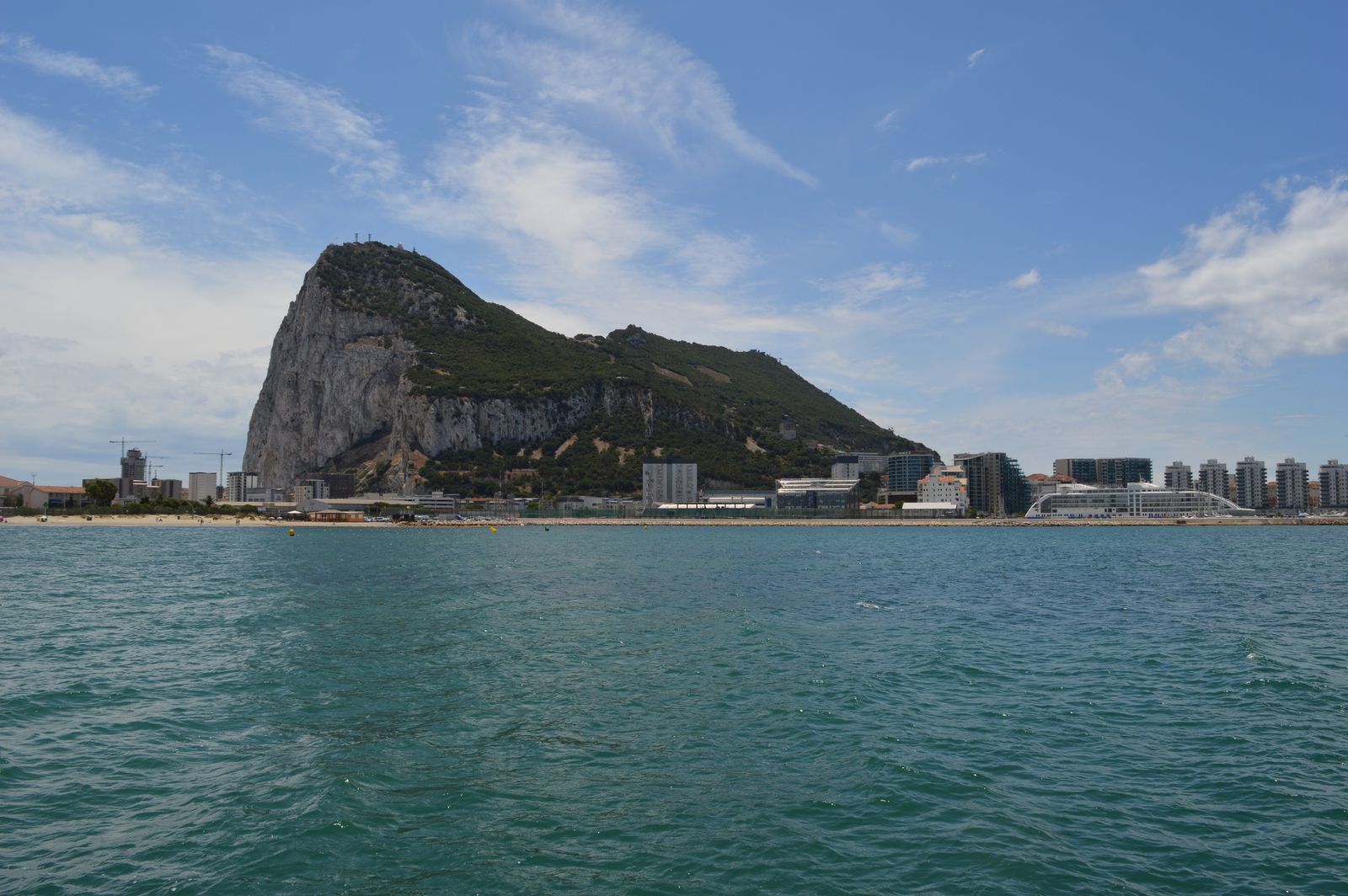
Gibraltar is one of the most geopolitically compressed destinations on earth — a 6.7-square-kilometre British Overseas Territory clinging to a 426-metre limestone monolith at the entrance to the Mediterranean, where the Atlantic meets the Med, where Barbary macaques roam the rock, where WWII tunnels run through the mountain and where the views from the top extend on a clear day to Morocco, 23 kilometres across the Strait. The Rock of Gibraltar — Calpe to the ancients, one of the two Pillars of Hercules that marked the edge of the known world — is simultaneously a nature reserve, a military fortification of 3,000 years, a tax-free shopping destination and a surprisingly likeable British colonial town with palm trees and a Main Street of unashamedly English pubs.
The 426-metre limestone monolith dominates Gibraltar from any angle. The Upper Rock Nature Reserve at the summit hosts Europe’s only wild primate population — around 300 Barbary macaques, utterly unafraid of humans and well-practiced at stealing snacks. The cable car from the town centre delivers you to the top for views across the Strait of Gibraltar to Africa on a clear day.
Over 50 kilometres of tunnels honeycomb the Rock — the Great Siege Tunnels (18th century, blasted by hand from solid limestone during a Spanish-French siege) and the WWII tunnels (dug by the Royal Engineers under the orders of General Eisenhower, who directed Operation Torch from a chamber inside the Rock) are accessible on guided tours. The scale of the WWII underground complex is extraordinary.
The Strait of Gibraltar is one of the world’s best dolphin-watching locations — common, bottlenose and striped dolphins are year-round residents of the channel, and pilot whales, fin whales and sperm whales migrate through in season. Boat trips from the marina take 2 hours and reliably encounter large pods.
Gibraltar (Wikipedia) →A baked chickpea flour flatbread of Genoese origin — the only truly unique dish of Gibraltar, brought by Genoese settlers in the 18th century. Dense, golden and savoury, eaten warm from the pan and considered Gibraltar’s national dish despite its Italian origins.
A baked chickpea flour cake, denser than the Nice socca, served hot from the oven at the Casemates market — Gibraltar’s only truly indigenous dish.
Thin crispy olive oil pastry biscuits flavoured with anise and sesame — sold throughout Gibraltar as the traditional sweet.
fried chickpea pasta) are the local specialities. British pub food — fish and chips, steak and ale pie — coexists with Spanish tapas from across the border. Main Street’s pubs and the waterfront’s restaurants are the social hubs.
Gibraltar’s own microbrewery produces lagers and ales using the territory’s famous natural water — available at the garrison towns’ pubs and restaurants. The most local beer possible for this tiny territory perched above the Strait.
Gibraltar Airport (GIB) has direct flights from the UK. British Airways and easyJet serve London; Jet2 serves regional UK airports. The land border with Spain is 5 min from town. For trip planning, see the official Gibraltar tourism portal.
💡 Gibraltar is one of the most directly connected British Overseas Territories — British Airways and easyJet both operate year-round Heathrow and Gatwick services. The flight is 2h30, shorter than flying to many Mediterranean destinations.
💡 Malaga (AGP) is the most connected airport near Gibraltar — the bus to La Línea (€12, 1h30) then walking across the border (10 min) is the cheapest route from most European cities.
💡 Gibraltar Airport is uniquely accessible — after crossing the runway on foot (or waiting for planes to pass by car), the town centre is 5 minutes away. No other airport in the world is this close to its city centre.
💡 Gibraltar Town is compact and flat along Main Street; the Upper Rock requires either the cable car (£15 return) or a steep uphill walk. The cable car summit gives the best views; most people do town on foot and cable car for the Rock.
May to October is best — warm (20–28°C), the Strait swimmable, the dolphins plentiful, the Rock accessible. July and August are peak. November to April is mild (12–18°C) with the Levanter cloud forming on the Rock — dramatic and atmospheric. The famous Levanter (easterly wind) can make any month breezy.
Gibraltar uses the Gibraltar pound (GIP, pegged 1:1 with GBP) and also accepts GBP. It is broadly comparable to southern England in cost, with cheaper tobacco, alcohol and fuel.
Calentita (a baked chickpea flour cake, the national dish of Gibraltar, served warm in slices from the oven &mdash)
The Strait of Gibraltar dolphin tours (2 hours, departing from the marina, encountering common dolphins, bottlenose and striped dolphins &mdash)
The Rock Hotel (opened 1932, the finest hotel in Gibraltar, on the Upper Rock with panoramic views of the Strait and Morocco, where Winston Churchill and Noël Coward stayed, from £)
The Rock for one day, caves and tunnels for one, Main Street for one, dolphin watching for one, La Línea for one, Europa Point for one, Tarifa for one. Gibraltar — 6.5km² of British territory at the entrance to the Mediterranean — is one of the most historically layered and geographically extraordinary places in Europe.
The Rock of Gibraltar (426m, a 6.5km² British Overseas Territory at the southern tip of the Iberian Peninsula, the most strategically important piece of rock in European history) by cable car to the summit — the 360-degree panorama (Spain’s Costa del Sol to the north, the Rif Mountains of Morocco 14km to the south, the Atlantic to the west and the Mediterranean to the east) and the Barbary macaques (the only wild monkeys in Europe, approximately 300 animals in five groups on the Upper Rock).
💡 The Barbary macaques of Gibraltar (Macaca sylvanus, the only free-living non-human primates in Europe) arrived from North Africa at an unknown point in history — probably brought by Moorish settlers in the 8th century, though some evidence suggests they were present before the Moors. British legend holds that if the macaques ever leave Gibraltar, British rule will end; Winston Churchill ordered their numbers reinforced during WWII when they fell to just 7 animals.
St Michael’s Cave (a natural limestone cavern at 300m on the Rock, with stalactites and stalagmites in a chamber large enough to seat 600 people for the concerts regularly held there — the finest natural concert venue in Europe) and the Great Siege Tunnels (a network of tunnels carved by hand into the Rock by British soldiers during the Great Siege of 1779–1783, when Spain and France besieged Gibraltar for 3 years and 7 months — the longest siege in British military history).
💡 The Great Siege of Gibraltar (1779–1783) lasted 3 years, 7 months and 12 days — the longest siege in British history and one of the longest in European military history. The garrison of 5,000 under General George Eliott held off 40,000 Spanish and French troops. The tunnels bored into the Rock during the siege (originally to place cannons pointing along the north face) were the first man-made tunnels in Gibraltar; the system expanded to 55km during World War II.
Main Street (the main commercial street of Gibraltar Town — 700m of duty-free shops selling tobacco, alcohol, electronics and British goods, ending at Casemates Square, the former place of execution now the main social square) and the Moorish Castle (a Nasrid-dynasty tower and gate dating from the 14th century — the surviving remnant of the fortifications built by the Moors who held Gibraltar from 711 to 1462).
💡 Gibraltar was held by the Moors from 711 AD (the landing of Tariq ibn Ziyad — the name Gibraltar derives from Jabal al-Tariq, meaning “Mountain of Tariq”) to 1462 when it was taken by the Duke of Medina Sidonia. It was ceded to Britain by Spain in the Treaty of Utrecht (1713) after the War of the Spanish Succession, making it the first British territory acquired by treaty rather than conquest. Spain has sought its return ever since.
Boat tour from Gibraltar marina into the Strait of Gibraltar (one of the world’s great wildlife hotspots — common dolphins, bottlenose dolphins, striped dolphins and sperm whales are regularly encountered in the narrow passage where Atlantic and Mediterranean waters mix; the nutrient-rich upwelling supports one of the highest densities of cetaceans in European waters — common dolphin pods of 100–500 animals are regularly seen).
💡 The Strait of Gibraltar (14km at its narrowest, between Punta Marroquí in Spain and Punta Cires in Morocco) is the most important maritime passage in the world for cetaceans — three dolphin species, three whale species and orca pods all use the Strait for feeding and migration. The mixing of Atlantic and Mediterranean water creates a unique oceanographic environment that sustains an extraordinary concentration of marine life.
The border crossing into La Línea de la Concepción (Spain) — the only land border in Gibraltar, crossing the runway of Gibraltar Airport (aircraft have priority; the road is closed when planes land) — and Algeciras (30 min by bus, the main port for ferries to Morocco, with the finest fresh tuna (atun rojo) in Andalucía at the market restaurants near the port).
💡 Gibraltar Airport’s runway (1,777m) crosses Winston Churchill Avenue — the main road between Gibraltar and Spain — at a right angle, creating one of the world’s only airports where road traffic must stop for aircraft. The crossing is controlled by traffic lights; it operates approximately 50 times per day. The airport also functions as a military base; RAF Gibraltar operates from the northern end.
Europa Point (the southernmost tip of Gibraltar and one of the southernmost points of mainland European territory, with the Ibrahim-al-Ibrahim Mosque — the only mosque on British sovereign territory, funded by King Fahd of Saudi Arabia and opened in 1997 — the Trinity Lighthouse and on clear days the clear view of Morocco 14km across the Strait).
💡 The Ibrahim-al-Ibrahim Mosque at Europa Point (funded by Saudi Arabia’s King Fahd, opened in 1997, the largest mosque on the Iberian Peninsula in terms of its visible scale from the Strait) was controversial when built — a Saudi-funded Islamic building on British sovereign territory within sight of Spain. It serves Gibraltar’s Muslim community of approximately 4,000 (12% of the population, mostly of Moroccan descent).
30 min bus to Tarifa (the southernmost point of continental Europe — the Cape Trafalgar offshore, site of Nelson’s final battle in 1805, where the Spanish and French fleet was destroyed — and Tarifa itself: the wind and kite-surfing capital of Europe, a medieval walled town with the finest windsurfing beach in the world at Playa de los Lances). Fly from Gibraltar (GIB) or Malaga (AGP).
💡 The Battle of Trafalgar (21 October 1805, fought off Cape Trafalgar 45km northwest of Gibraltar) was the most decisive naval engagement since Actium — Nelson’s 27 ships defeated the combined Franco-Spanish fleet of 33 ships without losing a single vessel, ending Napoleon’s invasion plans for England and establishing British naval supremacy for the next 100 years. Nelson was killed at the moment of victory by a French sharpshooter.
UK/EU passports enter freely; most nationalities need no visa for short visits. The Spain-Gibraltar border crossing can involve queues — allow extra time. Walking from La Línea de la Concepción (Spain) takes 10 minutes.
Gibraltar is 6.7 km². The cable car to the summit takes 5 minutes. The entire territory can be explored on foot in a day.
Winston Churchill Avenue (the main road to Spain) crosses the runway at ground level. Traffic lights stop cars when planes land or take off — one of the world’s most unusual airport crossings.
The only wild primates in Europe live on the Upper Rock. They are accustomed to humans and will take food from bags — keep your belongings secured.
The GIP is pegged 1:1 to GBP. Both currencies accepted. Euros also widely taken. Cards accepted everywhere.
Do not feed the macaques — it’s illegal and they are clever, aggressive and have been known to snatch bags, sunglasses and phones.
Official tourism app with Rock trails, tunnel schedules and dolphin tour listings.
FreePoint your camera at menus, signs or street text for instant translation. Download the language pack offline before you arrive for full use without data.
FreeReal-time and offline exchange rates for all world currencies — converts prices instantly so you always know what you are paying in your home currency.
FreeFind and book hotels, guesthouses and apartments with free cancellation on most rates — one of the widest selections of accommodation worldwide.
FreeBrowse millions of traveller reviews for restaurants, attractions and hotels — helps identify the best local spots and avoid tourist traps.
FreeGibraltar sits within easy reach of several other destinations — each with a completely different character.
