SR
Suriname
Dutch jungle republic of extraordinary cultural diversity
Dutch jungle republic of extraordinary cultural diversity
Suriname is South America’s smallest and most culturally improbable country — a former Dutch colony where the population speaks Dutch as the official language, follows Hinduism, Islam, Christianity and Winti (an African animist tradition) simultaneously, and eats roti alongside Javanese noodles, Chinese dim sum and Maroon jungle cuisine. Paramaribo’s Dutch colonial historic centre is a UNESCO World Heritage Site — the only one in the country. Beyond the capital, 90% of Suriname is covered by pristine Amazon rainforest, one of the most biodiverse and least-disturbed patches of wilderness on earth, inhabited by Maroon communities — descendants of escaped enslaved Africans who recreated West African culture in the jungle.
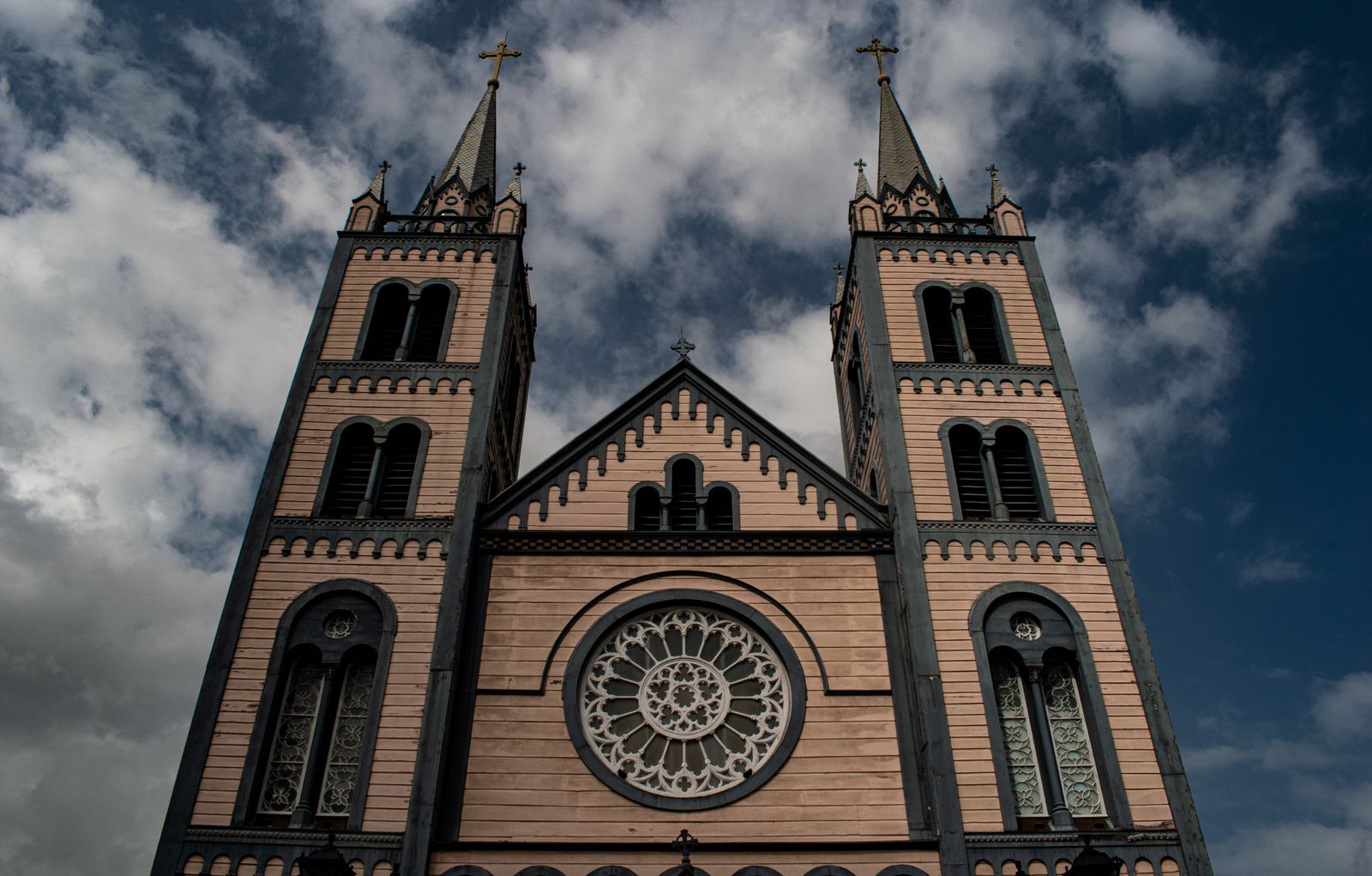
The UNESCO-listed capital is built entirely of tropical hardwood — an extraordinary colonial streetscape of 17th and 18th-century Dutch buildings in vivid yellow, white and green. The Saint Peter and Paul Cathedral (1885) is the largest wooden building in the Western Hemisphere. The Waterkant waterfront and the historic Fort Zeelandia combine Dutch colonial architecture with a vivid multicultural street life found nowhere else in South America.
A UNESCO Natural World Heritage Site covering 1.6 million hectares of pristine Amazon rainforest — one of the largest protected wilderness areas on earth. Accessible by small plane from Paramaribo, the reserve shelters jaguars, giant river otters, harpy eagles and over 400 bird species in an intact ecosystem of extraordinary richness.
The Saramaka and other Maroon communities living along the Upper Suriname River maintain a culture of West African origin — their wood-carving, textile (pangi cloth), boat-building and spiritual traditions preserved from 17th-century Africa with extraordinary continuity. Village visits by dugout canoe are the most culturally profound experience Suriname offers.
Indian-Surinamese flatbread with curried potato and chicken) served at roadside shops is the national street food.
a baked casserole of grated tayer root and salted chicken — a Jewish-Surinamese Sephardic recipe of extraordinary depth) is the Sunday celebration dish. Javanese
stir-fried noodles), Chinese dim sum and Creole
mixed meat and rice) all coexist on the same street.
Suriname’s national lager, brewed in Paramaribo since 1956 — a golden, moderately strong pale lager that is the default drink at every snackbar, rum shop and waterfront restaurant. The most recognisable product of the Surinam Brewery.
Javanese coconut milk drink) are the drinks of Paramaribo.
Johan Adolf Pengel International (PBM), 45km south of Paramaribo, is the main airport. SLM (Surinam Airways) and Caribbean Airlines serve the main routes. Amsterdam is the primary European gateway. For trip planning, see the official Suriname tourism portal.
💡 Amsterdam is the only European city with direct connections to Paramaribo — both KLM and SLM operate AMS–PBM direct, reflecting Suriname’s status as a former Dutch colony with a large diaspora in the Netherlands.
💡 Miami is the main US gateway (4h30 direct). Trinidad (1h30) is the natural Caribbean combination. Guyana (Georgetown to Paramaribo is 3h by road — the most interesting overland approach).
💡 The Johan Adolf Pengel airport is 45km from Paramaribo centre — public bus from the junction (1h, SRD 5) or taxi (50 min, US$20–35). The historic city centre is compact and walkable.
💡 Suriname has virtually no roads south of the coastal strip — 80% of the country is accessible only by river. All interior tours require a boat and a guide. Car hire (US$40–80/day) is useful for Brownsberg and coastal destinations.
February to April and August to November are the drier seasons — the jungle interior accessible, the Marowijne River navigable, Paramaribo’s outdoor life pleasant. August to November is the best window: the forest floor drier, wildlife more concentrated around water, and the Atlantic coast leatherback turtle nesting at its peak (March–August).
Suriname is moderately priced — Paramaribo is affordable, but interior jungle tours require a guide and boat. The Surinamese Dollar (SRD) is the currency; USD is widely accepted.
Pom — a Surinamese dish of tayer root (Xanthosoma sagittifolium, a tropical tuber with a fibrous, slightly acidic flavour) grated and baked with chicken, tomatoes and citrus in a clay dish — is considered the national dish.
Borgoe rum (Surinamese dark rum, produced from Surinamese sugar cane since 1965, aged 3&ndash)
Awarradam Lodge (deep in the Central Suriname Nature Reserve, accessible only by boat, with private jungle cabins, canopy walks and guided wildlife research) is the finest eco-lodge in Suriname &mdash.
Paramaribo for two days, the Brownsberg Nature Reserve for one, the Central Suriname Nature Reserve for two, the Marowijne River for one, the Atlantic coast for one. Suriname — South America’s smallest country and most ethnically diverse — is one of its most surprising.
Paramaribo — the capital, with a UNESCO World Heritage historic city centre of 17th–18th century Dutch colonial wooden architecture (unique in the Americas — the entire city centre is built of painted wood, not stone), the Saint Peter and Paul Cathedral (1885, the largest wooden church in the Western Hemisphere), and the Hindu temples, mosques and synagogue within 500m of each other — a living demonstration of Suriname’s extraordinary multiculturalism.
💡 Suriname is the only country in the Americas with Dutch as the official language (apart from the Netherlands Antilles). Its population is a unique mix: Hindustanis (Indian indentured labourers, 27%), Maroons (descendants of escaped African slaves who established free communities in the interior, 22%), Creoles (21%), Javanese (Indonesian indentured labourers, 14%), Chinese, Indigenous Amerindians and Dutch settlers. No single group is a majority.
The Centrale Markt (the most ethnically diverse market in South America — Javanese noodle stalls, Hindustani roti shops, Maroon wood carvings, Chinese grocery stores and Dutch bakeries all within 200m) and the Stichting Volkslectuur Suriname — the museum of Surinamese folk art with the finest collection of Maroon woodcarving and textile art outside the Smithsonian.
💡 The Maroons of Suriname are descendants of West African slaves who escaped Dutch plantations in the 17th and 18th centuries and established independent communities in the interior jungle — the largest free Black communities in the Americas at the time. They signed peace treaties with the Dutch colonial government in 1762 (the Ndyuka) and 1762–1767 (the Saramaka), preserving their independence. Their woodcarving and textile traditions are among the most sophisticated in the Americas.
90km from Paramaribo. Brownsberg Nature Reserve (8,400 hectares on a 450m plateau above the Brokopondo Reservoir, the largest artificial lake in the Americas by area) — howler monkeys, 8 primate species, 450+ bird species and the plateau edge viewpoint over the lake (a flooded landscape of dead tree stumps stretching to the horizon).
💡 The Brokopondo Reservoir (created by the 1964 Afobaka Dam, flooding 1,500km² of forest and displacing 6,000 Saramaka Maroons) is the largest artificial lake in the Americas by surface area. The submerged trees are still standing after 60 years — the lake is called the “sea of death” locally. The reservoir provides 40% of Suriname’s electricity.
5h boat from Atjoni via the Suriname River. The Central Suriname Nature Reserve (UNESCO World Heritage Site, 1.6 million hectares of pristine equatorial rainforest — 5,000+ plant species, 680+ bird species, giant river otters, jaguars — one of the largest protected areas in South America with no roads and no resident population).
💡 The Central Suriname Nature Reserve was inscribed by UNESCO in 2000 as one of the world’s greatest remaining intact tropical ecosystems —1.6 million hectares with no logging, no agriculture and no roads, accessible only by river. It contains the source headwaters of four major Surinamese rivers and is home to species still being discovered by science.
A full day in the reserve — canopy tower birding at dawn (harpy eagles, giant anteaters, peccaries and the extraordinary biodiversity of undisturbed Amazonian forest), a dugout canoe exploration of the forest rivers and a night walk (red-eyed tree frogs, caiman, tapir tracks and the nocturnal forest entirely transformed by torchlight).
💡 The harpy eagle (Harpia harpyja — the largest and most powerful eagle in the Americas, with talons the size of a grizzly bear’s claws, capable of carrying prey up to 7kg) is the apex aerial predator of the South American rainforest and is reliably found in the Central Suriname Nature Reserve. It nests in the forest canopy and hunts sloths and monkeys.
3h from Paramaribo by boat. The Marowijne River (the border with French Guiana) — Maroon communities of the Ndyuka and Saramaka people in villages accessible only by river, where the men practice the most sophisticated woodcarving tradition in the Americas (geometric abstract motifs in hardwood, carved with machetes and chisels).
💡 The Ndyuka Maroon woodcarving tradition produces objects of extraordinary geometric complexity — chairs, paddles, combs, trays and ritual objects covered in interlocking diamond, spiral and chevron patterns, each design unique to the carver’s family lineage. The tradition has been maintained in the jungle since the 17th century with no contact with West African sources; it represents an entirely New World development.
3h30 from Paramaribo by boat. Galibi Nature Reserve (the Atlantic coast of Suriname, where leatherback sea turtles (Dermochelys coriacea) nest March–August in the largest Atlantic nesting population on the continent) — one of the most important leatherback nesting sites in the world, with up to 30 nests per night at peak. Fly from Johan Adolf Pengel (PBM).
💡 The Surinamese Atlantic coast (Galibi and Matapica) hosts one of the three largest leatherback turtle nesting populations in the world, alongside Trinidad’s Grand Riviere and French Guiana’s Awala-Yalimapo. Leatherbacks travel from Suriname to Arctic feeding grounds — a round trip of 12,000km — before returning to the same beach to nest.
Visa required for most nationalities but e-visa available online. Tourist card on arrival for some nationalities.
Connected to Amsterdam (KLM direct), Miami, Bogota and regional Caribbean hubs.
Suriname has communities of South Asian, Javanese, African, Chinese, Lebanese, Indigenous and Dutch descent. Paramaribo’s colonial centre is UNESCO-listed.
The SRD has experienced high inflation. USD and Euro exchangeable at banks. Carry local currency for markets and taxis.
The Surinamese interior (Maroon villages, Brownsberg Nature Park, Raleigh Falls) requires organised tours, as roads give way to rivers. Organised multi-day tours are the best approach.
Dutch is official; Sranan Tongo (a creole language) is widely spoken. English is understood in Paramaribo and tourist areas.
Most jungle destinations require light aircraft from Johan Adolf Pengel Airport. Boat travel up the Suriname River is possible but slow.
— Main mobile provider; SIM cards available at the airport.
Free— Good in Paramaribo; limited in the interior. Download offline maps.
FreePoint your camera at menus, signs or street text for instant translation. Download the language pack offline before you arrive for full use without data.
FreeReal-time and offline exchange rates for all world currencies — converts prices instantly so you always know what you are paying in your home currency.
FreeFind and book hotels, guesthouses and apartments with free cancellation on most rates — one of the widest selections of accommodation worldwide.
FreeBrowse millions of traveller reviews for restaurants, attractions and hotels — helps identify the best local spots and avoid tourist traps.
FreeSuriname sits within easy reach of several other destinations — each with a completely different character.


