ZW
Zimbabwe
Victoria Falls, Hwange elephants & Great Zimbabwe ruins
Victoria Falls, Hwange elephants & Great Zimbabwe ruins
Zimbabwe is one of Africa’s most rewarding and underrated destinations — a country of wildlife, dramatic landscapes and the ruins of a great African civilisation, currently experiencing a tourism renaissance after difficult decades. Victoria Falls — the largest waterfall in the world by combined width and height — is one of the Seven Natural Wonders, a thundering curtain of water 1,708 metres wide that throws permanent rainbows and can be heard from 40 kilometres away. Hwange National Park has one of the largest elephant populations on earth. Great Zimbabwe, the ruined stone city that gave the country its name, was the capital of a medieval African empire controlling the gold trade between the Limpopo and Zambezi rivers.
The world’s largest waterfall — 1,708 metres wide and dropping up to 108 metres — creates a permanent mist cloud visible from space. The Zimbabwean side offers the best full-frontal views along the rainforest trail; the Zambian side allows swimming in the Devil’s Pool at the very lip during dry season. The Falls are at their most powerful (and obscuring) February–April; the most photogenic October–December.
Zimbabwe’s largest national park and one of Africa’s greatest elephant sanctuaries, with a population estimated at 40,000–45,000. Hwange’s waterholes during dry season (Jul–Oct) concentrate elephants, lions, leopards, wild dogs (one of Zimbabwe’s strongest populations) and buffalo in great density. Self-drive and guided safaris are both possible.
A UNESCO World Heritage Site — the ruins of a 14th-century stone city that was once sub-Saharan Africa’s largest settlement outside Ethiopia. The Great Enclosure’s dry-stone walls, built without mortar to heights of 11 metres, remain one of the most impressive architectural achievements of medieval Africa. The site controlled the Zimbabwe Plateau’s gold and cattle trade.
A UNESCO World Heritage Site on the Zambezi floodplain where elephants stand on their hind legs to reach acacia pods, hippos laze in oxbow pools and canoe safaris bring visitors face-to-face with Africa’s megafauna. Walking safaris with armed guides are offered — the most intimate wildlife experience in Africa.
a thick maize porridge eaten with one hand and used to scoop stews of beef, goat, chicken or dried fish.
Braai (BBQ) is central to Zimbabwean social life — beef, goat or game meat grilled over an open wood fire, served with roasted mealies (corn cob) and tomato relish. Nyama means “meat” in Shona; a good braai is the apex of Zimbabwean hospitality.
Sun-dried or fried caterpillars of the Gonimbrasia belina moth, harvested from mopane trees in Matabeleland and the Midlands — crunchy when fried with onion and tomato, chewy when dried. A high-protein traditional food eaten across southern Africa.
leafy greens with peanut butter) form the authentic Zimbabwean meal. Game meat — warthog, kudu, impala — appears on menus at safari lodges and adds a distinctly African dimension. Zimbabwe produces surprisingly good wine in the Eastern Highlands and
Zimbabwe’s definitive beer, brewed since 1898 and surviving every economic upheaval. The golden lager is drunk cold at sports clubs, bush camps and city bars throughout the country.
Victoria Falls (VFA) and Harare (HRE) are the main international airports. Bulawayo (BUQ) serves southern Zimbabwe. Ethiopian Airlines and Kenya Airways provide the strongest international connections. For trip planning, see the official Zimbabwe tourism portal.
Johannesburg is the primary gateway for Zimbabwe — Airlink connects JNB to VFA (2h) and HRE (1h45) daily.
Combining Victoria Falls with Botswana (Kasane is 1h30 from VFA) and Zambia (Livingstone is 10 minutes by bridge) is the classic southern Africa circuit.
Victoria Falls town is walkable — the falls entrance, the bridge and the main street are all within 2km. Shared shuttles to Hwange (2h) run daily from the main tour operators and are the most practical transport.
Zimbabwe’s roads are generally good between major cities on the main routes (VFA to Hwange, Bulawayo to Harare). Self-drive is possible in a standard car on tar roads; 4WD is needed inside national park tracks.
May to October is the dry season — Victoria Falls at manageable levels (peak flow March–May can obscure the view with spray), Hwange game viewing excellent as wildlife concentrates at waterholes. June and July are cool and ideal. The wet season (November–April) brings lush green landscapes and newborn animals.
📅 Zimbabwe is in its best season in April, May, June, July, August, September, October. See where else is good to go in those months, or browse where to go by month.
Zimbabwe uses USD as its primary currency (the Zimbabwean dollar has had multiple collapses; USD is universally accepted). Prices are moderate by southern African standards — comparable to Zambia, less expensive than Botswana.
The Zimbabwe National Parks fee for Victoria Falls is US$30 per person (the most affordable entry to one of the world’s greatest natural wonders).
White-water rafting on the Zambezi (Grade 4–5 rapids below Victoria Falls, 25 rapids in 25km, the finest one-day white-water run in the world) costs US$110–130 for a full day including all equipment and a riverside lunch.
The Elephant Camp (above Victoria Falls gorge) and Singita Pamushana (Malilangwe Wildlife Reserve, the most exclusive property in Zimbabwe at US$1,200–2,000pp/night) represent the country at its most refined.
Victoria Falls for two days, Hwange National Park for two, Lake Kariba for one, Matobo Hills for two. Zimbabwe contains some of the most striking landscapes in Africa — Victoria Falls, Hwange and Matobo are among the continent’s finest.
Victoria Falls (Mosi-oa-Tunya, “the smoke that thunders”, UNESCO World Heritage Site) — 1.7km wide, 108m high, the largest waterfall by volume in the world — is audible from 40km away and visible from 50km as a permanent column of spray. The footpath through the rainforest on the Zimbabwean side gives views of all five distinct falls.
Victoria Falls produces so much spray that a permanent rainforest grows on the gorge rim directly opposite — the only rainforest in the area, fed entirely by the waterfall mist. In peak flow (April–May) the spray is so dense that the falls themselves are invisible. The dry season (August–October) gives the clearest view.
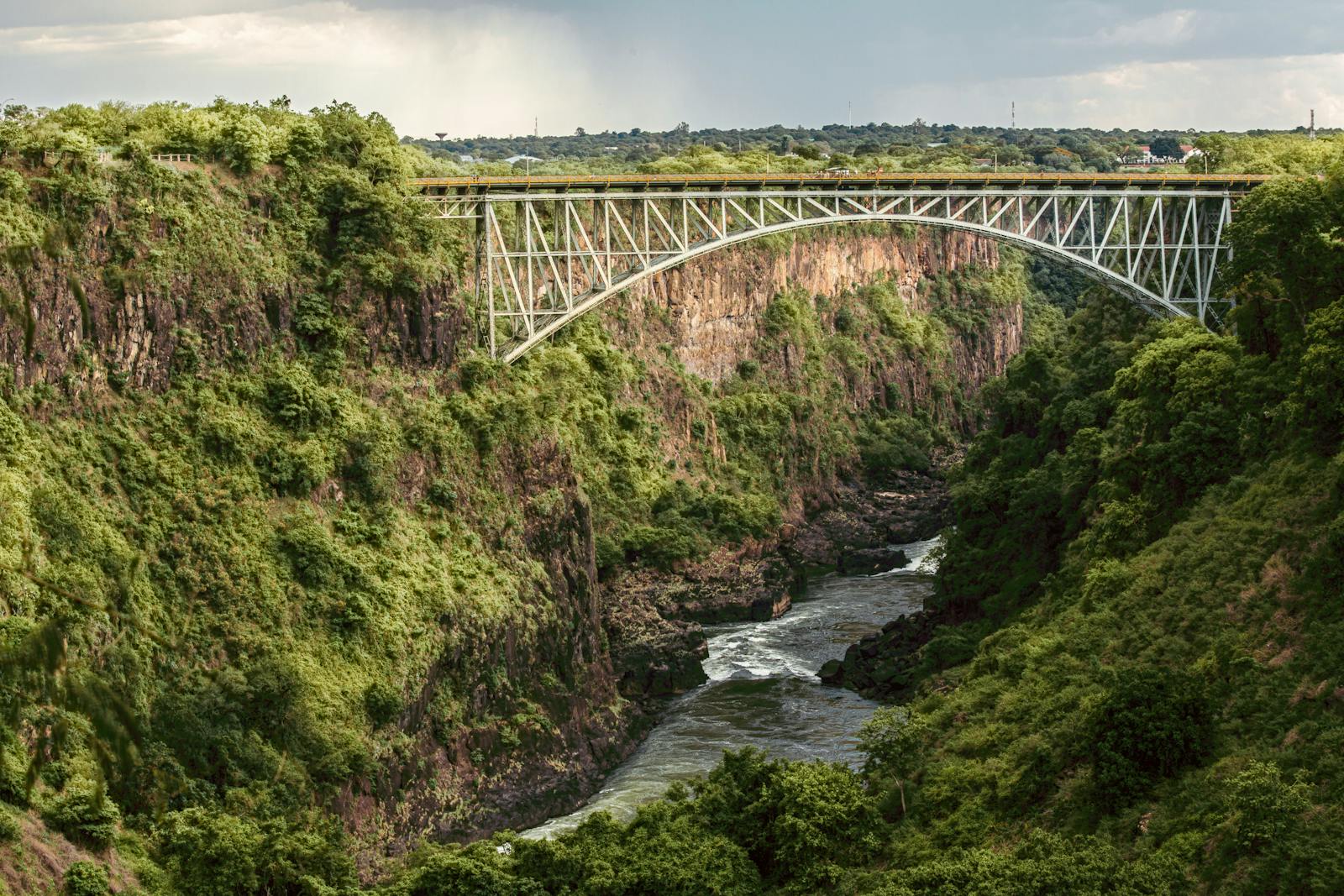
The Victoria Falls Bridge bungee jump (111m, the highest commercial bungee in Africa, with the Zambezi gorge below and the spray of the falls alongside) and the Devil’s Pool — a natural rock pool at the lip of the main falls where swimmers can lean over the edge during the low-water season (September–January).
The Devil’s Pool sits on the Zambian side of the falls (accessible by boat from Livingstone) — a submerged rock barrier allows swimmers to lie at the very edge of Victoria Falls and look 108m straight down to the gorge below. Only accessible in low water season (September–December). An extraordinary and alarming experience.
2h from Victoria Falls. Hwange National Park (14,600km², Zimbabwe’s largest park) — artificial waterholes pumped from underground allow year-round game viewing that concentrates herds of 100–200 elephants in the dry season. Sable antelope, wild dog and the largest population of lions in Zimbabwe.
Hwange has no permanent natural water — the wildlife depends entirely on artificial waterholes pumped since 1969. Approximately 45,000 elephants use the park (the largest single concentration of elephants in Africa), drinking 200 litres per elephant per day from the pumped holes.
Walking safari with an armed ranger — the closest possible wildlife experience, on foot at 10–30m from elephants, giraffe and buffalo. Full-day 4WD game drive through the main Hwange circuits (Main Camp, Sinamatella, Robins) for lion, cheetah and the dry-season concentrations of game.
Hwange wild dogs (painted wolves) are among the most endangered large carnivores in Africa — approximately 120 individuals in the park. The Painted Wolf Foundation works directly with local communities in the Hwange corridor. Hwange has one of the most stable and well-studied wild dog populations on the continent.
4h from Hwange. Lake Kariba (5,580km², created by the Kariba Dam in 1959, one of the largest man-made lakes in the world) — houseboat safaris on the lake with elephants drinking from the shore, tiger fishing (the most aggressive freshwater fish in Africa), and the sunsets over the Matusadona mountains.
Operation Noah (1959–1964) rescued 6,000 animals stranded on islands as the Kariba reservoir filled — one of the largest wildlife rescues ever attempted. Elephants were towed behind boats; black rhinoceroses sedated and transported. The operation is documented in the book “Noah’s Flood” by Rupert Fothergill.
6h from Kariba or 4h from Bulawayo. Matobo National Park (UNESCO World Heritage Site) — a 3,100km² landscape of granite domes (balancing rocks, some 50m high, balanced on points no larger than a dining table) with San Bushman rock art in hundreds of caves and Cecil Rhodes’ grave on World’s View.
The Matobo “World’s View” — a smooth granite dome with views 360 degrees over the boulder landscape — is where Cecil Rhodes asked to be buried in 1902. The grave is still there. A choice by a man who shaped an entire continent, buried in an ancient African landscape above the treeline.
Walking rhino tracking in Matobo — black and white rhinoceros in a landscape of granite boulders, tracked on foot with an armed ranger. The Nswatugi Cave (the finest San rock paintings in Zimbabwe, 2,000-year-old giraffes and hunting scenes in red ochre, still vivid). Fly from Bulawayo (BUQ) or Victoria Falls (VFA).
Matobo has the highest density of vervet monkeys, leopards and black eagles (Verreaux’s eagle, the largest eagle in Africa) in the world. The combination of San rock art from 2,000 years ago and rhinos walking past the caves at dawn is entirely unique.
Visa on arrival or KAZA Uni-Visa (covers both Zimbabwe and Zambia) available at Victoria Falls. E-visa also available online.
After hyperinflation in 2008-2009 Zimbabwe adopted the USD. The ZiG gold-backed dollar launched in 2024, but USD is still widely accepted. Carry small bills.
The Kavango-Zambezi Uni-Visa (USD 50) allows entry to Zimbabwe and Zambia on a single visa — useful for crossing at Victoria Falls.
Game viewing in Hwange and Mana Pools is best during the dry season when animals concentrate around waterholes.
USD is the dominant currency for tourists. Carry cash as card facilities are limited outside major hotels.
Zimbabwe’s national parks charge USD entry fees. Mana Pools and Hwange walking safaris are among Africa’s best value premium experiences.
Quick answers to the questions people most often ask before visiting Zimbabwe.
May to October is the dry season — Victoria Falls at manageable levels (peak flow March–May can obscure the view with spray), Hwange game viewing excellent as wildlife concentrates at waterholes. June and July are cool and ideal.
Victoria Falls (VFA) and Harare (HRE) are the main international airports. Bulawayo (BUQ) serves southern Zimbabwe. Ethiopian Airlines and Kenya Airways provide the strongest international connections.
Expect roughly US$60–100 a day on a budget and US$200–400 mid-range, or US$600+ for a more luxurious trip, per person and excluding flights.
Zimbabwe uses the US dollar (US$).
Plug types: Type D / G (240V).
— Wildlife identification app excellent for Hwange and Mana Pools game viewing.
Free— Good coverage in major towns; offline maps essential for national parks.
FreePoint your camera at menus, signs or street text for instant translation. Download the language pack offline before you arrive for full use without data.
FreeReal-time and offline exchange rates for all world currencies — converts prices instantly so you always know what you are paying in your home currency.
FreeFind and book hotels, guesthouses and apartments with free cancellation on most rates — one of the widest selections of accommodation worldwide.
FreeZimbabwe sits within easy reach of several other destinations — each with a completely different character.


