SZ
Eswatini
Last absolute monarchy, Reed Dance & highveld wilderness
Last absolute monarchy, Reed Dance & highveld wilderness
Eswatini (formerly Swaziland) is one of Africa’s smallest countries and the world’s last absolute monarchy — a tiny, landlocked kingdom surrounded by South Africa and Mozambique with a proud cultural tradition, mountain and valley scenery and warm, accessible people. The Reed Dance (Umhlanga) held each August–September, when thousands of young women present cut reeds to the Queen Mother, is one of Africa’s greatest cultural spectacles. Hlane Royal National Park has recovering rhino, elephant and lion populations; Malolotja Nature Reserve offers hiking through intact highveld. Swazi craft — particularly hand-blown glass, textiles and candles — is among Africa’s finest.
The largest protected area in Eswatini, Hlane has recovering populations of white rhino, elephant and lion. Self-drive game viewing is possible; guided night drives reveal leopard, hyena and civets. The park is smaller and more intimate than South Africa’s reserves but good value and wild.
A wilderness of intact highveld, mountain streams and ancient rock formations with hiking through one of the most biodiverse highland ecosystems in southern Africa. Black eagles, bald ibis and the rare blue swallow nest here. The Malolotja rope bridge is a dramatic 100-metre suspension crossing above a gorge.
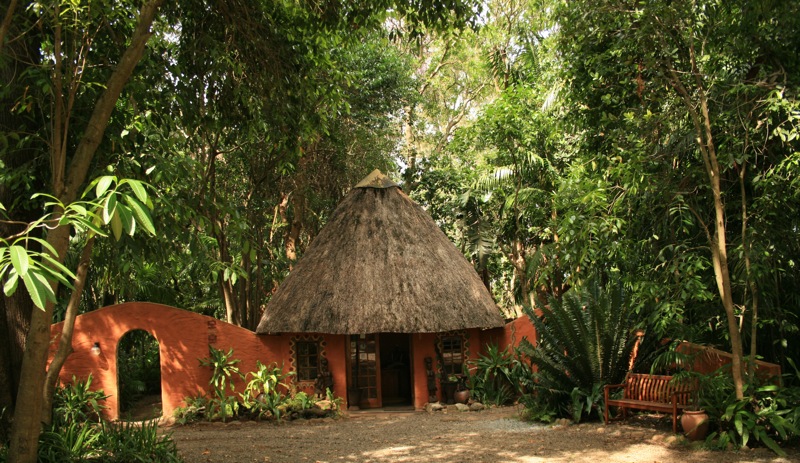
A living cultural village near Ezulwini demonstrating traditional Swazi architecture, music, dance and daily life. The Ligugu Lemaswati cultural village and the Mlilwane Wildlife Sanctuary adjoining it make the Ezulwini Valley the cultural and tourist heart of the country.
Eswatini (Wikipedia) →A thick porridge of ground sorghum or maize, cooked until very stiff and eaten with umhluzi (sauce) or vegetables — the traditional staple of Eswatini, with a slightly fermented, earthier flavour than maize-only porridge. Eaten at every traditional gathering.
Fermented milk, eaten with maize or sorghum porridge.
Grilled lamb and beef are common at restaurants and gatherings; braai (barbecue) culture is shared with South Africa.
A thick, slightly sour traditional beer brewed from fermented sorghum and maize — drunk in a calabash or communal pot at weddings, funerals and ancestral ceremonies. Cloudy, low-alcohol and deeply cultural; the act of brewing it is as important as drinking it.
The local lager, named after the huge granite dome near Mbabane. The Malkerns Valley has well-known craft centres.
King Mswati III International Airport (SHO) near Manzini handles regional connections via Airlink from Johannesburg. The main entry routes are overland from South Africa. For trip planning, see the official Eswatini tourism portal.
Johannesburg (50 min, Airlink daily) is the only practical air gateway. Most international visitors fly into JNB and either connect to SHO or drive into Eswatini (3h from Johannesburg).
Driving from Johannesburg (3h) is the most popular approach — the Oshoek/Ngwenya border crossing is the smoothest and most commonly used. Eswatini combines naturally with Kruger Park (2h) or the Drakensberg.
King Mswati III Airport (SHO) is near Manzini, 40km from Mbabane. Most lodges offer transfers; a taxi costs SZL 100–300.
A hire car (SZL 400–800/day) is recommended for self-drive visits to Hlane and Mlawula. Mkhaya requires the official Land Rover transfer from the meeting point — private vehicles are not permitted inside the reserve.
May to September is the best window — cool and dry (15–22°C), the bush open, game-viewing excellent and the Incwala ceremony in December–January and the Umhlanga Reed Dance in August–September are the most celebrated cultural events. October to April is hotter (20–30°C) and wetter, with lush green landscapes.
📅 Eswatini is in its best season in April, May, June, July, August, September. See where else is good to go in those months, or browse where to go by month.
Eswatini uses the Swazi Lilangeni (SZL, pegged 1:1 to the South African rand ZAR; both accepted everywhere). It is one of the most affordable destinations in southern Africa.
Sishwala (a very thick maize porridge — the staple starch of Eswatini, firmer than pap, broken apart with the hands and dipped into stew — the defining Swazi food, eaten at every meal) costs SZL 20–60 at a local cook shop.
Hlane Royal National Park’s guided lion walk (an accompanied walk on foot near the lion enclosures with a ranger)
Mkhaya’s Stone Camp (an all-inclusive bush camp accessible only by Land Rover, with stone-walled tents open to the bush, no electricity, no fences and black rhino grazing outside the camp at night) is one of the most atmospheric wildlife.
Mbabane and Ezulwini Valley for one day, Mantenga for one, Hlane for one, Mlawula for one, Sibebe Rock for one, Mkhaya for one, cultural ceremony for one. Eswatini — Africa’s last absolute monarchy — has the world’s most extensive black rhino conservation reserve, the world’s largest exposed granite dome and the most striking traditional ceremonies in southern Africa.
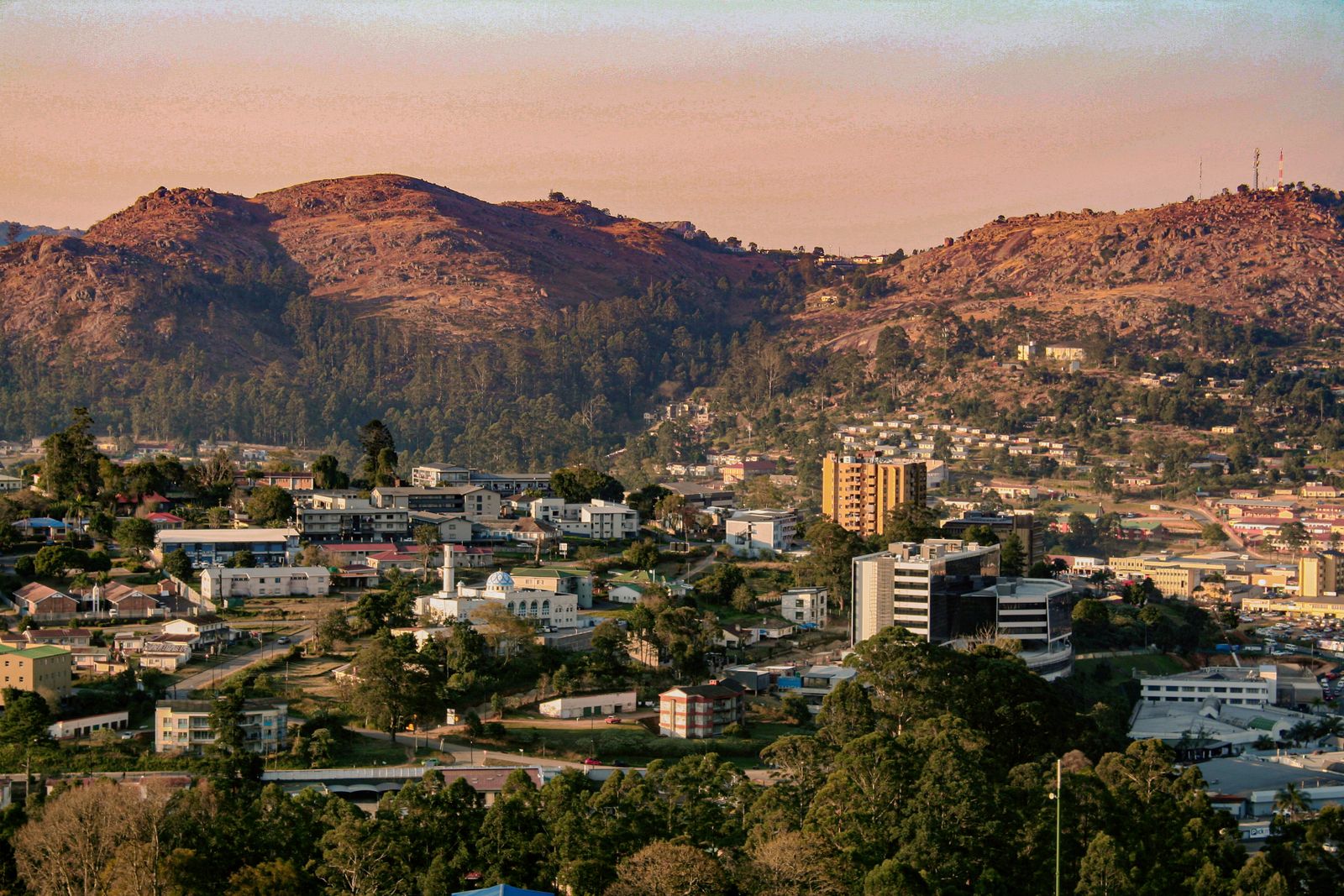
Mbabane — the administrative capital of Eswatini (formerly Swaziland, renamed in 2018 by King Mswati III — the last absolute monarchy in Africa, population 1.2 million, a landlocked kingdom entirely surrounded by South Africa and Mozambique) with the Swazi Market and the surrounding Ezulwini Valley — the Royal Valley between Mbabane and Manzini with the royal residences, traditional handicraft markets and the Mantenga Cultural Village.
Eswatini (renamed from Swaziland in April 2018 on the 50th anniversary of independence) is the last absolute monarchy in Africa. King Mswati III (crowned in 1986 at age 18, the world’s youngest head of state at the time) rules by decree; political parties are banned since 1973 under a state of emergency that has never been lifted. The country is simultaneously one of the world’s most severely HIV/AIDS-affected nations, with the highest HIV prevalence rate in the world at approximately 27% of adults.
The Mantenga Nature Reserve (the most accessible game reserve in Eswatini, with impala, warthog, crocodile and rock hyrax in the bushveld above the Lusushwana River) and the Mantenga Cultural Village (Ligugu Lemaswati — a living museum of traditional Swazi homestead architecture, where performers demonstrate the Sibhaca warrior dance — a complex rhythmic stomp dance in leopard-skin regalia — and the traditional cooking and craft-making).
The Sibhaca dance (a Swazi male warrior dance performed barefoot on beaten earth, using complex rhythmic patterns of stamping, jumping and ululating — the most physically demanding traditional dance in southern Africa) was originally performed at the royal court and at battles; it is now the most recognised cultural export of Eswatini and is performed internationally at cultural festivals.
Hlane Royal National Park (the largest protected area in Eswatini, 30,000 hectares in the hot lowveld — Eswatini’s premier game reserve with white rhino, elephant, lion, leopard and a large population of vultures) — on the former royal hunting grounds of the Swazi kings (Hlane means “wilderness” in siSwati — it was the personal hunting ground of King Sobhuza II before being converted to a conservation area).
Hlane Royal National Park was created from the personal hunting grounds of King Sobhuza II — the Swazi king who reigned for 82 years (1899–1982), the longest verified reign of any monarch in recorded history. Sobhuza II led Swaziland to independence from Britain in 1968 at the age of 69, having been king for 69 years. He is the central figure of modern Swazi national identity.
Mlawula Nature Reserve (a 16,500-hectare reserve on the eastern border with Mozambique, the most remote and wildest area in Eswatini — dense riverine forest along the Mlawula River, rocky granite outcrops, the finest birdwatching in the country with 350+ species including the rare Pel’s fishing owl and the African broadbill) and the Lubombo Mountains (the 600m escarpment that forms the eastern edge of Eswatini).
Eswatini has the highest density of plant species per unit area of any country in sub-Saharan Africa — the intersection of three distinct biomes (the highveld Afromontane grassland, the middleveld bushveld and the lowveld savannah) creates exceptional botanical diversity in a small area. The Lubombo mountain range contains a number of plant species found nowhere else on earth.
Sibebe Rock (a 3,800 million-year-old granite dome rising 350m above the valley floor near Mbabane — the world’s second-largest exposed granite monolith after Australia’s Mount Woodroffe, and the largest in the world by surface area, with a guided hike to the summit taking 3–4 hours and providing panoramic views over the Ezulwini Valley and, on clear days, the skyline of Johannesburg 350km to the west).
Sibebe Rock (at 3,800 million years old, Precambrian granite formed in the Archean era — among the oldest exposed rock surfaces accessible to hikers anywhere on earth) is the world’s largest exposed granite dome by surface area. The walk to the summit requires rope assistance in places due to the steep, smooth granite slabs; a local guide is compulsory.
Mkhaya Game Reserve (the most exclusive and intimate game reserve in Eswatini — 10,000 hectares of thornveld, accessible only by guided Land Rover from a specific meeting point, with the highest density of black rhino in Africa, white rhino, elephant, buffalo, hippo, giraffe and sable antelope — founded by Ted Reilly, the conservationist who saved the black rhino in Eswatini from extinction in the 1970s).
Mkhaya’s black rhino population (one of the highest-density black rhino populations in Africa) was essentially created single-handedly by Ted Reilly (1938–2020), who established Big Game Parks in Eswatini and negotiated with King Sobhuza II to create protected reserves on royal land in the 1960s–1970s. When Reilly began, black rhino were virtually extinct in Eswatini; the current population of 30–40 animals represents a conservation success story.
The Incwala ceremony (the Kingship ceremony held over three weeks in December–January, the most sacred and private ceremony in Swazi culture, celebrating the king’s power and the first fruits of the harvest — the “Little Incwala” is partly open to visitors) or the Umhlanga Reed Dance (August–September — the largest annual event in Eswatini, when 50,000+ unmarried young women cut reeds from the Usutu River and present them to the Queen Mother, danced in traditional beaded regalia). Fly from Johannesburg (JNB) or Durban (DUR) via Eswatini Airlink (SHO).
The Umhlanga Reed Dance (the annual August–September ceremony where 40,000–80,000 unmarried young women and girls from across Eswatini travel to the royal palace at Ludzidzini to cut reeds and dance before the Queen Mother and King) is the largest single annual event in any African country — larger than most music festivals, entirely voluntary and deeply meaningful as a celebration of Swazi womanhood and respect for the royal family.
Visa-free for most nationalities including EU, UK, USA, Australia for stays up to 30 days.
Opens to international flights from Johannesburg. Eswatini is bordered entirely by South Africa (except one Mozambique border), making a South Africa road trip connection the most common approach.
The SZL is pegged 1:1 to ZAR. Both are accepted everywhere. Cards in larger towns; cash in rural areas.
Eswatini (formerly Swaziland) is governed by King Mswati III as the world’s last absolute monarchy in Africa. The Incwala and Umhlanga Reed Dance ceremonies in December and August respectively are impressive cultural spectacles.
The lilangeni is pegged 1:1 with the South African rand; rand is accepted everywhere.
Car hire from Mbabane or Manzini is recommended; the country is small (180km N-S) and driveable in a long day.
Quick answers to the questions people most often ask before visiting Eswatini.
May to September is the best window — cool and dry (15–22°C), the bush open, game-viewing excellent and the Incwala ceremony in December–January and the Umhlanga Reed Dance in August–September are the most celebrated cultural events. October to April is hotter (20–30°C) and wetter, with lush green landscapes.
King Mswati III International Airport (SHO) near Manzini handles regional connections via Airlink from Johannesburg. The main entry routes are overland from South Africa.
Expect roughly SZL 400–700 ( (about US$20–40)) a day on a budget and SZL 1,200–2,500 mid-range, or SZL 3,000+ for a more luxurious trip, per person and excluding flights.
Eswatini uses the Swazi Lilangeni (SZL).
Plug types: Type M (three-pin, 230V).
Point your camera at menus, signs or street text for instant translation. Download the language pack offline before you arrive for full use without data.
FreeReal-time and offline exchange rates for all world currencies — converts prices instantly so you always know what you are paying in your home currency.
FreeFind and book hotels, guesthouses and apartments with free cancellation on most rates — one of the widest selections of accommodation worldwide.
FreeBrowse millions of traveller reviews for restaurants, attractions and hotels — helps identify the best local spots and avoid tourist traps.
FreeEswatini sits within easy reach of several other destinations — each with a completely different character.