DM
Dominica
Nature Isle — boiling lake, champagne reef & volcanic wilderness
Nature Isle — boiling lake, champagne reef & volcanic wilderness
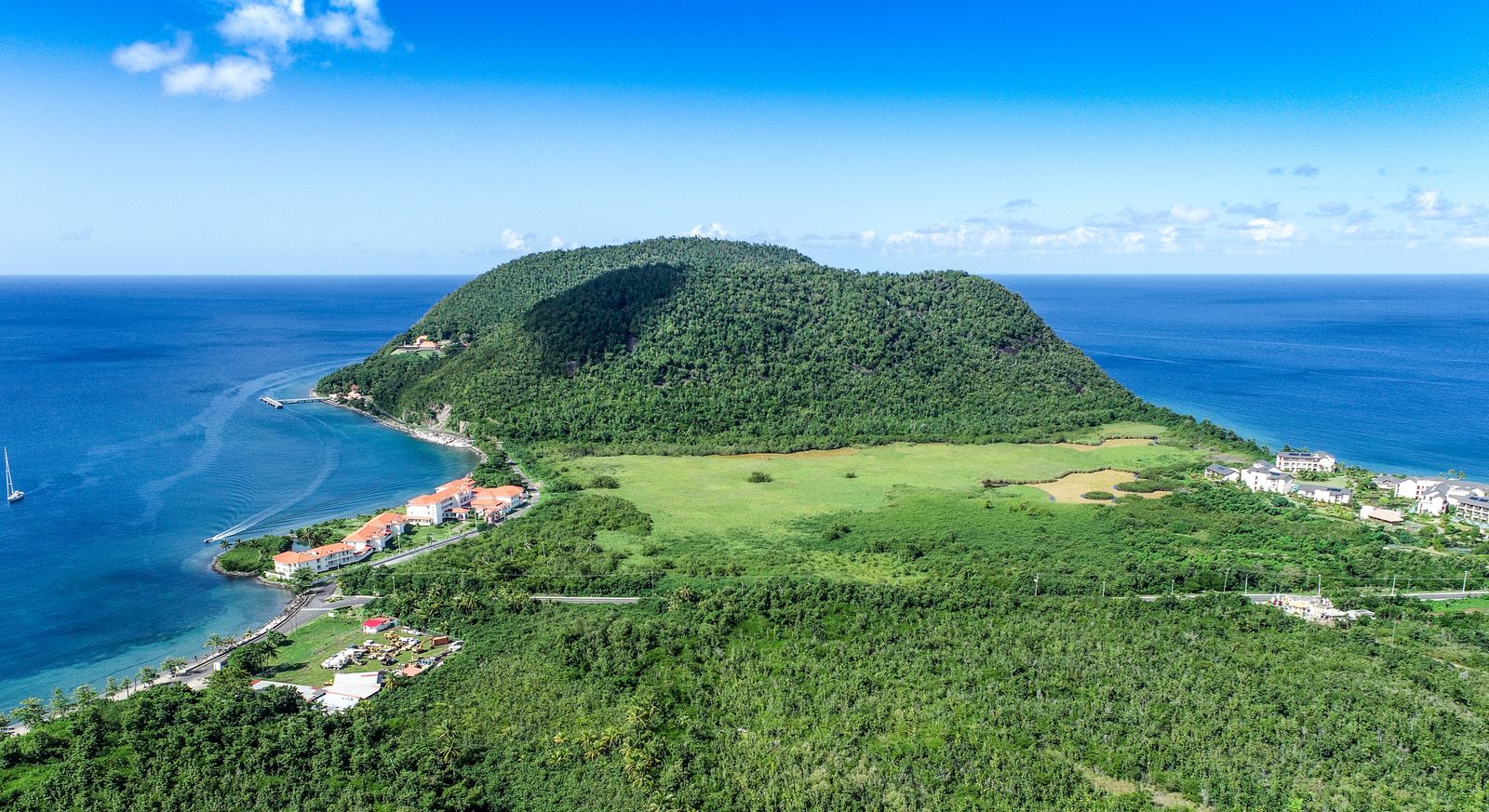
Dominica is the “Nature Isle of the Caribbean” — a volcanic island so rugged, forested and undeveloped that Christopher Columbus reportedly said he could still recognise it from his 1493 visit. This is the least touristy and most dramatically natural island in the Caribbean — no flat beaches, no mega-resorts, no cruise ship crowds — just 750 metres of vertical volcanic relief covered in rainforest, hot springs, rivers, waterfalls and the world’s second-largest boiling lake. The Titou Gorge, where a river runs through a narrow slot canyon to a bubbling hot spring, is one of the Caribbean’s most striking natural features. Dominica’s whale watching (resident sperm whales year-round) and diving on the Champagne Reef (a volcanic hot spring venting directly onto a coral reef, creating ‘champagne’ bubbles) are Caribbean firsts.
The world’s second-largest boiling lake — a 60-metre cauldron of bluish-grey water, constantly boiling and obscured by vapour, reached by a 6-hour hiking circuit through the Valley of Desolation (a geothermal landscape of fumaroles, sulphuric streams and alien-looking mineral deposits). One of the most striking hiking experiences in the Caribbean.
A unique snorkelling and diving experience: a volcanic hot spring vents carbon dioxide bubbles directly onto a shallow coral reef, creating “champagne” streams of warm bubbles rising through the fish and coral. The warm, clear water and geological activity make Champagne Reef unlike any other reef in the Caribbean.
A narrow slot canyon where a river flows between volcanic walls to a hot spring pool at the far end — the approach requires swimming through cool dark water to reach the warm pool in a cathedral of rock. Used as a filming location in Pirates of the Caribbean. One of the Caribbean’s most intimate natural experiences.
The Caribbean’s last indigenous people, the Kalinago (formerly known as Caribs), have a 3,700-acre territory on Dominica’s eastern coast where traditional craft, canoe-building and cultural practices are maintained. The Kalinago Barana Auté model village demonstrates traditional architecture and the history of the island’s original inhabitants.
Dominica (Wikipedia) →Despite the name, a giant frog (crapaud) that was once the national dish; it is now critically endangered and protected, so it should not be eaten.
Freshwater crayfish from Dominica’s many rivers, stewed with garlic and thyme or grilled.
A thick green soup of dasheen leaves, okra, crab and coconut milk — a Sunday lunch favourite.
The breadfruit tree grows throughout Dominica’s lush interior — roasted whole over an open fire, boiled in coconut milk, fried as chips or cooked alongside saltfish. A taste of the island’s Carib and African culinary heritage, available year-round.
Tilapia and other river fish, plus roasted breadnut, are country-kitchen staples. Fresh soursop, passion fruit and carambola juices are everywhere.
Dominica’s own lager, brewed on the island.
Rum from the small Macoucherie estate distillery on the west coast.
Douglas-Charles Airport (DOM) on the northeast coast and Canefield (DCF) near Roseau are both small airports; most visitors connect through Barbados, Antigua or St Maarten. For trip planning, see the official Dominica tourism portal.
All flights to Dominica require a connection through another Caribbean island — there are no long-haul direct services. Barbados, Antigua and St Maarten are the most useful hubs depending on your origin.
The fastest routes from Europe and North America route through Barbados (BGI) or Antigua (ANU). From France, Air France to Guadeloupe (PTP) then Air Antilles to Canefield (DCF) is the most direct.
Canefield (DCF) is the most convenient airport — 5 minutes from Roseau. Douglas-Charles (DOM) is newer and handles larger aircraft but requires 1h30 to reach Roseau.
The Boiling Lake hike (7–8h) is legal to do independently but a certified guide is strongly recommended — the trail is poorly marked in places and conditions change rapidly in the volcanic zone. All Dominica Nature Tour Guides are government-certified.
January to May is best — dry season, the diving at its best, the sperm whales year-round (Dominica has the world’s most reliable sperm whale population). June to November is the wet season with hurricane risk; Dominica was devastated by Hurricane Maria in 2017. July to September is wettest.
📅 Dominica is in its best season in February, March, April, May, June. See where else is good to go in those months, or browse where to go by month.
The Eastern Caribbean Dollar (XCD, approx 2.70 XCD = 1 USD) is the currency. Dominica is the most affordable English-speaking island in the Lesser Antilles.
Mountain chicken (Leptodactylus fallax — the giant ditch frog, the largest frog in the Lesser Antilles, native only to Dominica and Montserrat, called “mountain chicken” because it tastes like chicken when fried —)
Dominica is the most affordable island in the English Caribbean for eco-activities.
Secret Bay (a clifftop eco-resort above Dominica’s west coast, with private plunge pools on each villa deck overlooking the Caribbean and the whale waters below, from US&dollar)
Roseau for one day, Boiling Lake hike for one, whale watching for one, Titou Gorge for one, Kalinago Territory for one, Scotts Head diving for one, Trafalgar Falls for one. Dominica — the Nature Island of the Caribbean — has the second-largest boiling lake on earth, the world’s most reliable sperm whale watching and the last indigenous Caribbean territory.
Roseau — the capital of Dominica (the most mountainous Caribbean island, the “Nature Island”, 751km², 74,000 people — not to be confused with the Dominican Republic) — the smallest capital city in the Americas, with the Dominican Museum (in the old post office, covering the history of Dominica’s indigenous Kalinago people — the only pre-Columbian people in the Caribbean who were never conquered by Europeans — and the colonial and post-colonial periods) and the Old Market (where enslaved Africans were once sold).
The Kalinago people (the indigenous Caribbean people the Europeans called Caribs, who had displaced the earlier Arawak from the eastern Caribbean by the time of European contact) are the only pre-Columbian people in the Caribbean who were never completely conquered. They resisted British and French colonialism through military resistance throughout the 17th and 18th centuries; a Kalinago Territory of 1,500 hectares in the northeast of Dominica was established in 1903 and is the only legally recognised indigenous Caribbean territory in the world.
Boiling Lake — the second-largest naturally boiling lake in the world (a flooded fumarole on the edge of the Valley of Desolation, the hot volcanic centre of Dominica, where the water temperature ranges from 82–92°C and the lake is permanently shrouded in thick clouds of steam — reached by a 7–8 hour return hike through the Morne Trois Pitons National Park, one of the most striking hikes in the Caribbean).
The Boiling Lake hike (7–8 hours return from Laudat village, gaining 700m in elevation, passing through rainforest, volcanic fumarole fields, the hot Valley of Desolation and the cold Titou Gorge with its hot spring thermal pool) is the most demanding and rewarding day hike in the Caribbean. The lake is a flooded fumarole — the water is heated from below by volcanic activity and boils at the edges; the centre is at atmospheric boiling point (slightly below 100°C at altitude).
Dominica has the most reliable sperm whale population in the world — a resident clan of approximately 35 sperm whales (Physeter macrocephalus) that lives year-round in the deep waters off the west coast (the underwater slope drops to 1,000m within 5km of shore, providing ideal deep-foraging habitat for the world’s largest toothed predator). Morning boat tours from Roseau offer the highest success rate of any whale watching destination on earth.
Dominica’s resident sperm whale clan has been studied since 1984 by the Dominica Sperm Whale Project — one of the most intensive long-term cetacean studies in the world. Individual whales are identified by the markings on their flukes; the researchers have named and tracked over 35 individuals across multiple generations. The Dominican sperm whale clan is one of the most genetically distinct populations in the Atlantic.
Titou Gorge (a narrow basalt slot canyon near Laudat, filled with cold river water that mixes with a hot spring at the inner chamber — the starting point for the Boiling Lake hike, swimmable on the return — the gorge narrows to less than 2m, with 10m walls of black volcanic rock, the water alternating between cold river and warm volcanic spring) and the Middleham Falls (a 50m waterfall deep in the Morne Trois Pitons rainforest).
Titou Gorge featured in the opening sequence of Pirates of the Caribbean: Dead Man’s Chest (2006) and is the gorge through which the characters escape in the opening scene. The production chose Dominica for filming specifically because of the intact volcanic landscape and the gorge’s otherworldly character. The gorge is a short walk from the car park at Laudat and requires swimming in.
The Kalinago Territory — a 1,500-hectare reserve on the northeast coast of Dominica, home to the 3,000-strong Kalinago community (the last indigenous Caribbean people maintaining a territory), with the Kalinago Barana Autê cultural village (a recreation of a traditional Kalinago village on the clifftop above the Atlantic, with traditional cassava bread-making, basket weaving, canoe building and guided walks to the Isulukati Waterfalls).
Cassava bread (flatbread made from grated cassava root, the starch pressed out to remove the naturally occurring cyanide, then formed into discs and griddle-baked — the staple food of the Kalinago and all pre-Columbian Caribbean people for thousands of years before European contact) is still made in the Kalinago Territory using the same hand-grating and pressing method. The cassava press (the couleuvre or matapi — a woven tube that expresses the poisonous juice when stretched and twisted) is a unique Kalinago technology.
Scotts Head (the southern tip of Dominica — a dramatic peninsula where the Atlantic and Caribbean meet, with the finest shore-diving in the Caribbean at the Scotts Head Pinnacles — volcanic pinnacles rising from 30m to within 3m of the surface, covered in black coral, sea fans and sponges with schools of jacks and amberjack circling) and the village of Soufriere (a volcano-heated bay with black sand and hot water seeping from the beach).
Dominica has more dive sites per mile of coastline than any other Caribbean island — the volcanic topography creates a wide variety of underwater landscapes: walls, pinnacles, hot springs, fumaroles bubbling through the sea floor, and the Champagne Reef (a shallow dive site where volcanic gas bubbles continuously from the sea floor, creating an underwater champagne effect). Many dive sites are accessible directly from shore without a boat.
Trafalgar Falls (two waterfalls — “Father” (75m) and “Mother” (50m) — plunging into a cold rock pool 15 minutes from Roseau, surrounded by the rainforest of the Roseau Valley, with a natural hot spring thermal pool at the base of the Mother Falls accessible by scrambling over the rocks — the most visited attraction in Dominica) before departing from Douglas-Charles (DOM) or Canefield (DCF). Dominica was the first Caribbean island to receive “Blue Flag” ocean conservation certification.
Hurricane Maria (18 September 2017 — a Category 5 storm with 260km/h winds that struck Dominica directly, destroying 95% of all structures and all electrical infrastructure, damaging 100% of the island’s forest canopy and displacing 90% of the population) was the worst natural disaster in Dominica’s history and one of the worst in Caribbean history. Recovery took 3+ years; the island is now rebuilding specifically to become the world’s first climate-resilient country.
Visa-free for EU, UK, USA and most Commonwealth nationals.
Douglas-Charles Airport (DOM) handles turboprop aircraft; direct international flights don’t serve Dominica. Connect via Barbados, Puerto Rico or a fast ferry from Martinique or St Lucia.
Dominica is an island in the Eastern Caribbean — separate country from the Dominican Republic (Hispaniola). A very common mistake.
Called the Nature Isle of the Caribbean. 365 rivers, two boiling lakes, active volcanoes, rainforest. The Morne Trois Pitons National Park is UNESCO World Heritage.
No jet airport — propeller flights from Barbados, Martinique, Guadeloupe or St Maarten. A new international airport is under construction.
A guide is mandatory for the Boiling Lake hike — arrange through the Dominica Tourism Authority. The trail is unmarked in sections and weather changes rapidly.
Quick answers to the questions people most often ask before visiting Dominica.
Dominica has no long-haul jet service. Fly to a hub such as Barbados, Antigua, St Maarten or Guadeloupe, then take a short turboprop flight (30–45 minutes) to Douglas–Charles Airport (DOM) or Canefield. Ferries also link Dominica with Guadeloupe and Martinique.
No. Dominica is a small, English-speaking island nation in the Eastern Caribbean. The Dominican Republic is a separate, much larger country on the island of Hispaniola.
January to May, the dry season, is best for hiking and diving. June to November is the wet season with hurricane risk.
Yes — Dominica is one of the most reliable places in the world to see sperm whales, which live off its west coast year-round. Whale-watching trips run from Roseau.
A guide is strongly recommended for the Boiling Lake trail, a tough full-day hike through the Valley of Desolation to one of the world's largest boiling lakes. Arrange one locally before you go.
Point your camera at menus, signs or street text for instant translation. Download the language pack offline before you arrive for full use without data.
FreeReal-time and offline exchange rates for all world currencies — converts prices instantly so you always know what you are paying in your home currency.
FreeFind and book hotels, guesthouses and apartments with free cancellation on most rates — one of the widest selections of accommodation worldwide.
FreeBrowse millions of traveller reviews for restaurants, attractions and hotels — helps identify the best local spots and avoid tourist traps.
FreeDominica sits within easy reach of several other destinations — each with a completely different character.
Dominica is one of the world’s least-visited places. See all 90 in our guide to the world’s least-visited countries & territories.


