GL
Greenland
Cathedral icebergs, dog sledding & the world’s largest ice sheet
Cathedral icebergs, dog sledding & the world’s largest ice sheet
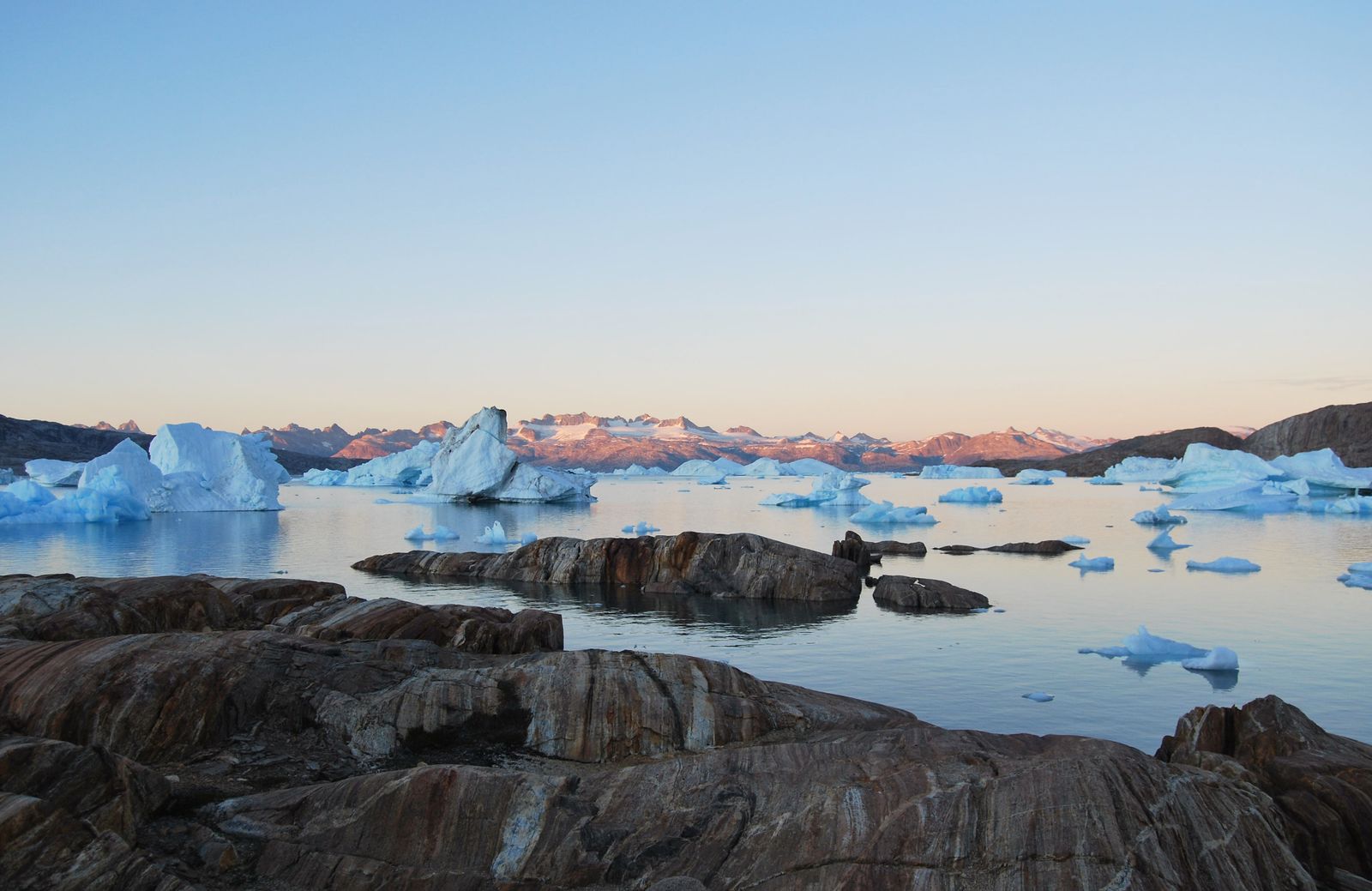
Greenland is the world’s largest island and one of its most dramatic destinations — an autonomous Danish territory of 2.1 million square kilometres, 80% covered by an ice sheet up to 3 kilometres thick, where icebergs the size of cathedrals calve from glaciers into fjords of incomparable grandeur. Ilulissat, on the west coast, sits at the mouth of the Sermeq Kujalleq glacier — the most productive glacier in the northern hemisphere, producing 10% of all Greenlandic icebergs, now a UNESCO World Heritage Site. The Greenlandic iceberg fjord, where icebergs too large to exit the fjord ground and wait for the current, is one of the world’s most awe-inspiring natural spectacles. The Inuit culture of the Greenlandic people — their relationship with dog sled, kayak, narwhal and northern lights — is one of humanity’s most striking adaptations to extreme environment.
The Sermeq Kujalleq glacier calves icebergs into the Ilulissat fjord at a rate of 20–40 metres per day, filling the fjord with monuments of blue-white ice that drift slowly north into Disko Bay. Hikes along the fjord rim reveal constantly changing iceberg panoramas; boat tours between the bergs at midnight sun illuminate their forms in golden light.
Greenland’s winter (January–April) offers two of the Arctic’s defining experiences — dog sledding across the sea ice with trained Greenlandic sled dogs (a tradition of practical necessity, now carefully maintained) and the northern lights over snow-covered tundra and fjord. The Greenlandic husky (larger and more powerfully built than other sledding breeds) is a cultural icon.
The world’s largest fjord system — Scoresby Sund on the remote east coast has icebergs, polar bears, musk oxen and the abandoned Norse settlement at Ittoqqortoormiit (one of the world’s most remote inhabited towns). Accessible only by helicopter or expedition ship.
A soup of seal, reindeer or whale meat with rice and onion — the national dish.
Raw beluga or narwhal skin with attached blubber — a traditional Greenlandic food and important source of vitamin C in the Arctic diet. Acquired taste; often offered to visitors at Greenlandic feasts.
Slow-cooked reindeer (tuttu) with crowberries and root vegetables — a winter staple.
A fish from Greenland’s fjords and rivers, served smoked or cured like gravlax.
Caught in the deep, cold fjords of West Greenland — among the finest halibut in the world, prized for its firm, white, butter-rich flesh. Smoked or pan-fried with a simple lemon butter sauce at Nuuk‘s best restaurants.
Nuuk (GOH) and Ilulissat (JAV) are the main airports. Air Greenland connects via Reykjavik (2h) or Copenhagen (4h). Greenland has no road connections between towns — all travel is by air, boat or dog sled. For trip planning, see the official Greenland tourism portal.
Copenhagen (4h) is the main gateway; Air Greenland operates daily connections. Reykjavik (2h) is the shortest crossing and makes the Greenland + Iceland combination very natural.
Greenland is closer to Canada than to Europe — the eastern coast is just 300km from Baffin Island. Most North Americans route via Reykjavik or Copenhagen.
Air Greenland is the only domestic carrier — booking well in advance is essential as capacity is tiny. Helicopter links connect the smaller settlements; some are only accessible by helicopter in winter.
There are no roads between Greenlandic towns; every journey is an expedition. Dog sledding in winter (January–April, when the sea ice is solid) is the classic Greenlandic experience — a tradition unchanged for 4,000 years.
June to August is prime — the ice sheet accessible, icebergs at peak in Ilulissat, humpbacks in Disko Bay, the midnight sun in full effect. July is warmest (12–16°C in the south). February to March offers Northern Lights, dog sledding and the return of light. September has aurora and the last of the summer boats.
📅 Greenland is in its best season in January, February, March, June, July, August. See where else is good to go in those months, or browse where to go by month.
Greenland uses the Danish krone (DKK). It is one of the most expensive destinations in the world due to the cost of importing everything; budget travel is very limited.
Suaasat — Greenland’s national dish (seal, whale or reindeer meat slow-cooked with rice and barley in a simple broth) — is the traditional food of Greenlandic hunters.
The Hotel Arctic in Ilulissat (directly overlooking the icefjord, the finest hotel in Greenland, with the world’s most dramatic breakfast view)
Private helicopter charters over the Ilulissat icefjord at sunset (DKK 3,000–8,000 per person) or onto the Greenland ice sheet are the most dramatic money-can-buy experiences in the Arctic.
Nuuk for two days, Ilulissat icefjord for two, Disko Island for one, East Greenland for one. Greenland — the world’s largest island, 80% covered by its ice sheet — is the most dramatic and least-visited destination in the North Atlantic.
Nuuk (65°N, population 19,000 — the world’s smallest national capital, on a rocky peninsula where two fjords meet the Davis Strait) — the National Museum of Greenland (the finest collection of Arctic archaeology anywhere: the Qilakitsoq mummies, 8 Greenlandic Inuit found perfectly preserved in a rock crevice in 1972, dating from 1475, with their clothing intact) and the old colonial district of Nuuk with its painted wooden houses.
The Qilakitsoq mummies — 8 Greenlandic Inuit individuals (6 women and 2 children) found in 1972 in a rock crevice near Uummannaq, preserved by Arctic cold and desiccation for 500 years — are the most important archaeological find in Greenland. Their clothing (complete sealskin and bird-skin garments) is the finest surviving example of Greenlandic Inuit tailoring.
Nuuk Fjord (one of the largest fjord systems in the world, extending 200km inland from the city) by kayak or zodiac — beluga whales and harbour porpoises in the outer fjord, the red gneiss cliffs of the inner fjord, sea eagles perching on cliff ledges and the silence of a fjord system entirely without roads or settlements beyond the capital.
Greenland has no road connections between its towns — all inter-settlement travel is by boat, helicopter or small aircraft. The total road network is approximately 150km (all within individual towns). The island’s interior is covered by the Greenland ice sheet (1.7 million km², the second-largest ice body on earth after Antarctica) which makes land connections impossible.
1h flight from Nuuk. Ilulissat (68°N, population 4,500) — the Ilulissat Icefjord (UNESCO World Heritage — the calving glacier Sermeq Kujalleq produces 10% of all Greenlandic icebergs, about 35 km³ of ice per year — the most productive glacier in the Northern Hemisphere, calving icebergs the size of skyscrapers that run aground in the shallow fjord and drift slowly into Disko Bay).
Sermeq Kujalleq (Jakobshavn Isbrae) is one of the world’s fastest-moving glaciers — advancing 20–46m per day, or approximately 40km per year. It calves approximately 35 km³ of ice into the fjord annually. The iceberg that sank the Titanic in 1912 is believed to have originated from Sermeq Kujalleq, drifting south into the transatlantic shipping lanes over 2–3 years.
The Sermermiut Trail (a 5km loop from Ilulissat to the edge of the icefjord — the icebergs beached at the fjord mouth, some 100m tall and 500m long, visible from a boardwalk 50m above) and the humpback whales in Disko Bay (Disko Bay has one of the largest seasonal concentrations of humpback whales in the North Atlantic, feeding on the Arctic krill bloom from July to September).
The icebergs beached at the mouth of the Ilulissat Icefjord have been there for up to 15 years — grounded on the shallow sill at the fjord entrance, calved from Sermeq Kujalleq but unable to drift out into Disko Bay until they melt sufficiently to float free. Some are 15 storeys tall; the parts visible above water represent only 10% of their total volume.
3h ferry from Ilulissat. Disko Island (Qeqertarsuaq — 8,578km², the largest island in the Arctic Ocean outside the main Arctic archipelagos, with basalt cliffs, hot springs at the village of Qeqertarsuaq, a herd of musk ox in the interior and the most diverse flora in Greenland — 350 plant species in a landscape that is ice-free year-round due to volcanic heat).
Disko Island has hot springs (the Qeqertarsuaq springs reach 18°C — warm by Arctic standards) caused by geothermal activity from the island’s basaltic volcanic origins. The springs sustain a micro-ecosystem of warmth-tolerant plants and insects; the island has the highest plant diversity in Greenland.
2h flight from Ilulissat. Kulusuk (East Greenland — the most remote inhabited coast in Greenland, accessible only by air or boat, with the finest dog-sledding in the world in winter and the most dramatic fjord scenery in Greenland in summer — the Blosseville Coast fjords, the Ammassalik Island pack ice and the traditional Tunumiit Inuit culture).
The Tunumiit people of East Greenland (the Ammassalik Inuit) had their first contact with Europeans in 1884 — one of the last inhabited areas on earth to be “discovered” by outsiders. Their culture, including the qajaq (kayak) skills, drum dancing and the tupilak (carved bone figurines representing spirit helpers/enemies) is the most intact surviving Greenlandic Inuit tradition.
Return flight to Nuuk. The Greenlandic national dish: suaasat (seal, whale or reindeer meat slow-cooked with rice and onion in a broth — the most important traditional food in Greenland) at the Hereford Beefstouw restaurant in Nuuk, which also serves the finest steak in Greenland alongside local specialties. Fly from Nuuk (GOH) via Reykjavik (KEF) or Copenhagen (CPH).
Mattak (raw narwhal or beluga whale skin and blubber, cut into cubes and eaten raw or pickled in brine) is the defining traditional delicacy of Greenland, still regularly eaten by Greenlandic hunters and served at cultural events. The skin contains more vitamin C per gram than oranges — an essential nutrient in an environment with no fresh fruits or vegetables for most of the year.
Air Greenland flights from Copenhagen and Reykjavik to Nuuk, Ilulissat and Kangerlussuaq. Expedition ships in summer; no road connections between towns — all inter-settlement travel is by plane, boat or dog sled.
Air Greenland serves Nuuk (GOH) from Copenhagen. Ilulissat (JAV) is the main tourism hub. No roads connect towns; inter-settlement travel is by boat, helicopter or small aircraft.
Greenland has no roads between settlements. Every journey beyond a town is by boat, ski, dogsled or helicopter. Plan extra time for weather cancellations.
As an Arctic destination with extreme logistics, Greenland is expensive. Budget accommodation in Nuuk from USD 150/night; Ilulissat and Uummannaq are higher.
Nuuk and Ilulissat are prime northern lights destinations from October to March. Summer (May-August) offers midnight sun and iceberg season.
Greenland is expensive — plan on high accommodation and transport costs. Camping is possible in summer for independent travellers.
Quick answers to the questions people most often ask before visiting Greenland.
Fly with Air Greenland from Copenhagen (about 4 hours) or from Reykjavik (about 2 hours) to Nuuk or Ilulissat, the main tourism hub. Expedition cruises also visit in summer.
No. Greenland has no road network between settlements, so all travel between towns is by plane, helicopter, boat, or in winter by dog sled.
June to August for icebergs at their peak in Ilulissat, whale watching and the midnight sun; February to March for the northern lights, dog sledding and returning daylight.
Yes — Greenland is one of the best places in the world for them, typically from about September to March. Nuuk and Ilulissat are good bases.
Very — almost everything is imported. Expect around DKK 800–1,500 per day on a budget and DKK 2,500–4,500 mid-range. The currency is the Danish krone.
Download offline maps before you travel so navigation works without mobile data — essential for walking, driving and finding local spots.
FreePoint your camera at menus, signs or street text for instant translation. Download the language pack offline before you arrive for full use without data.
FreeReal-time and offline exchange rates for all world currencies — converts prices instantly so you always know what you are paying in your home currency.
FreeFind and book hotels, guesthouses and apartments with free cancellation on most rates — one of the widest selections of accommodation worldwide.
FreeGreenland sits within easy reach of several other destinations — each with a completely different character.
Greenland is one of the world’s least-visited places. See all 90 in our guide to the world’s least-visited countries & territories.


