FK
Falkland Islands
Five penguin species, orca beach hunts & albatross colonies at world’s end
Five penguin species, orca beach hunts & albatross colonies at world’s end
The Falkland Islands is a British Overseas Territory of 778 islands in the South Atlantic, 300 kilometres off the Patagonian coast, with one of the world’s greatest concentrations of wildlife outside a national park. The islands are home to five species of penguin (rockhopper, magellanic, gentoo, king and macaroni), enormous black-browed albatross colonies, elephant seals, sea lions and orca pods that hunt sea lions on the beaches in dramatic fashion. Stanley, the world’s southernmost capital, has the rusting wrecks of sailing ships in its harbour and a peat-fire warmth to its British character. The 1982 war between Britain and Argentina left a landscape of memorials, unexploded minefields (now penguin havens — penguins are too light to trigger the mines) and a story of extraordinary military drama still very present in local memory.
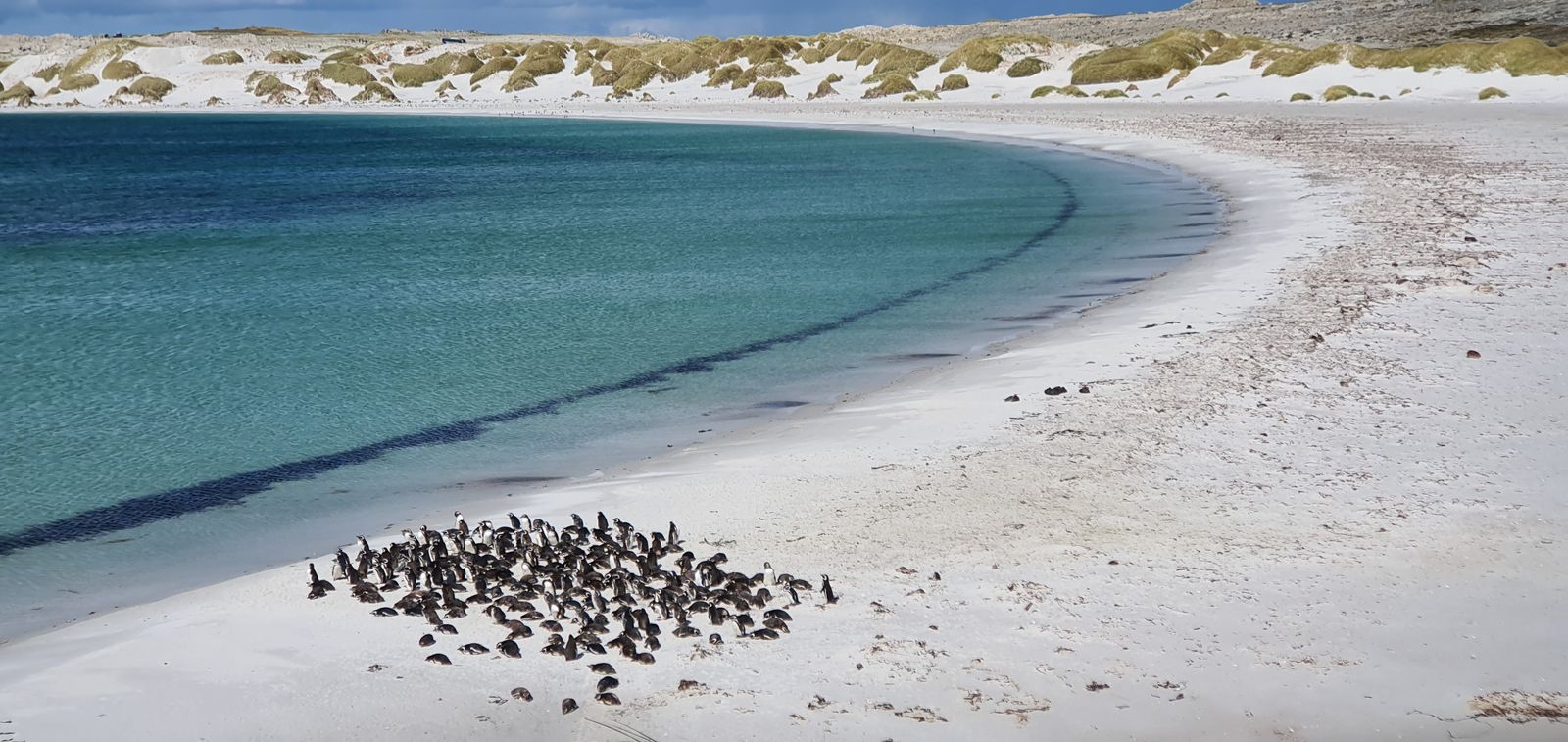
The Falklands’ most spectacular wildlife site — a sandy peninsula two hours’ drive (4WD only across open camp) from Stanley hosts the largest king penguin colony in the Falklands, with 1,000+ adult kings standing two feet tall among hundreds of brown-woolly chicks, surrounded by magellanic and gentoo penguins. One of the Southern Hemisphere’s most accessible and moving wildlife encounters.
A small island at the Falklands’ southern tip with the world’s best shore-based orca sightings — orcas charge the beach at speed to snatch sea lion pups in an extraordinary hunting behaviour observed here almost daily in season. Southern elephant seals, rockhopper penguins, striated caracaras and five penguin species live on a 10-square-kilometre island of remarkable wildlife density.
A privately owned island with the Falklands’ most accessible black-browed albatross colony — hundreds of nesting albatrosses at close range, plus rockhopper penguins, king cormorants and macaroni penguins on different cliff sections of a single headland (The Neck) reachable on foot from the farm.
Falkland Islands (Wikipedia) →A game bird endemic to the Falklands, hunted sustainably in season — the meat is dark, rich and gamey, slow-roasted or casseroled with root vegetables. The Islands’ connection to this bird is similar to Scotland’s to grouse; it appears on most restaurant menus.
from the island’s sheep flocks — there are 500,000 sheep for 3,000 people) are the local specialities. Fresh
Grey mullet caught fresh from the harbour at Stanley and the sheltered inlets of West Falkland — pan-fried with butter or smoked at the local smokehouse. A local fish whose quality is largely unknown beyond the Islands.
Brown trout introduced to the Islands’ rivers in the 19th century have reached exceptional sizes in the cold, rich Falklands streams — caught by fly-fishing enthusiasts from around the world who come specifically for these fish. Some of the finest trout fishing on earth.
from the local brewery are the everyday pleasures.
from the Empetrum rubrum berry, native to the Falklands) on scones is the island’s distinctly local tradition.
Mount Pleasant Airport (MPN) is the main international airport, 60km from Stanley. LATAM (via São Paulo and Santiago) and the RAF Airbridge (from Brize Norton for UK residents) serve the island. For trip planning, see the official Falkland Islands tourism portal.
💡 The RAF Airbridge (weekly flight from Brize Norton to Mount Pleasant, operated for British forces and available to civilians when seats permit — the fastest and cheapest UK option at £500–900 return) was established after the 1982 war and remains the primary UK connection.
💡 Santiago (5h, LATAM, twice weekly) is the most practical South American gateway. The Buenos Aires route was suspended after the 1982 war; limited services have been trialled since; check current status before booking.
💡 FIGAS (the Falkland Islands Government Air Service — a fleet of small aircraft serving all Falkland Island settlements from Stanley's grass strip) is essential for reaching the outer islands. Flights must be booked in advance through the Stanley office.
💡 A 4WD hire car (£60–100/day) is essential for Volunteer Point and any camp travel outside Stanley. The Falklands has approximately 500km of sealed road and a further 1,000km of rough track accessible only by Land Rover or ATV.
October to March is the austral summer — the only viable window for most visitors (7–15°C, long daylight hours, the wildlife at its most active). November to January is the peak with penguin chicks and seal pups. April to September is the austral winter (0–7°C, strong winds, most outer settlements inaccessible).
The Falkland Islands pound (FKP, pegged 1:1 to GBP) is the currency; GBP accepted. It is expensive due to remoteness — most supplies are imported from the UK or Chile.
Falkland Island lamb (the Corriedale and Polwarth sheep breeds raised on the tussac grass of the Falkland camp, producing a flavour significantly more intense than New Zealand or British lamb &mdash)
FIGAS (Falkland Islands Government Air Service — operates Britten-Norman Islander and Cessna 172 light aircraft between Stanley and all Falkland Islands settlements, the primary transport for outer island visits — flights from)
Sea Lion Island Lodge (an all-inclusive wildlife lodge on Sea Lion Island — the finest wildlife watching lodge in the Falklands, with king penguins, elephant seals, orcas and rockhopper penguins visible from the lodge perimeter,)
Stanley for one day, Volunteer Point for one, Sea Lion Island for one, Bleaker Island for one, Pebble Island for one, West Falkland for one, Stanley farewell for one. The Falkland Islands — 500km from Argentina in the South Atlantic — has the world’s largest accessible king penguin colony, orcas hunting elephant seals, and the atmospheric wreckage of the 1982 war.
Stanley — the capital of the Falkland Islands (a British Overseas Territory of 12,200km² in the South Atlantic, 500km east of Argentina, population 3,400 — one of the most isolated inhabited places on earth) with the Historic Dockyard Museum (the finest museum in the South Atlantic, covering Falklands history from 1592 through the golden age of sail, the 1982 war and the present) and the ship wrecks in the harbour.
💡 The 1982 Falklands War (2 April to 14 June 1982 — Argentina invaded the Falkland Islands on 2 April; Britain retook them after a 74-day conflict, with 255 British and 649 Argentine military deaths) was the last conventional military conflict in the South Atlantic. The war permanently changed British domestic politics (it restored Margaret Thatcher’s popularity), Argentine domestic politics (it led directly to the fall of the military junta) and the international law of territorial self-determination.
Volunteer Point (90km north of Stanley by 4WD — the most spectacular wildlife site in the Falklands and one of the finest in the world: a beach holding approximately 1,000 king penguins (Aptenodytes patagonicus — the second-largest penguin species, 90cm tall, with the most extraordinarily long breeding cycle of any bird: 14 months from egg to independent chick), 5,000+ gentoo penguins and 600+ Magellanic penguins in adjacent colonies, all completely unafraid of humans).
💡 King penguins (Aptenodytes patagonicus) have the longest breeding cycle of any bird: the single egg takes 55 days to incubate (held on the feet under a brood pouch), the chick takes 14–16 months to develop to independence — the entire cycle taking over a year. The brown, fluffy king penguin chick (which looks like a completely different species from the adult — early naturalists classified it as a separate species, the “woolly penguin”) is one of the most characterful animals in the natural world.
1h by light aircraft. Sea Lion Island (the southernmost inhabited island in the Falklands — 8km², one of the finest wildlife watching sites in the South Atlantic, with southern elephant seals hauled out on the beaches (males up to 2,200kg — the largest living land carnivore), southern sea lions, Magellanic and gentoo penguins nesting metres from the lodge, and orca hunting sea lions on the beach (the same behaviour documented at Peninsula Valdés in Argentina).
💡 Southern elephant seals (Mirounga leonina — the world’s largest seal at up to 2,200kg for adult males, with a trunk-like inflatable nose used in dominance displays) haul out on Sea Lion Island beaches in October–November (pupping season) in numbers exceeding 500 individuals. The males’ battles for harems (involving rearing up to 3m and crashing together with tremendous force) are among the most violent displays of any animal in the world. Females weigh only 400kg — one of the greatest sexual size differences in any mammal.
A day trip to Bleaker Island (15 min by light aircraft from Stanley — an uninhabited island of tussac grass, white sand beaches and the largest rockhopper penguin colony accessible in the Falklands (Eudyptes chrysocome — the smallest crested penguin, with vivid yellow brow feathers and bright red eyes, nesting in dense colonies on rocky cliff-tops and leaping between rocks with both feet together — hence the name) and Commerson’s dolphins in the bay.
💡 Rockhopper penguins (Eudyptes chrysocome) are the most characterful penguins in the Falklands — their habit of jumping from rock to rock on steep clifftops (rather than waddling up slopes like other penguins) with both feet together, combined with their vivid yellow crest feathers and bright red eyes and bills, make them the most photographed penguin in the Falklands after the king penguin.
1h by light aircraft. Pebble Island (in the north of West Falkland, site of the 1982 SAS raid on Argentine aircraft — the burned-out remains of 11 Argentine aircraft still lie on the airstrip, one of the most atmospheric World War II-style battlefield sites in the South Atlantic — and the finest upland goose, steamer duck and striated caracara concentrations in the Falklands — the striated caracara (Phalcoboenus australis — the “Johnny Rook”, the most inquisitive bird in the world) will steal your gear if unattended.
💡 The SAS raid on Pebble Island (14–15 May 1982 — a pre-dawn raid by 45 SAS soldiers on the Argentine-held Pebble Island airstrip, destroying 11 aircraft and the fuel and ammunition dumps in 30 minutes without British casualties) is considered one of the most successful special forces raids in British military history. The destroyed Argentine Pucará aircraft, Shorts Skyvan and Piper Navajos are still on the airstrip, largely unchanged.
A 4WD traverse of West Falkland (the larger and less-visited of the two main islands, with the Mount William range and the Hornby Mountains, inhabited primarily by sheep farms — camp life, where settlement owners are known by their farm names — and Port Howard (the finest example of a traditional Falkland Islands sheep farm, with a small museum of Falklands Farm life and 1982 War artefacts) — the most authentic Falklands experience outside Stanley.
💡 Falkland Islands sheep farming (the primary industry from the 1860s to the 1980s, when the islands had approximately 600,000 sheep farmed by a handful of large estates) created the distinctive “camp” culture of the Falklands — “the camp” being everything outside Stanley, from the Afrikaans “campo” meaning countryside. The farm manager families who lived in extreme isolation on West Falkland for generations created a distinctive culture with its own vocabulary, customs and values that is closer to rural Australia than to Britain.
The SS Great Britain (the wreck of Brunel’s revolutionary iron steamship, beached in Sparrow Cove 7km from Stanley in 1886 — the world’s first ocean-going screw-propelled iron ship, launched 1843, now being conserved in situ by the Falkland Islands Government, with the original bowsprit and hull visible above water at low tide) — the most historically significant ship wreck in the South Atlantic. The original ship is in dry dock in Bristol, UK. Fly from Stanley (MPN).
💡 The SS Great Britain (designed by Isambard Kingdom Brunel, launched in Bristol 1843, the world’s first large screw-propelled ocean-going iron ship — the most technologically revolutionary vessel of the 19th century — was beached in Sparrow Cove in the Falklands in 1886 after damage in Cape Horn storms. The Falkland Islands Government completed a major conservation project in 2020–2023 to stabilise the hull in situ; the ship is now protected as an internationally significant maritime monument.
Weekly RAF flights from Brize Norton (UK) via Ascension Island; commercial flights from Santiago and Punta Arenas (Chile). Cruise ships visit in the summer season (Nov–Mar).
LATAM Chile operates the twice-weekly service from Santiago with a stop at Mount Pleasant MPN. The one-way flight takes 8-9 hours from Santiago.
The Falklands receive roughly 30,000 cruise visitors and only 2,000 land-based visitors per year. Land-based accommodation must be booked months ahead.
Rockhopper penguins, elephant seals, black-browed albatross and king penguins are all seen at close range without fences or crowds. Animals treat humans with indifference.
Accessible by small plane (FIGAS — the Falkland Islands Government Air Service, booking in advance essential) or by arrangement with individual farm operators.
For the extraordinary seabird and penguin diversity across the islands.
FreePoint your camera at menus, signs or street text for instant translation. Download the language pack offline before you arrive for full use without data.
FreeReal-time and offline exchange rates for all world currencies — converts prices instantly so you always know what you are paying in your home currency.
FreeFind and book hotels, guesthouses and apartments with free cancellation on most rates — one of the widest selections of accommodation worldwide.
FreeBrowse millions of traveller reviews for restaurants, attractions and hotels — helps identify the best local spots and avoid tourist traps.
FreeFalkland Islands sits within easy reach of several other destinations — each with a completely different character.
