ES
Canary Islands
Teide volcano, lava fields, eternal spring & the world’s oldest telescope
Teide volcano, lava fields, eternal spring & the world’s oldest telescope
The Canary Islands is Spain’s Atlantic archipelago — seven volcanic islands off the coast of Morocco that enjoy year-round sunshine, dramatic landscapes ranging from the Saharan sand dunes of Maspalomas to the lava fields of Lanzarote and the ancient laurel forest of La Gomera, and some of the world’s finest stargazing from the summit of Tenerife’s Teide (Spain’s highest peak at 3,715m, the tallest volcano in the Atlantic islands and a UNESCO World Heritage Site). Despite their reputation as Europe’s mass-tourism beach capital, the Canaries contain some of the continent’s most striking natural environments: Tenerife has Spain’s most visited national park; La Palma’s Roque de los Muchachos hosts some of the world’s most important astronomical observatories; La Gomera has a forest communication system (Silbo Gomero, a UNESCO-listed whistled language); and El Hierro, the westernmost island, runs entirely on renewable energy.
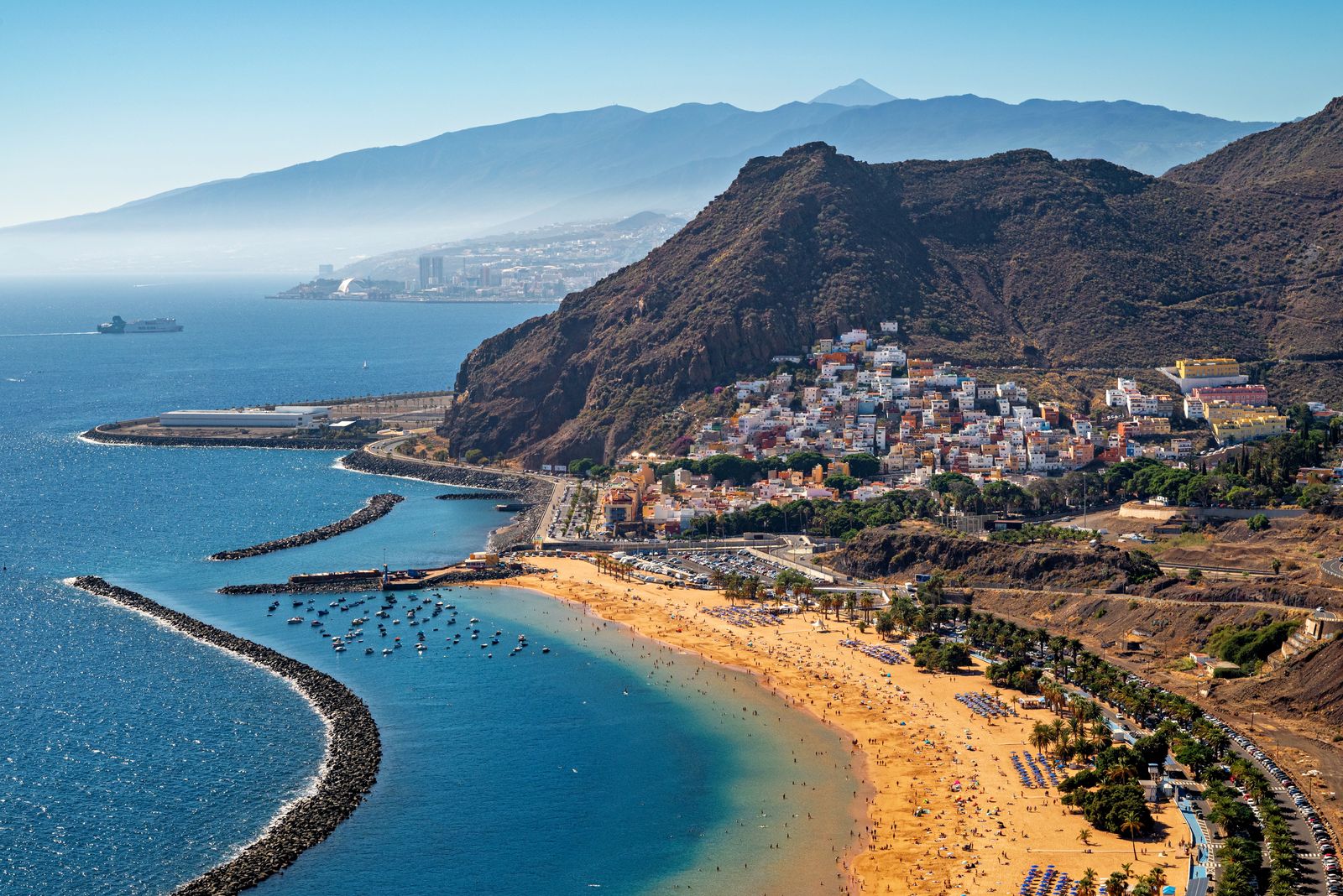
A UNESCO World Heritage Site and Europe’s most visited national park — Teide volcano (3,715m) rises from a vast caldera of black lava fields and coloured volcanic rock in a landscape of Mars-like desolation at altitude. The cable car and guided summit ascent (permit required) reward with views over the Atlantic to all seven islands on clear days. The night sky from the Teide Observatory is among the world’s finest.
The most dramatic island for geological tourism — Lanzarote’s Timanfaya National Park preserves the volcanic landscape of 1730–1736 eruptions that covered a third of the island in lava. Restaurants cook food using geothermal heat; camel rides cross the lava fields; and César Manrique’s great architecture (Jamiéos del Agua, the Cactus Garden) integrates seamlessly with the volcanic terrain in a UNESCO Biosphere Reserve.
The “Beautiful Island” — La Palma has the steepest ocean island topography on earth and the Caldera de Taburiente National Park — a 9-kilometre wide ancient caldera of dramatic depth, accessible by hiking trails through Canarian pine forest. The Roque de los Muchachos Observatory at 2,426m hosts some of the world’s largest telescopes including the Gran Telescopio Canarias (the world’s largest single-mirror telescope).
The smallest easily accessible Canary Island has a UNESCO-listed laurisilva forest (Garajonay National Park) — a primordial cloud forest of ancient laurel, tree heath and Canarian laurel in constant mist, the last remnant of the subtropical forests that covered southern Europe in the Tertiary era. Columbus stopped here on his first voyage to America in 1492.
Canary Islands (Wikipedia) →Small potatoes boiled in very salty water until wrinkled, served with red and green mojo sauces.
Toasted grain flour dating back to the pre-Hispanic islanders, used in soups, porridge and desserts.
A prized local fish with firm white flesh, usually grilled whole and served with mojo and papas arrugadas.
A velvety almond cream from Gran Canaria — ground blanched almonds, sugar, egg yolk, lemon zest and cinnamon, chilled and spooned over ice cream or eaten as a dessert on its own. The name means “tastes good to me” in Spanish.
The defining sauce of the Canary Islands — dried chíllis, garlic, cumin, paprika, vinegar and olive oil ground to a pungent red paste. Every family has its own recipe; it accompanies bread, papas arrugadas, fish and meat at every meal.
Canarian honey rum — locally distilled agricultural rum sweetened with wildflower honey from island bees. Served as a digestif, over crushed ice or stirred into hot coffee. The best expressions come from La Palma and Tenerife.
The ancient Malvasía (Malmsey) grape grows on the volcanic soils of Lanzarote, Tenerife and La Palma. Once exported across Tudor England and mentioned in Shakespeare, it is now produced as elegant dry whites and rich late-harvest sweet wines.
The lager of the Canary Islands — brewed in Las Palmas de Gran Canaria since 1939 by Compañía Cervecera de Canarias. Omnipresent at every bar and beach chiringuito across all seven islands.
Tenerife South (TFS), Gran Canaria (LPA), Lanzarote (ACE) and Fuerteventura (FUE) are the main hubs. easyJet, Ryanair and Jet2 dominate UK routes; Binter Canarias connects the islands internally. For trip planning, see the official Canary Islands tourism portal.
Virtually every UK regional airport has direct Canary Islands services in winter. Fuerteventura and Lanzarote are particularly well served from smaller UK airports.
Madrid (2h30) has the most frequent connections, with multiple daily Iberia and Vueling flights to all seven major islands.
The Lanzarote–Fuerteventura ferry (25 min) is the quickest inter-island connection. Binter Canarias covers all islands efficiently; book ahead in July–August.
Car hire is very affordable across the Canaries (IGIC 7% tax). Tenerife and Gran Canaria have good bus networks; the smaller islands require a car to explore fully.
The Canaries enjoy near-perfect year-round sun — temperatures between 18°C and 28°C throughout the year. December to February is peak winter-sun season; June to September is warmest. Lanzarote and Fuerteventura are the driest, best for beaches year-round.
The Canaries use the euro with reduced local tax (IGIC 7% vs mainland 21%), making them one of the most affordable Eurozone holiday destinations.
Papas arrugadas — wrinkled Canarian potatoes boiled in heavily salted water, served with mojo verde (herb and garlic) or mojo rojo (chilli and pepper) — are the defining snack of the islands, costing €3–7 at any bar or restaurant.
Malvasía de Lanzarote — a white wine from the Malvasia Volcánica grape grown in volcanic ash craters in La Geria, with a distinctive mineral-volcanic character — is the finest wine produced in the Canaries.
Abama Golf & Resort (Tenerife, two Michelin-starred restaurants, from €250/night) and the Baobab Suites are Tenerife’s finest luxury addresses.
Tenerife for two days, Gran Canaria for one, Lanzarote for two, La Palma for one, Fuerteventura for one. The seven Canary Islands are Spain’s greatest natural playground — Europe’s finest year-round Atlantic escape.
Tenerife has Teide National Park (UNESCO — Pico del Teide at 3,715m is Spain’s highest peak, a lunar lava landscape accessible by cable car to 3,555m) and La Laguna (UNESCO World Heritage colonial city). The Las Cañadas caldera — 16km wide — surrounds the volcano cone.
Teide is the third-largest volcano on earth measured from its ocean-floor base (–3,000m to 3,715m = 6,700m total). It was the reference point for transatlantic sailors for four centuries.
The Teide cable car (3,555m in 8 minutes) for the lunar landscape, then the Anaga Rural Park (UNESCO Biosphere — ancient laurisilva forest on the northeast peninsula, with ravines descending to quiet beaches accessible only on foot).
The Anaga forest is one of the last fragments of the subtropical laurel forest that covered southern Europe before the ice ages. It has been continuously forested for over 20 million years.
45 min from Tenerife. Gran Canaria — the Maspalomas Dunes (4km² of Saharan sand abutting the Atlantic, the most dramatic beach landscape in Spain) in the south; lush banana-plantation valleys in the north; and Las Palmas (a city of 380,000 with the finest colonial old town in the Canaries, the Vegueta district).
The Maspalomas Dunes migrate 3m per year under the northeast trade wind, fed by Saharan sand transported by ocean current. Protected as a nature reserve since 1987.
45 min from Gran Canaria. Lanzarote — Timanfaya National Park (300 volcanic cones from the 1730–1736 eruption; 400°C heat 10m below the surface; a bucket of water erupts as a geyser) and César Manrique’s masterworks scattered across the island.
The 1730–1736 Lanzarote eruption lasted 6 years — one of the longest volcanic episodes in recorded history, covering a third of the island in lava and destroying 16 villages.
The Fundación César Manrique — a house of 5 volcanic bubbles connected underground — and the La Geria wine region (vines planted individually in volcanic ash craters, the most striking viticulture landscape in Europe).
César Manrique successfully campaigned for a voluntary ban on billboards and high-rise buildings across all of Lanzarote — the island remains the only major tourist island in the Atlantic without billboard advertising.
1h from Lanzarote. La Palma — the Roque de los Muchachos Observatory (2,400m, home of the Gran Telescopio Canarias — the world’s largest optical telescope at 10.4m) and the Caldera de Taburiente National Park (a 9km-wide ancient caldera filled with Canarian pine forest).
La Palma has 300+ clear nights per year and is the best stargazing destination in Europe. The GTC at Roque de los Muchachos completed in 2009 is used by 19 countries.
1h from La Palma. Fuerteventura — the Corralejo Dunes (5km of white Saharan sand protected as a national park on the north coast) and the Jandia Peninsula (30km of Atlantic beach, the finest windsurfing and kitesurfing in Europe). Fly from FUE or TFS.
Fuerteventura is the oldest Canary Island geologically (20 million years) and the closest to Africa (100km from Morocco). The constant wind that erodes it also makes it the premier kite and windsurfing destination in Europe.
EU/Schengen territory of Spain. UK, US, Australian citizens enter visa-free up to 90 days.
Gran Canaria (LPA) and Tenerife South (TFS) handle the most international traffic. Binter Canarias connects inter-island in 30-60 minutes.
The seven major islands range from the volcanic moonscapes of Lanzarote to the laurel forests of La Palma and La Gomera to the arid sand dunes of Fuerteventura — more variation than any single nation in Europe.
Climbing Teide (3,715m, Spain’s highest peak) to the summit crater requires a free permit booked via the Parque Nacional del Teide website. The cable car to 3,555m does not need a permit.
Binter Canarias and Canaryfly operate inter-island flights (30–60 min); ferries also connect the main islands but are slower.
A free permit is required to hike above the cable car station to the summit — book months in advance at reservasparquesnacionales.es.
Quick answers to the questions people most often ask before visiting the Canary Islands.
Fly directly to one of the main airports — Tenerife South (TFS), Gran Canaria (LPA), Lanzarote (ACE) or Fuerteventura (FUE). Flights from the UK take around 4–4h30 and from Madrid about 2h30.
Any time — the islands enjoy year-round sun with temperatures of roughly 18–28°C. December to February is peak winter-sun season, and June to September is the warmest.
It depends on your trip: Tenerife for Mount Teide and variety, Gran Canaria for dunes and mountain villages, Lanzarote for volcanic landscapes, Fuerteventura for long beaches, and La Palma or La Gomera for hiking and forests.
Yes — to hike to the 3,715 m summit crater above the cable-car station you need a free permit from the national park, which should be booked well in advance.
They are among the most affordable euro holiday destinations, helped by a lower local sales tax (IGIC). Expect around €45–80 per day on a budget and €100–165 mid-range.
Point your camera at menus, signs or street text for instant translation. Download the language pack offline before you arrive for full use without data.
FreeReal-time and offline exchange rates for all world currencies — converts prices instantly so you always know what you are paying in your home currency.
FreeFind and book hotels, guesthouses and apartments with free cancellation on most rates — one of the widest selections of accommodation worldwide.
FreeCanary Islands sits within easy reach of several other destinations — each with a completely different character.
Canary Islands is one of the world’s least-visited places. See all 90 in our guide to the world’s least-visited countries & territories.


