TN
Tunisia
Sahara sands, Roman ruins and Mediterranean shores
Sahara sands, Roman ruins and Mediterranean shores

The UNESCO medina of Tunis: the Great Mosque of Zitouna (9th century, one of the oldest universities in the world), the souks of the Hafsid period and the Bardo Museum’s extraordinary Roman mosaic collection.

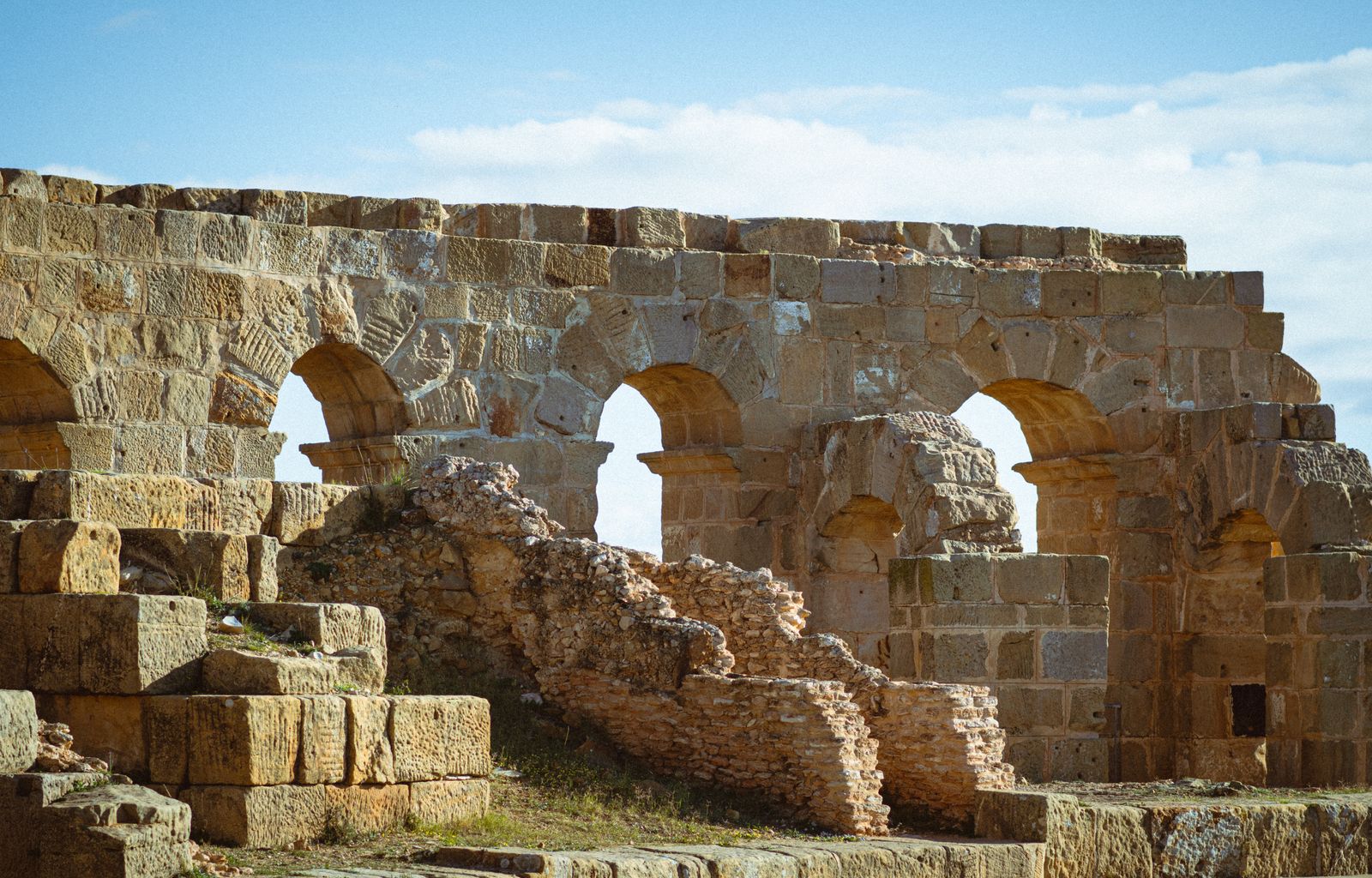
The remains of the city that nearly destroyed Rome: the Baths of Antoninus (the largest Roman baths outside Rome), the Byrsa Hill museum and the Punic ports.

A 3rd-century Roman amphitheatre with 35,000 seats: better preserved internally than Rome’s Colosseum, in the middle of a provincial Tunisian town.

UNESCO Dougga (Thugga): the most complete Roman provincial city in North Africa, with a Capitol, a theatre, baths and a triumphal arch on a hilltop.

A blue-and-white clifftop village above the Gulf of Tunis: the Cafe des Nattes’s terrace, the jasmine vendors and the view from the ridge to Carthage and the sea.

The Sahara gateway at Douz: camel treks into the Grand Erg Oriental dunes and the Chott el-Jerid salt lake (a white flat expanse with mirages in summer).

Underground cave dwellings (troglodyte houses): the Hotel Sidi Driss was the Lars Homestead set for Star Wars (1976). Berber families still live in the cave pits.

The fourth-holiest city in Islam after Mecca, Medina and Jerusalem: the Great Mosque of Kairouan (founded 670 AD, one of the oldest mosques in the world) and the medieval medina.
Semolina couscous steamed over a spicy harissa broth with lamb, merguez sausage, chickpeas and vegetables: the national dish, eaten every Friday.
A crispy deep-fried pastry triangles filled with egg, tuna, capers and harissa: the definitive Tunisian street snack, eaten in one bite so the yolk doesn’t run.
A deep bowl of slow-cooked chickpeas with cumin, harissa, lemon and olive oil, with stale bread torn in: the working-class breakfast of Tunisia, eaten at midnight-to-dawn stalls.
Spiced lamb and beef sausages with harissa and cumin: the street-grilled food of every Tunisian market.
Heavily sweetened mint tea in a glass: poured from height to create foam. Or Turkish coffee. Both drunk at every cafe terrace throughout the day.
A Tunisian Jewish distillate of figs: 40% alcohol, unique to Tunisia. Drunk chilled as an aperitif in the coastal resorts.
Tunisia’s national lager: cold, light and correct at a beach cafe.
Tunisia’s chilli-garlic paste: used in everything from couscous to brik to salads. The Nabeul region produces the finest.
Tunis Carthage (TUN) is the main hub; Djerba (DJE) receives many European charters. Tunisair is the national carrier; Nouvelair and TunisAir Express serve domestic routes and charter traffic. For trip planning, see the official Tunisia tourism portal.
💡 Tunisia is 3 hours from London — one of North Africa’s most accessible destinations. Budget carriers have significantly reduced fares on Djerba and Tunis routes in recent years.
💡 Italy is the closest major European country to Tunisia — just 150km across the Mediterranean. Rome–Tunis is 1h45 and one of the shortest intercontinental flights in the world.
💡 Louages — shared long-distance taxis that depart when full — are the fastest and most practical way to travel between Tunisian cities. They cost 2–3x bus prices but travel at twice the speed.
💡 A car is essential for the best Tunisia itinerary — the Sahara towns, Matmata, the ksour (Berber fortresses) of the south and the Roman sites are spread across the country and poorly served by public transport.
March to May and September to November are ideal — Tunis and Carthage pleasant, the Sahara accessible and not lethally hot. July and August see temperatures above 40°C in the south. December to February is mild on the coast (15–20°C) and cold in the highlands.
Tunisia is one of the best-value destinations in the Mediterranean — significantly cheaper than Morocco, with excellent food, Roman ruins and Sahara access at North African prices.
Lablabi — slow-cooked chickpeas in a tomatoey broth, served in a bowl of broken bread with tuna, capers, olive oil and harissa — is Tunisia’s most distinctive street food and breakfast dish. At a local café it costs TND 2–4.
Tunisian wine (from the Mornag, Grombalia and Cap Bon regions) is entirely unknown outside North Africa and entirely excellent &mdash.
Dar Ben Gacem (a 15th-century palace in the Tunis Medina converted to a 12-room hotel) and Dar Said in Sidi Bou Said are Tunisia’s finest boutique addresses &mdash.
Tunis and Carthage for two days, Sidi Bou Said for one, El Djem for one, Matmata for one, the Sahara at Douz for two. Tunisia contains more Roman ruins, more varied landscapes and more layers of history than most visitors expect.
Tunis Medina (UNESCO World Heritage Site) — a 1,000-year-old labyrinth of souks organised by trade: gold, copper, silk, leather, spices, in streets that haven’t fundamentally changed since the 9th century. The Bardo National Museum: the largest collection of Roman mosaics in the world, including the complete floor mosaics from the Villa of Antoninus Pius (2nd century CE).
💡 The Bardo Museum mosaic collection includes the Neptune Mosaic (4th century CE, 9m × 6m, one of the largest intact Roman mosaic floors on earth) and the Virgil Mosaic (3rd century CE, showing the poet between the Muses). No comparable collection exists outside Rome itself.
25km from Tunis. Carthage — the city-state that challenged Rome for domination of the Mediterranean in the 3rd–2nd centuries BCE, destroyed in 146 BCE and every stone salted — is now a series of archaeological parks on the hills above the Bay of Tunis. The Punic port, the Antonine Baths (the third largest in the Roman world) and the Tophet (child sacrifice site, disturbing and archaeologically significant).
💡 Carthage was founded c.814 BCE by Phoenician settlers from Tyre. At its height it controlled Sicily, Sardinia, Iberia and the western Mediterranean trade routes. The Roman Senate voted to destroy it three times before actually doing so. The phrase “Carthago delenda est” became the model for modern political rhetoric.
20km north of Tunis on the Carthage promontory. Sidi Bou Said is a clifftop village of white buildings with blue doors and window grilles — the prototype for the “blue and white Mediterranean village” aesthetic replicated across North Africa and the Greek islands. Paul Klee and August Macke painted here in 1914; their Tunisian colour studies changed European art.
💡 Paul Klee wrote in his diary on arriving at Sidi Bou Said in April 1914: “Colour has taken possession of me; no longer do I have to chase after it. It has taken possession of me forever.” The trip transformed his palette and is considered one of art history’s decisive moments.
3h south of Tunis. The El Djem Amphitheatre (3rd century CE, capacity 35,000, the fourth-largest in the Roman world and the best preserved outside Rome, entirely free-standing on the Tunisian plain) is one of the most astonishing ancient structures in Africa.
💡 El Djem was built entirely without a hillside to support it — unlike most amphitheatres, which are built into hillsides. The vaulted subterranean corridors beneath the arena (where animals and gladiators were held) are still accessible and largely unchanged from the 3rd century.
2h30 from El Djem. Matmata is a Berber village of pit-houses — dwellings dug vertically into the soft limestone, with a central courtyard open to the sky and rooms opening off its sides. The Hotel Sidi Driss (a pit-house hotel where Star Wars’ Lars homestead scenes were filmed in 1976) is still operating.
💡 The Hotel Sidi Driss in Matmata was used as the exterior and interior of Luke Skywalker’s home in the original 1977 Star Wars. George Lucas filmed here in 1976 and returned for the prequel scenes in 2000. The hotel has preserved the original sets.
2h from Matmata. Douz is the “gateway to the Sahara” — the last town before the Grand Erg Oriental, the great sand sea of dunes stretching 600km south into Algeria and Libya. A camel trek into the dunes at sunset, overnight in a Bedouin camp, and the dawn in the silence of the Sahara.
💡 The Sahara is the largest hot desert on earth (9.2 million km²) and covers 30% of Africa. The Grand Erg Oriental near Douz is its most accessible section from Tunisia — the dunes reach 20–30m high and the silence at dawn, broken only by wind, is complete.
3h from Douz. Kairouan (UNESCO World Heritage Site) — one of the holiest cities in Islam, the first Muslim city in North Africa (670 CE), with the Great Mosque of Kairouan (the oldest surviving mosque in North Africa, 7th century, 9th century expansion) and the medina’s carpet workshops. Fly from Tunis Carthage (TUN).
💡 The Great Mosque of Kairouan is the fourth holiest site in Islam after Mecca, Medina and Jerusalem. Non-Muslims can visit the outer courtyard and enter the prayer hall with appropriate dress. The hypostyle prayer hall (17 aisles, 414 columns from Roman and Byzantine ruins) is one of the great Islamic interiors.
Local taxis otherwise; always agree fares before entering.
A brik: TND 1.50 (EUR 0.45). A restaurant meal: TND 15-30 (EUR 4.50-9).
The Arab tradition of welcoming guests is warm and genuine.
Louages (shared long-distance taxis) depart when full: fast, cheap, the correct intercity transport.
Parts of western Tunisia near the Algerian border require extra care. Check your government’s current advice.
Available at Tunis airport.
Covered shoulders and legs at mosques; scarves available for loan.
Welcome and thank you in Arabic: universally appreciated.
Ride-hailing in Tunis and major Tunisian cities — safer and cheaper than street taxis.
FreeAlternative ride-hailing across Tunisia — lets you set and negotiate your own fare.
FreeBook Sahara desert tours, Sidi Bou Said day trips, Carthage ruins and Tunisian cultural experiences.
FreeTunisia’s primary messaging platform — contact riads, guides and transport operators.
FreeBook hotels and riads in Tunis, Sousse, Hammamet and across Tunisia.
FreeTrack TND (Tunisian Dinar) rates — cash is widely used; ATM withdrawals give the best rates.
FreeA medina capital, a rival to Rome, a postcard blue village, one of Islam’s holy cities and a lotus-eaters’ island — five sides of Tunisia.
Tunisia sits within easy reach of several other destinations — each with a completely different character.


