OM
Oman
Frankincense trails and pristine mountain deserts
Frankincense trails and pristine mountain deserts

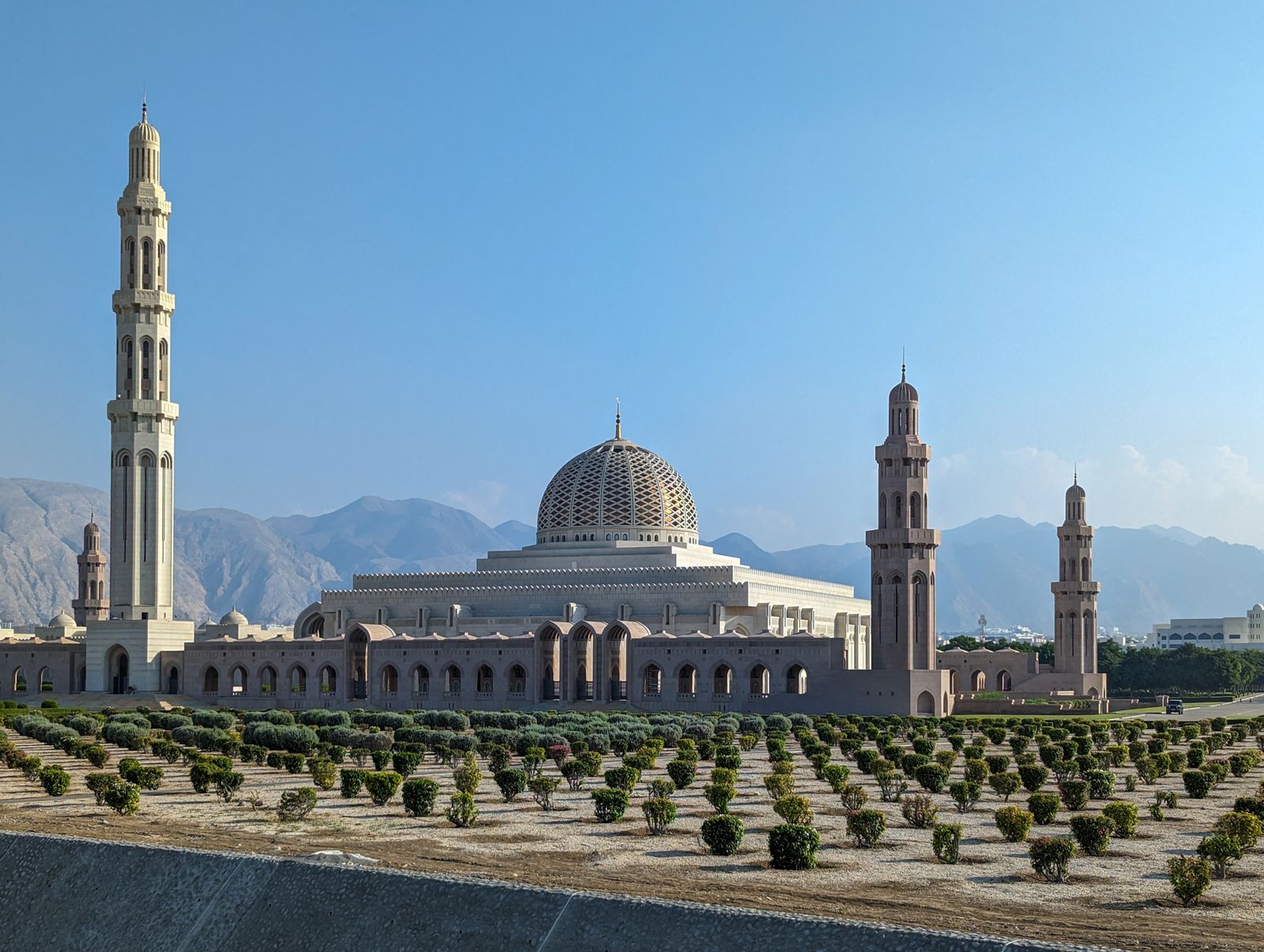
The Sultan Qaboos Grand Mosque (the second-largest in the world when completed in 2001), the Royal Opera House and the Mutrah Souk’s 200-stall labyrinth of frankincense, silver and textiles.

The Khors of Musandam: inlet fjords of the Hajar Mountains dropping 1,000m to the water, explored by traditional wooden dhow. Dolphins swim alongside in the morning.

Orange dunes up to 150m high: a Bedouin camp overnight, camel riding at sunset, and a night sky above the desert that ranks among the finest in the world.

The most complete traditional Omani city: the 17th-century round fort, the Friday goat and livestock souk (the finest traditional market in Oman) and the silversmith craft quarter.

Wadi Shab: a 2km walk through a gorge to a swimming hole accessible through a cave. Wadi Bani Khalid: emerald pools under date palms with mountain walls above.

A 2,980m plateau above the clouds: rose water production, pomegranate orchards and the cliff-edge village of Bilad Sayt with no road access until 2006.

The only place in Arabia where a monsoon brings green jungle from July to September: the Job’s Tomb, the frankincense trees and the Ayn Athum and Darbat waterfalls.

The Ras al Jinz Turtle Reserve: green and loggerhead turtles nesting on the beach from June to October, accessible on a night tour. Sur‘s dhow-building tradition has continued for 500 years.
A whole goat or camel marinated in spices and slow-roasted in an underground sand oven for 24-48 hours: the ceremonial feast food of Oman, prepared for Eid and weddings.
Saffron rice cooked with dried limes (loomi), cardamom and slow-cooked meat (chicken or lamb): Oman’s version of the Gulf rice dish, more aromatic than Saudi kabsa.
Slow-cooked wheat and lamb pounded to a smooth porridge: the Ramadan staple throughout the Gulf, eaten at iftar.
A sticky, dense sweet of sugar, rosewater, saffron, cardamom and nuts: served to every guest in a small bowl with Arabic coffee. The most distinctively Omani food.
Very lightly roasted coffee with cardamom and rosewater, served in a small handleless cup from a long-spouted dallah pot: the Omani welcome ritual.
Slow-roasted kingfish basted with lemon and saffron, served with white rice and lime sauce: Muscat’s finest seafood dish.
Oman is a Muslim country; alcohol is available only in licensed hotels. The Omani laban (salted buttermilk) and fresh mango juice are the non-alcohol staples.
Oman produces 250 date varieties: the Fardh, Khalas and Naghal are the finest. Presented at every social encounter.
Both work in Muscat. Rent a car for Nizwa, the Wahiba and the fjords.
A restaurant meal: OMR 5-15 (EUR 12-36). Desert camp: OMR 50-100/night.
Being offered qahwa and halwa is a ritual; sit and accept. Rushing is impolite.
Covered shoulders and knees in souks, mosques and rural areas. Swimwear only at beaches.
The Wahiba Sands, Jebel Akhdar and mountain wadis require a 4WD.
Extremely low crime; a genuine sense of security everywhere.
Both give good 4G coverage including the major tourist sites.
Oman is a Muslim country; public alcohol consumption is not permitted.
Muscat International (MCT) is the main hub. Oman Air is the national carrier and offers excellent connections. No visa required for many nationalities on arrival; check current requirements. For trip planning, see the official Oman tourism portal.
💡 Oman Air flies direct from Heathrow to Muscat in 7 hours — one of the Middle East’s most underrated long-haul products. Business class is particularly excellent value compared to Emirates or Qatar.
💡 Dubai is the most convenient regional hub — a 1-hour flight, or a 5-hour drive along the E11 coastal highway via Fujairah. The drive from Dubai through the UAE to Muscat is entirely feasible and scenic.
💡 Car hire in Muscat (from OMR 12–20/day) is essential for exploring Oman beyond the capital. The road network is excellent — Highway 15 to Nizwa is smooth and scenic through the Hajar Mountains.
💡 Oman’s road network is among the finest in the Middle East — highways are smooth, signposted and well maintained. The drive from Muscat to Nizwa (2h) is one of the most scenic in the country, with the Hajar mountains rising on both sides.
October to April is the prime window — Muscat and the desert warm and clear, the Hajar Mountains accessible, wadis flowing. May to September is extremely hot on the coast (40–45°C) but the Dhofar region (Salalah) experiences the khareef monsoon in July–September, turning green and cool against the norm.
Muscat for two days, the Hajar Mountains and Nizwa for two, the Wahiba Sands for one, Sur and the turtles for one, the Musandam Peninsula for one. Oman is the most underrated country in the Middle East.
The Sultan Qaboos Grand Mosque (2001, open to non-Muslims outside prayer times — the main prayer hall holds 20,000, its Persian carpet is the largest hand-woven carpet in the world at 4,263m² woven by 600 women over 4 years). The Mutrah Souq (the oldest in Muscat, frankincense, silver Omani khanjar daggers, textiles) and the Mutrah Corniche.
💡 The carpet in the Sultan Qaboos Grand Mosque weighs 21 tonnes, has 1.7 billion knots and took 600 Iranian women 4 years to weave. The chandelier above it weighs 8 tonnes and contains 1,122 Swarovski crystal lights.
The Royal Opera House Muscat (2011, Omani-Islamic architecture with a European concert hall inside, the finest music venue in the Middle East) for an evening performance or a daytime tour. The Al Alam Palace (the Sultan’s ceremonial palace, not open inside but the colourful facade and the flanking forts of Mirani and Jalali are freely visible from the corniche).
💡 The Royal Opera House Muscat was built over 8 years and contains 1,100 tonnes of Italian marble, hand-painted ceilings, and an acoustic design by the same engineers behind the Vienna State Opera. Oman has no indigenous classical music tradition — Sultan Qaboos created the institution from nothing.
2h from Muscat. Nizwa was the capital of Oman for centuries — the Nizwa Fort (17th century, its round tower the largest in Oman, commanding the oasis below) and the Nizwa souq (the largest silver and copper market in Oman, with a Friday morning goat market and gunsmiths still producing traditional Omani rifles).
💡 The Nizwa goat market (Friday mornings) is a genuine weekly livestock market entirely unchanged from centuries past — hundreds of goats in pens, men in white dishdasha and turbans, negotiations in Arabic. It is not a tourist attraction; it is the actual Friday market.
30 min from Nizwa. Jabrin Castle (1675, the finest decorated interior in Oman — painted ceilings, Quranic inscriptions, private apartments of the Imam) is almost entirely unvisited. Al Hamra — a 400-year-old mud-brick village partially abandoned, its old houses standing intact in the Hajar foothills.
💡 Jabrin’s painted ceilings are extraordinary — geometric and floral patterns in ochre, blue and green covering every surface of the reception rooms, done in the 17th century with natural pigments that remain vivid. The castle was abandoned for 200 years before restoration.
2h from Nizwa. The Wahiba Sands (180km of classic red Arabian dunes reaching 100m, accessible by 4WD in 2h from Nizwa) for a sunset camel ride, dune driving and an overnight stay in a Bedouin camp or desert lodge under the stars. The Milky Way over the Wahiba at 2am is the clearest sky in Oman.
💡 The Wahiba Sands (Al Sharqiyah Sands) are home to a small Bedouin community who have lived nomadically in the desert for centuries. A documented 1986 Royal Geographical Society expedition found species unknown to science; the dune ecosystem is genuinely complex.
2h30 from Wahiba. Ras Al Jinz Turtle Reserve — green sea turtles nesting and hatching year-round, with a peak from May–October. The reserve limits access to organised night tours (essential to book). Sur (the traditional dhow-building capital of Oman, the last working traditional dhow yard in Arabia).
💡 Ras Al Jinz sees approximately 20,000 green turtle nesting events per year. Night tours (9pm and 2am) take small groups to watch females digging nests, laying eggs or hatchlings emerging — one of the most intimate wildlife encounters available in the Arabian Peninsula.
4h from Muscat. The Musandam Peninsula (an Omani exclave separated from the rest of Oman by the UAE) has dramatic limestone fjords (khor) plunging into the Strait of Hormuz — the “Norway of Arabia.” A dhow cruise through the fjords of Khasab with dolphins is the most memorable experience.
💡 The Strait of Hormuz (visible from Musandam’s peaks) carries approximately 20% of the world’s oil supply. The Musandam coastline is entirely undeveloped despite being 3h from Dubai — the border crossing (requiring exit from UAE and entry to Oman) keeps it genuinely remote.
Oman is moderate to expensive — more affordable than Qatar or the UAE but priced as a quality destination. The Omani Rial (OMR) is one of the highest-valued currencies in the world (1 OMR ≈ US$2.60).
Shuwa — a whole goat or camel marinated in spices, wrapped in banana leaves, slow-cooked in an underground clay oven for 24–48 hours, traditionally served at festivals — is Oman’s most ceremonial dish.
Omani halwa — a dense, sticky confection of sugar, ghee, rosewater, saffron and cardamom, eaten in small cubes with Omani coffee (qahwa, cardamom-spiced, served in tiny cups) — is the traditional Omani hospitality ritual.
Alila Jabal Akhdar — a cliff-edge resort on the Green Mountain at 2,000m, with a swimming pool cantilevered over a 1,000m canyon — is Oman’s most spectacular address at OMR 150–400/night.
Ride-hailing in Muscat and major Omani cities — much more reliable than street taxis.
FreeThe dominant ride-hailing app in Muscat — often has more drivers available than Uber in Oman.
FreeBook Wahiba Sands desert camps, Wadi Shab hikes, Jebel Akhdar mountain tours and Omani experiences.
FreeOman’s most popular food delivery app — covers Muscat and major Omani cities.
FreeOman’s primary messaging platform — contact hotels, car rental agencies and local services.
FreeBook hotels and desert camps across Oman — Wahiba Sands camps sell out during cooler months.
FreeFrom the Grand Mosque of Muscat to the ancient forts of Nizwa, the rose gardens of Jebel Akhdar, the dhow yards of Sur, the Wahiba Sands dunes, and the Khareef of Salalah.
Oman sits at the gateway to the Arabian Gulf — its neighbours range from ultra-modern city-states to vast desert kingdoms.


