SC
Seychelles
Granite islands with pristine tropical beaches
Granite islands with pristine tropical beaches

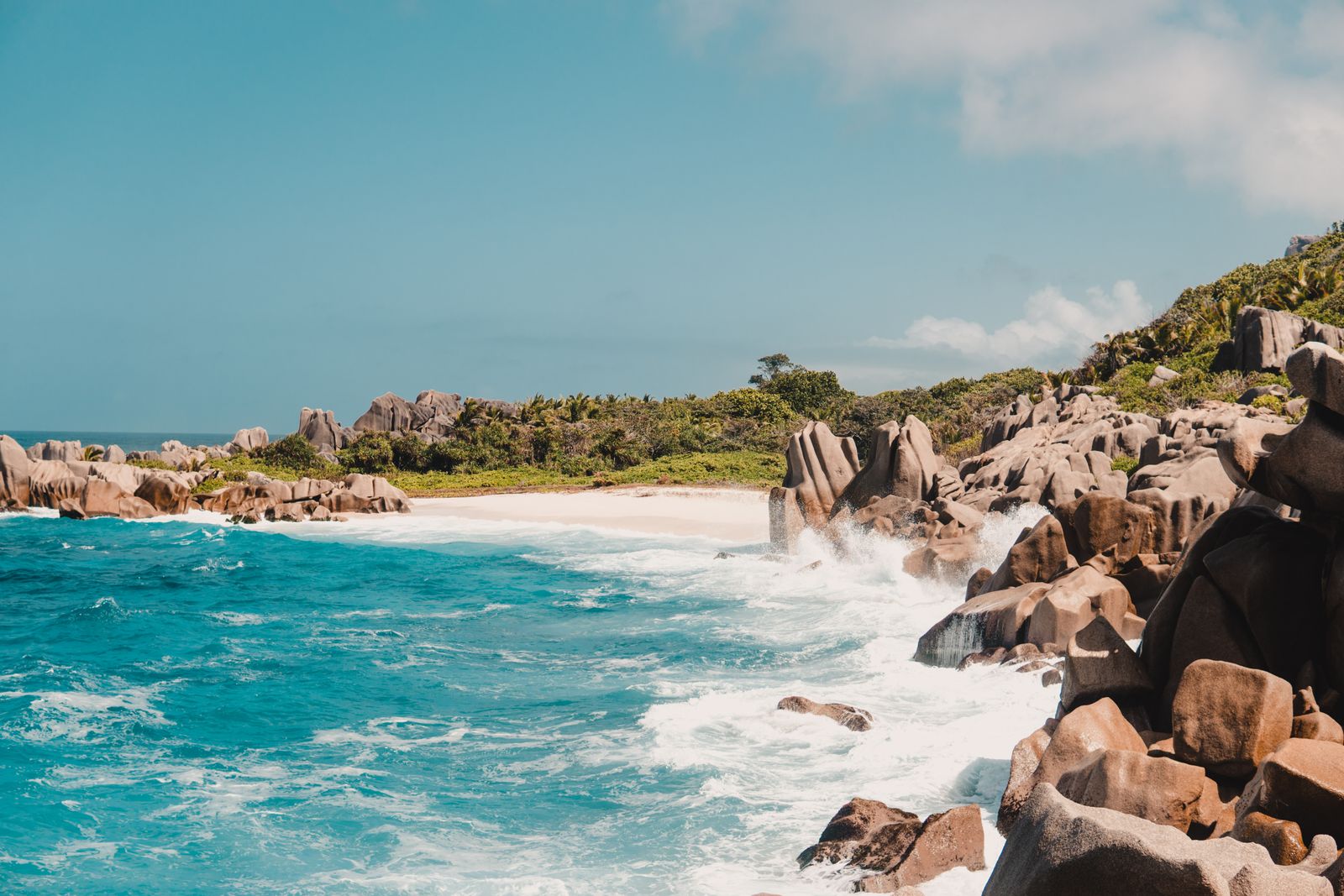
Shallow turquoise water between enormous pink granite boulders: one of the most photographed beaches on earth, accessible by bicycle across La Digue island from the ferry dock.

UNESCO: a primeval palm forest of coco de mer (the world’s largest seed) where the black parrot (endemic to Praslin) lives. General Gordon called it the original Garden of Eden in 1881.

UNESCO: the world’s second-largest coral atoll and the largest giant tortoise population (150,000 Aldabra tortoises) anywhere on earth. Accessible only by chartered liveaboard.

Consistently voted one of the world’s finest beaches: a wide arc of white sand between granite headlands, with excellent snorkelling in the bay.

The tiny capital of Victoria (population 26,000) with its clock tower replica and the Morne Seychellois National Park’s cloud forest above the city.

A mangrove island reachable by day trip from Praslin: 300 free-roaming giant Aldabra tortoises on the beach and the old leper colony doctor’s house.

A strictly managed nature reserve: hawksbill turtles nesting on the beach, Seychelles warblers and fairy terns in the tree canopy.

The most accessible beach on Mahe: a 3km crescent of soft sand with watersports, snorkelling and the best sunset view from the island.
Breadfruit or plantain cooked in coconut milk with vanilla and nutmeg: the definitive Seychellois dessert, eaten at celebrations.
Fresh red snapper grilled whole with a sauce Creole of tomatoes, onion, chilli, thyme and lime: the most frequently eaten main course in the Seychelles.
A clear broth of mixed leafy greens (brede) with garlic, ginger and tomato: the daily vegetable soup of Seychellois households.
Cooked shark meat shredded and mixed with bilimbi (a sour fruit), onion and chilli: eaten as a condiment with rice dishes. A genuine Seychellois speciality.
A coconut and cacao Seychellois rum: smooth, tropical and the correct beach sundowner.
The local lager: cold, light and correct at any beach snack shack.
Strong black tea with evaporated milk: drunk throughout the day in every Seychellois home.
Lentils cooked in tomato sauce with cumin and coriander: Indian Ocean comfort food eaten with white rice at every family lunch.
Seychelles International (SEZ) on Mahé is the main gateway. Emirates, Etihad and Air France serve the main routes. The Indian Ocean island circuit (Mauritius, Maldives, Réunion) connects naturally. For trip planning, see the official Seychelles tourism portal.
💡 Emirates via Dubai (4h30 onward) is the most frequent option; British Airways operates seasonal direct Heathrow–Mahé flights. Dubai is the primary connecting hub.
💡 Paris has a year-round direct connection (Air France). Dubai is the hub of choice for most European travellers routing via the Middle East. Nairobi (3h) is the best African gateway.
💡 The Cat Cocos ferry (Mahé–Praslin 1h, Praslin–La Digue 15 min) is the primary inter-island transport; far cheaper than the domestic flight. Book in advance in high season.
💡 La Digue has no cars — bicycle and ox cart are the only transport. Mahé’s bus network (SCR 5 per trip) covers the coastal circuit and is one of the best-value transport networks in the Indian Ocean.
April–May and October–November are the inter-monsoon seasons — the calmest seas, lightest winds, best diving visibility and the most settled weather. The northwest monsoon (November–March) brings calm weather to the west coasts; the southeast trade winds (May–September) are stronger but the seas are clear and the whale sharks are in residence.
The Seychelles is one of the most expensive destinations in the world — comparable to the Maldives, with the Seychellois Rupee (SCR) as currency. Budget travel is possible but limited; the island group rewards those who invest.
Octopus curry — slow-cooked octopus in a coconut milk, turmeric, ginger and Creole spice base — is the Seychelles’s most beloved dish.
The inter-island ferries (Cat Cocos high-speed catamaran: Mahé–Praslin 1h SCR 600; Praslin–La Digue 15 min SCR 400) are the only affordable inter-island transport for mid-range travellers; the 30-min domestic flight costs 3–4x more.
North Island (9 villas, William and Kate’s honeymoon destination, US$5,000–15,000/night) and Four Seasons Resort Desroches Island (private coral island, the finest diving resort) represent the extreme premium of the Seychelles market.
Mahé for one day, Praslin for two, La Digue for two, North Island or Denis Island for one, an outer atoll (Aldabra or Alphonse) for one. The Seychelles — 115 islands in the western Indian Ocean — is the finest archipelago on earth.
Mahé (the main island, 27km long, 8km wide) — Victoria (the smallest capital city in the world by population, 27,000) with the Seychelles Natural History Museum, the Mahé markets (fresh tuna, breadfruit, cinnamon bark, vanilla pods) and Beau Vallon beach for the first evening — a safe, sheltered bay on the northwest coast.
💡 The Seychelles was uninhabited when French explorers arrived in 1742 — one of the last habitable places on earth with no indigenous human population. The current Seylhellois Creole population (96,000) is almost entirely the result of French colonisation, African slave importation and Indian and Chinese indentured labour arriving in waves from the 18th to the 20th century.
30-min flight or 1h fast ferry. Praslin — the second island, home to the Vallée de Mai (UNESCO World Heritage Site, a 19.5-hectare primary palm forest where the coco de mer (Lodoicea maldivica) — the largest seed in the plant kingdom, resembling a human pelvis, weighing up to 25kg — grows in its last wild habitat). Gordon believed the Vallée de Mai was the original Garden of Eden.
💡 The coco de mer (Lodoicea maldivica) is endemic to Praslin and Curieuse islands in the Seychelles — the largest seed in the plant kingdom, taking 7 years to germinate and 25 years to produce its first seed. The palm can live 800 years and reaches 30m. Before the island was discovered, the coconuts washed up on Indian and Maldivian beaches as “sea coconuts” — believed to grow on the ocean floor; hence the name.
Anse Lazio (the finest beach in the Seychelles — a sheltered bay of pink-tinged granite boulders and crystal water, consistently ranked in the top 5 world beaches) and the Praslin National Park (the only habitat of the Seychelles black parrot (Coracopsis barklyi), endemic to Praslin, with fewer than 1,000 individuals — the rarest parrot in Africa and one of the most restricted bird ranges on earth).
💡 The Seychelles black parrot is endemic only to Praslin island — an area of 37km². It feeds on native palm fruits and is entirely dependent on the Vallée de Mai ecosystem. The population was estimated at 580–920 individuals in 2015; habitat loss and nest site competition are the primary threats.
15-min boat from Praslin. La Digue (the third island, 10km², population 3,000, no cars — transport by bicycle and ox cart) — Anse Source d’Argent (the most photographed beach in the world — the giant pink granite boulders, smooth and sculpted by millennia of wave action, above turquoise water and white sand) and the vanilla plantations in the island interior.
💡 Anse Source d’Argent appears in more advertising photographs, Instagram posts and travel magazine features than any other beach in the world. The giant granite boulders (precambrian granite, 750 million years old — the Seychelles are the only mid-ocean island group consisting of continental granite rather than volcanic basalt) are the result of millennia of differential weathering.
A full day by bicycle — La Digue is 9km long and entirely rideable in half a day — the Grand Anse (rougher, often empty), the Nid d’Aigle viewpoint (the highest point on the island, 333m, with views across the island chain), and the L’Union Estate (a restored vanilla and copra plantation with a population of Aldabra giant tortoises roaming the grounds).
💡 The Aldabra giant tortoise (Aldabrachelys gigantea) is the only surviving giant tortoise species in the Indian Ocean (the Galapagos giant tortoise is a separate species). The Aldabra Atoll holds the world’s largest wild population (100,000+). Tortoises on La Digue and Mahé are introduced populations; the Aldabra wild population is the authentic source.
Denis Island (a flat coral island with 25 villas, the finest sport fishing in the Seychelles, green turtle nesting on the beach and a resident colony of 2,000 sooty terns) or North Island (9 exclusive villas, the most expensive hotel in the world by some measures, at US$5,000–15,000/night, where William and Kate honeymooned in 2011) for a day of complete isolation.
💡 North Island was purchased in 1997 and converted into a 9-villa conservation resort — the team cleared invasive species, restored native vegetation and reintroduced Seychelles white-eye, Seychelles magpie-robin and giant tortoises that had been extinct on the island. It combines the world’s most exclusive resort with one of its most ambitious island restoration projects.
Alphonse Island (45-min charter flight, a coral atoll in the outer Seychelles with the finest bonefishing flats in the world, pristine reef and no other development) or St. François Atoll (UNESCO-listed, accessible by liveaboard, 400km of untouched reef). Fly from Mahé (SEZ).
💡 Alphonse’s bonefishing (Albula vulpes — the bonefish, a shallow-water flats fish that is the pinnacle of saltwater fly fishing, for its speed, intelligence and the aesthetic challenge of sight-fishing on clear flats) is considered the finest on earth — the flats are undisturbed, the fish large and plentiful, and the setting a remote coral atoll 400km from the nearest town.
Cat Cocos and Inter Island ferries link Mahe, Praslin and La Digue. Helicopter charters for speed.
A guesthouse (auberge): EUR 80-150/night. A resort: EUR 300-1,000+/night.
Unhurried, music-loving and generous.
La Digue has almost no cars; rent a bicycle from the ferry dock (SCR 100/day).
The Seychelles is relatively sheltered but cyclones can still affect travel. Insurance is recommended.
Available at Mahe airport. 4G on the Inner Islands.
Six Senses, Fregate and North Island are all 6-12 months ahead for peak season.
Before 10am it is empty. After 11am it has 200 tourists.
Book inter-island ferry tickets between Mahé, Praslin and La Digue — the main way to travel between islands.
FreeRide-hailing available on Mahé — limited drivers but useful for airport and hotel transfers.
FreeBook whale shark snorkelling, Vallée de Mai nature reserve entry, island-hopping and Seychelles tours.
FreeThe Seychelles’ primary messaging platform — essential for contacting guesthouses and boat operators.
FreeBook guesthouses and villas across the islands — La Digue accommodation is very limited; book early.
FreeBook self-catering villas and bungalows — often better value than hotels in the Seychelles.
FreeThe world’s smallest capital, an easy beach hub, the Garden-of-Eden island, the ox-cart isle and a rainforest wilderness — five sides of the Seychelles.
Seychelles sits within easy reach of several other destinations — each with a completely different character.


