CW
Curaçao
Painted Dutch colonial harbour, blue liqueur & Caribbean wall diving
Painted Dutch colonial harbour, blue liqueur & Caribbean wall diving
Curaçao is the largest and most culturally rich of the ABC islands — a Dutch Caribbean island off the coast of Venezuela with a capital, Willemstad, of architectural beauty. The Handelskade waterfront — a row of tall, brightly painted Dutch colonial merchant houses reflected in the Sint Annabaai channel — is one of the most photographed streetscapes in the Caribbean and a UNESCO World Heritage Site. Curaçao’s Papiamentu language (a creole blending Dutch, Spanish, Portuguese, African and Arawak elements), its Afro-Caribbean drum music (tambú), its outstanding diving (dramatic walls, wrecks including the Superior Producer and healthy coral) and the famous Curaçao liqueur (distilled from the dried peel of the laraha citrus, unique to the island) make it the most culturally layered island in the Dutch Caribbean.
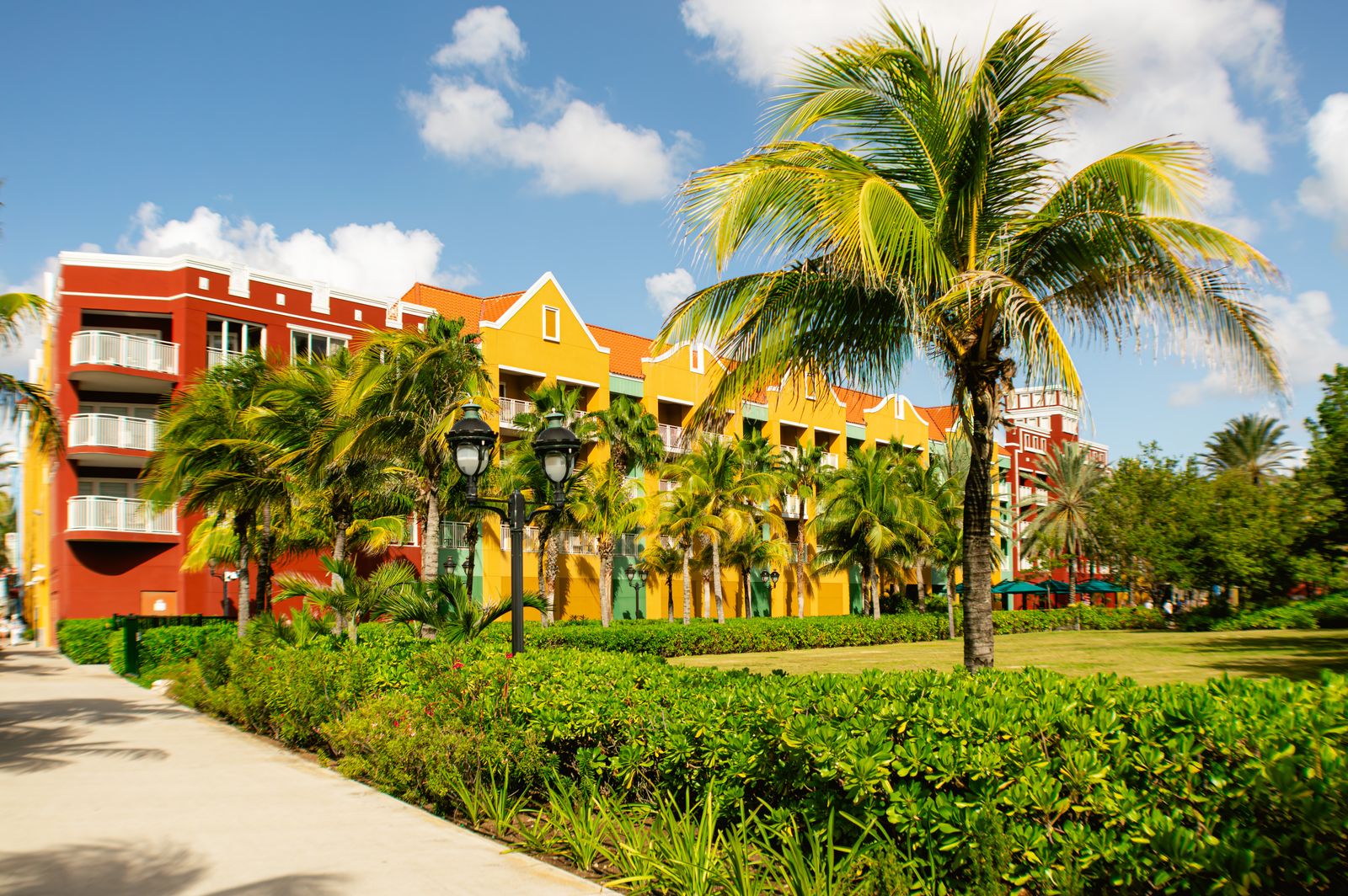
A UNESCO World Heritage Site — the Handelskade waterfront of 17th-19th century Dutch merchant houses in every pastel shade, the Pontoon Bridge (Emma Bridge, a floating pedestrian bridge that swings open for ship traffic), the octagonal Fort Amsterdam (still housing the Governor’s Office) and the Punda and Otrobanda neighbourhoods form one of the Caribbean’s most distinctive and beautiful urban environments.
Curaçao’s west coast has over 65 named dive sites along a sheltered, current-free coastline of dramatic wall dives starting in 5 metres of water. The Superior Producer wreck (a 1977 cargo ship at 30m, encrusted with soft corals and visited by eagle rays and sea turtles), the tugboat wreck at 5m and the coral gardens of Mushroom Forest are Caribbean diving highlights.
The wild northwestern quarter of the island — a national park of dry thorn forest, towering cacti, roaming white-tailed deer and the summit of Mount Christoffelberg (375m) — the highest point on the island with views across to Venezuela. The park has petroglyphs from Arawak inhabitants and several endemic bird species.
Cura%C3%A7ao (Wikipedia) →A hollowed round of Gouda or Edam stuffed with spiced chicken, olives, raisins and capers and baked — the Dutch Caribbean national dish.
Braised goat stew with local vegetables, tomato and Curaçao spices — the most traditional Curaçaoan home dish, slow-cooked until the goat is completely tender and the sauce is thick and aromatic. Eaten with funchi (cornmeal porridge) or pan bati.
A firm cornmeal side, similar to polenta, served with stews and fish.
The original orange liqueur, made by Senior & Co. at Landhuis Chobolobo since 1896 from the peel of the bitter laraha orange; the bright blue version is just coloured.
Hato International (CUR) is a well-connected hub. KLM connects via Amsterdam; American Airlines via Miami; Avianca via Bogotá. Curaçao’s location outside the hurricane belt makes it a year-round destination. For trip planning, see the official Curaçao tourism portal.
Amsterdam is the primary European gateway — KLM direct AMS–CUR in 10h, with excellent connections from the UK via Amsterdam. Curaçao is a constituent country of the Kingdom of the Netherlands.
Miami (3h) is the most convenient US gateway. Bogotá (2h) makes Curaçao a natural extension of a South America trip.
The Queen Emma Pontoon Bridge is free to cross on foot (it swings open for passing ships). Willemstad is compact and walkable; most attractions are within a 20-minute walk of the waterfront.
Car hire (US$40–70/day) is the best option for the beaches and national park — most west coast beaches are 30–45 min from Willemstad on good roads. Drive on the right.
Curaçao sits outside the hurricane belt and is the most reliably sunny Dutch Caribbean island year-round. December to April is the driest period (26–29°C). May to November brings occasional showers but the trade winds keep it pleasant. The island averages 330 sunny days per year.
Curaçao uses the Netherlands Antillean guilder (ANG) at a fixed rate of ANG 1.79 = US$1, and USD is widely accepted. It is mid-range — less expensive than the Dutch islands of Sint Maarten or Bonaire’s dive resorts.
Keshi yena — the national dish of Curaçao (a whole Gouda or Edam cheese shell filled with slow-braised chicken or beef, olives, capers, raisins and Angostura bitters, then baked in the oven until the cheese shell melts around the)
The Curaçao liqueur cocktail (Senior Blue Curaçao + fresh lime + rum or vodka, served over ice with a sugar rim) is available at every bar in Willemstad from ANG 8–15 (US$5–8).
Baoase Luxury Resort (Willemstad, the finest boutique hotel in Curaçao, 35 suites on the sea, from US&dollar)
Willemstad for two days, the Christoffelberg for one, Cas Abao beach for one, Klein Curaçao for one, the east coast for one, the Curaçao liqueur distillery for one. Curaçao — one of the ABC islands of the Dutch Caribbean — is one of the most architecturally distinctive islands in the Caribbean.
Willemstad (UNESCO World Heritage Site) — a capital split between Punda and Otrobanda by the Sint Annabaai channel, with the most photogenic waterfront in the Caribbean: a 200m row of 17th–18th century Dutch colonial townhouses painted in saturated yellows, pinks, oranges and greens, reflected in the harbour. The Queen Emma Pontoon Bridge (a 167m floating bridge on 16 pontoons, swinging open for ships, the most famous bridge in the Caribbean).
The colourful buildings of Willemstad were not always coloured — they were originally whitewashed. According to local legend, a Governor-General in the 18th century suffered migraines from the glare of the white walls and issued an edict mandating that buildings be painted any colour other than white. Architectural historians have found no documentary evidence of this, but the story is told by every Curaçaoan guide.
The Drijvende Markt (Floating Market — Venezuelan fishing boats moored at the Sha Caprileskade, selling fresh fruit, vegetables and fish directly from their boats every morning since the early 20th century) and Fort Nassau (a 1797 fort on a 70m hill above the harbour, with 360-degree views of the entire island and the Klein Curaçao island in the distance) and the Mikveh Israel-Emanuel Synagogue (1732, the oldest continuously active synagogue in the Americas).
The Mikveh Israel-Emanuel Synagogue (consecrated 1732) is the oldest synagogue in continuous use in the Americas. The Curaçao Jewish community (Sephardic, descended from Portuguese Jews who fled the Inquisition via Amsterdam and Brazil) founded the congregation in 1651 — 81 years before the current building. The sandy floor of the synagogue recalls the sandy floors used by secret Jews in the Inquisition period to muffle the sound of prayer.
The Christoffel National Park (4,450 hectares, the largest protected area in Curaçao) — the Christoffelberg (375m, the highest point on the island, a 3–4h round-trip hike through the dry scrub forest of the northwest, with views of Venezuela (60km) on clear mornings) and the white-tailed deer (Odocoileus virginianus curassavicus — a subspecies endemic to Curaçao, almost extinct by 1980, now 300+ after intensive protection).
The Curaçao white-tailed deer is the smallest subspecies of white-tailed deer in the world — adults weigh 30–40kg, compared to 90kg+ for mainland North American white-tails. Adapted over millennia to the island’s dry, sparse scrub environment, the population was near-extinct in the 1980s and has been rescued by the Christoffel National Park protection programme.
The west coast beach circuit — Cas Abao (the finest beach in Curaçao — a 300m arc of white sand backed by cliffs, with calm, clear turquoise water and the best snorkelling on the island from the northern point), Playa Lagun (a narrow fjord-like inlet with wall diving directly from the beach) and Playa Porto Marie (a wide, developed beach with calm water and a coral nursery project offshore).
Curaçao’s dive sites are consistently rated among the best in the Southern Caribbean — the lack of hurricanes means coral development is uninterrupted, and the island’s position outside the hurricane belt has created some of the most intact wall and pillar coral formations remaining in the Caribbean. Tugboat Beach has a deliberately sunk tugboat at 5m depth, the most accessible wreck dive in the region.
2h boat trip from Willemstad. Klein Curaçao — a small, flat, uninhabited island 15km southeast of Curaçao, with a white sand beach on the Caribbean side and a rough Atlantic shore on the windward side, a decommissioned lighthouse and some of the clearest water in the Southern Caribbean — is a full-day escape from the main island.
Klein Curaçao (Small Curaçao) is technically part of Curaçao’s territory and is uninhabited except for occasional fishermen. Sea turtles nest on its beaches from May to October; the island is a critical loggerhead and green turtle nesting site. Day-trip boats operate from the Bapor Kibra marina in Willemstad.
The east coast of Curaçao — Playa Kanoa (a natural sea pool in the volcanic rock, accessible at low tide), the Hato Caves (a 25-million-year-old limestone cave system with stalactites, stalagmites and prehistoric Arawak rock paintings, inhabited by 3 species of fruit bats) and the Ostrich Farm (a working ostrich farm that is also the largest in the Caribbean).
Hato Caves contain Arawak rock paintings and petroglyphs dating from approximately 2,000 years ago — the Arawak people were the pre-Columbian inhabitants of Curaçao, displaced or absorbed by the Spanish after 1499. The cave art includes sun symbols, abstract geometric patterns and stylised human figures, the only surviving pre-Columbian artistic tradition in the Netherlands Antilles.
The Senior Curaçao of Curaçao Distillery (Landhuis Chobolobo — the original producer of Curaçao liqueur, distilling since 1896 from the dried peel of the laraha citrus fruit — a bitter orange that evolved from Valencia oranges planted by the Spanish, adapted to the island’s dry climate — mixed with neutral alcohol, sugar and spices). The original production is Blue Curaçao (artificially coloured) but the natural product is amber. Fly from Hato (CUR).
The laraha orange (Citrus aurantium var. currassuviensis) evolved from Valencia oranges planted by the Spanish in the 15th century; unable to thrive in the dry Curaçaoan soil, the fruit became small, bitter and virtually inedible but the peel developed an intensely aromatic oil. Dried laraha peel has been used to flavour spirits since the 17th century; the Senior distillery trademarked the liqueur in 1896.
Most nationalities including EU, UK, USA enter visa-free; check specific requirements.
Connections from Amsterdam (KLM direct), Miami, Bogota and regional Caribbean islands.
The ANG is pegged to USD at 1.79:1. USD widely accepted; cards work throughout.
The Dutch colonial town of Willemstad with its pastel-coloured merchant houses (17th-18th century) is UNESCO-listed. The floating Queen Emma pontoon bridge opens to let ships pass — a free ferry takes pedestrians across.
Like Aruba, Curaçao sits below the hurricane belt — a reliable year-round destination.
Car hire essential for exploring beyond Willemstad — the bus network is limited.
Quick answers to the questions people most often ask before visiting Curaçao.
Fly into Hato International Airport (CUR). There are direct flights from Amsterdam (about 10 hours), Miami (about 3 hours) and New York, plus connections via Bogotá.
No — Curaçao lies south of the main hurricane belt, which makes it a reliable year-round destination with around 330 sunny days a year.
Any time of year. December to April is the driest period (26–29°C); May to November brings occasional showers, but the trade winds keep it pleasant.
The official currency is the Netherlands Antillean guilder, being replaced by the new Caribbean guilder, at a fixed rate of about 1.79 to the US dollar. US dollars are widely accepted and cards work throughout.
A hire car is the best way to explore beyond Willemstad and reach the western beaches, as buses are limited.
Point your camera at menus, signs or street text for instant translation. Download the language pack offline before you arrive for full use without data.
FreeReal-time and offline exchange rates for all world currencies — converts prices instantly so you always know what you are paying in your home currency.
FreeFind and book hotels, guesthouses and apartments with free cancellation on most rates — one of the widest selections of accommodation worldwide.
FreeBrowse millions of traveller reviews for restaurants, attractions and hotels — helps identify the best local spots and avoid tourist traps.
FreeCuraçao sits within easy reach of several other destinations — each with a completely different character.
Curaçao is one of the world’s least-visited places. See all 90 in our guide to the world’s least-visited countries & territories.


