MO
Macau
Portuguese fado meets Chinese fireworks over the world’s biggest casino
Portuguese fado meets Chinese fireworks over the world’s biggest casino
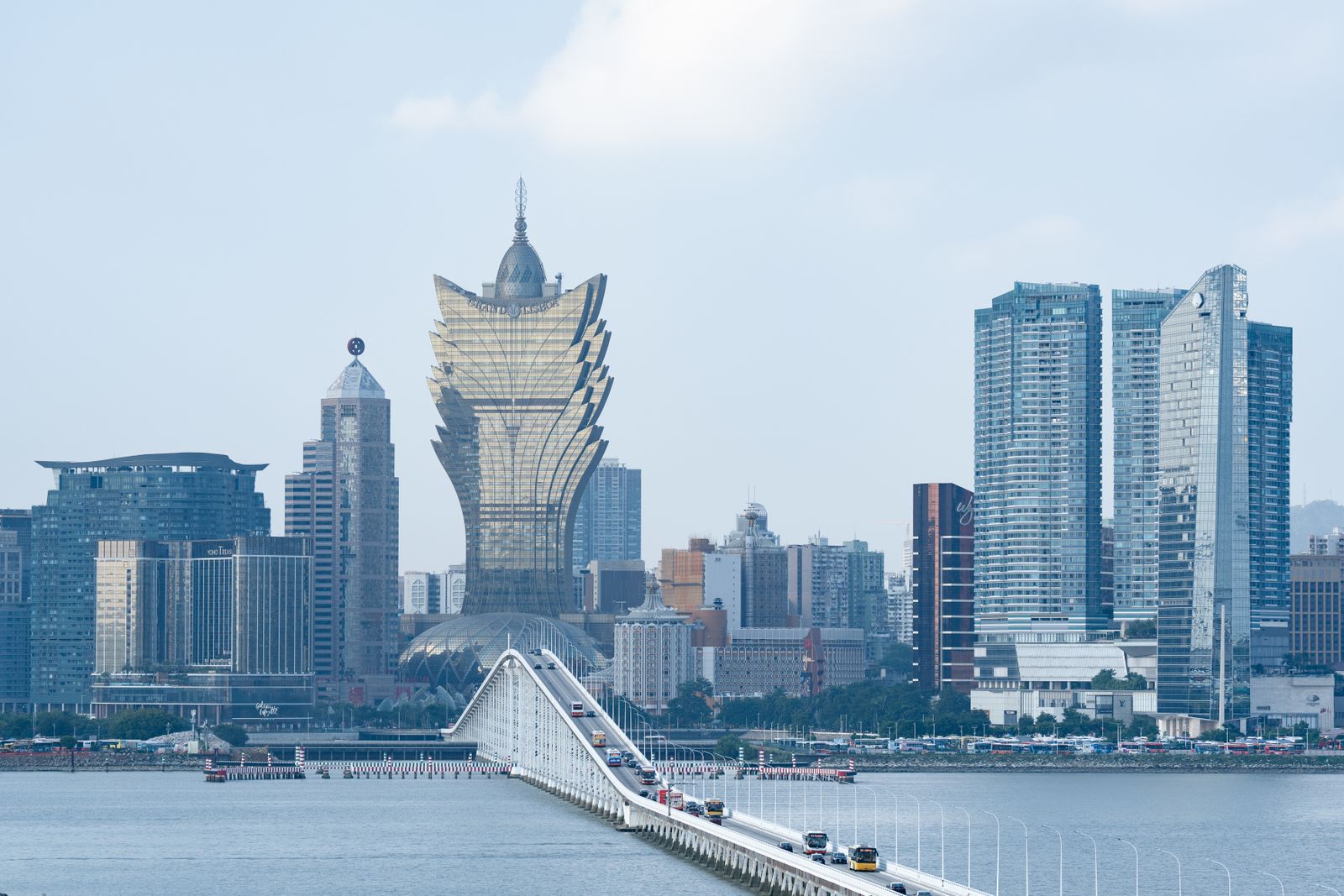
Macau is Asia’s most improbable destination — a tiny peninsula and two islands on the South China Sea that were a Portuguese colony for 450 years, and since 1999 a Special Administrative Region of China. The result is a city of cultural collision: the Ruins of St Paul’s Cathedral and the Monte Fortress face China’s largest casino floor across a street; Portuguese pastel de nata bakeries stand next to Cantonese dim sum restaurants; and a UNESCO-listed historic centre of European-style streets, baroque churches and Chinese temples coexists with the neon excess of the Cotai Strip — Las Vegas transposed to Asia, and considerably larger. Macau handles more gambling revenue than any other city on earth — more than six times Las Vegas — yet its UNESCO heritage and Portuguese-Chinese fusion culture are equally striking.
The façade of the 17th-century Cathedral of St Paul — all that remains after the 1835 fire — is Macau’s defining image: five tiers of intricate stone carvings blending European Baroque with Chinese and Japanese imagery. The adjoining Monte Fortress, built by the Jesuits in the early 17th century, overlooks the entire peninsula and houses the Macau Museum inside its walls.
Twenty-five historic monuments and public spaces are inscribed as a UNESCO World Heritage Site — the Senado Square with its wave-pattern black-and-white Portuguese pavement, A-Ma Temple (the oldest in Macau, 1488), the Mandarin’s House (a compound of 60+ rooms), the Protestant Cemetery and the neoclassical Lou Kau Mansion form a historic precinct unlike anywhere else in Asia.
The Cotai Strip — built on reclaimed land between Taipa and Coloane — contains the world’s largest casino floor (The Venetian Macao), replicas of Venice’s Grand Canal, the MGM Cotai, the Morpheus tower (designed by Zaha Hadid) and dozens of other mega-resort properties whose combined scale exceeds Las Vegas. Even non-gamblers are dazzled by the sheer improbability of the spectacle.
The southernmost island, Coloane, retains a quiet Portuguese village character quite different from the casino frenzy of the mainland — Coloane Village’s Chapel of St Francis Xavier, pastel houses and village square with the famous Lord Stow’s Bakery (inventor of the Macanese egg tart) offer the most peaceful corner of Macau.
Galinha à Africana — grilled chicken in a spicy coconut and peanut sauce, a Macanese signature.
Minced meat and diced potato fried with soy sauce, often topped with a fried egg — Macanese home cooking.
The classic Portuguese soup of shredded kale, potato and chourico sausage — one of the dishes that survived intact from the Portuguese colonial period and is served today at Macanese restaurants as an authentic link to Lisbon’s tavern culture.
Salt-dried Norwegian cod reconstituted and cooked in dozens of ways — another Portuguese legacy fully absorbed into Macanese cooking. Bacalhau à Bras (shredded with eggs and olives) and bacalhau com natas (baked in cream) are the most common preparations in Macau.
Portuguese-style egg tarts; Lord Stow’s Bakery in Coloane made them famous in Macau. Dim sum and roast pigeon are other local favourites.
Macau International (MFM) handles regional flights; most international visitors arrive via Hong Kong (HKG) by ferry or helicopter. The Macau ferry terminal connects to multiple Pearl River Delta cities. For trip planning, see the official Macao tourism portal.
Most visitors arrive from Hong Kong by ferry (1h, departing every 15–30 min from multiple terminals). The HKIA direct ferry is the most convenient for international arrivals — no need to clear HK immigration.
Macau Airport (MFM) handles direct connections from Southeast Asia and Taiwan. Most European and long-haul visitors route through Hong Kong and take the ferry.
The Taipa Ferry Terminal is more convenient for the Cotai Strip; the Outer Harbour terminal is closer to the historic Peninsula. Both run frequent services to Hong Kong.
The free casino shuttle buses (connecting all major Cotai resorts to both ferry terminals, the border gates and the airport) are the best free transport in Asia — anyone can board regardless of whether they plan to gamble.
October to December is the best window — cool and dry (18–25°C), the Grand Prix in November, the air clear. March to May is also pleasant. June to September is hot and humid (28–33°C) with typhoon risk. January and February are the coolest months but busy with Chinese New Year.
📅 Macau is in its best season in January, February, March, April, October, November, December. See where else is good to go in those months, or browse where to go by month.
Macau uses the Macanese Pataca (MOP), pegged to the Hong Kong dollar at approximately 1:1. Overall mid-range; cheap eats are excellent, but hotels around the Cotai Strip are expensive.
Minchi (minced pork or beef fried with onion, potato, soy sauce, Worcestershire and a fried egg on top)
Bacalhau (salt cod — the defining ingredient of Portuguese cuisine, prepared in dozens of ways in Macau: bacalhau à Brás with egg and potato, bacalhau com natas in cream sauce, bacalhau grelhado grilled with olive oil)
Macau has more Michelin-starred restaurants per km² than almost any other city — 22 starred restaurants in a territory of 32km², including three 3-star restaurants.
Peninsula historic sites for two days, Cotai Strip for one, Taipa Village for one, Coloane for one, Macau Tower for one, Grand Prix circuit for one. Macau — the world’s most densely populated territory and its largest gambling hub — combines 450 years of Portuguese colonial heritage with the energy of the world’s richest casino district.
Macau Peninsula — the original Portuguese settlement (1557–1999, the longest European colonial presence in Asia) with the Ruins of St Paul (the façade of the 17th-century Jesuit cathedral of Mãe de Deus — the most elaborate piece of Christian religious architecture in East Asia, a Baroque stone façade decorated with Chinese carvings of camellias, chrysanthemums and a ship) and the Senado Square (Largo do Senado — Portuguese wave-pattern cobblestone square surrounded by yellow and white colonial buildings, the heart of Macau’s UNESCO Historic Centre).
The Ruins of St Paul are all that remain of the Mãe de Deus church (1602–1640), destroyed by fire in 1835. The stone façade survived because it was built separately from the wooden church structure. The carvings are a unique fusion: the Jesuit missionaries employed Japanese Christian craftsmen who incorporated East Asian floral motifs alongside European Christian iconography.
The Fortaleza do Monte (a 17th-century Portuguese fortress above the ruins with cannon still in position and the Macau Museum inside) and A-Ma Temple (the oldest temple in Macau, dedicated to Matsu the sea goddess, founded 1488 — the name “Macau” derives from “A-Ma-Gao” meaning Bay of A-Ma — with the incense coils hanging from the beams and the granite carvings of the fishing fleet).
A-Ma Temple (1488) predates the Portuguese arrival in Macau by 69 years, making it older than the colony itself. The temple was founded by Fujianese fishermen who settled in the area before Portuguese contact. The name “Macau” derives from Portuguese sailors misunderstanding the name of the bay (“A-Ma-Gao”, Bay of A-Ma) as the name of the entire territory.
The Cotai Strip (a land reclamation between the islands of Taipa and Coloane, built from 2007 onward, containing the largest concentration of integrated casino-resort hotels in the world — The Venetian Macao (the largest casino in the world at 546,000m², with 3,000 slot machines, a replica Grand Canal with gondolas and 3,000 hotel suites), the Parisian Macao (a half-scale Eiffel Tower) and the MGM Cotai).
Macau overtook Las Vegas as the world’s largest gambling market in 2007 and by 2013 was generating 7x the gambling revenue of the Las Vegas Strip. At its peak (2014), Macau’s casino revenue was US$45 billion per year — more than the GDP of many countries. The market contracted sharply after the 2015 anti-corruption crackdown in mainland China, which reduced VIP gambling significantly.
Taipa Village — the original village of the island of Taipa (now surrounded by the Cotai casino developments but intact, a grid of pastel-painted Portuguese colonial houses, a church, a covered market and the finest traditional Macanese restaurants) with the Taipa Houses Museum (five restored Portuguese colonial villas from 1921 showing the domestic life of Macanese families at the height of the Portuguese era).
The Macanese people (the community of mixed Portuguese-Chinese, Portuguese-Malay and Portuguese-African descent that developed during the Portuguese colonial era) speak Patuá — a Portuguese-based creole incorporating Cantonese, Malay and English elements. Patuá is now spoken by fewer than 50 people (mostly elderly) and is considered critically endangered by UNESCO.
15 min from Taipa. Coloane — the southernmost and quietest island, still largely undeveloped, with the Hac Sa Beach (the only natural black sand beach in Macau, backed by a forest park), the Lord Stow’s Bakery (in Coloane Village — the original source of the Macanese egg tart (pastel de nata), founded by Andrew Stow in 1989, which became the most famous food export of Macau, now copied throughout Asia) and the Chapel of St Francis Xavier.
Lord Stow’s egg tart (pastel de nata) — Andrew Stow’s 1989 adaptation of the Portuguese pastel de Belém, baked in a flakier, richer shortcrust pastry shell rather than the puff pastry of the Lisbon original, with a less sweet egg custard — was so successful that it spread throughout the former Portuguese colonial world. It is now the defining street food of Hong Kong and is sold in hundreds of franchises across Asia.
The Macau Tower (338m, the 10th-tallest tower in the world at time of construction, with the world’s highest commercial bungee jump from 233m — designed by AJ Hackett — and the SkyWalk (an external walk around the circumference of the tower at 233m with no guardrail, only a harness) and the finest panorama of the Pearl River Delta: Macau’s peninsula, Taipa, Coloane, Hengqin Island and on clear days the skyscrapers of Zhuhai, Shenzhen and Hong Kong.
The Macau Tower bungee jump (233m, the world’s highest commercial bungee) was designed by AJ Hackett, the New Zealander who commercialised bungee jumping in 1988 from the Eiffel Tower. The tower’s observation deck and SkyWalk are open daily regardless of whether one jumps; the external walk (233m, no guardrail, tethered harness) costs MOP 688 and is one of the more extraordinary walks available in a major city.
The Macau Grand Prix street circuit (the Guia Circuit — a 6.2km street circuit through the hills above the Macau Peninsula, the oldest surviving street circuit in the world after Monaco, used since 1954 for the Macau Grand Prix, a race that has served as the proving ground for every Formula 1 driver of the past 40 years) and a final Macanese meal: minchi (minced pork or beef with potato, soy sauce and fried egg — Macau’s most beloved everyday dish). Fly from Macau (MFM) or Hong Kong (HKG).
The Macau Grand Prix (first run in 1954) is considered the most important motorsport race outside Formula 1 — the Formula 3 race is the traditional final audition for F1, and virtually every Formula 1 world champion of the past 30 years won at Macau before reaching F1: Ayrton Senna won in 1983, Michael Schumacher in 1990, Mika Häkkinen in 1990, David Coulthard in 1991.
Ferry from Hong Kong takes 55–75 minutes (Terminal at Taipa or Macau Outer Harbour). Direct flights operate from major Asian cities. Most visitors day-trip from Hong Kong.
The Hong Kong-Zhuhai-Macau Bridge (2018) and regular ferries from Hong Kong make Macau an easy day trip or weekend from Hong Kong.
The MOP and HKD are virtually interchangeable. Both widely accepted. Most casino transactions are in HKD. Cards everywhere.
While the Cotai Strip casinos generate more gambling revenue than Las Vegas, Macau’s historic Taipa village, Portuguese forts, barrack-style worker housing (bairros) and UNESCO World Heritage old city are its most rewarding attractions.
Visa-free for most nationalities for 30–90 days. Separate entry from mainland China — a China visa does not cover Macau.
Free shuttle buses run from all major casinos to the ferry terminal and airport — useful even for non-gamblers as they cover most of Cotai and the peninsula.
Quick answers to the questions people most often ask before visiting Macau.
Take a high-speed ferry (around 1 hour) from Hong Kong's ferry terminals or directly from Hong Kong International Airport, or a shuttle bus across the Hong Kong–Zhuhai–Macau Bridge. There's also a helicopter service.
Most nationalities can visit Macau visa-free for 30 to 90 days. Macau has its own entry rules, separate from mainland China — a Chinese visa isn't needed to visit Macau, and a Macau visit doesn't count as entering the mainland.
October to December is best — cool, dry and clear, with the Macau Grand Prix in November. March to May is also pleasant; June to September is hot and humid with typhoon risk.
The Macanese pataca (MOP), pegged to the Hong Kong dollar at almost 1:1. Hong Kong dollars are widely accepted, and casinos mostly work in HKD.
No — Macau's historic centre is a UNESCO World Heritage Site, with the Ruins of St Paul's, Senado Square and colonial Portuguese streets, and Taipa Village and Coloane offer Macanese food and quieter corners.
Point your camera at menus, signs or street text for instant translation. Download the language pack offline before you arrive for full use without data.
FreeReal-time and offline exchange rates for all world currencies — converts prices instantly so you always know what you are paying in your home currency.
FreeFind and book hotels, guesthouses and apartments with free cancellation on most rates — one of the widest selections of accommodation worldwide.
FreeMacau sits within easy reach of several other destinations — each with a completely different character.
Macau is one of the world’s least-visited places. See all 90 in our guide to the world’s least-visited countries & territories.


