HK
Hong Kong
Neon city where East meets West in style
Neon city where East meets West in style

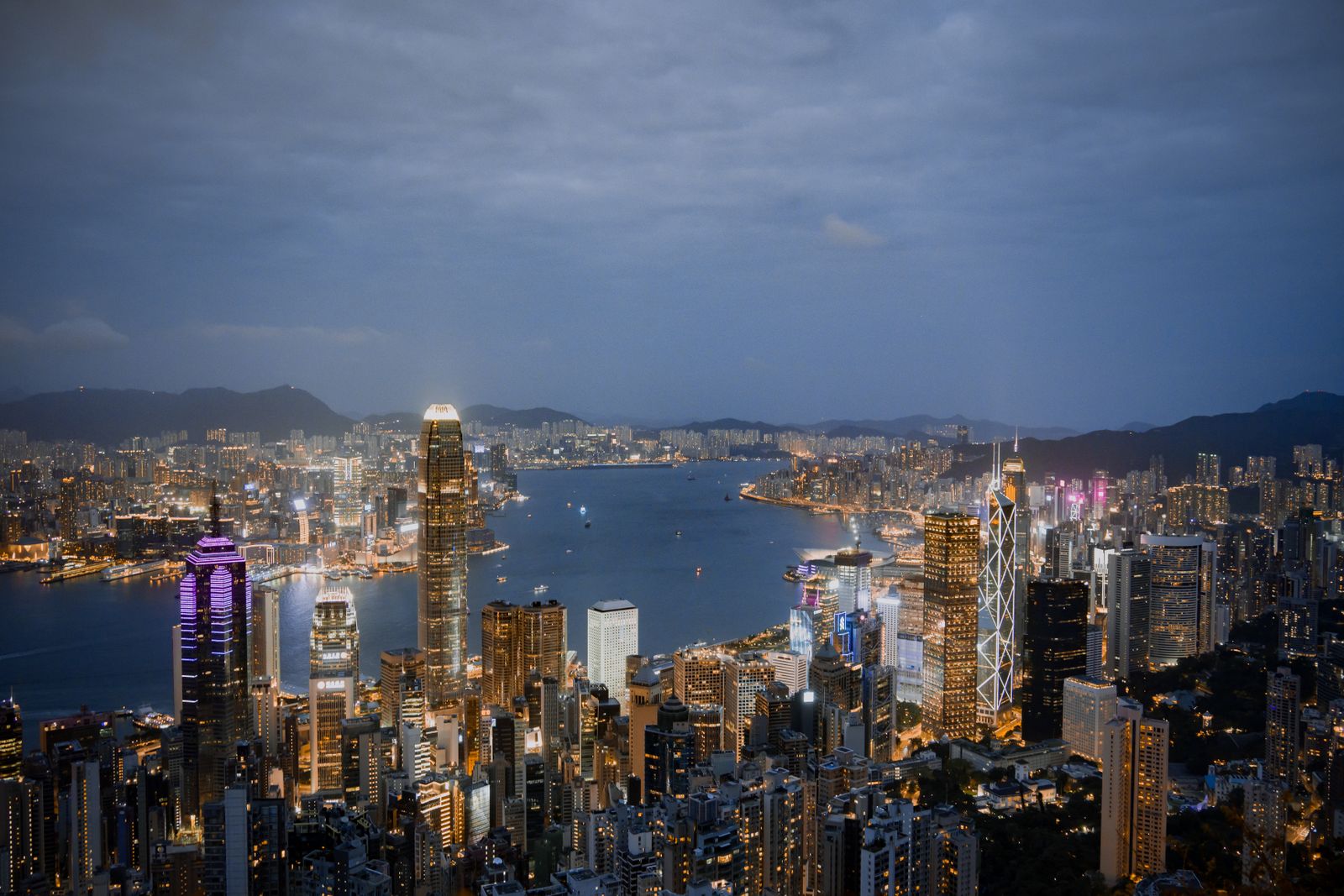
The world’s most dramatic harbour skyline: the Tsim Sha Tsui waterfront promenade, the Star Ferry crossing (16 minutes, USD 0.30) and the Symphony of Lights show at 8pm.
Photo: Haydn Hsin, CC BY-SA 3.0

The Peak Tram (the world’s steepest funicular, 1888) to Victoria Peak (552m): a 360-degree view of the harbour, Kowloon and the green hills.
Photo: Daniel Case, CC BY-SA 3.0

A Cantonese night market of fortune tellers, Cantonese opera and dai pai dong food stalls: the most atmospheric street in Kowloon after dark.
Photo: Wikimedia Commons contributor, CC BY-SA 3.0

A 34m bronze Buddha on a 268-step hilltop: accessible by cable car (Ngong Ping 360) over mountains and sea, with the Po Lin Monastery below.
Photo: Huangdan2060, CC BY 4.0

The most densely populated urban district on earth: the Goldfish Market, the Ladies’ Market, the Flower Market and the Jade Market in a grid of neon-lit streets.
Photo: Underwaterbuffalo, CC BY-SA 4.0

A 9km coastal ridge hike with 360-degree views of the South China Sea: the Dragon’s Back trail from Shek O passes above Big Wave Bay beach.
Photo: DearEdward from New York, NY, USA, CC BY 2.0

Hong Kong’s most authentic neighbourhood: electronics markets, fabric shops, dai pai dong seafood stalls and the cheapest dim sum in the city.
Photo: MICDWIM YAINZ RPMMO, CC BY-SA 4.0

A car-free island 35 minutes by ferry: the Bun Festival tower (May), a Taoist temple, fishing junks and the best seafood outside the city centre.
Hong Kong (Wikipedia) →Photo: Man77, CC BY-SA 3.0
Steaming bamboo baskets of har gow (shrimp dumplings), siu mai (pork dumplings), char siu bao (BBQ pork buns) and cheung fun (rice noodle rolls): the Sunday Cantonese brunch culture.
Crispy-skinned roast goose with plum sauce: a Cantonese speciality that Hong Kong does better than anywhere. Yung Kee in Central was the benchmark for 75 years.
Thin egg noodles in a clear prawn-and-pork bone broth with plump wontons: eaten for breakfast and late night at bamboo-and-plastic traditional noodle shops.
A flaky pastry shell with a silky baked egg custard: the definitive Hong Kong bakery item. Best eaten warm at Tai Cheong Bakery in Central.
Honey-glazed roast pork hanging in the window of every cha siu bao bakery: eaten over rice or in a bun.
Young Master Ales and Gweilo Beer are the most respected. A massive craft beer scene has developed in the last decade.
Strong Ceylon tea strained through a silk sock (hence the nickname) and blended with evaporated milk and sugar: the definitive Hong Kong cafe drink.
A sweet bun with a sugar-and-butter crackled crust (resembling a pineapple): split and filled with a cold pat of butter. The Hong Kong breakfast.
Hong Kong International (HKG) at Chek Lap Kok is one of the world’s busiest airports. Cathay Pacific is the home carrier. The Airport Express to Central takes 24 minutes — one of the best airport rail connections in the world. For trip planning, see the official Hong Kong tourism portal.
Cathay Pacific’s Heathrow–Hong Kong route (13h) is one of the great long-haul products in aviation — consistently top-rated Business and Economy cabins. Book 2–3 months ahead for the best economy fares.
Cathay Pacific operates a hub at HKG connecting East Asia to Europe and the Americas — Hong Kong is one of the world’s finest aviation hubs for connections with minimal transit time.
The Airport Express check-in service allows passengers to check bags at Hong Kong or Kowloon station up to one day before departure — bags are collected at the destination. The service is unique globally and transforms the departure experience.
The Octopus card (top up at MTR stations) covers MTR, ferries, trams, buses and even convenience stores — the most practical single card for any city transit system in the world. Pick one up at the airport.
October to December is ideal — clear skies, low humidity, comfortable temperatures (18–25°C), the harbour at its most beautiful. January to March is cool and sometimes drizzly but comfortable. April to September is hot, humid and typhoon-prone (June–September peak).
📅 Hong Kong is in its best season in October, November, December. See where else is good to go in those months, or browse where to go by month.
Hong Kong is expensive by Asian standards — comparable to London or Sydney for accommodation and restaurants. Street food and the MTR are among the best value in the world; the extremes are extreme.
The cha chaan teng (Hong Kong milk tea cafe) is a distinctly local institution — strong pulled black tea blended with evaporated milk, served hot or over ice, with buttered toast with condensed milk.
Dim sum (yum cha) at a traditional Cantonese restaurant — har gow (shrimp dumplings), siu mai (pork dumplings), char siu bao (barbecue pork buns), cheung fun — costs HK$100–250pp at a good mid-range restaurant.
Hong Kong has more Michelin-starred restaurants per capita than any city in the world — 71 starred restaurants including three with three stars (T’ang Court, Robuchon au Dôme, Lung King Heen).
The Peak and Central for two days, Kowloon for one, Lamma Island for one, Lantau and the Big Buddha for one, the New Territories for two. Hong Kong is dense and rewards a week of exploration.
The Star Ferry crossing from Kowloon to Central (7 minutes, HK$2.70, unchanged route since 1888) gives the finest view of the Hong Kong skyline — ranked among the greatest urban waterfront views in the world. The Escalator (the world’s longest outdoor covered escalator system, 800m from Central to Mid-Levels) for the street food and bar scene of SoHo.
The Wan Chai food market (Johnston Road) and the Temple Street Night Market (Kowloon) — cooked food stalls, fortune tellers, mahjong players — represent the old Hong Kong that persists beneath the skyscrapers.
The Peak Tram (funicular, 1888, 8-minute ascent, 373m vertical rise) to Victoria Peak (552m) — the view of the harbour and Kowloon peninsula and the Chinese mainland behind is one of the defining cityscapes on earth. The Avenue of Stars along the Tsim Sha Tsui waterfront for the Symphony of Lights (nightly 8pm, 44-building LED show).
The Peak Tram inclines at 27 degrees at its steepest — the buildings outside the window appear to lean dramatically. Buy tickets online to avoid the 1–2 hour queues at peak times. The best views are from the Sky Terrace 428 at the summit.
The Chi Lin Nunnery and Nan Lian Garden in Diamond Hill (Tang dynasty architecture, entirely wooden without nails, opened 2000): the finest traditional Chinese architecture in Hong Kong. The Kowloon Walled City Park (where the infamous lawless enclave of 33,000 people stood until 1993) with historical photographs and remnant walls.
The Kowloon Walled City (1947–1993) was a 0.026km² settlement of 33,000 people — the most densely populated place on earth at any time in history. The Chinese government and UK police had no jurisdiction; it was entirely self-governed. The park preserves its outline.
30-min ferry from Central to Yung Shue Wan. Lamma Island (population 6,000, no cars, beaches, seafood restaurants on stilts over the water) is the most accessible escape from urban Hong Kong. The 1h coastal path between Yung Shue Wan and Sok Kwu Wan passes caves, beaches and the island’s distinctive three wind turbines.
Lamma seafood at the Sok Kwu Wan seafood restaurants — choosing live fish and shellfish from tanks and having them cooked — costs HK$200–400pp for a generous feast. The restaurants project out over the water with views of the South China Sea.
40-min MTR to Tung Chung, then cable car (Ngong Ping 360). The Tian Tan Buddha (34m bronze, the world’s largest outdoor seated bronze Buddha) on Lantau’s highest plateau. Tai O fishing village (stilted houses over the water, one of the last traditional fishing communities in Hong Kong, shrimp paste production).
The cable car to Ngong Ping (5.7km, 25 minutes) over the Lantau mountains is the best scenic route in Hong Kong — crystal cabins give a 360-degree view over the island’s peaks and the South China Sea below. Close on rough weather days.
40 min from Central by MTR to Fanling or Sheung Shui. The Ping Shan Heritage Trail (Yuen Long): 800 years of Tang clan history in a well-preserved Hakka settlement — the oldest pagoda in Hong Kong, ancestral halls, a temple and a sung dynasty resting place. The Kam Tin walled village — a fully inhabited Hakka village with walls, moat and iron gates.
Kam Tin Wai (founded 15th century) is a Hakka walled village still inhabited by Tang clan descendants — approximately 400 people live within the original rectangular fortification, maintaining an agricultural community 45 minutes from Central.
30-min ferry from Central. Cheung Chau island (dumbbell-shaped, 25,000 residents, no cars, famous for its Bun Festival in April–May) for the morning market, the seafood lunch, and the 1h walk around the island past pirate caves and temples. Return to Central and fly from Hong Kong International (HKG).
Cheung Chau’s Bun Festival (May) involves 60-foot bamboo towers covered with sweet buns — the climbers race to the top to grab buns at midnight. Hong Kong’s most distinctively local festival and worth planning an itinerary around.
Fast, clean, cheap and covers almost everywhere. Octopus card for all transport.
HKD 2.70 (EUR 0.35) for the most scenic harbour crossing in the world.
A mid-range hotel: HKD 800-1,500/night. Street food: HKD 30-60.
English is official but Cantonese is used everywhere outside business.
All ferries from Central pier: Lantau, Lamma, Cheung Chau, Peng Chau.
Multiple operators: 3HK, CSL, SmarTone. Tourist SIMs from HKD 48 for a week.
A T8 signal closes the MTR. Check HKO.gov.hk for warnings.
Book weeks ahead for the most popular dim sum restaurants.
Quick answers to the questions people most often ask before visiting Hong Kong.
Fly into Hong Kong International Airport (HKG) — about 13 hours direct from London. The Airport Express reaches Central in about 24 minutes.
Many nationalities, including EU, UK and US citizens, can visit visa-free, typically for 90 days or more. Hong Kong has its own immigration rules, separate from mainland China.
October to December, with clear skies, low humidity and 18–25°C. January to March is cool and sometimes drizzly; April to September is hot, humid and typhoon season.
The MTR metro is fast, clean and covers almost everywhere; use an Octopus card for all transport. Don't miss the Star Ferry across Victoria Harbour — one of the world's great cheap rides.
Hotels are expensive — comparable to London — but street food and transport are cheap. Expect around HK$400–700 per day on a budget and HK$1,200–2,000 mid-range.
Hong Kong’s official metro app — plan journeys, check fares and top up your Octopus card for all transit.
FreeHong Kong’s universal transit and payment card app — tap to pay on MTR, buses, ferries, trams and shops.
FreeHong Kong’s most comprehensive restaurant guide — millions of reviews, menus and queue times.
FreeRide-hailing in Hong Kong — metered Green Cab taxis are also excellent and widely available.
FreeHong Kong’s dominant food delivery app — covers restaurants, dim sum and late-night options.
FreeBook Victoria Peak tickets, harbour cruises, Disneyland entry and Hong Kong experiences.
FreeSkyscraper-packed Central, neon Tsim Sha Tsui, the Big Buddha on Lantau, seafood-and-hiking Sai Kung and breezy Stanley — five very different sides of Hong Kong.
Hong Kong sits within easy reach of several other destinations — each with a completely different character.


