NF
Norfolk Island
Where the Bounty mutineers' descendants still live
Where the Bounty mutineers' descendants still live

A complete 18th-century British penal settlement preserved almost intact — UNESCO World Heritage Listed as part of the Australian Convict Sites, the Georgian stone buildings, barracks, granary and cemetery of the Second Penal Settlement (1825–1855) stand perfectly preserved in tropical gardens above the Pacific Ocean.
Photo: Keenan Cromwell, CC BY-SA 4.0

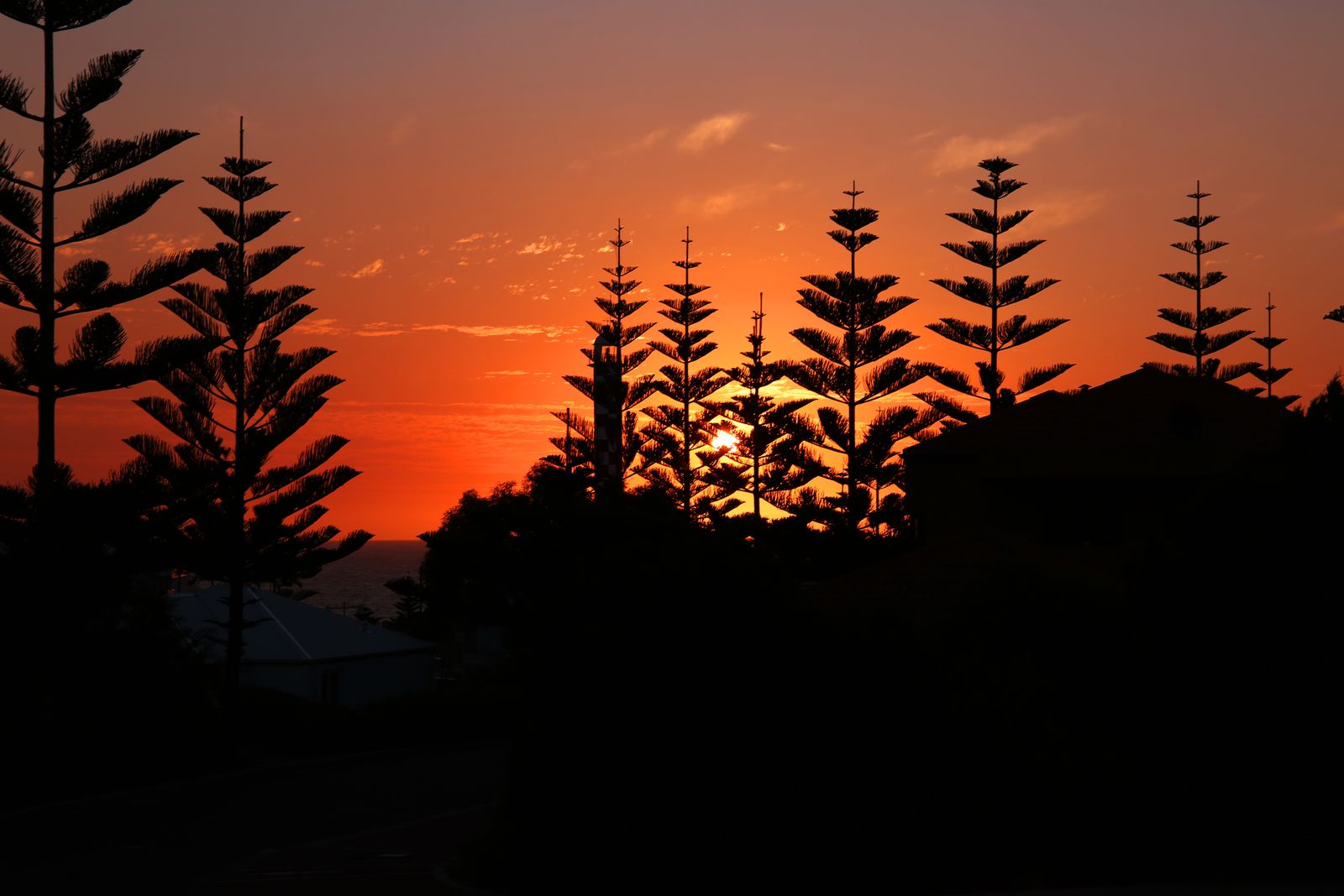
The Norfolk Island pine (Araucaria heterophylla) — one of the world’s most recognisable trees, tall, perfectly symmetrical pines taken by sailors worldwide as living masts. The island is blanketed in native forest; the tallest specimens exceed 50 metres.
Photo: thinboyfatter, CC BY 2.0

A perfectly calm turquoise lagoon enclosed by reef with excellent snorkelling — uniquely framed by Georgian convict buildings immediately behind the beach. The combination exists nowhere else on earth.
Photo: Inas, CC BY-SA 4.0
Graves of the Pitcairn descendants relocated to Norfolk in 1856 — surnames from the mutiny survive: Christian, Adams, Quintal, McCoy, Young. The community still speaks the unique Norf’k creole language created from 18th-century English and Tahitian.
The highest point on Norfolk Island at 319m — within national park forest with over 40 endemic plant species and the Norfolk Island green parrot, one of the world’s rarest parrots and a conservation success story.

A dramatic volcanic bay on the wild west coast with powerful surf, black rock formations and sunset views — accessible by road, completely undeveloped and one of Norfolk Island’s most striking natural vistas.
Norfolk Island (Wikipedia) →Photo: Inas, CC BY-SA 4.0
A thick split pea soup enriched with ham hock and Norfolk Island herbs — the defining winter comfort food, served at every local café. The Norfolk version uses local pumpkin and tomatoes to sweeten and deepen the traditional English recipe.
Fresh local trevally, kingfish and wahoo pan-fried in butter with lemon — the Wednesday night fish fry at the Leagues Club is a Norfolk institution where visitors join local families at communal tables. The freshest fish you will eat anywhere in the Pacific.
Polynesian sweet potato brought by the Pitcairn descendants — the Norfolk variety has orange flesh and great sweetness. Roasted, mashed or made into the traditional pilhai (sweet potato pudding) for celebrations.
Two island wineries using volcanic soil and subtropical climate — the wines are unusual for their latitude but locally produced and proudly served throughout the island’s restaurants and visitor centre.
Norfolk Island passion fruit (growing prolifically wild across the island) makes a good cheesecake topping — sharp, aromatic, intensely flavoured. Found at nearly every café and represents the island’s subtropical abundance.
Locally produced rum reflecting the Bounty connection — small batches for sale at the airport and local shops. The island’s signature spirit.
Norfolk Island Airport (NLK) is well-served by Australian cities. Air New Zealand and QantasLink serve the main routes. For trip planning, see the official Norfolk Island tourism portal.
Sydney, Brisbane and Melbourne all have direct services to Norfolk Island (2h30–3h). QantasLink is the primary carrier; book early as the small island has limited accommodation and flights fill during the school holiday periods.
Auckland (2h30, Air New Zealand) is the primary New Zealand connection. Norfolk Island is roughly equidistant between Sydney and Auckland, making it an easy add-on to either Australia or New Zealand visits.
Almost everything on Norfolk Island is within 15 minutes of the airport. The island has 80km of road; a complete circuit takes about an hour.
Norfolk Island has no public transport. Car hire (AUD 40–70/day) gives full independence; the island is so small that a tank of fuel lasts a week of driving.
Year-round is viable (18–24°C). October to May is the warmer period; June to September is cooler (17–20°C) but still pleasant. The island has no real dry season; rain falls in all months. The island is small enough to explore entirely in 4–5 days.
📅 Norfolk Island is in its best season in January, February, March, April, May, September, October, November, December. See where else is good to go in those months, or browse where to go by month.
The Australian dollar (AUD) is the currency. Comparable to Australian regional prices — moderate overall.
Norfolk Island saltfish and butter (the traditional local breakfast dish — salt cod desalted and pan-fried with local butter, served with fresh bread, the direct descendant of the Pitcairn Island cooking tradition carried from Tahiti)
Norfolk Island beef (the grass-fed cattle raised on the island’s rich volcanic pastures, producing a distinctive, well-marbled beef available at island restaurants and the island abattoir)
A private Bounty heritage dinner hosted by a Norfolk Island Pitcairn descendant family (sharing the story of Fletcher Christian and the mutiny, the Pitcairn years and the 1856 relocation, with traditional Pitcairn food including pilhai and duff)
Kingston for one day, Bounty heritage for one, national park and pines for one, Emily Bay for one, Mount Pitt for one, Bloody Bridge history for one, Sunday church for one. Norfolk Island — UNESCO convict settlement and Bounty mutineer colony — has the best-preserved Georgian architecture in Australia, critically endangered green parrots and the only speakers of the Pitkern language.
Kingston — the main town of Norfolk Island (an Australian territory of 34.6km² — 1,400km northeast of Sydney, population 2,200 — settled first by convicts from the First Fleet in 1788, then by the Pitcairn descendants of the Bounty mutineers in 1856, creating one of the most distinctive cultural blends in the Pacific) with Kingston and Arthur’s Vale Historic Area (UNESCO World Heritage — the best-preserved convict settlement in Australia, with Georgian buildings, the convict ruins, the cemetery and the Government House).
Norfolk Island was settled as a convict penal settlement by the First Fleet in 1788 — only 8 days after the establishment of Sydney. The island was chosen for its remote location and its Norfolk Island pine trees (Araucaria heterophylla — thought to be suitable for ship masts, though they proved too brittle in practice). The penal settlement was later abandoned, then reestablished as an even more brutal secondary punishment colony 1825–1855 for the most hardened convicts from mainland Australia.
The Bounty connection (in 1856, the entire population of Pitcairn Island — 193 people, all descendants of the Bounty mutineers and their Tahitian companions — was relocated to the abandoned Norfolk Island penal settlement, where they have lived for 170 years) with the Bounty Folk Museum and a visit to a Bounty descendant family still carrying the surnames Christian, Quintal, McCoy and Young — the same surnames carried by the original mutineers.
The 193 Pitcairn islanders who arrived on Norfolk Island in 1856 (and the 17 who eventually returned to Pitcairn) have produced a community that has maintained both islands for 170 years. Norfolk Island today (2,200 people) and Pitcairn today (50 people) together represent the entire living descendant population of Fletcher Christian and the Bounty mutineers.
Norfolk Island National Park (covering the interior of the island, the least disturbed subtropical forest in the Australian Pacific — with the extraordinary Norfolk Island pine (Araucaria heterophylla, endemic to the island — the most architecturally distinctive tree in the Pacific, growing to 60m with perfectly horizontal branch whorls, planted in gardens worldwide for 200 years as an ornamental tree) and the endemic Norfolk Island green parrot (Cyanoramphus cookii — critically endangered, fewer than 400 remaining).
The Norfolk Island pine (Araucaria heterophylla — endemic to Norfolk Island, growing to 60m with its characteristic symmetrical conical profile) has been planted worldwide as an ornamental since it was collected by Joseph Banks during Cook’s second voyage (1774). It is the most widely planted of all Pacific island endemic trees, grown in parks and gardens from San Diego to Durban, yet it remains critically endangered in its natural habitat on Norfolk Island due to introduced rats eating the seedlings.
Emily Bay (the calmest beach on Norfolk Island, enclosed by a fringing reef, with the finest snorkelling accessible from shore in the Australian Pacific — sea turtles feeding on the reef, trevally and parrotfish in the lagoon, the transparent clarity of the subtropical water — the most popular beach on the island and the site of the early morning turtle watching programme run by the Norfolk Island National Park).
Emily Bay’s green turtles (Chelonia mydas — the large green sea turtle that feeds on the seagrass beds within the bay, habituated to snorkellers and approachable within 2–3m — are part of a monitored population that nests on the island from November to February. The Norfolk Island green turtle nesting programme is one of the most northerly nesting sites for green turtles in the South Pacific.
Mount Pitt (319m — the highest point on Norfolk Island, accessed by a short walking track from the national park road, with 360° views of the island and its surrounding ocean and the finest birdwatching on Norfolk Island: the Norfolk Island green parrot (fewer than 400 individuals), the Norfolk Island whistler and the endemic grey fantail subspecies are all regularly seen on the summit track) and the Puppy’s Point cliff walk.
The Norfolk Island green parrot (Cyanoramphus cookii — critically endangered, with a population that fell to approximately 30 individuals in the late 1970s before a major conservation programme began) has recovered to approximately 350–400 individuals through predator control, nest box provision and habitat protection. It is the rarest endemic bird in any Australian territory and the most successful avian recovery programme in the South Pacific.
Bloody Bridge (the ruins of a stone bridge built by convicts in the 1840s, where three convicts killed their overseer and were publicly executed on the bridge — one of the most atmospheric historic sites in Australia, with the bloodstain (rust from the iron anchor embedded in the rock) still visible on the stone) and the Quality Row Georgian houses (the finest row of colonial Georgian buildings in Australia, housing government officers during both periods of settlement).
Quality Row in Kingston (the row of Georgian stone buildings constructed by convict labour between 1825 and 1855 — including the Commissariat Store, the Surgeon’s Quarters, the Engineer’s Workshop and the military barracks — is the best-preserved example of colonial Georgian institutional architecture in Australia. The buildings are constructed from local volcanic stone and coral limestone, using techniques brought directly from Britain.
The Sunday morning service at St Barnabas Chapel (the Melanesian Mission church, the finest Victorian Gothic church in the South Pacific) or the All Saints Anglican Church (where the Pitcairn descendants still sing the hymns brought from Tahiti in 1790 and maintained through 235 years of island life) and the Kingston market (the island’s weekly fresh produce and craft market) before flying from Norfolk Island (NLK).
The Pitcairn patois (Pitkern — a creole language descended from 18th-century English and Tahitian, the first language of many Norfolk Island Pitcairn descendants and the primary language still spoken in many families at home, listed as a critically endangered language with fewer than 1,000 speakers worldwide — mostly on Norfolk Island) is the most unusual creole language in the Pacific, containing words that have not been used in English since the 18th century.
Air New Zealand and Norfolk Air fly direct to Norfolk Island Airport (NLK). No visa required for Australian and New Zealand citizens.
Norfolk Island is an Australian external territory — entry requires an Australian visa for most passport holders. Check current requirements at the Australian Department of Home Affairs.
Banking infrastructure is limited. Bring AUD cash or ensure you have an Australian bank-linked card for EFTPOS transactions.
Norfolk’s relaxed pace and absence of commercial tourism development is its greatest asset. Cycling and walking are the preferred modes of transport.
Norfolk Island National Park is one of the most ecologically significant in the Australian system — guided wildlife walks with rangers are the best introduction to the endemic flora and fauna.
The annual re-enactment of the 1856 Pitcairn landing brings the entire community together for traditional ceremonies, feasting and cultural celebration.
Quick answers to the questions people most often ask before visiting Norfolk Island.
Fly into Norfolk Island Airport (NLK). Direct flights take about 2h30 from Sydney and Brisbane, around 3 hours from Melbourne, and about 2h30 from Auckland, with several services a week on the main routes.
Norfolk Island is an Australian external territory, so Australian entry rules apply. Australians and New Zealanders travel easily; most other nationalities need an Australian visa.
The island is pleasant all year (18–24°C). October to May is the warmer period, while June to September is cooler (17–20°C). Rain can fall in any month.
Four to five days is enough to explore the whole island — Kingston's historic convict settlement, the national park, the beaches and the coastal walks.
The Australian dollar (AUD). Banking is limited, so bring some cash. Expect around AUD 80–130 per day on a budget and AUD 180–300 mid-range.
Norfolk Island sits between New Zealand, Australia, New Caledonia and Vanuatu in the southwest Pacific — a neighbourhood of islands each with distinct natural character, from Fijian coral reefs to New Zealand fjords.
Norfolk Island is one of the world’s least-visited places. See all 90 in our guide to the world’s least-visited countries & territories.