PW
Palau
Jellyfish Lake, Blue Corner & the world's best diving
Jellyfish Lake, Blue Corner & the world's best diving
Palau is widely regarded as one of the world’s top five dive destinations — a remote Micronesian archipelago of some 340 islands in the western Pacific whose surrounding waters support a high concentration of marine megafauna and healthy reef ecosystems. The famous Jellyfish Lake on Eil Malk Island, where millions of harmless golden jellyfish complete a daily migration across a landlocked saltwater lake, is one of the world’s most unique natural experiences. The Blue Corner, German Channel and Ulong Channel are dive sites of global renown, where strong currents deliver enormous schools of barracuda, sharks, mantas and pelagic fish in dizzying density. Palau was the first country to adopt a shark sanctuary law and is the Pacific’s most serious marine conservation state.
The world’s most famous non-diving snorkelling experience — a landlocked marine lake on Eil Malk Island, separated from the Pacific long enough for its jellyfish population to lose their sting. Two million golden jellyfish migrate across the lake each day following the sun. Swimming among them in a silence broken only by the pulsing of translucent bodies is otherworldly. UNESCO Biosphere Reserve.
Consistently voted one of the world’s top dive sites — a submerged reef shelf where strong currents deliver schools of barracuda numbering in the thousands, grey reef sharks, white-tips, eagle rays, Napoleon wrasse and pelagic tuna in a constant procession. Divers hook into the reef with reef hooks and drift in an aquarium of almost impossible richness.
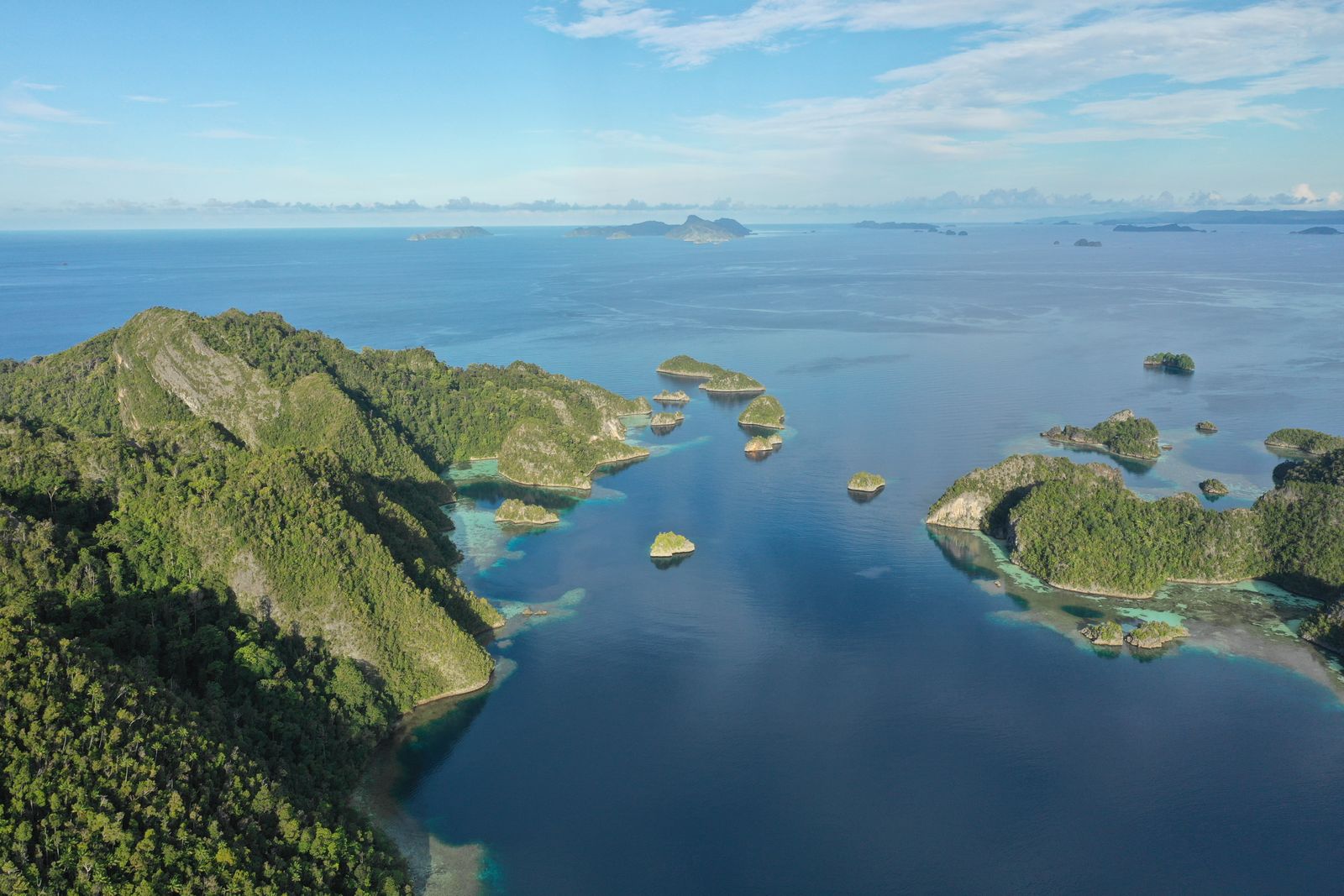
A UNESCO World Heritage Site of 445 uninhabited limestone mushroom islands, their bases undercut by wave action into narrow waists above a turquoise lagoon. Kayaking, snorkelling and picnicking on deserted white-sand beaches between these formations is the definitive Palau experience above the water line.
A channel dredged by German colonists in 1903 for boat access has become a permanent cleaning station for oceanic manta rays. Divers and snorkellers regularly encounter 10–20 mantas simultaneously being cleaned by small fish — an encounter of grace and scale that is one of the Pacific’s greatest wildlife experiences.
The traditional staple, grown in wetland patches and served boiled, baked or fried.
Tuna, mahi-mahi and reef fish, grilled, raw as sashimi or cooked in coconut milk — Japanese influence shows in the sashimi.
Fruit bat cooked in coconut milk and ginger — a traditional dish, now served mainly to curious visitors.
Fermented coconut toddy tapped from palm flower stalks — mild when fresh, stronger after a day.
Betel nut chewed with lime and pepper leaf is a common social habit — you will see red-stained pavements.
Roman Tmetuchl International (ROR) on Babeldaob serves Palau. United Airlines connects via Guam; Palau Pacific Airways serves direct regional routes. For trip planning, see the official Palau tourism portal.
Japan is Palau’s largest tourism market — JAL and Palau Pacific Airways connect Tokyo directly in 4h. Manila (1h30) is the closest international hub.
Guam (1h30) is the most practical Pacific hub for connections from North America. United Airlines operates Guam–Palau multiple times weekly.
Koror is the base for all Palau activities — all dive boats, Rock Island tours and island hops depart from Koror marina. The airport is on Babeldaob, 25 minutes from Koror.
Koror town is compact and walkable for daily needs. Babeldaob (the large island) needs a car to explore. All the dive sites, Rock Islands and jellyfish lake are reached by day boat from Koror marina.
October to May is best — the sea calmer, the dive visibility exceptional (30m+), the jellyfish lake accessible, the manta rays present at German Channel. November to April is peak (25–29°C). June to September is the wetter season; the diving is still excellent but some boat trips are affected.
📅 Palau is in its best season in January, February, March, April, May, October, November, December. See where else is good to go in those months, or browse where to go by month.
Palau uses the US dollar. It is expensive for the Pacific — the remoteness and small scale drives up prices for accommodation and food.
Clam soup (a clear broth of giant clam (Tridacna gigas, the world’s largest clam, which can reach 1.4m and 200kg) with coconut milk, ginger and taro leaf) is one of the finest dishes in Palauan cuisine, costing US&dollar.
Blue Corner, Jellyfish Lake and the Rock Islands are the three must-do Palau experiences.
The Palau Pacific Resort (the finest hotel in Palau, on its own beach on Koror, from US&dollar)
Koror for two days, German Channel mantas for one, Blue Corner drift dive for one, Jellyfish Lake for one, Rock Islands for one, Peleliu WWII battlefield for one. Palau — one of the world’s premier dive destinations — has the least disturbed reef system and marine biodiversity in Micronesia.
Koror — the main commercial town of Palau, on a small island connected by causeway to the Babeldaob (the large main island) — with the Belau National Museum (covering 3,000 years of Palauan history including the traditional bai meeting houses, storyboards and the turtle-shell and glass-bead jewellery of the chiefly system) and the first orientation dive at the house reef.
Palau has one of the most progressive marine protection policies in the world — the Palau National Marine Sanctuary (2020) closed 80% of Palau’s Exclusive Economic Zone (500,000km²) to fishing, making it one of the world’s largest fully protected marine areas. The Protected areas include all the famous dive sites. Visitors are asked to sign the Palau Pledge on arrival.
German Channel — a channel dredged by German colonial administrators in 1907 to create a shipping passage through the reef — is now the finest manta ray cleaning station in Micronesia. Resident oceanic manta rays (Mobula birostris, wingspan up to 7m) hover motionless over the sand at 15–25m while small wrasses clean parasites from their gill plates. 5–20 mantas present on most days.
Manta rays at cleaning stations hover almost motionless for up to 30 minutes — the cleaning symbiosis (wrasse fish picking parasites from the mantas’ gill plates and skin) requires the manta to remain still and slow its breathing. This behaviour makes them uniquely approachable for divers; German Channel mantas are so habituated to divers that they continue cleaning regardless of how many people are watching.
Blue Corner (a submerged reef platform on the outer wall of the Palau barrier reef, where two ocean currents collide — the fish biomass on a single Blue Corner drift dive is larger than most entire reef systems: grey reef sharks by the dozen, Napoleon wrasse, potato grouper, schools of barracuda and jack, all compressed into a wall dive at 10–30m by the constant current bringing nutrients).
Blue Corner is consistently voted the best dive site in the world by dive magazines — the combination of current, fish density, shark diversity and visibility (30m+) creates a dive experience that divers describe as the most overwhelming underwater moment of their lives. The “Palau hook” (a dive knife on a clip that hooks into the reef to hold position against the current and watch the fish) is used exclusively at Blue Corner.
Jellyfish Lake (Ongeim’l Tketau — a marine lake on Eil Malk Island, connected to the ocean through underground passages in the limestone, containing approximately 10 million golden jellyfish (Mastigias papua etpisoni) that have evolved in isolation over 12,000 years and lost their stinging ability — swimming through them is the most striking natural experience in Palau, and one of the most striking in the Pacific).
The jellyfish of Jellyfish Lake (Mastigias papua etpisoni) evolved in complete isolation from the open ocean population after the lake was sealed from the sea 12,000 years ago when sea levels fell. In isolation, they lost the need to sting (predators disappeared) and developed a symbiotic relationship with zooxanthellae algae — they migrate across the lake every day following the sun’s arc to maximise photosynthesis by their algal partners.
The Rock Islands (UNESCO World Heritage — 445 uninhabited limestone islands, each a mushroom-shape (undercut at the waterline by wave action) covered in dense forest, scattered across the southern lagoon in a 70km arc, with marine lakes, sea tunnels, undeveloped beaches and the finest snorkelling in Micronesia) — a full-day kayak through the maze of Rock Island channels.
The Rock Islands of Southern Palau are formed from ancient coral reef limestone that has been undercut by wave erosion at the waterline, giving them their distinctive mushroom-top shape. Each island is a closed ecosystem; the marine lakes within some Rock Islands contain entirely separate and often endemic species of fish, invertebrates and bacteria that have evolved independently.
1h boat from Koror. Peleliu — the site of one of the most brutal battles of the Pacific War (September–November 1944, the assault by the US 1st Marine Division on a heavily fortified Japanese position in a network of 500+ natural and man-made caves — the Battle of Peleliu cost 10,786 US casualties and almost the entire Japanese garrison of 11,000) — with tanks, aircraft and artillery still in the jungle and the famous Peleliu State Museum.
The Battle of Peleliu (September 15–November 27, 1944) was one of the bloodiest of the Pacific War — the Japanese had abandoned their standard banzai charge tactics in favour of a deep-cave defence system that required the Marines to root out each defensive position individually. The island was strategically unnecessary — a post-war assessment concluded that bypassing Peleliu would not have affected the outcome of the war.
Drive Babeldaob (the largest island in Micronesia after Guam — 396km² of dense rainforest, terraced hillsides from ancient agricultural systems, and the Badrulchau stone monoliths (16 large basalt pillars, 2–3m tall, set in a grassy clearing — purpose uncertain, possibly temple foundations or meeting place markers, the largest stone monument group in Micronesia)). Fly from Koror (ROR).
The Badrulchau stone monoliths (16 of an original 37 basalt columns remaining, on a hilltop in northern Babeldaob) are the most significant archaeological monuments in Micronesia. The basalt was quarried from a source 40km away and transported by unknown means. The arrangement and purpose are still debated; the most common interpretation is that they supported the floor beams of a large bai (meeting house).
Visa on arrival free for most nationalities up to 30 days.
Connections via Tokyo, Seoul, Manila and Taipei. Koror (the main town) is 30 min from the airport by road.
Visitors must sign the Palau Pledge in their passport on arrival — a commitment to respect the environment. The first country to add a legal environmental pledge to visitor passports.
Palau uses the US dollar. Cards accepted in larger businesses; bring cash for smaller operators and outer islands.
Visitors sign an environmental pledge (Palau Pledge) on arrival in their passport — a commitment to behave sustainably. Sunscreen containing oxybenzone (harmful to reefs) is banned.
Palau is expensive by Pacific standards — most accommodation and dive packages are at the mid-to-high end. Budget travellers should plan carefully.
Quick answers to the questions people most often ask before visiting Palau.
October to May is best — the sea calmer, the dive visibility exceptional (30m+), the jellyfish lake accessible, the manta rays present at German Channel. November to April is peak (25–29°C).
Roman Tmetuchl International (ROR) on Babeldaob serves Palau. United Airlines connects via Guam; Palau Pacific Airways serves direct regional routes.
Expect roughly US$100–180 a day on a budget and US$250–400 mid-range, or US$600+ for a more luxurious trip, per person and excluding flights.
Palau uses the US Dollar (USD).
Plug types: Type A / B (120V).
Point your camera at menus, signs or street text for instant translation. Download the language pack offline before you arrive for full use without data.
FreeReal-time and offline exchange rates for all world currencies — converts prices instantly so you always know what you are paying in your home currency.
FreeFind and book hotels, guesthouses and apartments with free cancellation on most rates — one of the widest selections of accommodation worldwide.
FreePalau sits within easy reach of several other destinations — each with a completely different character.


