PG
Papua New Guinea
800 languages, tribal shows & world-class coral diving
800 languages, tribal shows & world-class coral diving
⚠️ Travel advisory: check before you go
Governments urge a high degree of caution in Papua New Guinea because of violent crime and tribal conflict in parts of the Highlands. Check the latest advice before planning.
Latest official advice: UK FCDO · US State Department · Reviewed September 2026
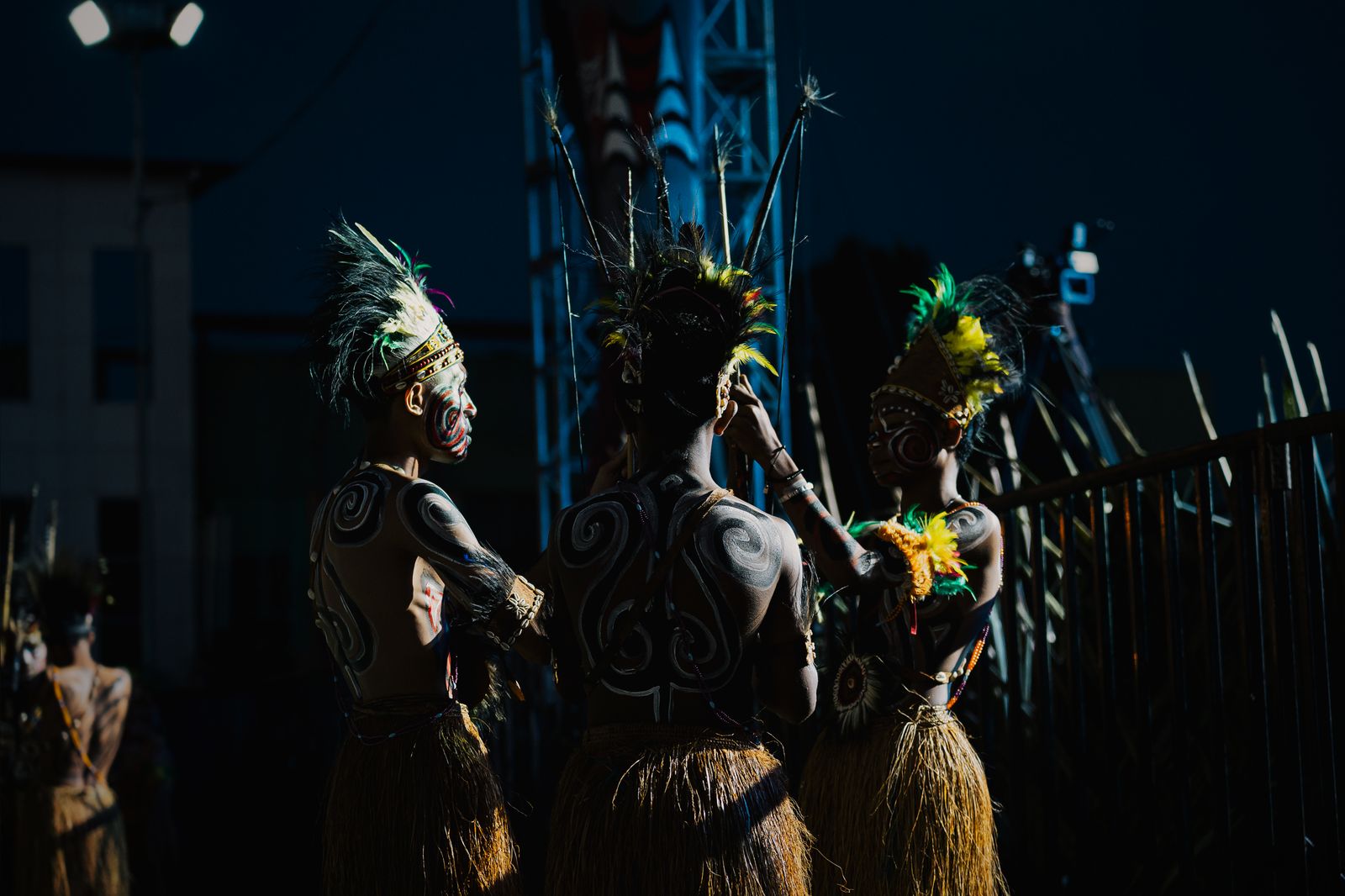
Papua New Guinea is one of the world’s most linguistically diverse and least-explored countries — a vast archipelagic nation of dense rainforest, volcanic highlands, coral reefs and 800+ living languages, where tribal customs, spirit houses (haus tambaran), elaborate body adornment and traditional exchange ceremonies continue largely undisturbed by the outside world. The Goroka Show and Mount Hagen Cultural Show, held annually in the highlands, gather tribes from across the country in a spectacle of headdresses, face paint, song and dance that has no parallel anywhere on earth. PNG’s reefs — particularly around Milne Bay and the Bismarck Sea — are among the most biodiverse in the world.
The Mount Hagen Cultural Show (August) and Goroka Show (September) are the world’s most striking cultural spectacles — hundreds of tribes converge in traditional dress, headdresses of bird-of-paradise feathers, faces painted in elaborate designs, singing traditional songs and performing ancient dances. These annual events were created to give tribes a peaceful gathering place; they have become one of the Pacific’s greatest events.
A multi-day boat journey along the 1,126-kilometre Sepik River — one of the world’s great waterways — passes through villages where carved wooden haus tambaran spirit houses reach 25 metres high and the traditions of sorcery, crocodile initiation and wood-carving remain vital. Sepik carvings are among the world’s most prized tribal artworks.
PNG’s Milne Bay Province, the Bismarck Sea and Kimbe Bay are within the Coral Triangle — the world’s most biodiverse marine ecosystem. Extraordinary macro diving (pygmy seahorses, nudibranchs) alongside large pelagics (whale sharks, hammerheads) and WWII wrecks (both Japanese and Allied) make PNG one of the world’s top three diving destinations.
Papua New Guinea (Wikipedia) →An earth-oven feast of pork, sweet potato, taro and greens cooked over hot stones — the great ceremonial meal.
Steamed, roasted in a mumu or boiled in coconut cream — a staple grown in many local varieties.
Starch extracted from the pith of sago palm trees — dried and used as a flour for pancakes and dumplings, or eaten as a dense paste. The staple food of the lowland and coastal peoples, providing cheap calories in regions where rice and sweet potato are unavailable.
Kaukau (sweet potato) is the Highlands staple. Fresh pawpaw, pineapple and passionfruit are sold at every market.
Papua New Guinea’s best-known beer, brewed since 1952.
Jacksons International (POM) in Port Moresby is the main hub. Air Niugini is the national carrier; Qantas and Singapore Airlines serve the main international routes. Domestic flights are essential. For trip planning, see the official Papua New Guinea tourism portal.
Singapore (5h from POM) and Sydney (4h from POM) are the primary gateways. Singapore Airlines and Qantas both have onward connections to POM.
Sydney and Brisbane are the most practical gateways for Australians. Singapore is the Asian hub. Qantas and Air Niugini share the Brisbane–Port Moresby route most frequently.
PNG’s road network is extremely limited and most inter-province travel requires domestic flights. Air Niugini and PNG Air cover the main routes; book well in advance as capacity is limited on smaller aircraft.
Port Moresby has a mixed security reputation — use hotel-organised taxis and transfers rather than informal vehicles. Most hotels have security; major tourist sites are well-established and safe with a guide.
May to October is the dry season on the south coast and Highlands — the Mount Hagen Show (August), the Goroka Show (September) and trekking season for the Kokoda Track. The north coast (Madang, Kavieng) can be visited year-round. December to March brings monsoon rains to most of PNG.
📅 Papua New Guinea is in its best season in May, June, July, August, September, October. See where else is good to go in those months, or browse where to go by month.
PNG is a premium adventure destination — internal flights are expensive, accommodation outside Port Moresby is limited and guided treks require an investment. The PNG Kina (PGK) is the currency.
SP Lager (South Pacific Lager — brewed in Port Moresby since 1952, the most widely consumed beer in PNG) is the defining social drink, sold ice-cold in tall brown bottles (SP stubbies) at trade stores throughout the country for PGK.
Air Niugini and PNG Air operate PNG’s domestic network; both have had safety incidents. The internal flight network is essential for reaching Goroka, Madang, Kavieng and Tufi from Port Moresby.
Tufi Resort (the only accommodation on the Cape Nelson fjords, PNG’s finest and most remote dive location) and Walindi Plantation Resort (Kimbe Bay, West New Britain, the finest reef diving in PNG) are the country’s most celebrated addresses.
Port Moresby for one day, the Kokoda Track for two, the Highlands (Goroka) for one, Madang for one, Tufi for one, Kavieng for one. PNG — the most linguistically diverse country on earth (840+ languages) — is also its most adventurous destination.
Port Moresby — a city of 400,000 with a reputation that precedes it — has the National Museum and Art Gallery (the finest collection of Melanesian art and cultural objects in the world — traditional masks, spirit boards, outrigger canoes and ceremonial objects from all PNG’s provinces), the National Parliament (a building with a traditional Haus Tambaran roof, 1984) and the Varirata National Park (1h from the city, the most accessible highland birding in PNG).
Papua New Guinea has 840+ distinct languages — approximately 12% of all languages spoken on earth in a country of 10 million people. The average PNG language has fewer than 5,000 speakers. The most widely spoken are Tok Pisin (PNG Creole, understood by 4 million) and Hiri Motu, developed for trade. New languages are still being documented in the interior.
40-min flight from Port Moresby to Kokoda (KDE). The Kokoda Track — a 96km trail through the Owen Stanley Range at 2,190m altitude, crossing terrain so difficult it took the Japanese army from July to September 1942 to push the Australian forces back to Imita Ridge, where the battle turned — is one of the most historically significant and physically demanding treks in the Pacific.
The Kokoda Campaign (July–November 1942) was Australia’s most consequential WWII engagement — 625 Australian soldiers died and 1,600 were wounded holding the Japanese advance 50km from Port Moresby. The terrain (94% relative humidity, daily tropical rain, 1,200m+ of daily ascent/descent through jungle) was the deciding factor. The track is still considered the most physically demanding accessible trek in the Asia-Pacific.
The Kokoda Track is walked in 7–10 days but a 2-day partial traverse gives a sense of the terrain — the jungle, the altitude changes (crossing from 50m to 2,190m and back), the village rest points, and the war memorials at Isurava (where the Australian stand of September 1942 is marked by four marble pillars inscribed with “Courage, Endurance, Mateship, Sacrifice”). Fly back to Port Moresby.
The Isurava Memorial (2002, designed by Australian architect Lawrence Nield) marks the site of the most intense fighting on the Kokoda Track in August–September 1942 — four black granite monoliths inscribed with “Courage, Endurance, Mateship, Sacrifice.” The 39th Battalion (average age 18) held here for 4 days against Japanese forces 3 times their number.
45-min flight from Port Moresby to Goroka (GKA). Goroka — the capital of Eastern Highlands Province, at 1,600m — is the gateway to the Highlands culture, with the Goroka Show (third week of September, a sing-sing gathering of 100+ Highland tribes in traditional bilum, headdress, face paint and feathered costumes), the Baining Fire Dancers and J.K. McCarthy Museum.
The Goroka Show and Mount Hagen Show (August) are the most striking cultural gatherings in Melanesia — Highland tribes from across PNG converge in traditional dress for competitive singing and dancing. Headdresses incorporating bird-of-paradise feathers, shells and ceremonial pigments have been worn at these gatherings for centuries; they represent the full range of PNG’s cultural diversity.
1h30 flight from Goroka to Madang (MAG). Madang — a small port town on PNG’s north coast surrounded by bays and islands, consistently rated one of the finest diving destinations in the world — WWII wrecks (Japanese Zero fighters and Betty bombers visible at 10–30m), coral walls and the Madang Lagoon (protected, diverse reef with no current).
Madang’s harbour was a major Japanese naval base in 1942–1944, and the seabed contains dozens of Japanese aircraft, ships and vehicles sunk during Allied air raids. The Betty bomber at 9m depth (diveable on a single tank from the surface) is one of the most intact WWII aircraft wreck dives on earth — the cockpit, engine cowlings and wing structure fully preserved.
1h15 flight from Port Moresby. Tufi — a cape on the southeast PNG coast, with fjord-like inlets carved by ancient rivers (unique in the tropics), coral reefs of great diversity in the Cape Nelson area and the most remote-feeling dive destination in Melanesia. Tufi Resort is the only accommodation on the cape.
Tufi’s fjords (locally called inlets or harbours) are submerged river valleys created when post-glacial sea level rise flooded the V-shaped valleys cut by rivers through the Cape Nelson plateau. This is one of very few tropical fjord landscapes on earth — the combination of rainforest-covered cliffs, calm dark water and dense coral reef at the mouth is unique.
2h flight from Port Moresby to Kavieng (KVG). Kavieng (New Ireland Province) — a small colonial town with the finest shark diving in PNG (grey reef sharks, white-tip sharks and regular encounters with silvertip sharks at the channel passes), traditional Malangan ceremonial woodcarving and the nearest access to the Bismarck Sea.
The Malangan funerary tradition of New Ireland Province produces the most elaborately carved wooden sculptures in Melanesia — complex interlocked compositions of humans, birds, fish and geometric forms, carved for funerary ceremonies and then allowed to decay, representing the release of the spirit. The finest examples are in European museum collections; the tradition continues in villages around Kavieng.
Visa on arrival available for most nationalities (AUD 100 fee); e-visa also available.
Jackson’s International Airport handles international flights. Domestic flights (Air Niugini, PNG Air) are essential to reach the Highlands, Milne Bay and Sepik — road travel between provinces is extremely difficult.
Port Moresby has elevated street crime. Stay in reputable accommodation, use hotel-arranged transport and avoid walking alone at night. The Highlands require local guides.
The PGK is the currency. ATMs in major towns; carry cash elsewhere. USD and AUD exchanged in banks.
Port Moresby has a reputation for crime — take precautions, avoid walking alone at night and use reputable transport. Highland and dive destinations are generally safer.
Light aircraft connect most highland and island destinations; roads are limited and often poor.
Quick answers to the questions people most often ask before visiting Papua New Guinea.
May to October is the dry season on the south coast and Highlands — the Mount Hagen Show (August), the Goroka Show (September) and trekking season for the Kokoda Track. The north coast (Madang, Kavieng) can be visited year-round.
Jacksons International (POM) in Port Moresby is the main hub. Air Niugini is the national carrier; Qantas and Singapore Airlines serve the main international routes. Domestic flights are essential.
Expect roughly PGK 200–400 a day on a budget and PGK 700–1,200 mid-range, or PGK 2,500+ for a more luxurious trip, per person and excluding flights.
Papua New Guinea uses the Papua New Guinea Kina (PGK).
Governments urge a high degree of caution in Papua New Guinea because of violent crime and tribal conflict in parts of the Highlands. Check the latest advice before planning. Always check current official travel advice before booking.
Main mobile provider with the broadest coverage across PNG.
FreeUseful in Port Moresby; very limited in rural areas. Offline maps recommended.
FreePoint your camera at menus, signs or street text for instant translation. Download the language pack offline before you arrive for full use without data.
FreeReal-time and offline exchange rates for all world currencies — converts prices instantly so you always know what you are paying in your home currency.
FreeFind and book hotels, guesthouses and apartments with free cancellation on most rates — one of the widest selections of accommodation worldwide.
FreeBrowse millions of traveller reviews for restaurants, attractions and hotels — helps identify the best local spots and avoid tourist traps.
FreePapua New Guinea sits within easy reach of several other destinations — each with a completely different character.


