PR
Puerto Rico
Old San Juan, glowing bays & rum-soaked Caribbean nights
Old San Juan, glowing bays & rum-soaked Caribbean nights
Puerto Rico is a Caribbean island that defies easy categorisation — a US Commonwealth territory with a fiercely independent Latin identity, a Spanish colonial history of great richness, bioluminescent bays that glow electric blue at night, and a food scene that has become one of the Caribbean’s most celebrated. San Juan, the oldest city in US territory, has the finest preserved Spanish colonial fortifications in the Americas — the massive El Morro and San Cristóbal forts, connected by kilometres of city walls, are UNESCO World Heritage Sites. In the south, Ponce charms with grand plazas and colonial mansions, while the offshore island of Culebra holds one of the world’s finest beaches at Flamenco. The island’s interior is a tropical mountain, home to the El Yunque rainforest rainforest — El Yunque, the only tropical rainforest in the US National Forest system. Puerto Rico produces some of the world’s finest rum; its beaches rival any in the Caribbean.
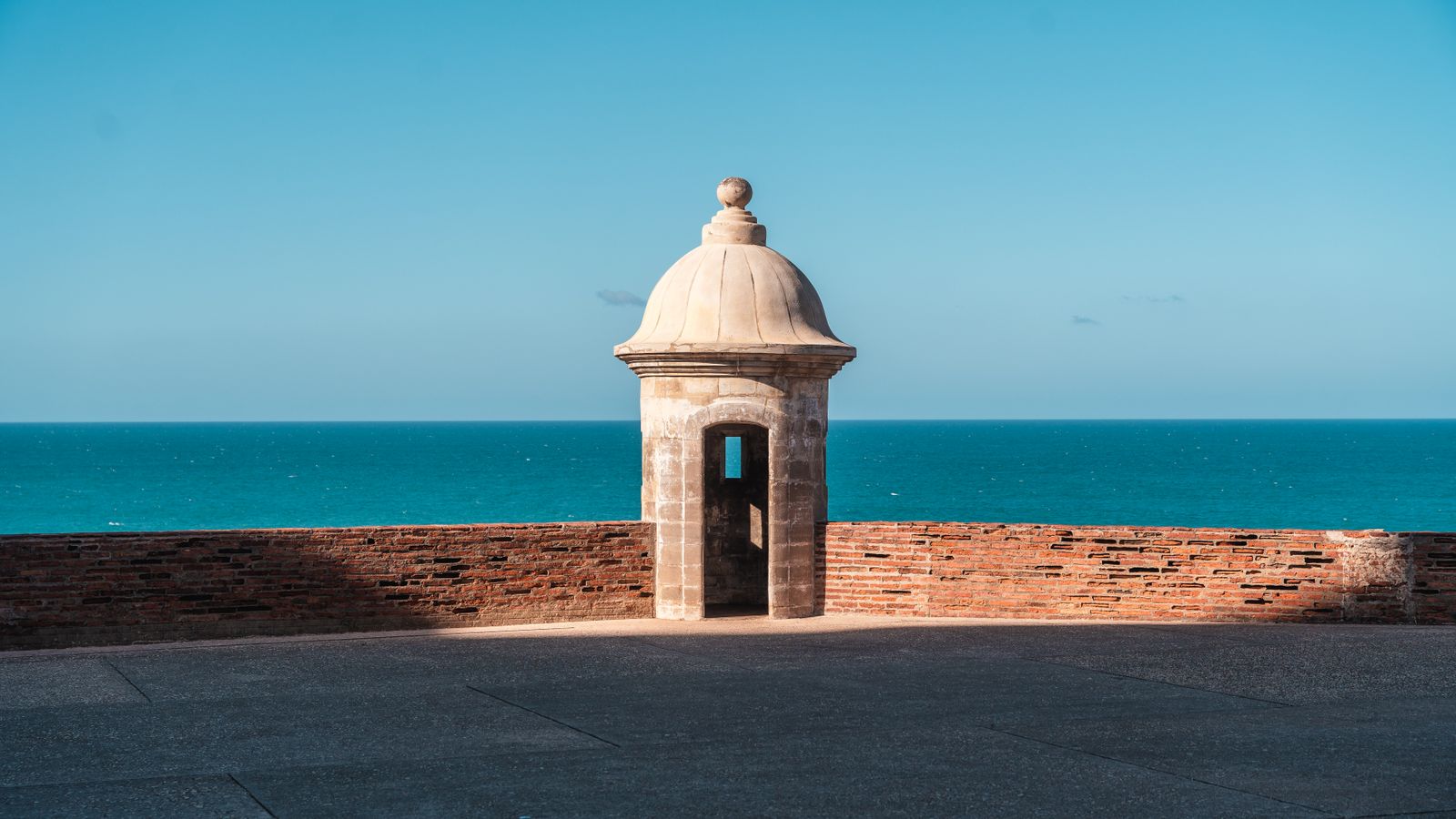
A UNESCO World Heritage Site — seven square blocks of cobblestoned streets paved with blue adoquines (volcanic rock tiles) lead past 16th-century churches, Spanish colonial mansions painted in vivid Caribbean pastels and the formidable walls and gates of the old city. The Castillo San Felipe del Morro, a massive 16th-century fortress on a headland above the Atlantic, is the most dramatic Spanish colonial fortification in the Americas.
Puerto Rico has three of the world’s five brightest bioluminescent bays — Mosquito Bay on Vieques Island is consistently rated the world’s brightest, glowing vivid electric blue from dinoflagellates (microscopic organisms) activated by movement in the water. Kayaking through the glowing bay on a moonless night, with your paddle trailing blue fire and your body silhouetted in neon, is one of the Caribbean’s most magical experiences.
The only tropical rainforest in the US National Forest system — 28,000 acres of cloud forest in the Sierra de Luquillo mountains east of San Juan, with waterfalls, endemic species (the Puerto Rican parrot, the coqui frog whose call defines the island’s nights) and trails ranging from easy boardwalks to challenging ridge climbs. La Mina waterfall and the Torre del Cielo observation tower are the highlights.
Two offshore islands with some of the Caribbean’s finest beaches. Flamenco Beach on Culebra consistently ranks among the world’s top beaches; Vieques’s Red, Blue and Sun Bay beaches are largely undeveloped and exceptional. Both islands are accessible by short ferry or flight from Fajardo.
Puerto Rico (Wikipedia) →Whole pig slow-roasted over wood until the skin crackles — the lechoneras along the mountain road at Guavate are famous for it.
Mashed fried green plantain with garlic and chicharrón, often filled with seafood or meat — the island’s signature dish.
Slow-roasted pork shoulder — marinated overnight in adobo (garlic, oregano, vinegar) and roasted for 8+ hours until the skin crisps to chicharrón and the meat falls apart. The centrepiece of every Puerto Rican Christmas and family celebration.
Twice-fried green plantain slices, served with mayo-ketchup as a snack or side.
Rice with pigeon peas and sofrito — the classic side, especially at Christmas.
Puerto Rico produces much of the world’s rum; Don Q and Bacardi (whose Cataño distillery runs tours) are the big names.
Luis Muñoz Marín International (SJU) in San Juan is the Caribbean’s largest hub. American, Delta, United, JetBlue and others operate direct routes from most US cities. No direct UK flights; Miami and New York are gateways. For trip planning, see the official Puerto Rico tourism portal.
Madrid is the only European city with direct connections to San Juan (Iberia, Air Europa, 8h30). From the UK, route via Miami (4h+) or New York (3h30+). Puerto Rico is US territory — no visa required for UK citizens under the Visa Waiver Program.
San Juan is one of the most connected airports in the Caribbean — direct flights from virtually every major US city. JetBlue is the largest carrier; flights cost US$100–300 from the Northeast.
The Ceiba ferry terminal (1h30 east of San Juan on the AutoPistas) has regular government ferries to Vieques (US$5) and Culebra (US$5) — among the best-value ferry routes in the Caribbean.
Car hire (US$40–80/day) is essential for El Yunque, Ponce and the south coast. Old San Juan, Condado and Santurce are walkable. The PR-52 south to Ponce is a well-maintained toll motorway.
December to April is peak season — the San Juan beaches busy, the El Yunque rainforest clear, the bioluminescent bays at their most reliable. January to March have the most pleasant temperatures (24–28°C). May to November is hurricane season; Maria (2017) was catastrophic.
📅 Puerto Rico is in its best season in January, February, March, April, November, December. See where else is good to go in those months, or browse where to go by month.
Puerto Rico uses the US dollar and has US-comparable prices — more expensive than most Caribbean islands but with US-quality infrastructure. No passport required for US citizens.
Mofongo — mashed fried plantain (plátano) pounded with chicharrón (fried pork skin) and garlic in a wooden pilon, shaped into a ball and served with broth, shrimp or pork — is Puerto Rico’s most important dish.
Ron del Barú (a single-batch Puerto Rican rum, aged 23 years in American oak)
The Condado Vanderbilt Hotel (1919, the original luxury hotel of Puerto Rico, restored to Art Deco grandeur, from US&dollar)
Old San Juan for two days, El Yunque for one, Vieques for two, Culebra for one, the south coast for one. Puerto Rico — the most culturally rich island in the Caribbean — combines 500-year-old Spanish colonial fortifications, bioluminescent bays, healthy coral islands and some of the finest rum in the world.
Old San Juan — a 7-square-block walled colonial city on a rocky peninsula, with blue adoquin cobblestones (ballast stones from Spanish galleons, laid to pave the streets in the 16th century), El Morro (Castillo San Felipe del Morro — a 140m cliff-top fortress begun in 1539, the most impressive Spanish colonial fortification in the Americas) and the pastel facades of La Fortaleza (the oldest executive mansion in continuous use in the Western Hemisphere).
El Morro (Castillo San Felipe del Morro) was begun in 1539 and took 170 years to complete to its current 6-level form. Its function was to guard the entrance to San Juan Bay from pirate and naval attack; the fort repelled Francis Drake (1595) and George Clifford, Earl of Cumberland (1598). Only the Duke of Albemarle (1625) briefly occupied it. The fort was never taken by force by a sea-borne attack — it was only surrendered to US forces in 1898 after Spain’s military defeat on land.
Castillo San Cristóbal (begun 1634, the largest Spanish fort in the Americas at 11 hectares, guarding the eastern approach to the city overland) and the Condado Lagoon (the Art Deco hotel strip, the original beach resort of Puerto Rico, 1930s) and La Perla (the working-class barrio squeezed between the city wall and the Atlantic, the filming location of Luis Fonsi’s “Despacito” video, with colourful houses and a rough, authentic charm).
La Perla was built by enslaved and free Afro-Puerto Ricans outside the walls of the colonial city — they were not permitted inside the gates after dark. The neighbourhood, built on a narrow ledge between the wall and the sea, became home to the most influential Afro-Caribbean music scene in Puerto Rico. “Despacito” (2017, Luis Fonsi — the most-watched YouTube video in history at its peak) was filmed here.
1h30 from San Juan. El Yunque National Forest — the only tropical rainforest in the US National Forest system (28,000 acres of Caribbean rainforest on the mountains of the northeast, receiving 250cm of annual rainfall, with 240 tree species, 150 fern species and the Puerto Rican parrot — one of the 10 most endangered birds in the world, with wild population now 100+ after recovery from a nadir of 13 in the 1970s).
The Puerto Rican parrot (Amazona vittata) was reduced to 13 individuals in 1975 by habitat loss, nest competition from pearly-eyed thrashers and hunting — the lowest wild population of any parrot species in history. A captive breeding and release programme, the most intensive for any bird species in the US, has raised the wild population to 100+ in El Yunque and 60+ in the Rio Abajo forest.
1h ferry from Ceiba. Vieques — a small island 8km east of the Puerto Rico mainland, with the finest beach in the Caribbean (Flamenco Beach — a perfect horseshoe of white sand, no development, calm water, consistently ranked in the world’s top 10 beaches) and Mosquito Bay (the brightest bioluminescent bay in the world — single-celled dinoflagellates glow blue-green when disturbed by movement, lighting up kayak paddles, swimmer’s hands and jumping fish).
Mosquito Bay (Bahia Bioluminiscente) on Vieques contains the highest concentration of bioluminescent dinoflagellates (Pyrodinium bahamense) of any water body in the world — up to 720,000 per gallon. The effect is most intense on moonless nights when the glow can be seen from the air. The bay was threatened by the US Navy’s bombing range (Vieques was a Navy testing ground until 2003); it has recovered significantly since the Navy left.
A full day on Vieques — Flamenco Beach in the morning (the last undeveloped beach of this quality remaining anywhere in the Caribbean, 1km of white sand backed by wooded hills, no cars, no vendors), the wild horses of Vieques (a herd of semi-wild horses descended from Spanish colonial stock that roams the island roads and beaches freely) and a kayak tour of Mosquito Bay at dusk.
The wild horses of Vieques are descended from horses left behind when the US Navy took over the island in 1941 and displaced the farming population. The horses have been feral for 80 years, roaming the forests and beaches of the eastern and western wildlife refuges. They are genetically closest to Paso Fino horses and are considered a cultural heritage of the island.
1h ferry from Vieques. Culebra — a tiny island (30km², population 2,000) with Flamenco Beach (consistently the finest beach in the Caribbean by multiple rankings — wait, that’s Vieques; Culebra has Playa Flamenco, also extraordinary) and Playa Flamenco (a perfect half-moon of white sand, sea grape shade, no development) and the finest snorkelling in the Puerto Rico region at Playa Tamarindo.
Playa Flamenco on Culebra is one of two beaches in the region with the same name as Flamenco Beach on Vieques — both are impressive, both relatively undeveloped, and both rank in world top-10 beach lists. Culebra’s population of 2,000 maintains a tight control over development; the island has resisted the resort development that consumed other Caribbean islands.
2h30 from San Juan. Ponce — Puerto Rico’s second city, with the finest Creole architectural heritage on the island (the Ponce Museo de Arte, the finest art museum in the Caribbean, with 4,500 works including Rubens and a strong Latin American collection) and the Hacienda Buena Vista (a restored 19th-century coffee estate in the mountains above Ponce). Fly from Luis Muñoz Marín (SJU).
Puerto Rico is the birthplace of piña colada — the drink was allegedly invented at the Caribe Hilton in San Juan in 1954 by barman Ramón Marrero (using Coco López cream of coconut, pineapple juice and Don Q rum). The claim is disputed by another barman, Ramón Por-tas Mingot, at the Barrachina bar in Old San Juan; both establishments display plaques.
🛂 Entry rules: ESTA for visa-free visitors
Citizens of Visa Waiver Program countries, including the UK, most of the EU, Australia, New Zealand and Japan, must have an approved ESTA before boarding a flight or ship to the United States (this also covers Puerto Rico). It costs about US$40, is valid for two years or until your passport expires, and allows stays of up to 90 days at a time.
Apply at least 72 hours before travel on the official CBP site or the ESTA Mobile app; many look-alike websites charge extra for the same form. Canadian citizens don’t need an ESTA. Everyone else needs a visa.
Official information: US CBP: official ESTA site · Reviewed September 2026
No passport or visa required for US citizens. International visitors need a US visa or ESTA (same as mainland USA).
US citizens need no passport; everyone else needs standard US entry documents (ESTA or visa). Puerto Rico uses USD and all US federal rules apply.
San Juan and the north have dense tourism infrastructure. The west (Rincón — excellent surfing) and southwest (Ponce) are quieter and more affordable. The bioluminescent bays (Vieques, Fajardo) require boat tours.
American Airlines, JetBlue and United have extensive mainland US connections. San Juan is also the main gateway for eastern Caribbean inter-island flights.
US dollars throughout; prices similar to mid-range US mainland cities.
Book kayak tours in advance — Mosquito Bay tours sell out weeks ahead. Tours are most striking on new moon nights with no rain.
Jun–Nov is hurricane season; Nov–Apr offers the most reliable weather.
Quick answers to the questions people most often ask before visiting Puerto Rico.
December to April is peak season — the San Juan beaches busy, the El Yunque rainforest clear, the bioluminescent bays at their most reliable. January to March have the most pleasant temperatures (24–28°C).
Luis Muñoz Marín International (SJU) in San Juan is the Caribbean's largest hub. American, Delta, United, JetBlue and others operate direct routes from most US cities. No direct UK flights; Miami and New York are gateways.
Expect roughly US$90–150 a day on a budget and US$200–350 mid-range, or US$500+ for a more luxurious trip, per person and excluding flights.
Puerto Rico uses the US Dollar (USD).
Plug types: Type A / B (120V).
— Both operate extensively in San Juan and the main tourism areas.
Free— Essential for restaurant reservations in Old San Juan’s popular spots.
FreePoint your camera at menus, signs or street text for instant translation. Download the language pack offline before you arrive for full use without data.
FreeReal-time and offline exchange rates for all world currencies — converts prices instantly so you always know what you are paying in your home currency.
FreeFind and book hotels, guesthouses and apartments with free cancellation on most rates — one of the widest selections of accommodation worldwide.
FreePuerto Rico sits within easy reach of several other destinations — each with a completely different character.


