AT
Austria
Mountain air and coffee-house afternoons
Mountain air and coffee-house afternoons

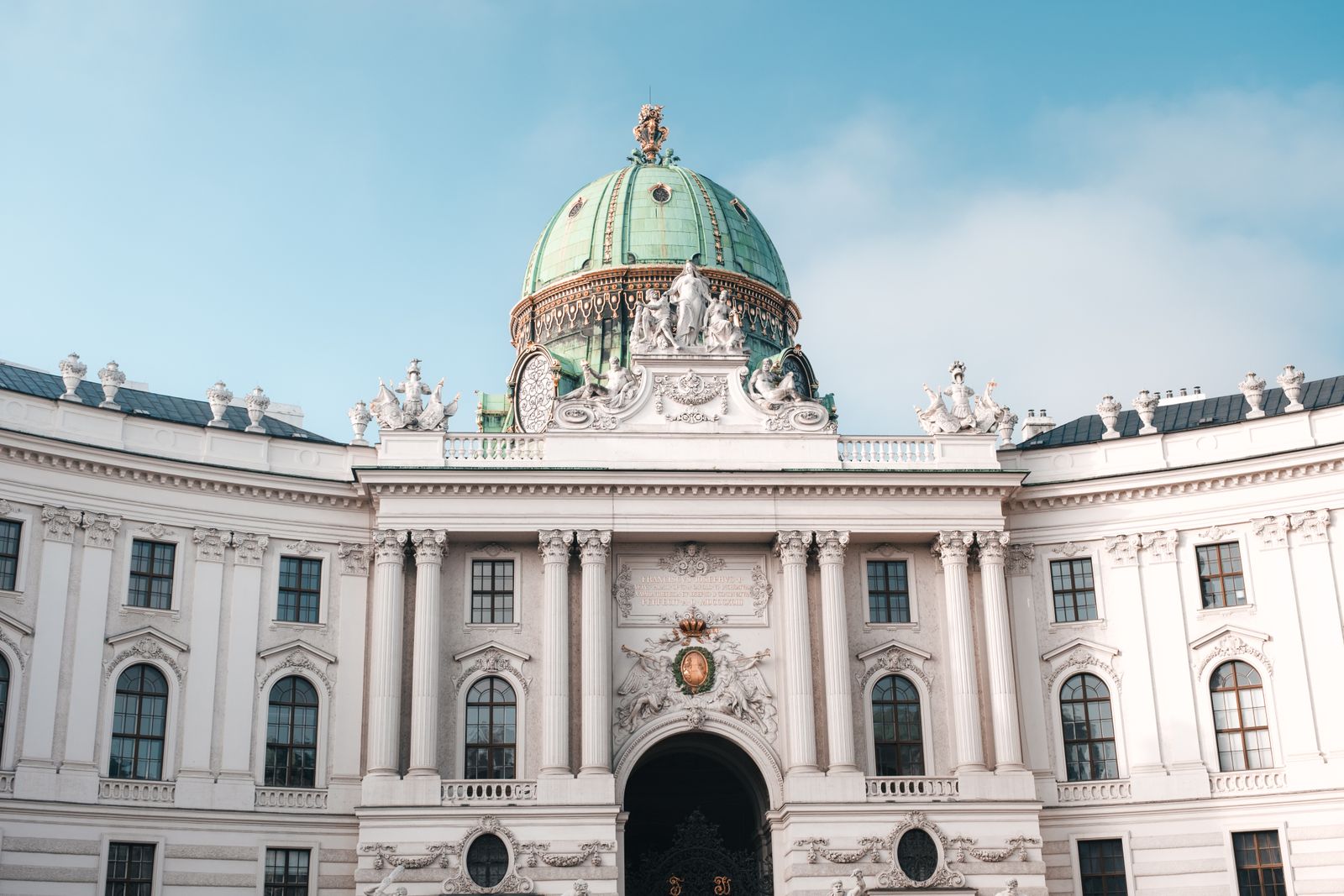
The Kunsthistorisches Museum (Vermeer, Rubens, Bruegel, Velazquez – one of the ten finest art museums in the world), the Vienna State Opera and the Ringstrasse’s imperial boulevard.
Photo: Hubertl, CC BY-SA 4.0

Schonbrunn: the Habsburg summer palace with 1,441 rooms and formal French gardens (UNESCO). The Belvedere’s Upper Palace has Klimt’s The Kiss.
Photo: Carl Goebel, Public domain

A UNESCO Baroque city of the Hohensalzburg Fortress on a cliff above it, the Mirabell Gardens, Mozart’s birthplace and the alpine backdrop that inspired The Sound of Music.
Photo: Uoaei1, CC BY-SA 4.0

A UNESCO-listed village on a glacier lake, with houses literally on stilts above the water and salt mines dating to 5,000 BC. The most photographed village in Europe.
Photo: C.Stadler/Bwag, CC BY-SA 4.0
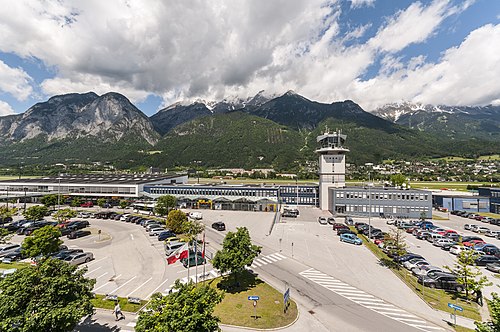
The Golden Roof’s copper tiles, the Olympic ski resort on the Nordkette and the Bergisel ski jump above the city: Austria’s alpine heart.
Photo: Ralf Roletschek, GFDL 1.2

A 48km toll road from 800m to 2,504m, passing glaciers, alpine meadows and the Pasterze Glacier (Austria’s longest). The finest mountain road in the Alps.
Photo: Sander Hoogendoorn from Gouda, Holland, CC BY 2.0

A Baroque Benedictine monastery on a clifftop above the Danube, with the Wachau Valley’s wine-covered slopes (UNESCO) stretching east towards Vienna.
Photo: Tournasol7, CC BY-SA 4.0

Austria’s second city with a UNESCO Altstadt, the clock tower on the Schlossberg hill and the modern Kunsthaus (art museum) by Peter Cook – a building that glows blue at night.
Photo: Ralf Roletschek, CC BY-SA 3.0 at
Breaded and fried veal cutlet, pounded thin, served with potato salad or parsley potatoes and a lemon wedge. The national dish of Austria. The Zum Wohl restaurant in Vienna’s 7th district serves the finest.
A dense chocolate cake with apricot jam between two layers of chocolate sponge, covered in dark chocolate icing. Created at the Hotel Sacher in 1832. The Hotel Sacher and Demel bakery dispute the original recipe with legal seriousness.
Boiled prime beef in a clear broth with apple-horseradish sauce and chive cream. Emperor Franz Joseph’s favourite dish; eaten at every classic Viennese restaurant.
Pan-fried roast beef with crispy onion rings and brown gravy. The Viennese butcher’s dish, eaten at wood-panelled gasthaus restaurants throughout Austria.
Austria’s signature white grape: crisp, peppery, with a white pepper finish. The Wachau and Kamptal regions produce the finest.
Melange (espresso with milk foam), Einspanner (espresso with whipped cream in a glass) and Kleiner Brauner (small espresso with cream on the side). Drunk for hours over a newspaper in a Kaffeehaus – the point is not the coffee but the sitting.
Thin stretched pastry wrapped around cinnamon apple filling. Served warm with vanilla sauce or whipped cream. The Austrian dessert that conquered Central Europe.
Vienna’s two local breweries produce light lagers that are drunk on draught (vom Fass) at every Heuriger (wine tavern) and beer garden.
Vienna Airport (VIE) is Austria’s main international hub, 18km from the city centre. ÖBB’s Railjet high-speed trains connect all major Austrian cities and run directly to Germany, Hungary, Czech Republic and beyond. For trip planning, see the official Austria tourism portal.
Austrian Airlines is Lufthansa Group — comfortable, punctual and competitive on price. Innsbruck (INN) is served by easyJet from Gatwick and Stansted for direct Alpine access.
Austrian Airlines flies direct Vienna–New York JFK and Vienna–Washington DC. Lufthansa Group connections via Frankfurt or Munich cover most other US cities.
Book on oebb.at — the ÖBB Sparschiene fares (advance purchase) offer Vienna–Salzburg from €9. The Klimaticket (€1,095/year) covers all Austrian public transport nationwide.
The City Airport Train (CAT) to Wien Mitte costs €14.90 single (€24.90 return) and takes 16 minutes — the fastest link. The S-Bahn S7 covers the same route for €4.40.
June to September is summer — hiking in the Alps, lake swimming in Salzkammergut, long evenings in Vienna’s Naschmarkt. December brings the Christmas markets (Vienna’s are the best in Europe). January and February are ski season.
📅 Austria is in its best season in June, July, August, September. See where else is good to go in those months, or browse where to go by month.
Austria is solidly mid-European in cost — comparable to Germany and slightly cheaper than Switzerland. The ski resorts are significantly more expensive than the cities in winter.
A Würstelstand (Viennese sausage stand) serves the Kaisermelange sausage with mustard and a bread roll for €3.50. It’s an institution, not a fast food compromise.
Standing-room tickets for the Vienna State Opera (Wiener Staatsoper) cost little more than a cinema ticket — one of the world’s great opera houses, at a fraction of the seated price. They go on sale from 10am on the day of the performance, online or at the box office.
Steirereck in Vienna’s Stadtpark is one of the 50 best restaurants in the world — the 5-course lunch menu at €105 is among the best-value fine dining experiences in Europe.
Vienna for culture and coffee, Salzburg for Mozart and the Sound of Music landscape, Hallstatt for one of the most photographed villages in Europe, Innsbruck for the Alps. All connected by ÖBB Railjet.
Walk the Ring boulevard: the Opera House, the Kunsthistorisches Museum (allow 3 hours), the Burgtheater. Then find a Viennese coffee house — Café Central or Hawelka — and order a Melange and an Apfelstrudel.
Vienna’s coffee house culture is a UNESCO Intangible Cultural Heritage. A Melange (half espresso, half steamed milk) at a marble table with a newspaper is the correct introduction to the city.
Schönbrunn Palace in the morning (the 40-room Grand Tour is manageable in 2 hours). Afternoon: Klimt’s The Kiss at the Upper Belvedere. The Naschmarkt in between — Vienna’s best outdoor market runs Mon–Sat.
Book Schönbrunn Palace tickets online. The gardens are free and include the oldest zoo in the world (founded 1752).
The MuseumsQuartier — one of the largest cultural complexes in Europe — houses the MUMOK (modern art), the Leopold (Schiele, Klimt) and several smaller galleries in one Baroque court. Afternoon: explore the 7th district (Neubau) for coffee and independent shops.
The Albertina has the finest graphic art collection in Europe, including 65,000 drawings by Dürer, Raphael and Michelangelo. Book ahead; the queues are long.
2h30 by ÖBB Railjet from Vienna. The Hohensalzburg Fortress dominates the city from the hill — view of the Alps. Mozart’s Birthplace on Getreidegasse. The Old Town is entirely walkable.
The Salzburg Card covers all public transport and free entry to 30+ attractions — worth it if you’re visiting more than 2 sights.
40 min by bus from Salzburg. Hallstatt — a lakeside village with 780 permanent residents — receives 1 million visitors a year. Go early in the morning (before 9am) and the lake is perfectly still. The historic centre is beautiful.
The Hallstatt Skywalk viewpoint above the village gives the classic photograph. Take the funicular (not the 1.5h hike) to save time. It opens at 9am.
2h from Salzburg by train. Innsbruck sits in a valley with 2,000m peaks directly above the city centre — the view from the old town is unlike anywhere else in Europe. The Nordkette cable car goes directly from the centre to 2,334m in 20 minutes.
The Ambras Castle above Innsbruck houses the Archduke Ferdinand II’s armour collection — one of the best in the world, and usually uncrowded.
Return to Vienna (3h30 by Railjet) for an international flight from VIE, or fly directly from Innsbruck airport (INN — served by easyJet and Austrian Airlines).
The Sacher Torte at Café Sacher in Vienna costs €8.90 a slice and is completely worth it. The debate about whether it’s better at Sacher or Demel has been going since 1876.
🛂 Entry rules: EES and ETIAS
Austria is in the Schengen area, which has two EU border systems for non-EU visitors.
EES (in force): since 10 April 2026 the EU’s Entry/Exit System registers non-EU visitors’ passport details, fingerprints and a photo the first time they enter the Schengen area, replacing passport stamps. Allow extra time at the border on your first trip; later crossings are quicker. EU, EEA and Swiss citizens are not registered.
ETIAS (not yet running): a €20 online travel authorisation for visitors who don’t need a visa, such as UK, US, Canadian and Australian citizens. It hasn’t started and no start date has been confirmed, so nobody can apply yet; ignore websites that offer to “pre-register” you for a fee.
Visa-free visitors can stay up to 90 days in any 180-day period across the whole Schengen area, not per country.
Official information: EU: Travel to Europe (EES & ETIAS) · Reviewed September 2026
Vienna to Salzburg: 2h30 by rail. Vienna to Innsbruck: 4h. Book at oebb.at.
Ranked top 1-3 in global liveability surveys every year. The public transport is comprehensive; the culture is impressive; the pastry is unsurpassed.
More affordable than Switzerland; comparable to Germany. A restaurant meal: EUR 15-30.
The world’s most famous opera ball (Wiener Opernball) opens the ballroom season in February. Tickets cost hundreds to thousands of euros.
St Anton, Kitzbuhel, Zell am See and the Zillertal are Austria’s finest ski regions.
Vienna’s Rathausplatz, Schonbrunn and Belvedere markets (late November to December 26) are the original and finest Christmas markets in Europe.
A glass of young Gruner Veltliner in a garden of a Grinzing or Gumpoldskirchen Heuriger costs EUR 4-5 and is the most Viennese thing you can do.
Herr and Frau Doktor are real titles used regularly. Warmth emerges after the first exchange.
Quick answers to the questions people most often ask before visiting Austria.
June to September is summer — hiking in the Alps, lake swimming in Salzkammergut, long evenings in Vienna's Naschmarkt. December brings the Christmas markets (Vienna's are the best in Europe).
Vienna Airport (VIE) is Austria's main international hub, 18km from the city centre. ÖBB's Railjet high-speed trains connect all major Austrian cities and run directly to Germany, Hungary, Czech Republic and beyond.
Expect roughly €60–85 a day on a budget and €130–170 mid-range, or €300+ for a more luxurious trip, per person and excluding flights.
Austria uses the euro (€).
Plug types: Type C / F (two-pin, 230V).
Austrian Federal Railways official app — buy Railjet and EC train tickets; includes real-time departure boards.
FreeReserve tables at Austrian restaurants in Vienna, Salzburg and Innsbruck.
FreeBook Vienna Opera House tours, Schoenbrunn Palace tickets, Hallstatt day trips and alpine experiences.
FreeBudget intercity buses across Austria and into neighbouring countries.
FreeExplore Austria’s top city destinations — from Salzburg to Vienna, each with its own distinct character.
Austria sits within easy reach of several other destinations — each with a completely different character.


