WF
Wallis and Futuna
France's forgotten Pacific kingdom — three volcanic islands, three kings
France's forgotten Pacific kingdom — three volcanic islands, three kings

An intact volcanic crater lake with walls dropping 100m straight into emerald water — one of three crater lakes on Wallis Island, each formed by separate eruptions with distinct water chemistry. Completely undeveloped and reachable by jungle trail; one of the Pacific’s most beautiful freshwater lakes.
Photo: Vogensto, CC BY-SA 4.0

A grand Catholic cathedral at the heart of the capital reflecting the great depth of faith on these islands — Marist missionaries arrived in 1837 and converted virtually the entire population within years. The cathedral is the spiritual centre of island life.
Photo: Brigitte & Heinz, CC BY-SA 2.0

More traditional and less visited than Wallis — steep volcanic terrain with dense jungle, black sand beaches and the site of the martyrdom of Blessed Pierre Chanel (1841), the first Beatified Martyr of Oceania, whose shrine draws Catholic pilgrims from across the Pacific.
Photo: Troisoc, CC BY-SA 4.0
A 15th-century Tongan fortified settlement revealing the military history when Tongan warriors occupied the Uvean kingdom — stone walls, ditches and platforms of considerable sophistication. The only large-scale prehistoric fortification in Wallis and Futuna, and virtually unknown to the outside world.

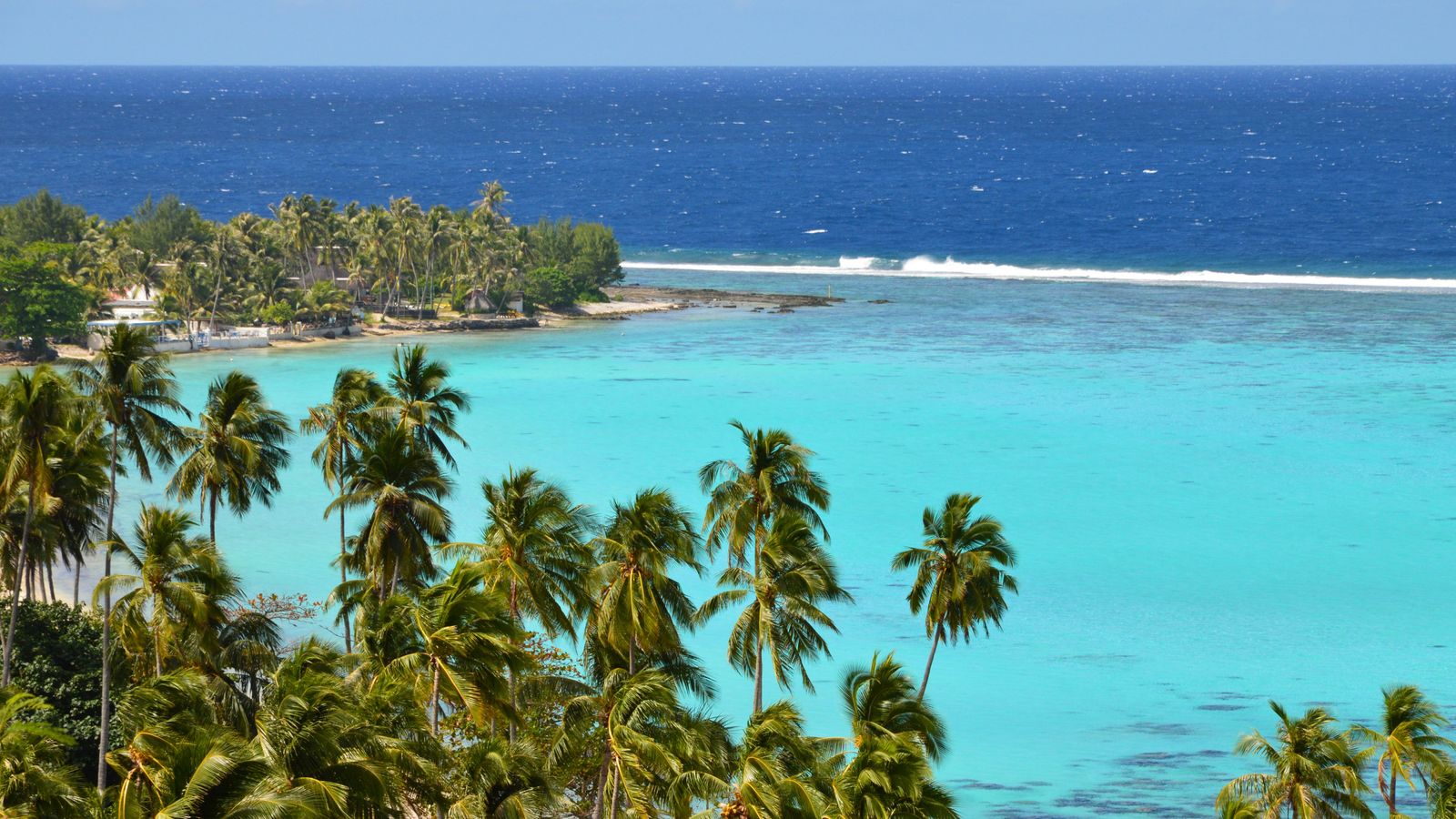
An enormous lagoon enclosed by one of the Pacific’s longest barrier reefs — completely undived, crystal-clear and abundant with reef fish, turtles and healthy coral. One of the least-visited lagoons in the entire Pacific.
Photo: G. Lamarche, CC BY 3.0
The site of the 1841 martyrdom of Pierre Chanel, now the patron saint of Oceania, in Poi village — a significant pilgrimage destination for Pacific Catholics, with a white shrine chapel set in tropical gardens. Canonised in 1954 by Pope Pius XII.
Wallis and Futuna (Wikipedia) →Communal feast cooked in an underground stone oven — whole pigs, fish, taro, breadfruit and palusami slow-cooked over heated stones. Every celebration involves a communal umu; the smoke rising through the jungle is the defining scent of both islands.
Raw tuna marinated in lime juice until lightly cured, then mixed with coconut cream, cucumber, tomato and green onion — the definitive Pacific dish, prepared daily in homes and the few local restaurants.
Dozens of taro varieties are cultivated on both islands — purple, pink, white and yellow-fleshed varieties baked in the umu or boiled. Taro cultivation defines the agricultural landscape of both Wallis and Futuna.
A ceremonial drink made from ground Piper methysticum root — mildly sedating, earthy, drunk from coconut shells at chiefly ceremonies. Central to Polynesian protocol throughout the islands.
Dense coconut-cream bread baked on heated stones — the same tradition found throughout Polynesia, deeply embedded in the food culture of the islands.
The beer of choice throughout the French Pacific — imported from Tahiti, served at the handful of bars on Wallis and Futuna alongside French wine imported via New Caledonia.
Hihifo Airport (WLS) on Wallis is the main gateway. Air Calin (Air Calédonie International) serves the main routes from Nouméa and Nadi. For trip planning, see the official Wallis and Futuna portal.
Air Calin (Air Calédonie International, the New Caledonia carrier) operates the only scheduled services to Wallis and Futuna from Nouméa (3h) and Nadi (2h30). Flights are 2–3 times per week; book well in advance.
From Europe and North America, Nouméa (New Caledonia) or Nadi (Fiji) are the practical hubs. Nouméa is well-served from Paris (16h direct, Air France) and Sydney (2h30, Qantas/Air Calin).
Air Wallis (the territory’s domestic carrier, operating a small aircraft between Wallis and Futuna) is the only practical inter-island transport. The crossing by sea is rough and unreliable.
Car hire (US$40–70/day) is the most practical option on Wallis. Futuna has limited road access; many villages are accessible only by foot or pirogue.
Year-round is warm (26–29°C). April to October is drier and more comfortable. November to March is the wet season with higher humidity and occasional cyclones. The islands have very few tourists in any month.
📅 Wallis and Futuna is in its best season in May, June, July, August, September, October. See where else is good to go in those months, or browse where to go by month.
The CFP franc (XPF, approx 120 XPF = 1 USD) is the currency. Prices are at French levels for imported goods, but local food and accommodation is modest.
Popoi (breadfruit fermented in a pit for weeks and then baked — the most distinctive starch of Wallis and Futuna, with an intensely sour flavour unique in the Pacific, eaten with fresh fish and coconut cream at local meals) is.
Uvean tapa cloth (the bark cloth made from the inner bark of the paper mulberry tree, beaten to paper thinness and decorated with geometric designs in red and black natural dyes)
Wallis and Futuna is one of the few places in the French Pacific where private fishing charters in clear waters are still affordable.
Mata-Utu for one day, Lalolalo crater lake for one, Futuna island for two days, Sigave for one, lagoon snorkelling for one, Pitonuku and departure for one. Wallis and Futuna — the least-visited French territory — has three living Polynesian kings, the first Catholic martyr of the Pacific, the most intact reef in French Polynesia and a tapa cloth tradition unchanged for 1,500 years.
Mata-Utu — the capital of Wallis and Futuna (a French overseas collectivity of 142km², population 11,000, in the South Pacific between Fiji and Samoa — one of the most obscure French territories and one of the least-visited inhabited places in the world, receiving fewer than 5,000 visitors per year) with the Cathedral of Our Lady of Peace (the largest and most impressive Catholic church in the Pacific — a neo-Romanesque structure built largely by the islanders themselves in the 1950s, containing remarkable Pacific-influenced artworks) and the Lavelua royal palace.
Wallis and Futuna is the only French overseas territory to have formally retained its traditional Polynesian royal system — the three kingdoms of Uvea (Wallis), Sigave (Futuna) and Alo (Futuna) each have a hereditary king (Lavelua for Uvea, Keletaona for Sigave, Tuigaifo for Alo) whose traditional authority is recognised alongside French law. The kings preside over village ceremonies, land allocation and customary disputes; the French government works with rather than against the royal system.
Lake Lalolalo (a volcanic crater lake in the interior of Wallis — a perfectly round freshwater lake 80m deep at the bottom of a collapsed volcanic caldera, surrounded by dense subtropical forest, with no outflow — the water is clear and deep blue, accessible by a walking trail from the road — the most beautiful natural feature on Wallis) and the traditional Uvean kava ceremony (the most important communal ritual on the island, performed at major meetings and celebrations with the pounded root of Piper methysticum mixed with water).
Lake Lalolalo (a maars-type volcanic crater lake on Wallis — formed by a phreatomagmatic eruption when rising magma encountered groundwater, creating a violent steam explosion that collapsed the crater and created the perfectly round lake — is one of the deepest crater lakes in the Pacific for its size. The surrounding forest has never been farmed or cleared; the lake ecosystem is essentially undisturbed.
By Air Wallis flight (30 min). Futuna (the smaller, more traditional of the two main island groups — two volcanic islands joined by an administrative bond, with the most intact traditional Polynesian culture in the French Pacific — no tourism infrastructure, village life organised entirely by the traditional chiefly system, the finest traditional tapa cloth in the Pacific made from beaten bark of the paper mulberry tree, and the Sanctuary of Saint Peter Chanel — the first Catholic martyr of the Pacific).
Saint Peter Chanel (Pierre Chanel — a French Marist missionary martyred on Futuna on 28 April 1841, killed by the order of the local king Niuliki who feared the Christian mission was undermining his authority — was canonised in 1954, making him the patron saint of Oceania and the only person to be canonised specifically for being killed in the Pacific Islands. The sanctuary at Poi (Futuna) is a significant Catholic pilgrimage site in the Pacific.
Sigave (the western kingdom of Futuna — a traditional Polynesian village of 1,500 people governed by the King Keletaona, with the finest handicrafts in Wallis and Futuna: the women weave exceptional fine mats (tapa and pandanus) while the men carve tikis and produce kava for ceremonial use — a village with no tourism infrastructure where visitors are welcomed as personal guests rather than customers, the most authentic traditional Pacific experience in French territory).
Futuna Polynesian culture (predating European contact by approximately 1,500 years and maintaining its traditional governance, ceremonies and material culture largely intact through a combination of geographic isolation and the French policy of parallel governance alongside the traditional royal system) is the closest surviving example of pre-contact western Polynesian society accessible to outside visitors.
The Wallis lagoon (a 200km² enclosed lagoon behind the barrier reef, with healthy coral gardens, abundant fish and the most intact reef ecosystem in the South Pacific accessible from a French territory — zero commercial fishing in the lagoon and the virtually complete absence of tourism have maintained the reef in a condition rarely seen outside the most remote Pacific atolls, accessible by local pirogue from Mata-Utu).
The Wallis Island lagoon (the barrier reef enclosing 200km² of calm lagoon around the main island — the reef has never been commercially fished, and local fishing is governed by traditional rights restricting effort to subsistence levels) contains some of the highest coral and fish biodiversity documented in French Polynesia, according to the IRD (Institut de Recherche pour le Développement) surveys of 2018.
Pitonuku (the ancient Uvean fortification — a pre-European stone fortress on the north coast of Wallis, built approximately 700 years ago as part of the Tongan conquest period (1250–1450 CE) when Tonga controlled large areas of western Polynesia, the most significant pre-European archaeological monument in Wallis — with the stone platforms (paepae) of former noble residences visible in the surrounding forest) and the traditional Uvean dance performance (the most distinctive performing art in the territory).
The Tongan conquest of Uvea (Wallis) approximately 1250–1450 CE (when Tongan warriors established a tributary kingdom on the island, leaving the fortification at Pitonuku and changing the island’s language, art forms and material culture) is recorded in both Tongan and Uvean oral traditions. The conquest era architecture (stone platforms, fortifications and enclosures) is the primary archaeological legacy on the island.
A final morning exploring the small colonial town of Mata-Utu (the cathedral, the covered market with fresh fish and local produce, the craft stalls with tapa cloth and fine pandanus mats) before flying from Hihifo Airport (WLS) back to Nouméa or Nadi.
Wallis and Futuna is one of the few remaining places in the world where traditional Pacific ceremonial life (the kava ceremony, the traditional dance, the chiefly protocol, the tapa cloth production and the communal fishing arrangements) continues unchanged alongside French governance, internet access and modern medical facilities — the coexistence of these two systems without significant conflict is the most distinctive aspect of the territory.
Air Calin operates just two flights per week to Wallis-Futuna Airport (WLS). This schedule drives all planning; book flights months in advance as they fill quickly.
EU passport holders enter as a French collectivity. Most other nationalities need a prior travel authorisation from the French administration in Mata-Utu.
Wallisian (Uvean) and Futunan are the daily languages; French is used in administration and education. English is rarely spoken.
The XPF (pegged to Euro at 119.33:1) is the only practical currency. Banking infrastructure is minimal; bring sufficient cash for your entire stay.
Arrive prepared for genuine disconnection — mobile coverage is patchy and internet access limited to Mata-Utu. This is one of the most remote inhabited islands on earth.
Fewer than 10 guesthouses exist on both islands combined. Contact the Wallis and Futuna Service du Tourisme months in advance.
Quick answers to the questions people most often ask before visiting Wallis and Futuna.
Fly into Hihifo Airport (WLS) on Wallis. Air Calin runs the only scheduled services — about 3 hours from Nouméa in New Caledonia and about 2h30 from Nadi in Fiji — with just a few flights a week, so book early. Futuna is reached by a short domestic flight from Wallis.
Wallis and Futuna is a French overseas collectivity. EU citizens enter freely; most other nationalities need prior travel authorisation from the French administration. Check the current rules for your passport well before travel.
The islands are warm all year (26–29°C). May to October is the drier, more comfortable season, while November to March brings higher humidity, more rain and the risk of cyclones.
The CFP franc (XPF), which is pegged to the euro. Banking is minimal and card acceptance is limited, so bring enough cash for your whole stay.
Expect roughly US$60–100 per day on a budget, US$120–200 mid-range and US$300 or more for the best available options. Imported goods are priced at French levels, while local food and guesthouses are modest.
Wallis and Futuna sits between Fiji, Samoa, Tonga, Vanuatu and New Zealand in the heart of Western Polynesia — a neighbourhood of islands where Melanesian and Polynesian cultures meet and overlap.
Wallis and Futuna is one of the world’s least-visited places. See all 90 in our guide to the world’s least-visited countries & territories.
