LB
Lebanon
Beirut, Baalbek & the best food in the Middle East
Beirut, Baalbek & the best food in the Middle East
⚠️ Travel advisory: most governments advise against travel
The US advises against all travel to Lebanon, and other governments advise against travel to large parts of the country, especially the south and the Bekaa, because of the risk of conflict. Check the latest advice before planning a visit.
Latest official advice: UK FCDO · US State Department · Reviewed September 2026
Lebanon is a country of contrasts compressed into an area smaller than Wales. Within an hour’s drive, you can ski the Lebanon Mountains and swim in the Mediterranean; cross from French-influenced Beirut’s sophisticated restaurant scene to the cedar-forested highlands; and move from Phoenician ruins to Ottoman souks to modernist beach clubs. Beirut itself is a city that refuses to die — rebuilt after civil war, scarred by more recent tragedy and yet pulsing with creative energy, food and a nightlife that once made it the Paris of the Middle East.
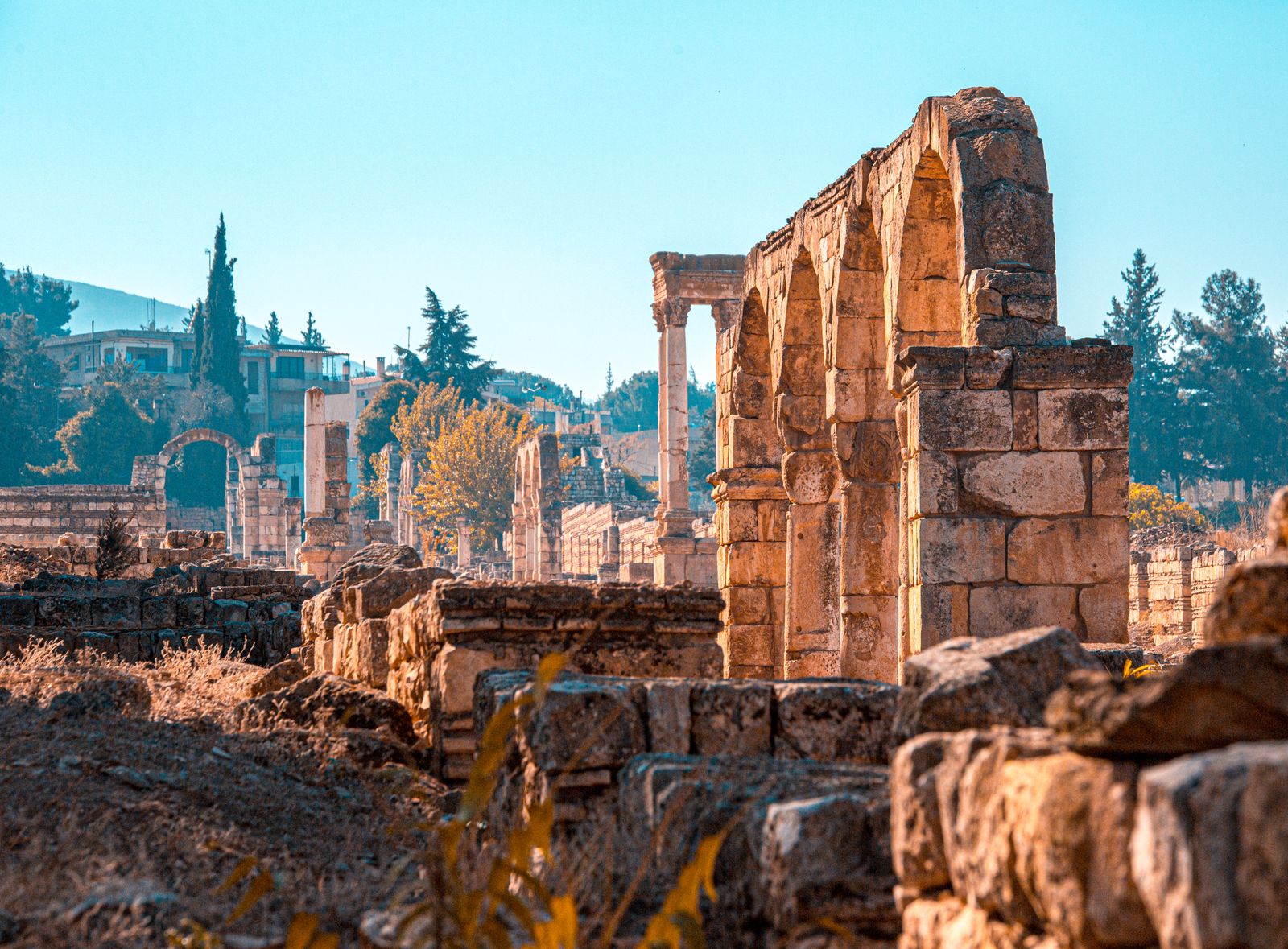
The Bekaa Valley produces some of the Arab world’s finest wine beside the Baalbek Roman temples of staggering scale. The port cities of Tyre (Sour) and Byblos (Jbeil) contain Phoenician harbours, Crusader castles and Roman ruins within walking distance of the sea. In the north, Tripoli holds the finest Mamluk architecture in the country, while the Jeita Grotto hides a cathedral of stalactites in the mountains above the coast.
Lebanon’s electric capital is divided between the rebuilt downtown, the bohemian Gemmayzeh and Mar Mikhael neighbourhoods, the upscale Achrafieh district and the beachfront Corniche. The National Museum of Beirut traces 6,000 years of Lebanese civilisation; Hamra Street is the intellectual pulse of the Arab world; and the city’s restaurant scene — Lebanese cuisine is widely considered the finest in the Middle East — is back and thriving.
The Roman temple complex at Baalbek in the Bekaa Valley is the largest and best-preserved in the world. The Temple of Jupiter, with its six remaining columns standing 22 metres tall on a podium that would have dwarfed the Parthenon, is a monument of ambition. The Temple of Bacchus — smaller but more complete — still has its roof. Together they form one of the most striking ancient sites anywhere.
One of the oldest continuously inhabited cities in the world — possibly the oldest — Byblos has a Phoenician harbour, Crusader citadel, Roman colonnaded street, medieval fishing port and stone-lane souk all within the same small headland. The name “biblos” (book in Greek) derives from Byblos’s role as the Phoenician port through which papyrus was traded to the ancient world.
A UNESCO World Heritage Site, the Qadisha Valley is a steep, dramatic gorge in the Lebanon Mountains containing ancient Christian monasteries carved into cliff faces and hermit caves occupied since the 3rd century. At the valley’s head, the last grove of the ancient Cedars of God — the famous cedars of Lebanon that built King Solomon’s temple — stands in an eerie alpine silence.
A spread of small shared dishes: hummus, mutabbal (smoky aubergine dip), kibbeh, fattoush and herb-heavy tabbouleh.
Ground lamb and bulgur shaped into ovals and fried, baked in trays, or served raw as kibbeh nayyeh.
Flatbread grilled over charcoal stuffed with spiced minced meat — street food that is the Lebanese equivalent of a burger.
Kafta, shish taouk and lamb chops, grilled over charcoal and served with garlic sauce.
Warm cheese pastry soaked in orange-blossom syrup. Lebanon also makes wine, mainly in the Bekaa Valley (Ksara, Château Musar, Ixsir).
Anise spirit mixed with water and ice until it turns milky — the classic drink with meze.
Beirut Rafic Hariri International (BEY) is the only commercial airport. Middle East Airlines (MEA) is the national carrier. Check FCO/State Dept travel advisories before booking given ongoing regional tensions.
MEA and British Airways both fly Heathrow–Beirut direct in 5 hours. Turkish Airlines via Istanbul is a convenient routing with high frequency.
Beirut is central to the Levant — Amman is 1h, Cairo 1h30, Nicosia 45 minutes. A Lebanon, Jordan, Egypt circuit makes excellent geographic sense.
Service taxis (“servees”) — shared taxis on fixed routes that pick up multiple passengers — are Lebanon’s backbone transport and cost US$1–3 per trip anywhere within Beirut. Flag them down anywhere on the main roads.
Car hire in Beirut (US$30–60/day from major agencies) is the best option for the Qadisha Valley, Cedars and Baalbek in a single circuit. Roads are good between cities; mountain roads are narrow in winter.
April to June and September to November are ideal — Beirut warm and wide awake, the Bekaa Valley accessible, the Cedars of Lebanon green. July and August are hot and humid but still very lively. December to February brings snow to the mountains — Lebanon has both skiing and Mediterranean coast within 45 minutes.
📅 Lebanon is in its best season in April, May, June, September, October, November. See where else is good to go in those months, or browse where to go by month.
Lebanon is officially mid-range but the economic crisis (2019–present) means prices fluctuate dramatically. The USD is now the de facto currency; the Lebanese Pound (LBP) has devalued 95%+ and is used for some local transactions.
Man’oushe — a flatbread topped with za’atar (wild thyme, sesame, sumac blend) and olive oil, baked on a saj (curved iron griddle) — is Lebanon’s definitive breakfast and costs US$1–2.
Lebanese wine from the Bekaa Valley (Chateau Ksara, Chateau Kefraya, Massaya, Chateau Musar) is produced in a valley at 1,000m altitude between two mountain ranges.
Beirut has one of the best restaurant scenes in the Middle East — Tawlet, Em Sherif and Mayrig are among the finest Lebanese cuisine restaurants in the world, at prices that remain affordable by London or Paris standards.
Beirut for three days, Baalbek for one, Byblos for one, the Qadisha Valley for two. Lebanon is the most culturally layered country in the Middle East — Phoenician, Greek, Roman, Byzantine, Crusader, Ottoman, French, and the inimitable Beirut itself.
Beirut has been destroyed and rebuilt seven times. The Downtown (Solidere), rebuilt after the 1975–1990 civil war, sits above Roman columns still visible at street level. The Corniche (the Mediterranean waterfront promenade, 5km, where all of Beirut walks at sunset) and Gemmayzeh and Mar Mikhael — the restored Ottoman warehouse districts now filled with bars and galleries.
The 2020 Beirut port explosion (August 4, 2020, caused by 2,750 tonnes of ammonium nitrate, one of the largest non-nuclear explosions in history) devastated the eastern districts. The rebuilt Gemmayzeh is a study in Lebanese resilience — the same buildings that were shattered are now functioning bars and restaurants.
The Sursock Museum (a 19th-century Italianate palace converted to a modern art museum) was partially destroyed in the 2020 explosion and has since partially reopened — the reconstruction is itself a symbol of the city. The Lebanese food circuit: man’oushe (flatbread with za’atar) for breakfast, mezze at lunch (hummus, kibbeh, fattoush, baba ghanoush, raw kebbeh), grilled meats for dinner.
The Lebanese mezze — 15–30 small dishes served simultaneously, built around bread, olive oil, herbs and fire — is the most directly influential cuisine in the world, the foundation of what the West calls “Middle Eastern food.” In Beirut it reaches a standard found nowhere else.
The National Museum of Beirut (the finest archaeological collection in Lebanon — Phoenician glass, Bronze Age figurines, Roman sarcophagi, and the story of a country with 9,000 years of continuous habitation) was on the Green Line during the civil war — curators encased the largest pieces in concrete to protect them. Hamra Street (the intellectual and cultural spine of West Beirut) in the evening.
During the civil war the National Museum was directly on the Green Line separating East and West Beirut. The curators encased the ground-floor mosaics and large sculptures in concrete blocks. The concrete was removed after 1991 — every piece survived.
1h30 from Beirut via the Bekaa Valley. Baalbek (UNESCO World Heritage Site) — the Temple of Jupiter (six surviving columns, the temple was 88m × 48m, the largest in the Roman world), the Temple of Bacchus (the best-preserved Roman temple in the world), and the Temple of Venus — is one of the most overwhelming ancient sites on earth.
The Temple of Jupiter at Baalbek was built with the largest stone blocks ever quarried — the foundation stones (trilithon) weigh 800 tonnes each, moved from a quarry 800m away by methods that remain unknown. The three standing columns are 22m tall and support a 5m-high entablature.
40 min from Beirut. Byblos (Jbeil) is claimed to be the oldest continuously inhabited city in the world (evidence of habitation from 8000 BCE) — a Phoenician, then Greek, then Roman, then Crusader city stacked on the same hill above the Mediterranean. The Crusader castle and the ancient port.
The word “Bible” comes from Byblos — the Phoenicians exported papyrus through this port, and the Greeks called the papyrus scroll “byblos” (from the city’s name). The oldest known alphabetic writing (Phoenician script, 1000 BCE) was found here.
1h from Byblos. The Qadisha Valley (UNESCO World Heritage Site) — a deep gorge in the Mount Lebanon range with Maronite Christian monasteries carved into the cliff faces, occupied continuously since the 4th century CE, and the Cedar Forest of God (Horsh Arz el-Rab) with 375 ancient cedars, some over 3,000 years old.
The Cedars of Lebanon are mentioned 103 times in the Bible and were used for Solomon’s Temple in Jerusalem (King Hiram of Byblos supplied them). The original forests covered Mount Lebanon; now only 12km² remain. The oldest cedar in the forest is approximately 3,000 years old.
2h from Beirut. Tyre (Sur) — the Phoenician city from which Carthage was founded, now a UNESCO World Heritage Site with the finest Roman hippodrome in the Middle East (137m × 480m, still intact), mosaic-floored streets and the Al-Bass archaeological site.
Alexander the Great besieged Tyre for 7 months in 332 BCE — Tyre was an island city, and Alexander built a 800m causeway from the mainland to reach it. The causeway gradually silted up and Tyre became a peninsula. Alexander’s causeway is still there.
Lebanon has a complex dual currency situation; US dollars and Lebanese pounds are both used. Carry cash (USD preferred) as the banking system is severely disrupted.
Lebanon has faced severe economic crisis and political instability since 2019. Check travel advisories before visiting; Beirut is more stable than the south near the Israel border.
The Lebanese pound has collapsed; USD is the practical currency. ATMs are unreliable — bring USD cash from outside. Exchange at Beirut money changers for better rates.
Lebanese hospitality is excellent. If invited to someone’s home, bring sweets or flowers. Refusing food or coffee is considered impolite.
Rafic Hariri International Airport (BEY) handles all international flights. Taxis from the airport should be negotiated in advance — settle on a price before getting in.
Check current travel advisories. Lebanon has experienced periods of instability; the political and economic situation requires monitoring before and during travel.
No functioning public transport system exists — hire a driver for day trips or use ride apps. Roads outside Beirut can be challenging.
Eating out in Lebanon is an experience — even modest restaurants serve outstanding food. Ask locals for their favourite neighbourhood spots.
Quick answers to the questions people most often ask before visiting Lebanon.
April to June and September to November are ideal — Beirut warm and wide awake, the Bekaa Valley accessible, the Cedars of Lebanon green. July and August are hot and humid but still very lively.
Beirut Rafic Hariri International (BEY) is the only commercial airport. Middle East Airlines (MEA) is the national carrier. Check FCO/State Dept travel advisories before booking given ongoing regional tensions.
Expect roughly US$40–70 a day on a budget and US$100–170 mid-range, or US$300+ for a more luxurious trip, per person and excluding flights.
Lebanon uses the USD / Lebanese Pound.
The US advises against all travel to Lebanon, and other governments advise against travel to large parts of the country, especially the south and the Bekaa, because of the risk of conflict. Check the latest advice before planning a visit. Always check current official travel advice before booking.
— Operates in Beirut and is the most reliable way to get around the city.
Free— Lebanon’s popular food delivery and ride-hailing app, widely used in Beirut.
Free— Works well throughout Lebanon; useful for navigating mountain villages and finding restaurants.
FreePoint your camera at menus, signs or street text for instant translation. Download the language pack offline before you arrive for full use without data.
FreeReal-time and offline exchange rates for all world currencies — converts prices instantly so you always know what you are paying in your home currency.
FreeLebanon sits within easy reach of several other destinations — each with a completely different character.


