LC
Saint Lucia
Twin Piton volcanoes, Caribbean drama & Creole soul
Twin Piton volcanoes, Caribbean drama & Creole soul
Saint Lucia is the Caribbean island that most justifies the word “dramatic” — the twin volcanic peaks of the Pitons (Gros Piton and Petit Piton) rise sheer from the Caribbean Sea in a UNESCO World Heritage Site of staggering beauty that has made this island one of the most photographed in the Atlantic. Beneath the Pitons, a drive-in volcano (the world’s only) bubbles with sulphuric mud pools and hot springs, and botanical gardens cascade down the hillside in a tumble of tropical colour. Beyond the Pitons, Saint Lucia is a lush, mountainous island of rainforest, banana plantations, excellent diving, the famous Friday-night jump-up at Gros Islet and some of the finest boutique hotel offerings in the Caribbean.
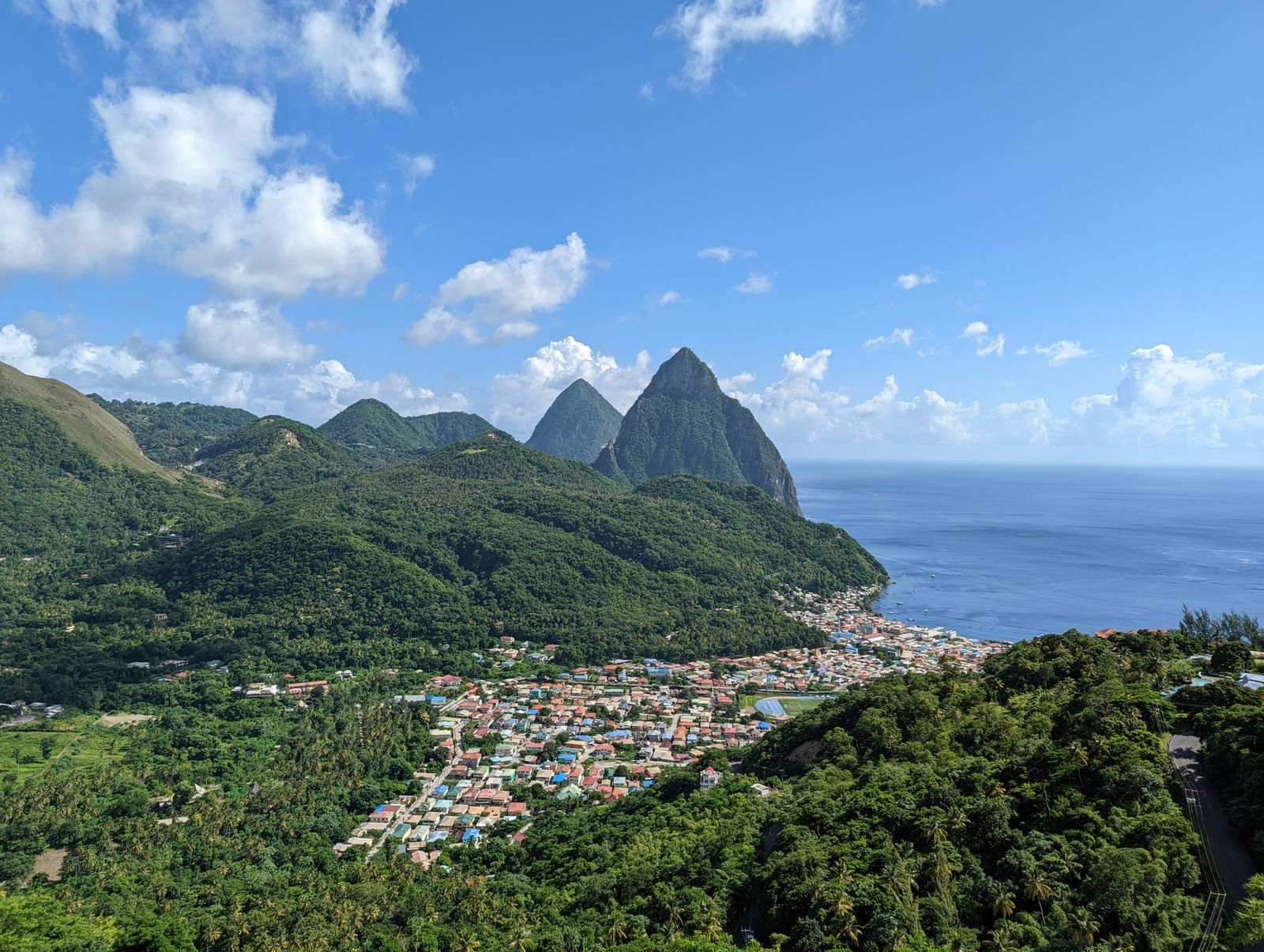
Gros Piton (798m) and Petit Piton (743m) are the defining image of the Caribbean — two volcanic spires rising directly from the sea near the fishing village of Soufrière, draped in dense forest and reflected in the blue Caribbean below. A UNESCO World Heritage Site since 2004. Climbing Gros Piton (3–4 hours with a guide) rewards with views across the entire island and out to sea. The Jalousie Plantation beach directly between the Pitons is among the Caribbean’s most dramatic settings.
The town of Soufrière, beneath the Pitons, is one of the Caribbean’s most atmospheric — its colourful market, colonial buildings and setting between mountains and sea are impressive. The nearby “drive-in volcano” Sulphur Springs — where you can drive to the edge of a volcanic caldera and bathe in hot mineral springs — and the Diamond Falls botanical gardens are the volcanic highlights.
Saint Lucia’s finest dive site lies directly below the Pitons — the Anse Chastanet reef has exceptional marine diversity including seahorses, frogfish and large sea turtles. The beach itself, backed by rainforest, is one of the Caribbean’s most beautiful. Shark Point, Anse la Raye Wall and the impressive wreck of the Lesleen M are other highlights.
Marigot Bay — a deep, sheltered harbour surrounded by hills, used in the filming of Doctor Dolittle — is the most beautiful anchorage in the Caribbean. Rodney Bay in the north has the island’s most developed marina, restaurants and nightlife, and the white sand of Reduit Beach.
Boiled green bananas with seasoned salt cod — the national dish.
A rich, deeply flavoured stew of root vegetables (dasheen, yam, green banana, breadfruit), salted meat and dumplings — Saint Lucia’s most sustaining dish, eaten on rainy days and at family gatherings. The variety of root vegetables gives it a complexity that simple meat stews lack.
Dasheen leaves cooked with okra, coconut milk and sometimes crab.
Small jackfish fried or grilled with Creole seasoning, a common local fish dinner.
Every Friday night the streets of Gros Islet fill with music, rum punch and grilled fish and chicken.
Hewanorra International (UVF) in the south and George F.L. Charles (SLU) near Castries in the north serve the island. British Airways and Virgin Atlantic fly direct from London; American Airlines connects via Miami. For trip planning, see the official Saint Lucia tourism portal.
British Airways and Virgin Atlantic both operate direct Gatwick–Hewanorra flights year-round. Hewanorra (south) is closer to the Pitons and Soufrière; George F.L. Charles (north) is closer to Rodney Bay and Castries.
Barbados (45 min) and Trinidad (1h) are the main Eastern Caribbean hub connections. American Airlines via Miami (3h30) is the most convenient US gateway.
Hewanorra is in the south — near the Pitons, Soufrière and the most dramatic scenery. If staying in Rodney Bay (north), arriving into SLU (when available) saves 1h30 of taxi. Car hire gives full freedom.
Car hire (US$50–80/day) is strongly recommended — Saint Lucia’s roads are winding and spectacular, and having your own vehicle makes the waterfalls, markets and beaches much more accessible. Drive on the left.
January to April is peak dry season — the Pitons at their most dramatic under clear skies, Marigot Bay calm, the northeast trade wind keeping temperatures pleasant (26–29°C). December is also excellent. June to November is hurricane season — Saint Lucia is on the southern edge of the main track but can be affected.
📅 Saint Lucia is in its best season in January, February, March, April, May, December. See where else is good to go in those months, or browse where to go by month.
Saint Lucia uses the Eastern Caribbean Dollar (XCD) at a fixed rate of XCD 2.70 = US$1. It is mid-range to expensive for the Caribbean — all-inclusive resorts dominate the accommodation market.
Bouyon — a hearty Saint Lucian soup of yam, dasheen, plantain, breadfruit, dumplings and salted pig tail in a rich broth — is the national comfort food.
The Anse La Raye Friday night fish fry (held every Friday in the fishing village of Anse La Raye, the most atmospheric street food event in Saint Lucia)
Jade Mountain (Soufrière, 24 open-wall sanctuaries without a fourth wall facing the Pitons, the most architecturally dramatic hotel in the Caribbean, from US&dollar)
Soufrière for two days, the Pitons for one, Marigot Bay for one, Rodney Bay for one, the rainforest for one, Castries market for one. Saint Lucia — the most dramatically beautiful island in the Eastern Caribbean — is dominated by the twin Piton peaks rising sheer from the sea.
Soufrière — the oldest town in Saint Lucia, a fishing village below the twin Pitons (Gros Piton, 798m, and Petit Piton, 743m — UNESCO World Heritage Site, two volcanic plugs rising sheer from the Caribbean Sea, the most recognisable landscape in the Caribbean) — with the Drive-In Volcano (Sulphur Springs — an active volcanic crater you can drive into, with boiling mud pools and sulphurous steam vents).
The Pitons were declared a UNESCO World Heritage Site in 2004 as a “volcanic spire” landscape of outstanding universal value — the twin peaks are among the most recognisable natural landmarks in the world, appearing on the Saint Lucia flag and on the XCD banknote. The Piton Management Area includes the volcanic complex, coral reefs and tropical forest.
The Gros Piton Trail (3–4h return, with a guide required by law — steep, forested, with views from the summit over Petit Piton, the Caribbean and Saint Vincent on clear days) and the Diamond Botanical Gardens and Mineral Baths (spring-fed mineral baths at 37°C, the original baths built for French troops by Louis XVI in 1784, with botanical gardens of tropical plants).
The Diamond Mineral Baths were built in 1784 by order of Louis XVI for the use of French troops who were suffering from tropical ailments — the mineral water (rich in sulphur, iron and other compounds from volcanic springs) was believed to have curative properties. The baths were destroyed during the Fedon Rebellion of 1795 and restored in the 20th century.
Snorkelling beneath the Pitons — the Marine Management Area (the most protected reef in Saint Lucia, directly below the Piton cliffs, with large corals, seahorses and French angelfish) by boat from Soufrière, and the 7km Piton Marine Reserve (the only section of the Saint Lucian coast where fishing and anchoring are completely restricted, producing the finest reef condition on the island).
The Piton Marine Reserve was created in 1986 when the coral directly beneath the Pitons was found to be among the most intact in the Eastern Caribbean — protected by the difficulty of anchoring in the deep water and the remoteness from the main tourist areas. The reef contains approximately 168 species of coral and 165 species of fish.
30 min from Soufrière. Marigot Bay — a deep, sheltered natural harbour ringed by palm-covered hills, used by Admiral Rodney to hide his entire fleet from the French by covering the masts with palm fronds — is consistently listed as the most beautiful bay in the Caribbean. The ferry across the bay (a 2-minute dugout canoe ride) and the beach bar beneath the palms.
Marigot Bay was the location of Dr Doolittle (1967) and various James Bond scenes — its visual quality has made it the most filmed location in the Eastern Caribbean. Admiral Rodney’s fleet concealment story (1778 — covering masts with palm fronds so that the bay appeared to contain only coconut palms from the sea) may be apocryphal but is fondly repeated.
Rodney Bay — the main resort area of Saint Lucia, with the finest marina in the Eastern Caribbean (home base of the annual Atlantic Rally for Cruisers, the world’s largest offshore sailing race, which arrives from Las Palmas every December with 200+ yachts) and Reduit Beach (the most accessible beach on Saint Lucia, 1km of safe swimming with calm trade-wind swells).
The Atlantic Rally for Cruisers (ARC) departs Las Palmas, Gran Canaria, every late November and arrives in Rodney Bay, Saint Lucia, approximately 3 weeks later — crossing 2,700 nautical miles of open Atlantic. It is the world’s largest offshore sailing event, with 250+ boats and 1,500+ sailors making the same crossing the Columbus fleet made in 1492.
The Rainforest Adventures Saint Lucia aerial tram (a 45-min gondola ride through the forest canopy of the central rainforest, at 300m altitude, above a river gorge) and the Tet Paul Nature Trail (a 45-min walk on the southwest coast above Soufrière with views of both Pitons and the Diamond Falls, one of the finest short walks in the Caribbean).
Saint Lucia’s central rainforest contains the endemic Saint Lucia parrot (Amazona versicolor — the national bird, reduced to 150 individuals in 1978, now 1,000+ after one of the most successful Caribbean parrot recovery programmes, driven by the Saint Lucia Forestry Department and a public education campaign that made the jackquot a symbol of national pride).
The Castries Market (the finest produce market in the Eastern Caribbean, Friday market in full colour — dasheen, christophine, breadfruit, cocoa pods, spices, bay leaves and the Saint Lucian woman in traditional madras dress) and the Gros Islet Friday Night Street Party (the most famous beach party in the Caribbean — the entire fishing village becomes an open-air nightclub every Friday from 10pm). Fly from Hewanorra (UVF) or George F.L. Charles (SLU).
Saint Lucia’s madras dress (the traditional national costume of the Caribbean, worn by women at festivals — a plaid cotton fabric originally imported from Madras, India, in the 18th century for the enslaved women of the French Caribbean, now a symbol of Creole identity across Martinique, Guadeloupe and Saint Lucia) is made in specific colour combinations that traditionally signified the wearer’s relationship status.
Visa-free for most Western nationalities including EU, UK, USA, Canada and Australia.
Hewanorra International (UVF) in the south handles international flights. Vigie Airport (SLU) in the north handles inter-island charters. For Soufriere and the Pitons, Hewanorra is closer.
The south (Pitons, Soufriere, chocolate plantations) is a 1.5h drive from Castries on mountain roads. A car or guided tour is strongly recommended.
The Sulphur Springs near Soufriere is marketed as the “world’s only drive-in volcano” — bubbling mud pools, sulphur vents and a sulfurous mud bath reputed to be therapeutic.
Minibuses (cheap) connect main towns; water taxis run between Castries and Soufrière (90 min by boat vs 2.5h by road). Car hire recommended for flexibility.
A mandatory local guide is required to climb Gros Piton — arrange through the Soufrière Regional Development Foundation. Start early to avoid afternoon clouds.
Quick answers to the questions people most often ask before visiting Saint Lucia.
January to April is peak dry season — the Pitons at their most dramatic under clear skies, Marigot Bay calm, the northeast trade wind keeping temperatures pleasant (26–29°C). December is also excellent.
Hewanorra International (UVF) in the south and George F.L. Charles (SLU) near Castries in the north serve the island. British Airways and Virgin Atlantic fly direct from London; American Airlines connects via Miami.
Expect roughly US$80–130 a day on a budget and US$200–350 mid-range, or US$600+ for a more luxurious trip, per person and excluding flights.
Saint Lucia uses the Eastern Caribbean Dollar (XCD).
Plug types: Type G (UK three-pin, 230V).
Point your camera at menus, signs or street text for instant translation. Download the language pack offline before you arrive for full use without data.
FreeReal-time and offline exchange rates for all world currencies — converts prices instantly so you always know what you are paying in your home currency.
FreeFind and book hotels, guesthouses and apartments with free cancellation on most rates — one of the widest selections of accommodation worldwide.
FreeSaint Lucia sits within easy reach of several other destinations — each with a completely different character.

