MR
Mauritania
Saharan desert cities, iron ore train & two million migratory birds
Saharan desert cities, iron ore train & two million migratory birds
Mauritania is one of West Africa’s most extraordinary and least-visited destinations — a vast desert nation where the Sahara meets the Atlantic, ancient Saharan trading cities are slowly being reclaimed by sand, and the iron ore train that crosses 700 kilometres of empty desert is one of the world’s great journeys. Chinguetti, once the seventh-holiest city in Islam and a gathering point for Saharan pilgrims heading to Mecca, is a medieval mud-brick city of crumbling library towers and drifting dunes — a UNESCO World Heritage Site sinking into the desert in slow motion. The Banc d’Arguin National Park, where the Sahara reaches the Atlantic, is a UNESCO site hosting one of the world’s largest concentrations of migratory shorebirds.
A UNESCO-listed medieval desert city that was once the meeting point of Saharan caravan routes and a gathering place for pilgrims — the minaret of the Chinguetti mosque, built in the 13th century from mud and ostrich eggs, is the icon of the Sahara. The city’s ancient manuscript libraries, holding thousands of medieval Islamic texts, are gradually being overtaken by dunes — giving the city a haunting, elegiac atmosphere unlike anywhere else.
A UNESCO World Heritage Site where the Sahara Desert meets the Atlantic Ocean in an extraordinary tidal flat system. The shallow lagoons and sandbanks between the mainland and the offshore islands support one of the world’s greatest concentrations of migratory birds — up to two million birds including flamingos, pelicans and spoonbills — alongside monk seals, dolphins and sea turtles.
One of the world’s great train journeys — a 700-kilometre freight train carrying iron ore from the Zouerate mines to Nouadhibou on the Atlantic coast crosses pure Sahara desert. The passenger carriage (sometimes just an open ore wagon) takes 16–18 hours through the emptiest landscape imaginable, arriving at the Atlantic covered in iron ore dust — one of the world’s most extreme and memorable travel experiences.
Mauritania (Wikipedia) →Rice cooked in a thick tomato-onion sauce with whole fish stuffed with herbs and yét (fermented mollusc) — the national dish shared with Senegal. Mauritanian versions tend to be richer and more intensely spiced, reflecting the Saharan influence on the coastal cuisine.
The everyday version of thiéboudienne — fresh fish cooked in a tomato broth with vegetables and rice. Whether the dish originated in Mauritania or Senegal is disputed by both; it is eaten daily throughout the Senegambian coast regardless.
camel or lamb meat with rice and vegetables) is the interior speciality.
sweet, slightly salty, nutritious) is drunk daily;
fermented camel milk mixed with water and sugar) is the nomadic refresher. Mauritanian tea — served in three progressively sweeter glasses from a small teapot in an elaborate ceremony that can take an hour — is the social institution of the desert.
Nouakchott-Oumtounsy International Airport (NKC) is the main gateway. Air France, Royal Air Maroc and Air Senegal serve major routes.
💡 Paris (5h30, Air France) and Casablanca (3h, Royal Air Maroc) are the most direct connections. The Canary Islands (2h30 from Gran Canaria) are a surprisingly close stepping stone.
💡 Dakar (1h, Air Senegal) is the closest and most convenient hub — combining Mauritania with Senegal is the natural itinerary for the Senegambia region.
💡 The new NKC airport is 25km north of Nouakchott (30 min). The Atar region (460km northeast) is the base for Adrar desert exploration; a 4WD is essential for Chinguetti, Ouadane and the Richat Structure.
💡 A 4WD with local driver-guide is essential for Adrar and Banc d’Arguin — the desert piste roads require 4WD and local knowledge. The Iron Ore Train (free in ore wagons) is one of the world’s most extraordinary travel experiences.
November to February is the only comfortable window — cool, dry desert conditions (15–28°C in the north, 22–32°C in the south). March to October brings extreme heat (40–50°C in the Sahara; Atar region) and the Harmattan dust winds in spring.
The Mauritanian ouguiya (MRU) is the currency. Affordable, though desert logistics can add up.
Mechoui de chameau (slow-roasted camel — the most prized food in Mauritanian culture, served at celebrations and in the better Nouakchott restaurants, with the camel’s rich, slightly gamey meat slow-cooked over charcoal and served)
Banc d’Arguin birdwatching (November to March — 2 million+ waders including dunlin, knot, sanderling and curlew sandpiper resting on the mudflats, with flamingos and grey herons in the mangroves, accessed by traditional Imraguen)
A private 4WD circuit of the Adrar (Atar–Chinguetti–Ouadane–Richat Structure — 3–4 days, US$200–400 for the vehicle — gives the most comprehensive exploration of the Saharan ghost cities and)
Nouakchott for one day, Chinguetti for one, Adrar desert for one, Ouadane for one, Banc d’Arguin for one, Atar desert camp for one, Iron Ore Train or farewell for one. Mauritania — 90% Sahara — has the seven holy city of Islam at Chinguetti, 2 million migratory shorebirds at Banc d’Arguin, the world’s longest train and the most spectacular night sky in Africa.
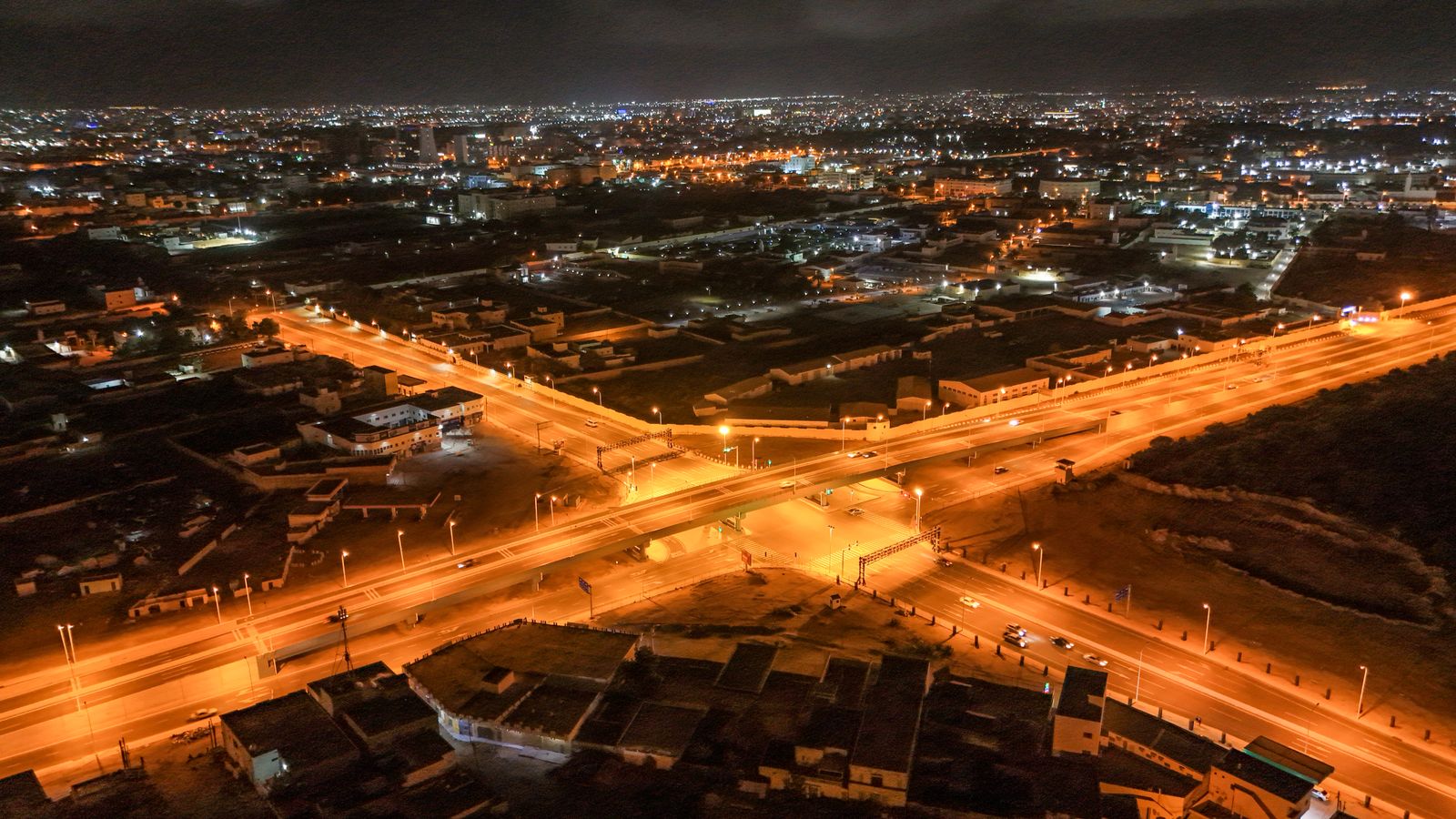
Nouakchott — the capital of Mauritania (a country of 1.03 million km² — 90% Sahara, population 4.5 million, one of the last countries to abolish slavery (1981, with criminal penalties not enacted until 2007 — and an estimated 90,000 people still living in conditions of slavery today according to Walk Free Foundation)) — a city that did not exist before 1957, built from scratch as the capital of the future independent country, with the Port de Pêche (the most dramatic artisanal fish landing in West Africa, 5,000+ pirogues on the beach each morning).
💡 Mauritania abolished slavery in 1981 (one of the last countries in the world to do so legally) and criminalised it in 2007. The Walk Free Foundation estimates that approximately 90,000 people (2% of the population) still live in conditions of hereditary slavery in Mauritania — the highest rate in the world by percentage of population. The practice is concentrated in the Haratin community (descendants of sub-Saharan Africans enslaved by Arab-Berber Moors) and is addressed by the NGO SOS Esclaves, which operates openly in Nouakchott.
Chinguetti (UNESCO World Heritage — the ancient caravan city on the edge of the Sahara at the foot of the Adrar Plateau, one of the seven holy cities of Islam in the Maliki tradition, the departure point of the West African Hajj for 700 years — with the 13th-century minaret (one of the oldest surviving Islamic monuments in sub-Saharan Africa), the private libraries containing 10,000+ ancient Arabic manuscripts and the spectacular dunes of the Adrar Erg surrounding the town on three sides).
💡 Chinguetti manuscripts (approximately 10,000 Arabic texts preserved in private family libraries — covering Islamic theology, astronomy, mathematics and history from the 9th to 19th century — are the most significant body of pre-modern Islamic scholarship in sub-Saharan Africa after the Timbuktu manuscripts. The manuscripts are being digitised by the Mauritanian National Library and international partners; deterioration from heat and dust is a constant threat.
The Adrar Plateau (a sandstone massif rising from the Sahara at 450–800m, with spectacular eroded canyon landscapes, the ancient oasis gardens of Terjit (a lush palm grove at the foot of a sandstone cliff, fed by an underground spring — the most dramatic desert oasis in West Africa), and the Richat Structure (the “Eye of Africa” — a 40km-diameter circular geological formation visible from space, interpreted by some conspiracy theorists as the lost continent of Atlantis, in reality a deeply eroded dome of ancient Precambrian rock).
💡 The Richat Structure (Eye of the Sahara — a 40km diameter circular formation of concentric rings of quartzite ridges in the Adrar desert of Mauritania, visible on satellite imagery as a bullseye in the desert — was formed by the erosion of a dome of ancient igneous and metamorphic rock over 100 million years. It is not a meteorite crater (the rocks show no impact shock features) and is not Atlantis — though Plato’s description of Atlantis as circular with concentric water and land rings has inspired this comparison.
Ouadane (UNESCO World Heritage — the ancient caravan city of the Adrar, founded 1147 as a trading post on the gold and salt routes between the Sahara and sub-Saharan Africa — abandoned progressively from the 16th century as trade routes shifted, now a spectral city of ruined mosques and tower houses in the desert, inhabited only by a small community in the surviving lower town, with the ancient manuscripts and the extraordinary desert landscape).
💡 The ancient cities of the Adrar (Chinguetti, Ouadane, Tichitt and Oualata — all UNESCO World Heritage — were the commercial and intellectual centres of a trans-Saharan trade network that moved gold, salt, slaves and Islamic scholarship across the desert for 800 years. The decline of this network (from the 16th century onwards as European maritime trade routes bypassed the Sahara) left these cities gradually abandoned, preserved by the extreme dryness of the Saharan air in a state of arrested decay.
Banc d’Arguin National Park (UNESCO World Heritage — a coastal ecosystem of mudflats, mangroves and shallow lagoons covering 12,000km² off the Mauritanian Atlantic coast — the most important waterbird wintering site in Africa, hosting 2 million+ migratory shorebirds each year (November–March), the largest breeding colony of grey herons in Africa, nesting flamingos and the traditional fishing communities of the Imraguen people who fish cooperatively with Atlantic dolphins).
💡 The Imraguen fishermen of Banc d’Arguin (a Mauritanian coastal people who have fished the shallow waters of the park for centuries using traditional sailing pirogues — with no motors, no industrial equipment — develop a cooperative fishing relationship with Atlantic humpback dolphins (Sousa teuszii) who drive mullet schools into the shallows where the fishermen wait with nets, one of the few documented cooperative human-dolphin fishing relationships in the world).
Atar (the main town of the Adrar region — the gateway for desert camping in the Adrar, with the traditional camel market (camels are the primary livestock of Mauritania, with 1.5 million animals providing transport, meat, milk and economic status), the weekly market with Saharan traders and the best Mauritanian tea ceremony — and an overnight desert camp in the Adrar dunes for the most spectacular night sky in Africa, the Milky Way fully visible without light pollution for 300km in every direction).
💡 The Mauritanian tea ceremony (ataya — the three-glass green tea ceremony of Mauritanian hospitality, each glass progressively stronger and sweeter, prepared slowly over an hour of conversation, the most important social ritual in Mauritanian culture — “the first glass is as bitter as life, the second as sweet as love, the third as gentle as death” — is the defining cultural experience of the Saharan hospitality tradition.
A final day in Nouakchott: the Iron Ore Train (the longest train in the world — a freight train up to 3km in length transporting iron ore from Zouerate in the Sahara to Nouadhibou port, taking passengers free of charge in the iron ore wagons, a famous traveller experience — the full journey takes 12–20 hours through the Sahara and is one of the world’s great iron road experiences) and the Nouakchott craft market (silver jewellery, leather goods and camel-bone carvings) before flying from Nouakchott (NKC).
💡 The Mauritanian Iron Ore Train (La Route du Fer — the 704km freight railway from the Zouerate iron ore mines to Nouadhibou port, operating 24 hours a day with up to 250 wagons per train, the third-longest train in the world by wagon count — allows passengers to ride free in the ore wagons (equipped with improvised seats) or in a single passenger car. The 12–20 hour Saharan crossing through the Adrar is one of the world’s great railway journeys.
Visa on arrival at Nouakchott airport for most nationalities.
Connected to Casablanca, Paris and regional African hubs. Nouadhibou in the north also has connections to Las Palmas.
Much of Mauritania is deep Sahara. Any desert travel requires a local guide, adequate water (10L/person/day minimum), satellite phone and a 4WD convoy.
The MRU is the currency. Euro and USD exchanged in Nouakchott. Very limited ATM coverage — bring sufficient cash.
4WD and experienced driver essential for Chinguetti and desert circuits. The iron ore train runs irregularly — inquire locally about schedule.
Point your camera at menus, signs or street text for instant translation. Download the language pack offline before you arrive for full use without data.
FreeReal-time and offline exchange rates for all world currencies — converts prices instantly so you always know what you are paying in your home currency.
FreeFind and book hotels, guesthouses and apartments with free cancellation on most rates — one of the widest selections of accommodation worldwide.
FreeBrowse millions of traveller reviews for restaurants, attractions and hotels — helps identify the best local spots and avoid tourist traps.
FreeMauritania sits within easy reach of several other destinations — each with a completely different character.
