YE
Yemen
Dragon Blood Trees of Socotra, Sana’a tower houses & Yemeni honey
Dragon Blood Trees of Socotra, Sana’a tower houses & Yemeni honey
⚠️ Travel advisory: most governments advise against travel
Governments advise against all travel to Yemen because of armed conflict, terrorism and kidnapping. This guide is kept for background and future planning.
Latest official advice: UK FCDO · US State Department · Reviewed September 2026
Yemen is one of the Arab world’s oldest and most culturally extraordinary civilisations — a country of immense historical depth whose accessibility for visitors has been severely curtailed by a devastating civil war since 2015. Before the conflict, Yemen was one of the world’s most rewarding destinations: the UNESCO-listed old city of Sana’a (one of the world’s oldest inhabited cities, its 6-8 storey tower houses decorated with geometric plasterwork unlike anything in the Arab world), the mud-brick skyscrapers of Shibam in the Hadhramaut Valley (the “Manhattan of the Desert”), the island of Socotra (home to the Dragon Blood Tree and some of the most alien landscapes on earth) and the Yemeni coffee and honey traditions of global significance. Socotra, technically part of Yemen, has continued to receive some visitors; check current advisories carefully.
A UNESCO World Heritage Site and one of the world’s most striking islands — the Dragon Blood Tree (Dracaena cinnabari), with its mushroom-shaped crown and blood-red resin, grows in forests on the Haggeher Mountains alongside 37% of plant species found nowhere else on earth. The white sand dunes of Qalansiyah Lagoon, the turquoise waters of Detwah Lagoon and the island’s healthy coral reefs make Socotra the “Galápagos of the Indian Ocean”. Some visits are currently possible via UAE charter flights.
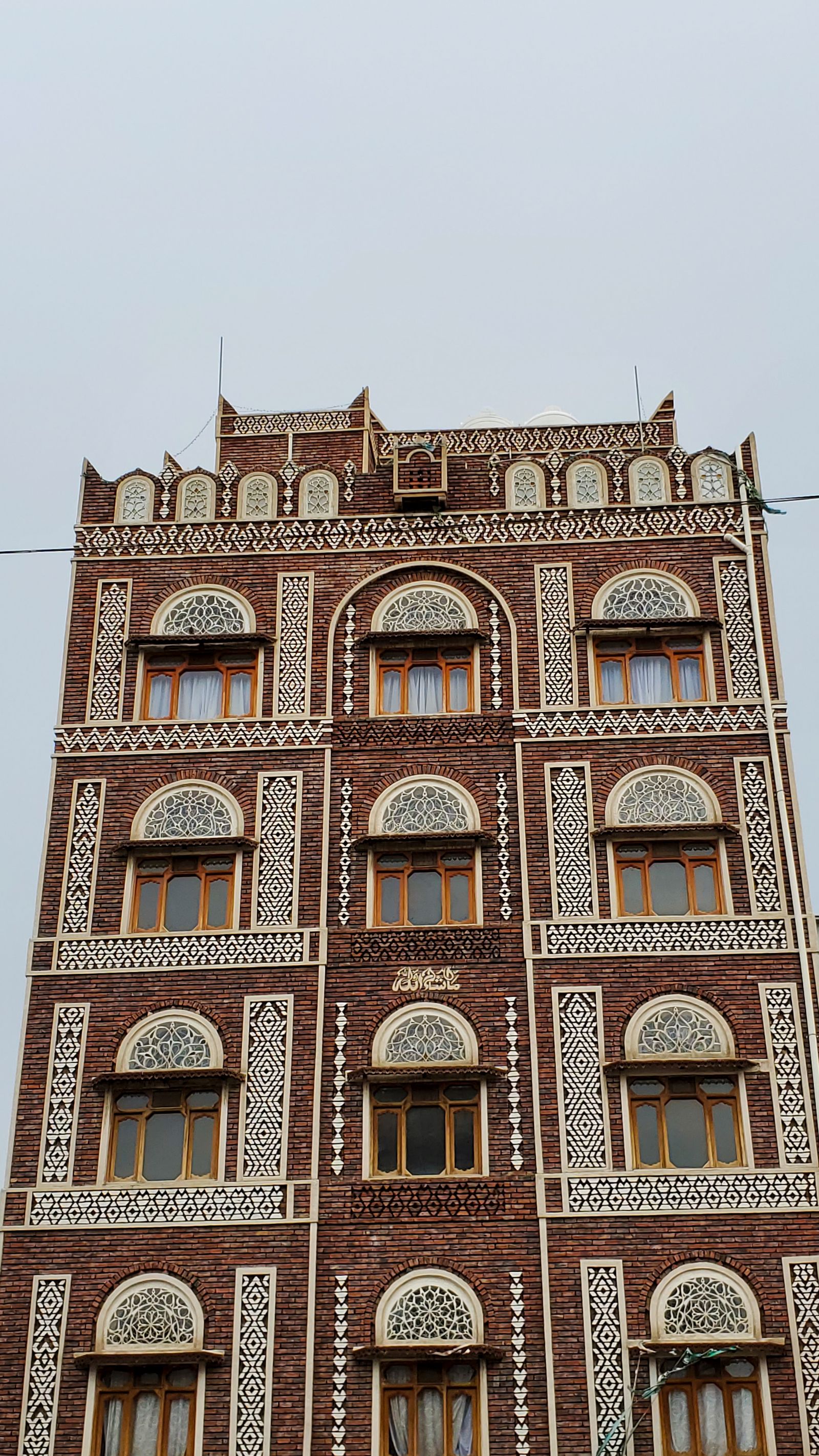
A UNESCO World Heritage Site of 6-8 storey tower houses decorated with elaborate white plasterwork, alabaster windows and geometric friezes — the largest surviving example of a pre-Islamic Arab city and one of the most architecturally distinctive urban landscapes on earth. The old city has over 6,000 houses, 103 mosques and 14 hamams, almost all pre-dating the 11th century.
The “Manhattan of the Desert” — a UNESCO-listed city of 500 mud-brick tower houses 5‑1 storeys tall, built in the 16th century in a valley floor and defended by the surrounding cliffs. The Hadhramaut Valley’s great architecture, date palm oases and Hadhrami cultural traditions are unique in the Arab world.
a simmering stew of meat, vegetables and hulba — fenugreek froth — served in a stone bowl, the national dish) is impressive.
Rice cooked in a clay pot with spiced lamb or chicken and dried limes, saffron and raisins — the celebratory rice dish of Yemen, similar to Gulf machboos but distinctly Yemeni.
A large, spongy sourdough crepe made from sorghum flour and served for breakfast with honey, ghee or bean stew — Yemen’s staple morning food, found across the country.
A spiced ginger and coffee husk drink, served hot with cardamom — Yemen’s traditional coffee culture predates espresso; qishr is drunk at every social gathering.
Lamb stew cooked with hulba (fenugreek foam), tomato, onion and spices in a stone pot (merjal), then stirred tableside until the fenugreek creates a frothy, intensely flavoured sauce — a Yemeni speciality with a unique texture unlike any other stew in the Arab world.
Whole lamb or chicken slow-cooked underground in a tandoor-like pit oven (taboon) until the meat falls from the bone, served on fragrant saffron rice — the defining celebratory dish of Yemen and the Gulf, originally Hadrami in origin and now found across the Arab world.
semolina porridge with lamb and ghee) are the great Yemeni dishes. Yemeni coffee (qishr — brewed from coffee husks with ginger, unique to Yemen) and Yemeni honey (Sidr honey from Hadhramaut, one of the world’s most prized) are globally famous.
Sana’a International Airport (SAH) has had limited operations during the conflict. Aden Airport (ADE) has operated more consistently. Socotra is served directly from Abu Dhabi and Muscat.
Cairo, Amman and Dubai are the most practical gateways when flights are operating. Aden Airport (ADE) has generally been more consistently operational than Sana’a during the conflict. Check all current airline operations.
Socotra is most practically reached via Abu Dhabi or Muscat with direct flights operating in the October–April season. The island has its own local Socotri government and has remained relatively stable compared to the mainland.
All movement in Yemen requires security assessment and, ideally, a trusted local partner organisation. The Sana’a–Aden highway and the Sana’a–Marib route pass through conflict-affected areas.
Yemen requires a local fixer or organisation with current security knowledge for all movement. Socotra is the most practically visited area; the mainland requires the highest level of conflict-zone travel preparation.
October to April is the most accessible period for the Red Sea coast and Sana’a (22–28°C). Socotra Island is best October–April (monsoon June–September closes the island). The Hadramawt and interior are best November–February. Yemen has been in active conflict since 2015; all major governments advise against travel. This content is for future reference.
📅 Yemen is in its best season in January, February, March, October, November, December. See where else is good to go in those months, or browse where to go by month.
The Yemeni rial (YER) is the currency; USD used by NGO/media workers. Affordable locally but all visits require specialist logistics.
Saltah (the national dish of Yemen — a stew of meat broth, vegetables, beans and fenugreek froth (hulba) served bubbling in a clay pot with flatbread — the most beloved and widely eaten dish in Yemen, available at local)
Socotra Island (accessible by direct flights from Abu Dhabi and Muscat when the conflict situation allows)
Yemen’s post-conflict tourism potential (five UNESCO World Heritage sites, the most striking vernacular architecture in Arabia, the Galapagos of the Indian Ocean at Socotra, the Queen of Sheba’s ruins at Marib)
Sana’a for two days, Socotra Island for one, Wadi Hadramawt for one, Marib Sabaean ruins for one, Aden for one, farewell for one. Yemen — Arabia Felix, the land of Sheba — has the most alien flora of any island at Socotra, the world’s first skyscraper city at Shibam, the ancient dam of the Queen of Sheba at Marib and the most striking tower house urban landscape in the world in the UNESCO Old City of Sana’a. Currently the world’s worst humanitarian crisis; all governments advise against travel.
Sana’a — the capital of Yemen (527,970km² at the southwestern tip of the Arabian Peninsula, population 33 million — one of the oldest continuously inhabited cities in the world, with a pre-Islamic history of 2,500+ years, the land of the Queen of Sheba according to Ethiopian and Yemeni tradition — devastated by a Saudi-led coalition war that began in March 2015 in response to the Houthi takeover of Sana’a and has killed an estimated 150,000–250,000 people, creating the world’s worst humanitarian crisis). All governments advise against all travel. This content is for informational purposes for when conditions improve.
The Yemeni civil war (began 2014–2015 when the Houthi movement (Ansar Allah) — a Zaidi Shia movement from northern Yemen backed by Iran — took control of Sana’a, prompting the Saudi-led military coalition intervention in March 2015 — has produced the world’s worst humanitarian crisis: approximately 80% of the 33 million population dependent on humanitarian aid, 20 million food insecure, cholera epidemic affecting 2.5+ million people, and an infrastructure destroyed by years of airstrikes and ground fighting.
Old Sana’a (UNESCO World Heritage — one of the most distinctive urban landscapes in the world, with 6,000+ tower houses built from rammed earth and baked brick, some dating to the 2nd century CE, rising 5–9 storeys with the characteristic stained glass “qamariyya” windows that fill each room with coloured light at dawn — a complete medieval Islamic city preserved in its original form, the finest example of pre-modern Yemeni domestic architecture accessible in the world).
Yemeni tower house architecture (the characteristic multi-storey rammed earth and stone buildings of Sana’a and the Yemeni highlands — built from a volcanic rock called “qudad” (a dark basalt) with decorative white gypsum friezes, each tower house a self-contained vertical community housing a single extended family across 5–9 floors — is the most distinctive domestic vernacular architecture in the Arabian Peninsula, with no parallel in the Middle East. The Sana’a skyline, with its organic tower clusters rising above the city walls, is one of the great human landscapes of the world.
Socotra Island (UNESCO World Heritage — a remote island in the Arabian Sea, 240km east of the Horn of Africa, belonging to Yemen — the “Galapagos of the Indian Ocean”, with the most striking endemic flora of any island in the world: the dragon blood tree (Dracaena cinnabari — an umbrella-shaped tree producing deep red resin, found only on Socotra, with 50,000+ trees on the Haggeher Mountains), 300+ endemic plant species and the arid coastal landscape) — accessible by direct flights from Abu Dhabi and Muscat when conditions allow.
The dragon blood tree (Dracaena cinnabari — a tree unique to Socotra, growing at 300–1500m altitude, with an alien-looking flat-topped umbrella canopy, producing a blood-red sap (dragon’s blood resin) used since antiquity as a varnish, dye and medicine, mentioned by ancient Greek, Roman and Arab sources — is the defining image of Socotra. The trees grow slowly (40+ years to maturity) and are found nowhere else on earth; the Haggeher Plateau of Socotra is the most dramatically alien landscape in the Arabian region.
Shibam Hadramawt (UNESCO World Heritage — the “Manhattan of the desert” — a 16th-century mudbrick skyscraper city in the Wadi Hadramawt canyon, with 500 tower houses of 5–11 storeys built from unfired mud brick, the tallest mudbrick buildings in the world — rising from a flat canyon floor like a pre-Columbian urban vision, the most striking vernacular urban landscape in the Arabian Peninsula) accessible from Mukalla on the Gulf of Aden coast.
Shibam Hadramawt (a walled city of approximately 7,000 people living in tower houses that rise 8–11 storeys from the canyon floor — built primarily in the 16th century to protect the city from Bedouin raids by concentrating the population in defensible vertical space — is considered the earliest example of urban planning based on vertical construction in human history. The tower houses (beit, meaning “house”) must be replastered annually with mud render to prevent erosion by the rare but violent rainfall of the Hadramawt.
Marib (the ancient capital of the Kingdom of Saba (Sheba) — the source of the Old South Arabian civilisation that built the Great Marib Dam (the most significant pre-Islamic engineering achievement in Arabia, first built approximately 700 BCE, maintaining agricultural irrigation for 1,000 years until its final collapse in 575 CE) and traded frankincense, myrrh and spices across the ancient world — with the ruins of the Bar’an Temple (the Moon Temple), the Awam Temple (the Bilqis Throne) and the ancient dam embankments accessible from Marib city).
The Marib Dam (built approximately 700 BCE, rebuilt and expanded multiple times, a massive earth dam 600m long controlling the Wadi Adhanah flood flow and irrigating 96km² of agricultural land — fed the most densely populated and agriculturally productive area of ancient Arabia for over 1,000 years before the final dam collapse in 575 CE triggered a massive migration of Sabaean population across the Arabian Peninsula, mentioned in the Quran as the people of Saba who abandoned the dam). The collapse of the dam is one of the most consequential engineering failures in ancient history.
Aden (the former British colonial capital of South Yemen, an ancient natural harbour at the tip of the Arabian Peninsula on the Red Sea — one of the most strategically important ports in the world, the “Gibraltar of the East” — with the crater city built inside a collapsed volcanic caldera, the Cisterns of Tawila (ancient water storage hewn from rock, 53 cisterns capable of storing 50 million litres), the colonial British architecture and the natural harbour used continuously since 1000 BCE).
Aden’s volcanic crater geography (the port of Aden is built inside the collapsed crater of an ancient volcano, forming a natural harbour of great security and depth — used continuously as a trading port since at least 1000 BCE, under Portuguese, Ottoman and finally British control (1839–1967) as the primary coaling and resupply station on the Suez Canal route between Britain and India — is the most dramatically situated port city in the Arabian region, with the crater walls rising on three sides above the harbour to 400m.
A final reflection on Yemen, the “Arabia Felix” (“Happy Arabia”) of the Romans — the most fertile and wealthy region of the Arabian Peninsula in the ancient world, producer of the frankincense and myrrh that filled every Roman, Greek and Egyptian temple, the land of the Queen of Sheba, the source of the civilisation that produced the Marib Dam and the Shibam skyscrapers — now the site of the world’s worst humanitarian crisis, carrying a heritage that waits for peace to be seen. Fly from Sana’a International Airport (SAH) or Aden (ADE) when conditions permit.
Yemeni frankincense and myrrh (Boswellia sacra and Commiphora myrrha — the resins that were the most valuable commodities in the ancient world, traded from the incense-producing trees of southern Arabia (mainly Yemen’s Dhofar region and neighbouring Oman) across the Incense Road to Egypt, Mesopotamia, Greece and Rome — made pre-Islamic Arabia the wealthiest region in the ancient world. The frankincense trade route from Yemen to the Mediterranean (3,000km by camel caravan) was the primary reason Nabataean Petra, Marib and dozens of other cities existed.
Yemen is experiencing an ongoing civil war. Most of the country is not safely accessible. Socotra receives some visitors via Abu Dhabi; check the latest advisories carefully for any potential visit.
Yemen has been in civil war since 2014. The mainland (Sana’a, Aden, the Arabian interior) is generally inaccessible to tourists. Socotra Island is the one area that periodically allows tourism; check current status with operators.
When Socotra is accessible, Felix Airways and FlyDubai periodically serve the island. The mainland airports are active military zones.
Any travel to Yemen, including Socotra, requires specialist war zone travel insurance. Regular policies will not cover Yemen.
Socotra is currently accessible via charter flights from Abu Dhabi operated by UAE-based tour operators.
Quick answers to the questions people most often ask about travel to Yemen.
No — Yemen has been in civil war since 2014–15, most of the mainland is not safely accessible, and most governments advise against all travel. Socotra island has received limited tourism through specialist operators. Check your government's current advice before considering any trip.
Socotra has been accessible at times via charter flights from Abu Dhabi arranged by specialist tour operators. Access depends on the current situation and season — the island is effectively closed during the June–September monsoon.
Mainland airports at Aden and Sana'a have operated only limited services during the conflict, with routes via Cairo, Amman and the Gulf. Socotra is reached separately by charter flights. Services change often, so check with specialist operators.
Yes — standard travel insurance won't cover Yemen, including Socotra. You need specialist insurance that covers travel to conflict areas.
October to April. The June–September monsoon brings strong winds and rough seas that close the island to visitors.
Download offline maps for Socotra before arriving; internet access is very limited.
FreeDownload offline maps before you travel so navigation works without mobile data — essential for walking, driving and finding local spots.
FreePoint your camera at menus, signs or street text for instant translation. Download the language pack offline before you arrive for full use without data.
FreeReal-time and offline exchange rates for all world currencies — converts prices instantly so you always know what you are paying in your home currency.
FreeFind and book hotels, guesthouses and apartments with free cancellation on most rates — one of the widest selections of accommodation worldwide.
FreeBrowse millions of traveller reviews for restaurants, attractions and hotels — helps identify the best local spots and avoid tourist traps.
FreeYemen sits within easy reach of several other destinations — each with a completely different character.
Yemen is one of the world’s least-visited places. See all 90 in our guide to the world’s least-visited countries & territories.

