UI
US Virgin Islands
Trunk Bay, two-thirds national park & Cruzan rum since 1760
Trunk Bay, two-thirds national park & Cruzan rum since 1760
The US Virgin Islands is an unincorporated US territory of three main islands — St Thomas, St John and St Croix — in the northeastern Caribbean, where American infrastructure and dollar currency meet Caribbean scenery of genuine beauty. St John is the jewel: two-thirds of the island is protected as Virgin Islands National Park, with Trunk Bay (one of the Caribbean’s most photographed beaches, with an underwater snorkelling trail) and Cinnamon Bay in a landscape of forested hills, coral reefs and colonial sugar plantation ruins. St Thomas has Charlotte Amalie, one of the Caribbean’s great duty-free shopping ports and a deep natural harbour of considerable history. St Croix, the largest island, has a distinctly different character — agricultural, historically rich and the home of excellent diving on the Buck Island Reef National Monument.
A National Park beach of beauty — a perfect arc of white sand with an underwater snorkelling trail along a marked reef path, turquoise water of great clarity and hills of protected forest behind. Consistently rated one of the world’s top ten beaches. Reached by ferry from St Thomas (45 min) + taxi to the park.
Two-thirds of St John is protected national park — the Reef Bay Trail descends through forest past Arawak petroglyphs and the ruins of 18th-century sugar plantation great houses to a quiet beach; Cinnamon Bay has outstanding snorkelling on the bay’s reef; and the Annaberg Sugar Mill ruins overlook Pillsbury Sound in a setting of colonial grandeur.
An underwater snorkelling and diving destination off St Croix’s north coast — the staghorn coral elkhorn formations of the Buck Island barrier reef are among the Caribbean’s most intact, with sea turtles and hawksbills nesting on the beach. Accessible by charter boat from Christiansted.
United States Virgin Islands (Wikipedia) →A thick, rich soup of leafy greens (dasheen or spinach), okra, salted beef, crab and coconut milk — the traditional dish of the US Virgin Islands at Christmas and festivals. Considered by some the finest soup in the Caribbean.
deep-fried pastry turnovers filled with spiced meat or saltfish — the island snack), fresh grilled
A lean, mild pelagic fish caught in the waters around the US Virgin Islands — grilled, baked or served as ceviche. Its mild flavour and firm texture make it a restaurant favourite throughout the islands.
The dorado fish caught fresh daily around the USVI — served grilled or in fish tacos at beachside restaurants. Paired with the rum from St Croix (Cruzan Rum, established 1760), the oldest rum distillery in the US.
produced at the Cruzan Rum Distillery since 1760, now one of the Caribbean’s largest) are the definitive USVI experiences.
cocktails and fungi (cornmeal and okra — the national side dish) complete the picture.
Cyril E. King Airport (STT) on St Thomas and Henry E. Rohlsen Airport (STX) on St Croix are the main gateways. American, Delta and United serve the main routes. For trip planning, see the official US Virgin Islands tourism portal.
Miami (2h30) and New York (3h30) are the most frequent US connections. As a US territory, no passport is required for US citizens; no customs or immigration on arrival from the continental US.
Most European visitors connect through San Juan, Puerto Rico (SJU — 30 min from STT) or Miami. San Juan is the most convenient hub, with 30-minute Cape Air connections to all Virgin Island airports.
The St Thomas–St John ferry (20–45 min from Red Hook or Charlotte Amalie, US$8–13 each way) runs frequently throughout the day. The BVI day trip from St John (30 min to Jost Van Dyke) requires a BVI tourist permit (US$20–30, available on the boat).
Drive on the LEFT in the USVI — a historical quirk from the Danish colonial period, despite using US roads and cars with left-hand drive. This is the most commonly surprising fact for US visitors arriving without research.
January to April is peak season — dry, clear (25–28°C), the sailing ideal, St John especially beautiful. December is the busiest month. June to November is hurricane season; September is the highest risk month. The USVI are outside the worst hurricane track but not immune.
📅 US Virgin Islands is in its best season in January, February, March, April, December. See where else is good to go in those months, or browse where to go by month.
The US dollar is the currency. Mid-to-high range for the Caribbean; comparable to Puerto Rico but more expensive than most other Caribbean islands.
Johnnycakes (deep-fried cornmeal and flour dough cakes — the traditional breakfast of the US Virgin Islands, sold at every roadside stall and local bakery for US$0.50–2 each, eaten with saltfish, fried egg or pate)
The Pain Killer (rum, pineapple juice, cream of coconut, orange juice and nutmeg)
The USVI–BVI sailing circuit (bareboat charter from St Thomas, sailing to Jost Van Dyke, Virgin Gorda, Tortola and Peter Island — the finest one-week sailing itinerary in the Caribbean — from US$200–500/day)
Charlotte Amalie for one day, St Thomas beaches for one, St John for two days, St Croix for one, Buck Island for one, Cruz Bay farewell for one. The USVI — America’s Caribbean — combines US convenience with Danish colonial history, 60% National Park land on St John and the finest elkhorn coral in the Caribbean at Buck Island.
Charlotte Amalie — the capital of the US Virgin Islands (a US territory since 1917, when the USA purchased the three main islands from Denmark for US$25 million — St Thomas, St John and St Croix — population 100,000, with US citizens but no presidential vote) with the 99 Steps (the Danish colonial stairway streets cut into the hillside), Blackbeard’s Castle (a Danish watchtower associated with the pirate Edward Teach) and the Havensight Mall duty-free shopping.
The US Virgin Islands were purchased from Denmark in 1917 for US$25 million (approximately US$570 million in 2024 dollars) — the most expensive territory purchase by the USA per square kilometre. The strategic motivation was to prevent Germany from acquiring the islands during World War I, which would have given a hostile power a naval base close to the Panama Canal. The purchase price included the islands’ archives, which contain some of the most complete records of the Danish colonial and slave-trade period in the Caribbean.
Magens Bay (consistently ranked one of the world’s finest beaches — a heart-shaped bay protected from wind on the north coast of St Thomas, with calm, clear Caribbean water, and the Magens Bay Authority beach park) and the Drake’s Seat (the panoramic viewpoint where Sir Francis Drake allegedly surveyed his fleet before raiding Spanish galleons in the 16th century, with the finest view of the USVI archipelago from a road-accessible point).
Magens Bay (on the north coast of St Thomas, sheltered from the Trade Wind swell by the island’s hills) has been ranked among the world’s best beaches by National Geographic, Condé Nast and multiple other publications since the 1950s. The beach is managed by the Magens Bay Authority (a non-profit organisation) which charges an entry fee of US$5 and uses the revenue to maintain the beach and forest.
45 min ferry. St John (the smallest and least disturbed of the three main USVI islands — 60% National Park land, with the Virgin Islands National Park covering most of the island, the finest snorkelling in the USVI at Trunk Bay (an underwater snorkel trail marked with plaques identifying the coral and fish species) and Cinnamon Bay (the longest stretch of white sand in the USVI — the most beautiful island in the US Virgin Islands by wide consensus).
The Virgin Islands National Park (established 1956 on St John, covering 60% of the island plus the adjacent underwater marine area — the most significant conservation achievement in Caribbean US territory history) was created largely through the philanthropy of Laurance Rockefeller, who bought most of the undeveloped land on St John and donated it to the US National Park Service. Without Rockefeller’s intervention in the 1950s, St John would have been developed like St Thomas.
Trunk Bay (the most famous beach in the USVI — a National Park beach on the north coast of St John with the Trunk Bay Underwater Snorkel Trail: a 225m marked snorkel trail with plaques identifying coral species, fish and marine life at 2–5m depth — the first marked underwater trail in the US National Park System and the most visited single site in the USVI) and the Cruz Bay shops and restaurants (the only town on St John).
The Trunk Bay Underwater Snorkel Trail (established 1960s — the first marked underwater interpretive trail in the US National Park System, with plaques attached to the reef identifying coral, sponge and fish species for snorkellers) was a revolutionary concept in marine conservation education. The concept was subsequently adopted by marine parks worldwide. The trail is at 2–5m depth and accessible to any swimmer.
45 min flight or 3h ferry. St Croix (the largest of the three main US Virgin Islands, 217km², with Christiansted (the finest example of Danish colonial architecture in the Caribbean, with the Christiansted National Historic Site — the yellow fort, the Scale House, the Steeple Building and the 18th-century warehouses) and Buck Island Reef National Monument (the finest elkhorn coral reef accessible in the USVI, 5km offshore).
Christiansted (the capital of St Croix during the Danish colonial period, 1733–1917) is the most intact example of Danish colonial urban architecture anywhere in the world — the yellow ochre forts, warehouses, arcaded streets and public buildings of the 18th and 19th century survive in excellent condition. The scale house (where goods were weighed for customs duties) and the Fort Christiansværn (a perfectly preserved Danish fortification of 1749) are the most significant buildings.
Buck Island Reef National Monument (5km northeast of St Croix — the finest elkhorn coral reef in the US National Park System, with an underwater trail at 5–12m and one of the most intact staghorn and elkhorn coral gardens in the Caribbean, designated a National Monument by President Kennedy in 1961 as “one of the finest marine gardens in the Caribbean Sea”) — accessible by charter boat from Christiansted in 40 minutes.
Elkhorn coral (Acropora palmata — the large, branching coral that forms the structural backbone of Caribbean shallow reefs, critically endangered after white band disease killed 97% of Caribbean elkhorn in the 1980s) has partial recovery at Buck Island under National Monument protection. Buck Island holds one of the largest remaining elkhorn coral stands in the Caribbean; it is one of the benchmark sites for monitoring Caribbean coral recovery.
A return to St John for Cruz Bay (the only town, with waterfront restaurants, boutiques and the atmospheric late-afternoon crowd of yachties, divers and day-trippers) and a final dinner of USVI lobster (the Caribbean spiny lobster, Panulirus argus — without claws, all tail meat, typically grilled with butter and garlic — the finest USVI seafood experience, US$30–60 at a Cruz Bay waterfront restaurant) before the ferry back to Charlotte Amalie (STT) for departure.
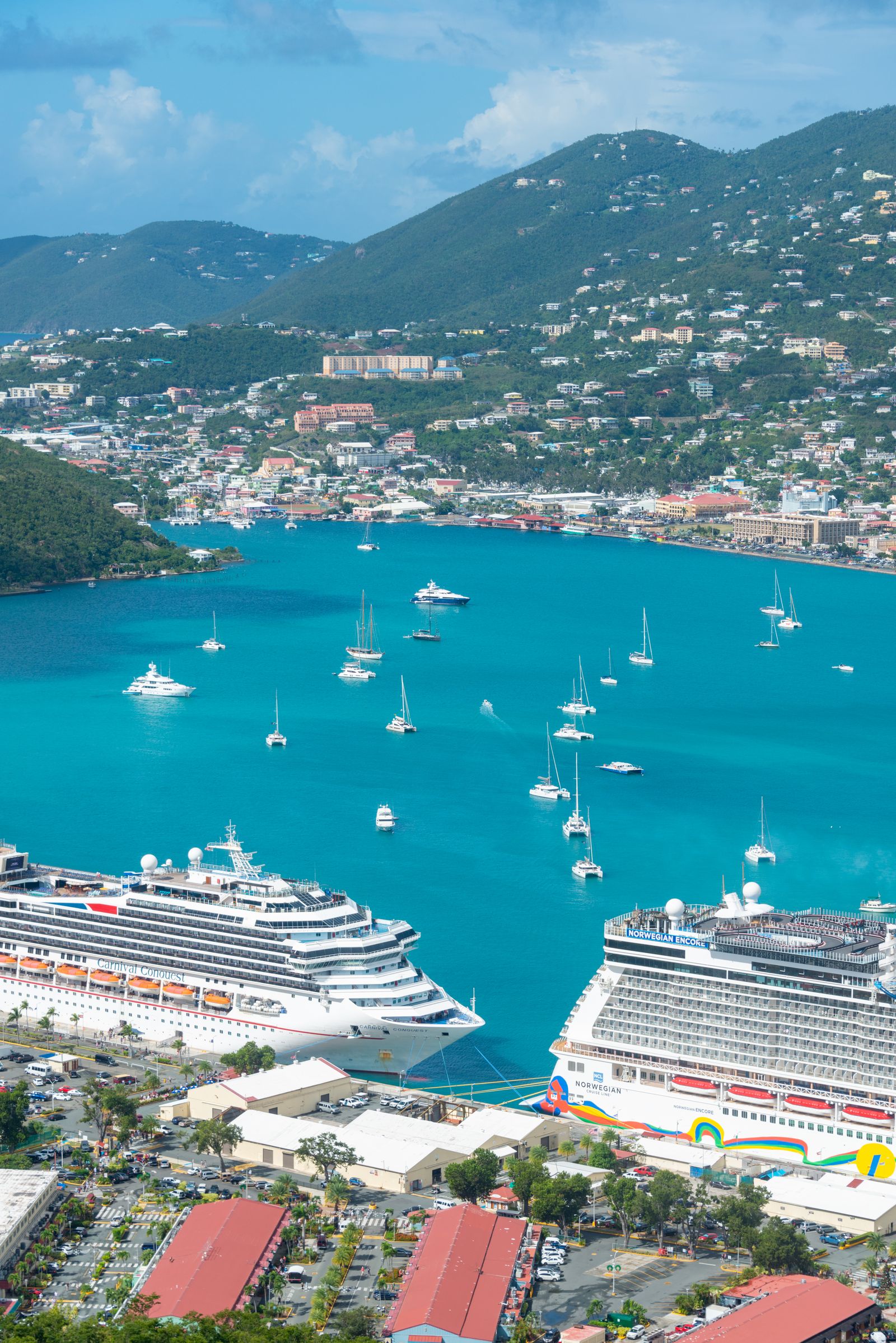
Cruz Bay on St John at sunset (the ferry dock, the waterfront bars, the returning charter boats and the USVI National Park backdrop of green hills dropping to turquoise water) is one of the most atmospheric departure points in the Caribbean — the combination of a US territory with Caribbean scale and a protected natural park creates a quality of life and visitor experience that St Thomas (5 cruise ships in port) lacks completely.
🛂 Entry rules: ESTA for visa-free visitors
Citizens of Visa Waiver Program countries, including the UK, most of the EU, Australia, New Zealand and Japan, must have an approved ESTA before boarding a flight or ship to the United States (this also covers US Virgin Islands). It costs about US$40, is valid for two years or until your passport expires, and allows stays of up to 90 days at a time.
Apply at least 72 hours before travel on the official CBP site or the ESTA Mobile app; many look-alike websites charge extra for the same form. Canadian citizens don’t need an ESTA. Everyone else needs a visa.
Official information: US CBP: official ESTA site · Reviewed September 2026
US territory — US citizens need no passport (state ID sufficient). Non-US nationals need a passport but no additional USVI visa beyond any US visa requirements.
American and United connect St Thomas to New York, Miami, Atlanta and other US cities directly. US citizens need no passport; foreigners need standard US entry.
Trunk Bay on St John is within the Virgin Islands National Park and consistently ranked among the finest beaches in the Caribbean. A snorkelling trail is marked underwater through the reef.
The USVI is a US territory; USD is the currency and US laws apply.
Ferries connect St Thomas, St John and St Croix. Car hire recommended on all three islands; drive on the left (British colonial legacy).
Quick answers to the questions people most often ask before visiting the US Virgin Islands.
Fly into St Thomas (STT) or St Croix (STX), with direct flights from Miami (about 2h30), New York, Atlanta and Charlotte. St John has no airport and is reached by ferry from St Thomas.
US citizens don't need a passport — a government-issued ID is enough. Non-US nationals need a passport and the same entry documents as for the mainland United States.
January to April is the dry peak season (25–28°C), ideal for beaches and sailing; December is the busiest month. June to November is hurricane season, with September the highest-risk month.
On the left — unusually for a US territory. Car hire is recommended on all three main islands, and ferries connect St Thomas, St John and St Croix.
It is mid-to-high range for the Caribbean: around US$80–140 per day on a budget and US$200–350 mid-range. The currency is the US dollar.
Point your camera at menus, signs or street text for instant translation. Download the language pack offline before you arrive for full use without data.
FreeReal-time and offline exchange rates for all world currencies — converts prices instantly so you always know what you are paying in your home currency.
FreeFind and book hotels, guesthouses and apartments with free cancellation on most rates — one of the widest selections of accommodation worldwide.
FreeBrowse millions of traveller reviews for restaurants, attractions and hotels — helps identify the best local spots and avoid tourist traps.
FreeUS Virgin Islands sits within easy reach of several other destinations — each with a completely different character.
US Virgin Islands is one of the world’s least-visited places. See all 90 in our guide to the world’s least-visited countries & territories.


