PN
Pitcairn Islands
The most remote inhabited island on earth — home of the Bounty mutineers
The most remote inhabited island on earth — home of the Bounty mutineers

A small village of 40-50 people clinging to the ridge above Bounty Bay — the most remote human settlement reached by sea. Colourful wooden houses, a library, a church, a school, the Pitcairn Museum and a honey operation are the entirety of the island’s infrastructure.
Photo: doublecnz, CC BY 2.0

The only landing point on Pitcairn — a rocky cove where the mutineers burned HMS Bounty in 1790, the anchor is still visible at low tide. All supplies and visitors are landed here by longboat; the experience of approaching Pitcairn by sea is unlike arriving anywhere else on earth.
Photo: Henning Axt, CC BY-SA 3.0

A UNESCO World Heritage Site — one of the world’s last raised coral atolls with an intact ecosystem, with four endemic bird species (including the Henderson petrel), ten endemic plant species and fossil evidence of a now-extinct pre-Polynesian culture. One of the most ecologically undeveloped islands in the Pacific.
Photo: Ron Van Oers, CC BY-SA 3.0 igo

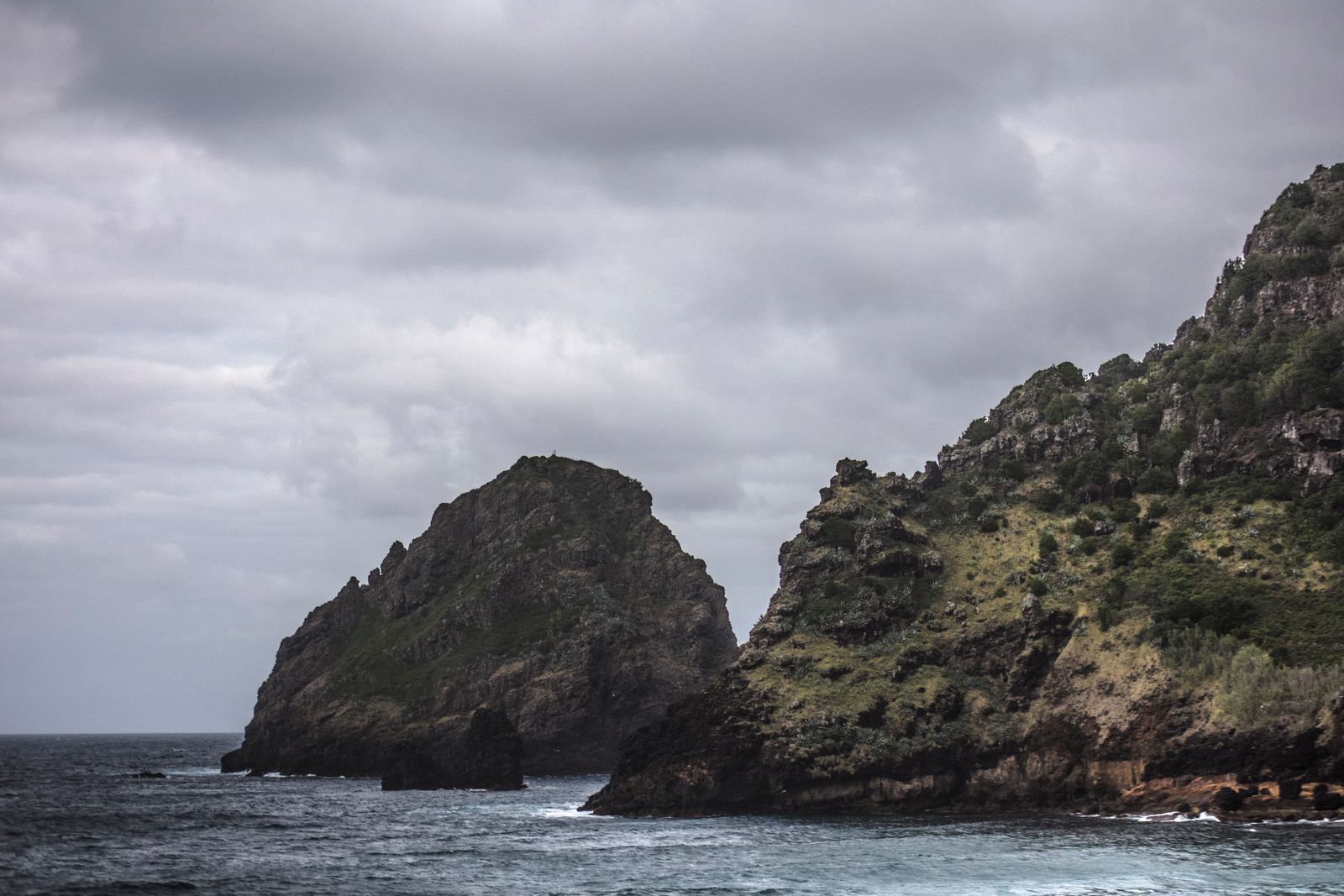
A rocky outcrop where Fletcher Christian is said to have kept watch for pursuing Royal Navy vessels — scrambling up to the lookout gives the same extraordinary 360-degree view of the Pacific that Christian himself had, watching for ships from a vantage point from which rescue and capture were equally feared.
Photo: Henning Axt, CC BY-SA 3.0
Pitcairn’s Manuka honey — produced by bees that have been isolated for 200 years — is considered among the finest in the Pacific. The islanders also carve wooden sharks, turtles and models of HMS Bounty; hand-made stamps are prized by philatelists worldwide. The island’s entire income comes from these crafts and honey.
An uninhabited coral atoll that Pitcairn islanders visit by boat for Easter and Christmas camping trips — white sand beaches, a perfect lagoon and no human habitation beyond the Pitcairners’ seasonal visits. Accessible only from Pitcairn, making it among the least-visited beaches on earth.
A traditional Pitcairn pudding made from sweet potato, coconut cream, sugar and vanilla — baked in the umu on special occasions. The recipe has been passed down unbroken since the Tahitian wives of the Bounty mutineers first made it on the island in the 1790s.
The same breadfruit variety brought to the Caribbean by Captain Bligh (the voyage that ended in the mutiny) grows prolifically on Pitcairn — baked, fried in coconut oil, made into breadfruit chips or boiled as the starchy accompaniment to every meal.
Caught daily in the open Pacific around the island — Pitcairn’s deep-water fishing grounds are some of the least fished in the world. Grilled whole over coals or eaten raw as a simple ceviche with lime and salt; the freshness is unmatched.
The island’s bees have been completely isolated for 200 years and produce Manuka honey of great purity — tested as disease-free and contaminant-free, it is exported in tiny quantities and sells for premium prices. The queen bees are the most genetically isolated honeybee population in the world.
Dense, sweet cake baked with fresh coconut cream — a Tahitian-influenced recipe preserved from the Bounty wives and prepared for community celebrations. The coconut palms on Pitcairn produce large, sweet nuts not found elsewhere.
Passiflora grows wild across Pitcairn — the intensely aromatic juice, pressed and drunk cold with water and sugar, is the island’s signature non-alcoholic drink. The passion fruit here has a concentrated flavour from the volcanic soil and year-round sun.
There is no airport and no scheduled ferry. All access is via the quarterly MV Silver Supporter cargo vessel from Mangareva (French Polynesia) or via private yacht and cruise ship. For trip planning, see the official Pitcairn Islands tourism portal.
The MV Silver Supporter (the Pitcairn supply ship) travels between Mangareva in French Polynesia and Pitcairn approximately quarterly. Passenger berths are available but extremely limited; all visits must be booked through Pitcairn Tourism well in advance.
Papeete (Tahiti) is the practical gateway — fly to Papeete, connect to Mangareva (3h30 by Air Tahiti), then take the MV Silver Supporter to Pitcairn (~36 hours at sea). The entire journey from Europe takes 4–5 days.
Private sailing yacht is the most common independent way to visit Pitcairn — hundreds of sailing vessels cross the South Pacific each year and Pitcairn is on the primary trade wind route. Anchor permission must be obtained in advance from the island council.
Pitcairn’s only roads are steep dirt tracks navigable by quad bike. The islanders use quad bikes and ATV scooters to move between the landing, the village and the farms. Visitors are taken on 4WD tours as part of all homestay packages.
December to March is the warmest and most accessible period (24–28°C). The supply ship visits every 3 months and the small vessel schedule determines practical access windows. The island has no dry season; rain falls year-round. June to August is the coolest period (18–22°C).
📅 Pitcairn Islands is in its best season in January, February, March, April, October, November, December. See where else is good to go in those months, or browse where to go by month.
The New Zealand dollar (NZD) is the currency. Visiting Pitcairn is expensive due to the cargo ship requirement, but on-island costs are minimal.
Pitcairn honey (certified disease-free, produced by European black bees in a completely isolated environment, the rarest honey in global commerce)
The MV Silver Supporter (the regular supply vessel for Pitcairn — carrying freight, passengers and mail from Mangareva in French Polynesia or New Zealand every 3 months) is the primary transport to Pitcairn.
Private yacht is the most flexible way to reach Pitcairn — sailing vessels (primarily on the Marquesas–Gambier–Pitcairn route across the South Pacific) can anchor in Bounty Bay with permission from the island council.
Adamstown for two days, Henderson Island for one, Oeno Atoll for one, community life for two days, departure for one. The Pitcairn Islands — the world’s least populous national jurisdiction — is descended entirely from the Bounty mutineers, produces the world’s only certified disease-free honey and guards two UNESCO World Heritage ecosystems accessible to no one but themselves.
Adamstown — the capital (and only settlement) of the Pitcairn Islands (a British Overseas Territory of 47km² in the South Pacific, population 50 — the least populous national jurisdiction in the world, descended from the Bounty mutineers and their Tahitian companions, the most isolated inhabited island group on earth at 5,300km from the nearest continent) reached by small boat from a passing cargo ship, the only point of entry.
The Bounty mutiny (28 April 1789 — Fletcher Christian led 25 sailors in overthrowing Captain William Bligh on HMS Bounty in the Tonga area, setting Bligh adrift in a small boat with 18 loyal crew and sailing the Bounty to Tahiti for 8 months, before departing with 6 Tahitian men, 12 Tahitian women and 1 girl to find a hiding place from the Royal Navy) ended on Pitcairn Island (23 January 1790), where the mutineers burned the Bounty in the bay now called Bounty Bay to prevent detection.
Bounty Bay (the only landing site on Pitcairn — where the Bounty was burned in 1790 and where the island’s handmade aluminium longboats launch through the surf to meet passing ships — the anchor of HMS Bounty is embedded in the rock at the base of the hill, visible at low tide, along with cannon balls and artifacts from the wreck) and the Pitcairn Island Museum (covering the mutiny, the first 20 years of the settlement and the island’s extraordinary 235-year history).
The islanders’ longboats (aluminium-hulled open boats built on Pitcairn by the islanders themselves, launched through the Bounty Bay surf to meet passing cargo ships — the only way to land on Pitcairn, as there is no harbour or airstrip) are the most critical piece of infrastructure on the island. The launches are timed for the calmest sea conditions and are considered extremely risky in poor weather; cruise ship visits are sometimes cancelled because the longboat cannot safely launch.
Christian’s Cave (a small cave on the cliff above Adamstown, traditionally held to be where Fletcher Christian withdrew in the final years of his life to watch for Royal Navy ships through a telescope — Fletcher Christian lived on Pitcairn for 9 years after the mutiny, becoming increasingly reclusive before being killed in the 1793 massacre by Tahitian men — the cave has extraordinary views of the surrounding ocean in all directions) and the Pitcairn honey (the purest honey in the world, produced by the island’s European black bees in a disease-free environment).
Pitcairn honey is the only certified disease-free honey in the world — the island’s European black bees (Apis mellifera mellifera) have never been exposed to varroa mite, American foulbrood, or any of the other diseases that affect beehives worldwide, making Pitcairn honey the purest possible product of European honeybees. The honey is sold globally and represents one of the island’s primary export earners, alongside Pitcairn postage stamps (which are among the most prized in the world for their extreme rarity).
Henderson Island (UNESCO World Heritage — a raised coral island 167km northeast of Pitcairn, 37km² of completely uninhabited raised coral forest, one of the few atolls in the world whose ecology has been essentially undisturbed by humans — accessible only by Pitcairn longboat, with 4 endemic bird species (Henderson petrel, Henderson fruit dove, Henderson lorikeet and Stephen’s lorikeet), undeveloped beaches and the clearest evidence of the original Polynesian settlement that died out before European contact).
Henderson Island (UNESCO World Heritage 1988 — the world’s best example of an elevated coral island ecosystem, with fossilised Polynesian bones and artefacts providing evidence of a population that established a settlement approximately 1,000 years ago and died out or departed before 1606, leaving no living descendants — represents an undisturbed control site for studying Pacific island ecology without the effect of introduced species.
Oeno Island (165km northwest of Pitcairn — an uninhabited atoll with a clear lagoon, white sand beaches and a marine ecosystem unaffected by fishing or development — the Pitcairn islanders make occasional trips to Oeno for holidays and turtle egg collection (a traditional right), the most beautiful natural environment in the Pitcairn group and the only place in the territory with a sandy beach) and the Pitcairn carved wood souvenirs (carved from local miro and rose wood by the islanders, the primary export income).
Oeno Atoll (a small coral atoll 165km northwest of Pitcairn, administered as part of the Pitcairn Islands British Overseas Territory — uninhabited, with a perfectly intact coral reef ecosystem, nesting green and hawksbill turtles and a lagoon of great clarity) is accessible only by Pitcairn longboat (4–6 hours one way) and visited perhaps twice per year by the Pitcairn islanders for collective holidays.
A day with the Pitcairn community (the 50 inhabitants — all descended from the 9 Bounty mutineers and their Tahitian companions, carrying the surnames Christian, Young, Warren, Brown and Christian — living in wooden houses around Adamstown, farming, fishing, carving, beekeeping and managing the island’s postal and internet-based income) with a communal meal at the public hall and a demonstration of the traditional rope-making and wood carving that have sustained the community.
The Pitcairn community has survived extraordinary challenges: in the late 19th century the entire population temporarily relocated to Norfolk Island (1856) before some returned; the community was nearly devastated by the 2004 child sexual abuse scandal that resulted in the imprisonment of 6 of the island’s 12 adult men; and the population has declined from 250 in the 1930s to 50 today, the minimum viable population for community survival.
A final exploration of Pitcairn’s forest trails (the island has 6km of walking tracks through subtropical forest with endemic Pitcairn warblers, the last surviving forest land birds, and the great variety of introduced tropical fruit trees planted by the original settlers — mango, breadfruit, banana, guava, pandanus — now growing wild through the island’s forest) before boarding the cargo ship tender for the multi-day voyage to the nearest port. All departures are by cargo ship only.
Pitcairn Island has had internet access since 1997 (one of the earliest remote communities on earth to connect) and has used its .pn internet domain and online honey and honey-product sales to maintain economic viability as the population has declined. The island’s online store (run collectively by the islanders) ships Pitcairn honey, stamps and carved wood worldwide, generating more per-capita export income than many far larger territories.
Pitcairn is visited by cargo vessels passing between New Zealand and Panama (approximately 3 visits per month) and by cruise ships (perhaps 20-30 per year). Arranging passage requires coordination through the Pitcairn Island Tourism office months in advance.
Contact the Pitcairn Island Tourism office at tourism@pitcairn.gov.pn to arrange approved visits. The island community manages visitor numbers carefully.
There is no mobile phone network on Pitcairn. Communication is via satellite internet (expensive and limited) and VHF radio. Arriving prepared for genuine digital disconnection is essential.
Pitcairn is the least populous territory in the world — all residents are descendants of the Bounty mutineers or have married into the community. The ratio of visitors to residents can exceed 1:1 on cruise ship days.
There are no doctors resident on Pitcairn (the island has a nurse). Serious medical emergencies require evacuation by ship to New Zealand, taking 3-4 days. Comprehensive travel insurance with evacuation cover is essential.
The Pitcairn Museum in Adamstown holds artefacts from HMS Bounty, the mutineers’ personal items, Pitcairn oral history recordings and the story of the island’s 235-year history since the mutiny.
Quick answers to the questions people most often ask before visiting the Pitcairn Islands.
By sea only — Pitcairn has no airport. Most visitors travel by ship from Mangareva in French Polynesia, and the island is also reached by passing cargo vessels and a limited number of cruise ships each year. Sailings are infrequent, so the ship schedule shapes your entire trip.
Yes. Visits are managed by the Pitcairn Island Council, which keeps visitor numbers small. Arrange your stay in advance through the island's tourism office before booking passage.
December to March is the warmest period (around 24–28°C), and October to April is generally the most practical season. Rain falls year-round, and June to August is the coolest time (18–22°C).
The New Zealand dollar (NZD). There are no banks or ATMs, so bring enough cash for your stay. Daily costs on the island are modest — roughly NZD 80–120 — but getting there is the expensive part, often NZD 8,000 or more for the full trip.
There is no mobile phone network. Communication is by limited, expensive satellite internet and VHF radio, so plan for a largely offline stay.
The Pitcairn Islands sit in the remote South Pacific, equidistant between French Polynesia and New Zealand — Norfolk Island, Fiji, Tonga, Samoa and French Polynesia are the closest Pacific island communities.
Pitcairn Islands is one of the world’s least-visited places. See all 90 in our guide to the world’s least-visited countries & territories.