JO
Jordan
Rose-red Petra and the sands of Wadi Rum
Rose-red Petra and the sands of Wadi Rum
⚠️ Travel advisory: check before you go
In September 2026 the US raised its advice to “reconsider travel” for this region because of tensions involving Iran. Flights and tourism are operating normally, but airspace closures and cancellations can happen at short notice, so keep plans flexible and travel insurance in place.
Latest official advice: UK FCDO · US State Department · Reviewed September 2026

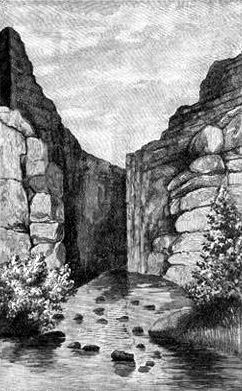
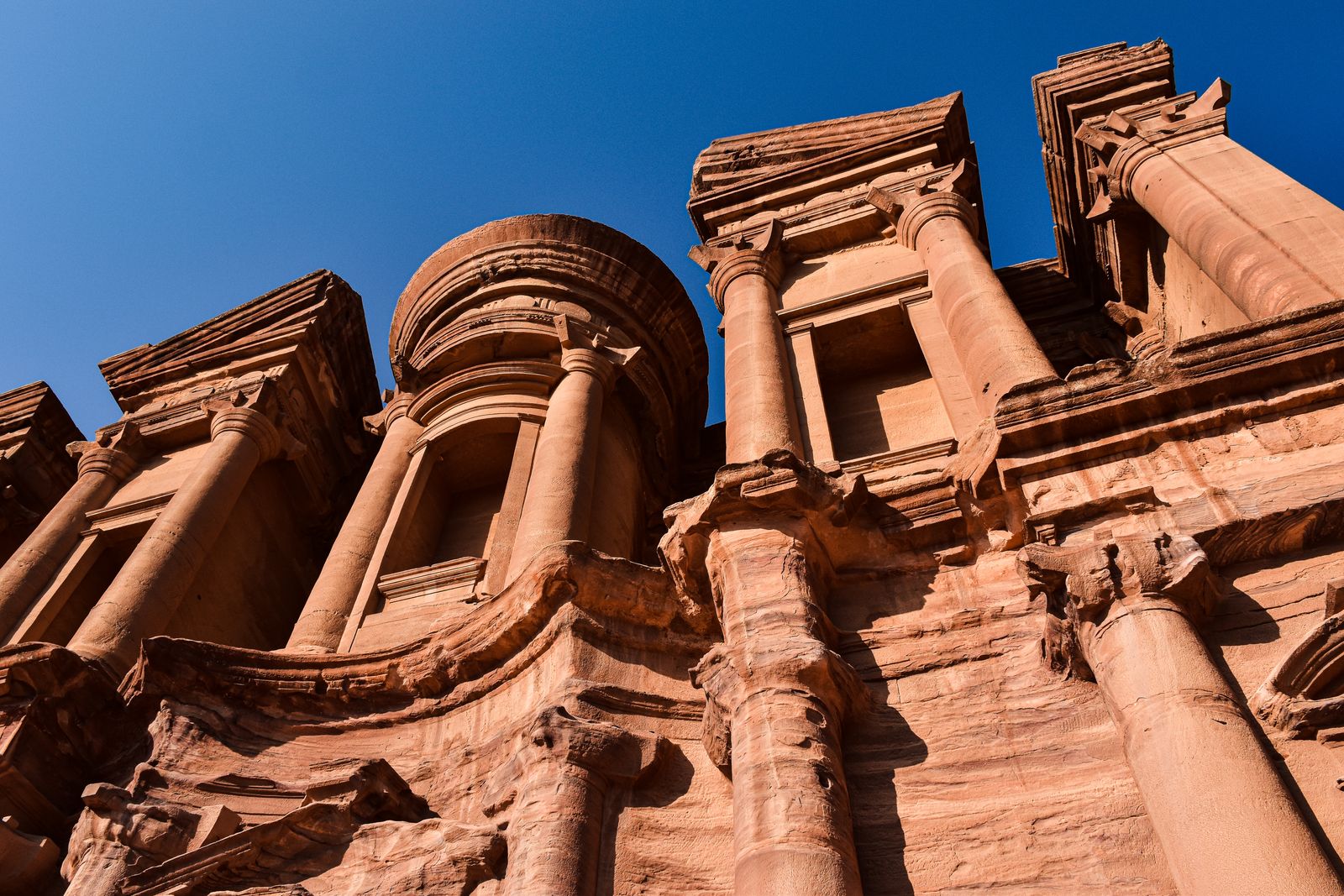
The Siq gorge (1.2km of winding slot canyon) emerging at the Treasury (Al-Khazneh): a 40m facade carved directly into rose-red sandstone. Petra extends beyond the Treasury to royal tombs, a colonnaded street, a monastery and Byzantine church.
Photo: Vyacheslav Argenberg, CC BY 4.0

The Valley of the Moon: red sandstone and granite formations rising 800m from the desert floor. Lawrence of Arabia was here in 1917. Jeep and camel tours, Bedouin camps and some of the darkest night skies in the Middle East.
Photo: Daniel Case, CC BY-SA 3.0
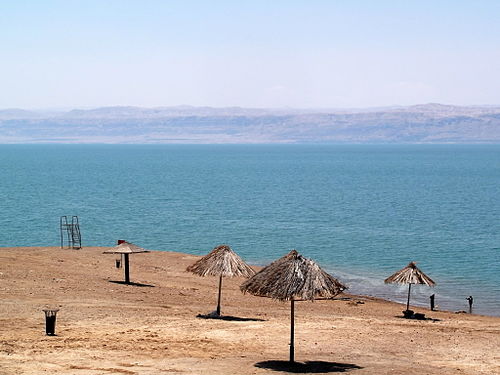
The lowest point on earth (430m below sea level): float effortlessly on 33% salinity water, cover yourself in black mineral mud and watch the evening light on the Judean Hills across the water.
Photo: لا روسا, CC BY-SA 4.0

The best-preserved Roman provincial city outside Italy: the Oval Piazza, Hadrian’s Arch, the Temple of Artemis and the South Theatre (still used for performances) – all intact from the 1st-3rd century AD.
Photo: Maya-Anaïs Yataghène from Paris, France, CC BY 2.0

The Roman Theatre (6,000 seats, 2nd century AD) in the middle of a modern capital, the Gold Souk, the Rainbow Street restaurant scene and the Jordan Museum’s collection.
Photo: Dan Lundberg, CC BY-SA 2.0

The Red Sea’s finest coral reefs accessible from the beach: the Cedar Pride wreck, the Japanese Garden coral park and the Saudi Arabian border 1km south.
Photo: Arian Zwegers, CC BY 2.0

A 320km² canyon reserve: the most biodiverse area in Jordan, with wolf, sand cat, ibex and the Rummana campsite – the finest trekking in Jordan from valley to desert.
Photo: Bernard Gagnon, CC BY-SA 3.0

Madaba’s 6th-century Byzantine mosaic map of the Holy Land (the oldest cartographic representation of Jerusalem) and Mount Nebo (Moses viewed the Promised Land from here, died here, his burial place unknown).
Photo: Raya Sharbain, CC BY-SA 4.0
Lamb cooked in dried yogurt (jameed) sauce and served over rice with pine nuts and almonds: the national dish of Jordan and the ceremonial meal of Bedouin hospitality. Eaten communally from a large shared platter.
A spread of 30+ small dishes: hummus, baba ghanoush, fattoush, kibbeh, warak dawali (stuffed vine leaves), labneh and fresh pita. Jordanian mezze is among the finest in the Levant.
Meat and vegetables cooked underground in a Bedouin earth oven at Wadi Rum camps: smoky, tender and the definitive Wadi Rum dining experience.
Shredded wheat pastry over sweet cheese, soaked in rose-water syrup: originally from Nablus (now Jordan’s contested neighbour), served warm from enormous trays.
Lightly roasted cardamom coffee in small handle-less cups: always the first thing offered to a guest. Drinking three cups is polite; covering the cup with your hand signals enough.
Sweet black tea with fresh mint: the universal social beverage of Jordan, drunk throughout the day.
Deep-fried spiced chickpea balls (falafel) in flatbread with tahini and pickle, and foul (slow-cooked fava beans with olive oil): the Jordanian breakfast.
An upside-down rice dish: rice cooked with vegetables and meat in a pot, then flipped onto the platter. The drama of the unveiling is part of the dish.
Amman Queen Alia (AMM) is the main hub; Aqaba (AQP) receives some regional flights. Royal Jordanian is the national carrier with good UK and European connections. For trip planning, see the official Jordan tourism portal.
Royal Jordanian and easyJet both serve Amman direct from London in around 5 hours. Budget carriers have significantly expanded UK-Jordan routes in recent years.
Jordan combines well with Israel (Wadi Araba and King Hussein Bridge crossings), Egypt (ferry Aqaba–Nuweiba) and Lebanon for a Levant circuit.
JETT buses (jett.com.jo) are the most reliable intercity option. For Wadi Rum, book a Jeep tour and camp from Aqaba or Petra — almost all operators offer overnight packages.
The JETT Airport Express to central Amman costs JOD 3.30 — significantly cheaper than taxis. Use Uber or Careem in the city for transparent pricing.
March to May and September to November are ideal — warm days, cool evenings, excellent light in Petra and Wadi Rum. July and August are hot (35–40°C) but the country still functions.
📅 Jordan is in its best season in March, April, May. See where else is good to go in those months, or browse where to go by month.
Jordan is moderately priced for the Middle East — cheaper than Israel or the Gulf states, more expensive than Egypt. Petra entry is the largest single cost.
Mansaf — lamb in dried yoghurt sauce over rice with pine nuts — is Jordan’s national dish. At a local restaurant it costs JOD 5–10 and is one of the great Levantine meals.
The Jordan Pass covers the Aqaba visa (JOD 10) and Petra entry (JOD 50 one day) — combined saving of JOD 60+ makes it the essential first purchase.
A luxury Bedouin camp in Wadi Rum — private tent, en-suite, gourmet dinner, sunrise over the desert — costs JOD 150–300 per night and is one of the finest overnight experiences in the Middle East.
Amman for one day, Petra for two, Wadi Rum for one, the Dead Sea and Aqaba to finish. Jordan is compact enough to do this circuit comfortably in a week.
The Amman Citadel (Jabal al-Qal’a) — the Temple of Hercules, the Umayyad Palace and a view over the limestone city below. The Roman Theatre in the downtown valley seats 6,000 and is still used for concerts.
The Jordan Museum at the 3rd Circle is Jordan’s finest — the Dead Sea Scrolls fragments, the Ain Ghazal statues (9,000 BCE, among the oldest large-scale human figures ever found) and a comprehensive pre-Islamic civilisations collection.
Enter through the Siq — a 1.2km crack in the sandstone cliffs — and the Treasury (Al-Khazneh) appears at the end, 43m tall and perfectly preserved. This moment, known to every visitor before they arrive, still delivers.
The Petra by Night experience (Mon, Wed, Thu: 8:30–10:30pm) lights the Siq and Treasury with candles. JOD 17. The silence and scale in candlelight is entirely different from daylight.
The High Place of Sacrifice gives the best viewpoint in Petra (45-min hike). The Monastery (Al-Deir) is comparable in scale to the Treasury but far less crowded — 800 steps, worth every one. The Royal Tombs in late afternoon light.
The Monastery is best in mid-afternoon when the sun is directly on the facade. The 45-minute climb discourages casual visitors and the upper area feels remote.
2h drive from Petra. The Valley of the Moon — red sandstone mountains rising from a flat sandy floor, silent except for the wind. A Jeep tour and overnight in a Bedouin camp under a sky with no light pollution.
Wadi Rum was T.E. Lawrence’s base during the Arab Revolt of 1917. The inscriptions left by Nabataean traders and Roman legionaries on the rock faces are largely unvisited and entirely free to find.
2h drive north. The Dead Sea is 430m below sea level with 34% salt concentration — the buoyancy is disorienting. The mineral mud on the shore gets applied universally.
The Dead Sea is shrinking at roughly 1m per year due to water diversion from the Jordan River. The old beach infrastructure shows how far it has retreated since the 1970s.
3h from the Dead Sea. Aqaba sits at the northern tip of the Red Sea with year-round warm water and coral reefs accessible directly from the shore. Over 350 species of coral, 1,000 species of fish.
The best snorkelling in Aqaba is at the Japanese Garden reef and the Yamanieh Coral Garden, both accessible from shore without a boat. Water is 20–27°C year-round.
3h drive back to Amman Queen Alia Airport for international flights. Or extend into Israel via the Wadi Araba crossing (30 min from Aqaba).
The Jordan Pass at jordanpass.jo covers the visa fee and Petra entry (normally JOD 50 for one day) plus 40 other attractions. At JOD 70–80 it pays for itself with Petra alone.
Careem (owned by Uber) is the dominant ride-hailing app throughout Jordan.
The Jordan Pass (USD 70/99/110) covers visa on arrival AND Petra entry (one/two/three days): significant savings.
Being offered coffee, tea and food before any transaction is genuine. Accepting is correct.
The Treasury is 1.5km from the gate; the Monastery is a further 3km and 850 stairs. Allow 6-8 hours for a proper visit.
The fixed Bedouin camps fill up months ahead in the October-April season.
Welcome and you are among family. The correct response is “ahlan bik”.
Covered shoulders and knees in cities and markets. Aqaba and Wadi Rum are more relaxed.
Opening prices are 3-5x the final price. Negotiation over tea is the correct method.
Quick answers to the questions people most often ask before visiting Jordan.
March to May and September to November are ideal — warm days, cool evenings, excellent light in Petra and Wadi Rum. July and August are hot (35–40°C) but the country still functions.
Amman Queen Alia (AMM) is the main hub; Aqaba (AQP) receives some regional flights. Royal Jordanian is the national carrier with good UK and European connections.
Expect roughly JOD 25–40 a day on a budget and JOD 70–110 mid-range, or JOD 200+ for a more luxurious trip, per person and excluding flights.
Jordan uses the JOD.
In September 2026 the US raised its advice to “reconsider travel” for this region because of tensions involving Iran. Flights and tourism are operating normally, but airspace closures and cancellations can happen at short notice, so keep plans flexible and travel insurance in place. Always check current official travel advice before booking.
Ride-hailing in Amman and major Jordanian cities — safer and more transparent than street taxis.
FreeThe dominant ride-hailing app in Amman — often more widely available than Uber in Jordan.
FreeBook Petra entry tickets, Wadi Rum desert camps, Dead Sea day trips and Jordanian tours.
FreeJordan’s primary messaging platform — contact hotels, guides and transport operators.
FreeJordan’s leading food delivery app — widely used in Amman and major cities.
FreeBook hotels across Jordan — Petra, Aqaba and Wadi Rum resorts book up quickly.
FreeExplore Jordan’s top city destinations — from Amman to Petra, each with its own distinct character.
Jordan sits within easy reach of several other destinations — each with a completely different character.