UA
Ukraine
Golden domes, baroque Lviv & Carpathian peaks
Golden domes, baroque Lviv & Carpathian peaks
Ukraine is Eastern Europe’s largest country and one of its most underappreciated destinations — a nation of golden-domed Orthodox churches, baroque city centres, vast steppe grasslands, Carpathian mountain villages and a Black Sea coastline that once rivalled the French Riviera. Kyiv (Kiev), the cradle of Slavic civilisation, wears its 1,000-year history with pride: the golden mosaics of Saint Sophia Cathedral date to 1037, the Pechersk Lavra cave monastery complex is one of Eastern Christianity’s holiest sites and the forested Kyiv Pechersk hillsides above the Dnipro River are magnificent in any season.
Lviv, the cobbled baroque city in the west, is often described as the most Central European of former Soviet cities — its coffee-house culture, Habsburg architecture and packed arts calendar have made it a perennial favourite. Ukraine’s warmth and generosity to visitors, its extraordinary cuisine and its defiant national pride make it a destination of real emotional resonance. Check current travel advisories carefully before visiting.
The Ukrainian capital sits dramatically on the bluffs above the Dnipro River. Saint Sophia Cathedral and its sister site Pechersk Lavra — together a UNESCO World Heritage Site — form the spiritual heart of the city. The golden-domed Saint Michael’s Monastery, Khreshchatyk Boulevard and the Maidan Nezalezhnosti (Independence Square) are central to Ukrainian identity. The city’s café and restaurant culture, art galleries and nightlife made Kyiv one of Europe’s most exciting cities before 2022.
Western Ukraine’s cultural capital is a baroque masterpiece — its UNESCO-listed historic centre largely untouched by WWII, packed with Renaissance-era merchants’ houses, ornate churches, Habsburg-era coffee houses and a university founded in 1661. The chocolate and coffee culture is extraordinary; the city’s Christmas market is among Europe’s finest; and a dozen nationalities’ architectural fingerprints give Lviv a layered beauty unlike anywhere else in the former Soviet space.
Ukraine’s Carpathians, stretching along the western border, offer hiking trails, wooden Hutsul villages, spectacular waterfalls and ski resorts in winter. The Shypit waterfall, Synevyr alpine lake and the ancient wooden churches of the Zakarpattia region — several UNESCO-listed — are the highlights of an area rarely visited by outsiders. Bukovel is Ukraine’s main ski resort.
Ukraine’s great Black Sea port city is built on a limestone cliff above a deep-blue sea, its centre all tree-shaded boulevards, crumbling belle époque mansions and the famous Potemkin Staircase leading down to the harbour. The city’s multilingual, multicultural character — Russian, Ukrainian, Jewish, Greek — produced a distinct cosmopolitan spirit and one of the Soviet Union’s greatest literary and musical traditions.
the beetroot soup here is richer and heartier than the Russian version — with pampushky (garlic bread rolls) is the national dish.
dumplings filled with potato and cheese, cherries or meat) with fried onions and sour cream are eaten at every celebration.
Cabbage rolls stuffed with minced pork (or beef) and rice, slow-cooked in a tomato and sour cream sauce — a Ukrainian Sunday staple inseparable from family gatherings and celebrations.
cured pork fat on black bread) are central to the Ukrainian table.Ukrainian
is outstanding — the country is the world’s third-largest producer.
Ukrainian grain vodka — often infused with honey (medova), peppers (pertsivka) or herbs. Drunk neat and ice-cold as a toast at every celebration, with a distinct clean sweetness that sets it apart from Russian vodka.
infused spirits with dried fruit and honey) are traditional spirits. The wine regions of Transcarpathia and Odessa produce increasingly good wine, and Ukrainian craft beer has experienced a remarkable renaissance.
Lviv Danylo Halytskyi (LWO) and Kyiv Boryspil (KBP) are the main airports. Note: airspace restrictions have affected flight availability since 2022 — check current options. LOT Polish Airlines and Turkish Airlines serve key routes. For trip planning, see the official Ukraine tourism portal.
💡 Warsaw is the most convenient European gateway for western Ukraine — LOT operates multiple daily Warsaw–Lviv connections in 1h30. Check current UK government travel advisories before booking.
💡 The overland route from Poland remains the most accessible approach for Western Europeans — direct trains from Krakow and Warsaw to Lviv are the most comfortable option. The Przemysl–Lviv leg is 2h by train.
💡 Ukrainian railways (Ukrzaliznytsia) are the recommended transport for civilian travel during the conflict — trains avoid the road network and have been maintained throughout the war period.
💡 Lviv’s historic centre is one of the most walkable in Central Europe — the Rynok Square, the Jesuit church, the Dominican church and the Armenian quarter are all within 10 minutes of each other on foot.
May to September is the best window for peacetime travel — Lviv’s cafes and cobblestones at their finest, the Carpathians hikeable, the Black Sea coast warm. Note: the ongoing war with Russia (since February 2022) means travel to Ukraine requires careful research of current conditions — western cities like Lviv have been less affected than eastern regions.
Western Ukraine (Lviv) is very affordable by European standards. Note: due to the ongoing conflict, costs and availability may vary significantly; check current conditions. The Ukrainian Hryvnia (UAH) is the currency.
Borscht (the deep red beetroot and cabbage soup with sour cream, served with garlic-rubbed bread) is Ukraine’s most important dish &mdash.
Horilka (Ukrainian vodka — from “horit’ ”, “to burn”) is the national spirit, traditionally distilled from grain or potato and infused with honey and pepper (medova z pertsem).
The Vintage Hotel (a 19th-century Austro-Hungarian mansion in Lviv’s historic centre, the finest boutique hotel in the city) and the grand Hotel Georges (open since 1900, where de Gaulle, Balzac and Lech Walesa have stayed) are Lviv’s most.
Lviv for three days, the Carpathian Mountains for two, Kyiv for two. Note: given the ongoing conflict, this itinerary focuses on western Ukraine (Lviv region) which has been less directly affected. Check all current government travel advisories before visiting.
Lviv — the cultural capital of western Ukraine, founded in 1256, with a UNESCO-listed historic centre of Austro-Hungarian, Polish, Armenian and Ukrainian architecture — is the most Central European city in Ukraine. The Rynok Square (one of the finest market squares in Central Europe — 44 townhouses of different architectural styles from Gothic to Neoclassical), the Armenian Cathedral (1363) and the Opera House (1900, in the style of the Vienna Opera).
💡 Lviv was the centre of the Austro-Hungarian province of Galicia from 1772 to 1918, a period that gave the city its distinctive Central European character — the coffee-house culture (Lviv has more cafes per capita than any other Ukrainian city), the beer brewing tradition (Lviv Brewery, founded 1715, the oldest continuously operating brewery in Ukraine) and the architectural eclecticism of the Habsburg empire.
The Lviv coffee culture — the city invented its own coffee-house tradition (the Lviv coffee ceremony involves roasting beans in a copper cezve over sand, a tradition from Ottoman merchants in the 17th century) and has 2+ cafes per 1,000 inhabitants, the highest density in Eastern Europe. The underground tunnels of the Lviv Tunnel of Horror and the Lviv Chocolate Workshop.
💡 Lviv claims to have invented coffee in Ukraine — coffee-houses first appeared here in the 17th century, introduced by Armenian and Turkish merchants who used the city as a trading hub on the Silk Road extension to Poland. The Virmenka coffee house (est. 1644, its exact location debated) may be the oldest in Ukraine. The Lviv coffee ceremony is registered as an element of intangible cultural heritage.
The Lychakiv Cemetery (the finest funerary art in Eastern Europe — the tombs of Ukrainian intellectuals, Polish nobles and Austro-Hungarian officers in a forested hillside cemetery that combines styles from 1786 to the present, a UNESCO candidate) and the High Castle (the ruins of a 14th-century fortress on a hill above the city, with views over the entire Lviv basin and the Carpathian foothills).
💡 Lychakiv Cemetery is one of the oldest and most important cemeteries in Eastern Europe — it contains the graves of Ivan Franko (Ukraine’s greatest poet after Shevchenko), Maria Zankovetska (the mother of Ukrainian theatre), and thousands of World War I and World War II soldiers from multiple nations buried in separate sections according to which side they fought on.
2h30 from Lviv. The Ukrainian Carpathians — the eastern extension of the Carpathian arc, with the highest point at Hoverla (2,061m), traditional Hutsul wooden churches (UNESCO Inscribed), the village of Verkhovyna (the cultural capital of the Hutsul people), and Synevyr Lake (the largest natural lake in the Ukrainian Carpathians, formed by a natural landslide dam, called “Sea Eye” for its blue colour surrounded by forest).
💡 The Hutsul people (Huzuly) of the Ukrainian Carpathians maintain one of the most distinct folk cultures in Eastern Europe — their embroidered textiles (vyshyvanka), carved wooden objects, painted Easter eggs (pysanky) and musical tradition (the trembita, a 3–4m wooden alpine horn) are the defining expressions of Carpathian Ukrainian identity.
A full day hiking in the Carpathian National Nature Park — the trail to Hoverla (Ukraine’s highest peak, 2,061m, 4h return, with views into Romania on clear days) or the gentler Yaremche Valley trail along the Prut River. The circuit of wooden Hutsul tserkvy (Greek Catholic churches built without nails, 17th–19th century, with the distinctive three-tiered tower of the Hutsul tradition).
💡 The Wooden Tserkvy of the Carpathian Region (Ukraine and Poland, UNESCO 2013) are the finest surviving examples of timber sacred architecture in Europe — 16 churches built without iron nails, using only wood joints and wooden pegs, following a construction tradition inherited from Byzantine church architecture and adapted to the materials and climate of the mountain forest.
5h train from Lviv to Kyiv. Kyiv — the mother of Slavic cities, founded in the 5th century, with the Pechersk Lavra (the Monastery of the Caves — a 11th-century monastery complex with underground cave networks containing the mummified remains of hundreds of monks, golden-domed cathedrals, and the finest collection of Byzantine art in Eastern Europe) and the St. Sophia Cathedral (1037, the oldest intact building in Kyiv, with original 11th-century Byzantine mosaics).
💡 The Kyiv-Pechersk Lavra (Monastery of the Caves) was founded in 1051 by the monk Anthony on the wooded hills above the Dnipro River — he dug the first cave cell by hand. The underground labyrinths contain the mummified (naturally desiccated) bodies of monks, saints and princes from the 11th to the 18th century. The gold-domed ensemble is the most important religious site in Ukraine.
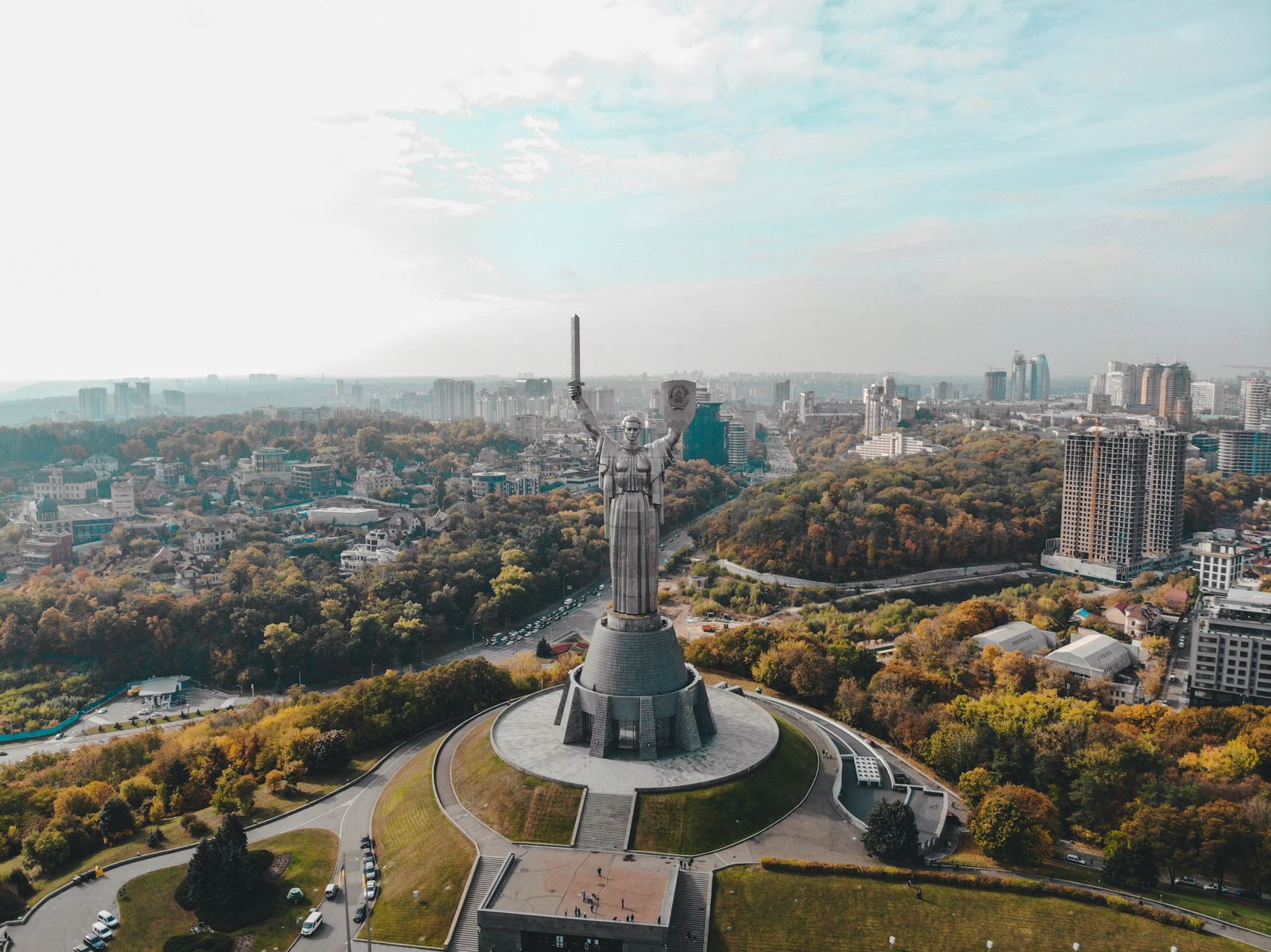
The Maidan Nezalezhnosti (Independence Square — the site of two Ukrainian revolutions: the Orange Revolution of 2004 and the Euromaidan of 2013–2014, where 130 people died defending Ukrainian sovereignty) and the Dnipro River embankment (the longest river in Ukraine, the source of early Slavic civilisation, the Motherland Monument). Fly from Kyiv Boryspil (KBP).
💡 The Euromaidan (November 2013–February 2014) was a revolution that removed President Yanukovych after he refused to sign the EU Association Agreement under Russian pressure. The protests escalated when riot police killed protesters; the subsequent Russian annexation of Crimea and war in Donbas followed directly. The Maidan has been the symbolic heart of Ukrainian civil society since.
Check your government’s current travel advisory before planning any visit to Ukraine. The security situation has been affected by the ongoing conflict since 2022.
Most Western nationals can enter visa-free for 90 days. Check current advisories before travel given the ongoing conflict; western Ukraine (Lviv) is more accessible than eastern regions.
Kyivstar, lifecell and Vodafone UA offer cheap tourist SIMs. Good 4G coverage in cities; buy at the airport or any phone shop.
The hryvnia (UAH) is the local currency. ATMs widely available in Kyiv and Lviv; carry some cash for markets and smaller towns.
Ukrainian is the official language; Russian is widely understood but politically sensitive. English is growing in Kyiv especially among younger people.
The hryvnia is used throughout. ATMs are widely available in cities. Cards accepted in larger establishments.
Ukrainian is the official language; Russian is also widely spoken. Basic Cyrillic literacy helps with navigation.
Ukrainians are exceptionally warm hosts. Accepting a meal invitation is customary and greatly appreciated.
— Main mobile providers with good data coverage in western Ukraine.
Free— Ukraine’s popular digital bank, useful for locals but informative on exchange rates.
Free— Works well across Ukraine with good transit and walking coverage.
FreePoint your camera at menus, signs or street text for instant translation. Download the language pack offline before you arrive for full use without data.
FreeReal-time and offline exchange rates for all world currencies — converts prices instantly so you always know what you are paying in your home currency.
FreeGolden-domed Kyiv, cobbled Lviv, Black Sea Odesa, the green Carpathians and Habsburg Chernivtsi — five sides of Ukraine.
Ukraine sits within easy reach of several other destinations — each with a completely different character.


