BY
Belarus
Soviet grandeur, primeval forest & European bison
Soviet grandeur, primeval forest & European bison
Belarus is Eastern Europe’s most unknown destination — a flat, forest-rich, Soviet-era republic between Poland, Lithuania, Ukraine and Russia that has opened increasingly to visitors with a generous visa-free regime. Minsk, flattened in WWII and rebuilt as a showcase of Stalinist architecture, has a monumental grandeur unlike any other European capital — its enormous central avenues, heroic socialist sculptures and one of the best-preserved Soviet cityscapes anywhere make it fascinating to explore. The Bialowieza (Belavezhskaya) Forest, shared with Poland and UNESCO-listed, is Europe’s last primeval lowland forest and home to the European bison, hunted to extinction in the wild and reintroduced here.
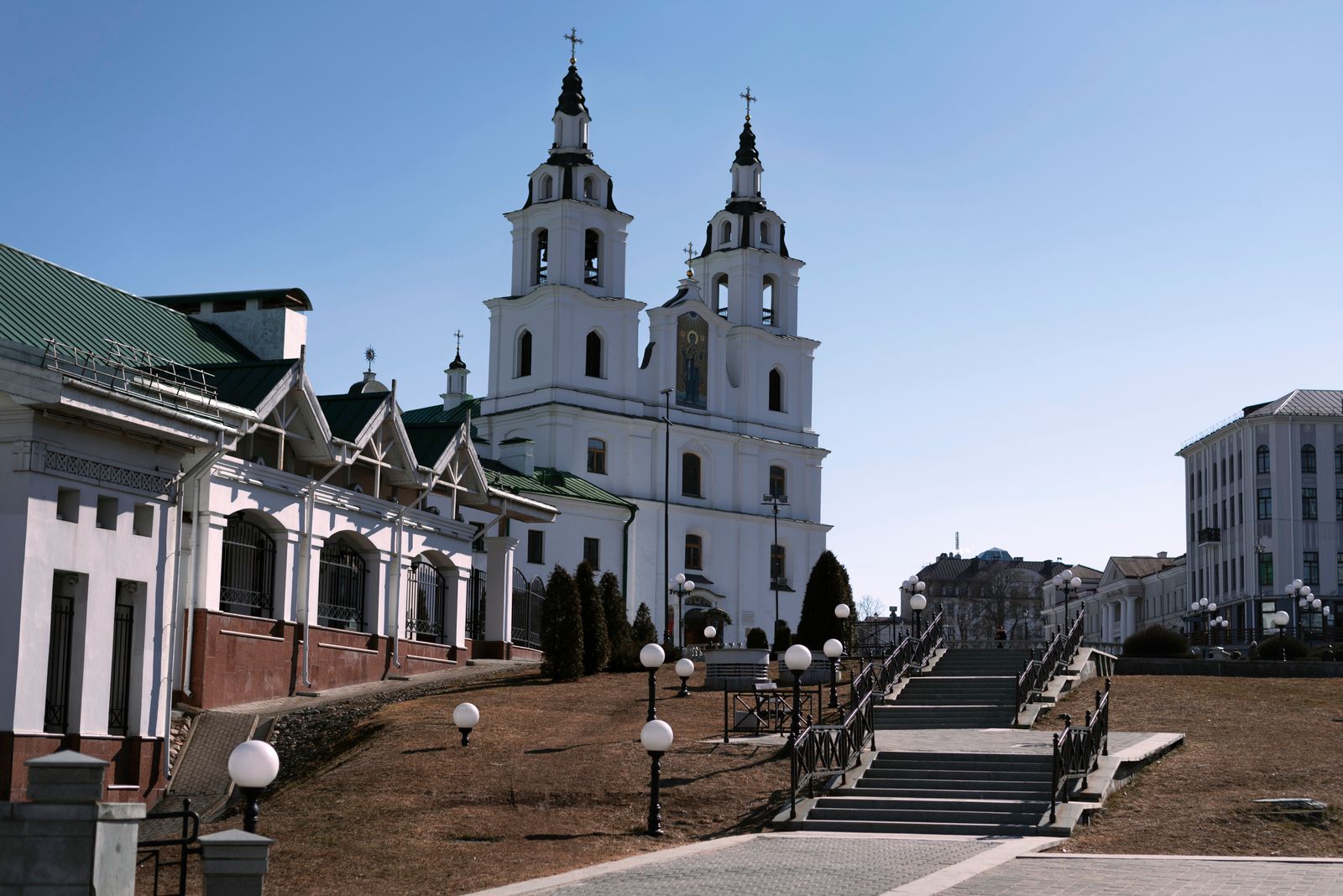
The Soviet-era capital is an extraordinary architectural experiment — wide boulevards lined with Stalinist classicism, the monumental Independence Square, the red-brick Trinity Hill old town and the island on the Svislach River. The Great Patriotic War Museum, the Yanka Kupala Theatre and the underground art spaces of the Oktyabrskaya metro area make Minsk richer than any first impression suggests.
Europe’s last ancient lowland forest, shared with Poland and UNESCO-listed, shelters European bison — the continent’s largest land animal, saved from extinction by a breeding programme. Guided jeep safaris through the primeval oak, ash and lime forest have a primordial quality; the forest also has wolves, lynx, elk, deer and extraordinary bird populations.
Two UNESCO-listed castles of the Radziwįłł family define the cultural heritage of the Belarusian Grand Duchy era. Mir Castle (16th century) with its mixture of Gothic and Renaissance elements and Nesvizh Castle (17th century) with its formal gardens and palace complex reflect the extraordinary power of this aristocratic dynasty at the heart of European history.
potato pancakes fried in oil, served with sour cream) are the national dish — simple, hot and deeply satisfying.
Hearty meat-filled dumplings cooked in broth — the Belarusian equivalent of pelmeni, heavier and larger, served as a main course.
A lightly fermented bread drink, barely alcoholic, sold in summer from yellow barrels on street corners — the most traditional Belarusian summer refreshment.
pork ribs in a creamy onion sauce served with draniki or pancakes) is the Sunday celebration dish.
chilled beetroot soup with egg and sour cream) is the summer staple. Belarusian vodka and
fermented bread drink) are the traditional drinks. The country also produces excellent dairy products — the cheese, sour cream and butter are outstanding.
Minsk National Airport (MSQ) is the main hub. Belavia (the national carrier) and Turkish Airlines serve the main routes. Note: EU and UK airlines suspended Belarusian airspace in 2021; check current options carefully. Entry requirements and visa rules may have changed. For trip planning, see the official Belarus tourism portal.
💡 Due to 2021 EU/UK airspace restrictions on Belarusian carriers (following the forced diversion of Ryanair flight FR4978), most Western European airlines no longer fly to Minsk. Turkish Airlines via Istanbul remains the most reliable option. Research current travel advisories before booking.
💡 Belarus is accessible from Russia, Turkey and Central Asia without airspace restrictions. Overland from Poland (Brest) and Lithuania (Grodno, Vilnius) is possible with appropriate visa documentation.
💡 The Minsk airport express train (30 minutes, BYN 4) is the most efficient connection. The Minsk Metro is excellent — two lines, modern rolling stock, and Soviet-era station art.
💡 Car hire in Minsk (BYN 30–70/day) is the most convenient option for the Mir–Nesvizh–Bialowieza circuit. Belarus roads are generally well-maintained; the M1 (Minsk–Brest) is a dual carriageway.
May to September is the best window — Minsk’s parks and Art Deco boulevards at their most pleasant, the Bialowieza Forest accessible (shared with Poland), the Mir and Nesvizh castles in summer light. July and August are the warmest months (22–25°C). Note: check current travel advisories before visiting; Belarus’s political situation requires careful planning.
Belarus is one of the cheapest countries in Europe for travellers. The Belarusian Ruble (BYN) is the currency; note that exchange rates and payment options may be affected by international sanctions — check current conditions.
Draniki (deruny) — grated potato pancakes fried in sunflower oil, served with sour cream (smyatana) — are Belarus’s most beloved dish.
Belaya Rus vodka and Lidskoe beer are Belarus’s most exported beverages.
The Renaissance Minsk Hotel and Marriott Minsk are the finest addresses in the capital — from BYN 150–400/night, with standards equivalent to Western European business hotels.
Minsk for three days, the Mir Castle for one, Nesvizh Castle for one, the Bialowieza Forest for one, Brest for one. Belarus is the most Soviet-feeling country in Europe — a living museum of 20th-century architecture, political art and pristine primeval forest.
Minsk — almost entirely rebuilt after 93% of the city was destroyed in WWII — is the finest surviving example of Stalinist Imperial architectural planning: wide boulevards, monumental public buildings, Victory Square (a 40m obelisk), the 1950s residential ensemble along Nezavisimosti Prospekt (UNESCO Tentative List) — 15km of Stalinist apartment blocks, government buildings and triumphal arches.
💡 Minsk was one of the most comprehensively destroyed cities in WWII — the first German air raids began on 22 June 1941 (the first day of Operation Barbarossa); the city was occupied for three years and 93% of its buildings destroyed. The current city centre is almost entirely 1940s–1950s reconstruction, making it the most intact surviving example of Stalinist city planning.
The Yauheniya Papova Street art district (galleries, independent shops and Soviet mosaic murals in the Trinity Suburb — the only surviving pre-war neighbourhood of wooden houses in central Minsk). The Minsk Metro (opened 1984, with stations decorated in Soviet mosaic art — among the finest remaining Soviet subway interiors, comparable to Moscow or Kyiv). The central Komarovsky Market.
💡 The Minsk Metro stations — particularly Nyamiha, Frunzenskaya and Yakuba Kolasa Square — are decorated with 1980s Soviet mosaic murals of exceptional quality depicting workers, technology, nature and Belarusian folk culture. They are in better condition than most Moscow Metro stations because Minsk is less visited.
Kurapaty (a forest on the northern edge of Minsk where the NKVD shot approximately 30,000–250,000 Belarusian citizens between 1937 and 1941 — one of the largest mass execution sites in the former Soviet Union, its scale still debated) and the WWII Memorial Complex “Khatyn” (a village of 149 inhabitants burned alive by Nazi and Belarusian collaborators in 1943).
💡 Khatyn village was burned on 22 March 1943 — the inhabitants were locked in a barn and set on fire; those who escaped were shot. The memorial (1969) consists of 26 chimneys marking each house, each with a small bell that rings every 30 seconds, representing the 1 village in 4 burned in Belarus during WWII. The name “Khatyn” was chosen in part for its similarity to “Katyn,” the site of Soviet massacres of Polish officers — a deliberate confusion.
1h30 from Minsk. Mir Castle (UNESCO World Heritage Site, 1520–1583, a late Gothic + Renaissance fortified castle with five towers, moat and palace interior, one of the best-preserved medieval castles in Eastern Europe) and the Mir Castle Complex village.
💡 Mir Castle was built by the Ilinich family, passed to the Radziwills (the most powerful noble dynasty in the Polish-Lithuanian Commonwealth), then to the Russian Wittgenstein-Sayn family after the 19th-century partition. Each owner added towers and buildings in their own style — Gothic, Renaissance, Baroque and Romantic all coexist within the same fortification walls.
30 min from Mir. Nesvizh Castle (UNESCO World Heritage Site, the primary residence of the Radziwill family 1583–1939, with Baroque palace buildings, formal gardens, a landscape park and the Corpus Christi Church containing the burial crypts of the Radziwill dynasty — the largest private burial complex in Eastern Europe, with 72 sarcophagi).
💡 The Radziwills were the most powerful noble family in early modern Europe — at their peak they controlled an estate larger than Switzerland, had their own private army of 10,000 men, and twice held the office of Lithuanian Grand Chancellor. Nesvizh Castle was their main residence; the mausoleum below Corpus Christi contains 600 years of the dynasty’s dead.
4h from Nesvizh. The Bialowieza Forest (UNESCO World Heritage Site, the last primeval lowland forest in Europe, spanning Poland and Belarus, 1,470km² on the Belarusian side) — the European bison (Bison bonasus, extinct in the wild by 1927, reintroduced from zoo populations from 1929) now numbers 800+ in the Belarusian sector.
💡 The European bison (wisent) was entirely extinct in the wild by 1927 — the last wild individual was shot by a poacher in the Bialowieza Forest on 9 April 1919. All living European bison (approximately 7,000 worldwide) descend from 12 individuals in captivity. The forest reintroduction programme beginning in 1929 is the most successful large mammal recovery in European history.
1h30 from Bialowieza. Brest Fortress (Brestskaya krepost’— a 19th-century citadel that became the site of the first major Soviet resistance to Operation Barbarossa on 22 June 1941, when a garrison of 9,000 held out against 17,000 German troops for 4 weeks after the surrounding Soviet army had retreated 400km east). Fly from Minsk (MSQ).
💡 The Brest Fortress resistance (June–July 1941) became one of the most celebrated acts of Soviet heroism — the last defenders held out for 4 weeks with no resupply, no medical support and no communication with outside forces. Inscriptions scratched on the walls (“I am dying but I do not surrender. Farewell, Motherland.”) were found after the war.
Visa-free entry (up to 30 days) for citizens of many countries via Minsk National Airport. Check current status carefully given the political situation.
Belarus introduced a 30-day visa-free regime for many nationalities at Minsk International Airport. However, entry directly from Russia or via Russia complicates re-entry to EU. Check current sanctions and border rules.
The BYN is the currency. ATMs available in Minsk; carry cash outside the capital. Western cards (Visa/Mastercard) may not work due to sanctions — Russian MIR cards or cash preferred.
Minsk has a clean, cheap, efficient metro with 3 lines. Buy a contactless card at any station. The Soviet-era stations are architecturally extraordinary.
Belarusian ruble used throughout. Western cards may not work — carry cash and exchange on arrival.
Point your camera at menus, signs or street text for instant translation. Download the language pack offline before you arrive for full use without data.
FreeReal-time and offline exchange rates for all world currencies — converts prices instantly so you always know what you are paying in your home currency.
FreeFind and book hotels, guesthouses and apartments with free cancellation on most rates — one of the widest selections of accommodation worldwide.
FreeBrowse millions of traveller reviews for restaurants, attractions and hotels — helps identify the best local spots and avoid tourist traps.
FreeBelarus sits within easy reach of several other destinations — each with a completely different character.

