LT
Lithuania
Baroque Vilnius, Hill of Crosses & shifting sand dunes
Baroque Vilnius, Hill of Crosses & shifting sand dunes
Lithuania is the Baltic state that surprises most — a country with more medieval history than almost anywhere in Europe, a capital of Baroque churches and villanies, a Hill of Crosses that is one of the most moving spiritual sites in the world, the unique sand-dune peninsula of the Curonian Spit, and a culinary renaissance that has made Vilnius one of Europe’s most interesting food capitals. The Grand Duchy of Lithuania was once the largest state in Europe, stretching from the Baltic to the Black Sea. Vilnius’s old town, a UNESCO World Heritage Site, has more Baroque architecture than any other city outside Rome; its Jewish heritage — Vilnius was the “Jerusalem of Lithuania” before the Holocaust — and its medieval street plan create a city of great depth and beauty.
A UNESCO World Heritage Site of architectural richness — Vilnius’s medieval and Baroque core contains over 1,500 historic buildings in a labyrinth of Gothic, Renaissance, Baroque and Neoclassical styles. The 17th-century Baroque cathedral, the Gate of Dawn with its miraculous icon, the Gediminas Tower overlooking the city, the University of Vilnius (one of the oldest in Northern Europe, founded 1579) and the artisan quarter of Uzupis — a self-declared artistic republic with its own constitution — form a city of endlessly rewarding streets.
One of the most striking religious sites in the world — a hillside near Šiauliai covered in over 100,000 crosses of every size, from monumental to tiny, placed by pilgrims over centuries of Lithuanian Catholic devotion and resistance. During the Soviet occupation, the Soviets bulldozed the crosses three times; each time they were rebuilt by night. The site is both deeply moving and visually overwhelming — a forest of faith that has no parallel in Europe.
A UNESCO World Heritage Site — a 98-kilometre sand-dune peninsula enclosing the Curonian Lagoon from the Baltic Sea. The shifting dunes reach 60 metres, creating a surreal desert-meets-forest landscape of fragile beauty. The Lithuanian section (the northern half, the southern half is Russian Kaliningrad) includes the resort town of Nida, famous for its amber and its sunsets over the lagoon.
A spectacular 15th-century castle on an island in Lake Galvė, 28 kilometres from Vilnius, is Lithuania’s most visited attraction — a red-brick Gothic and Renaissance fortress reflected in the surrounding water, connected by wooden bridges. The Karaite ethnic community (a tiny Turkic-speaking people brought to Lithuania by Vytautas the Great) still live in Trakai and serve their traditional kibinai pastries.
Large potato dumplings filled with minced meat and served with sour cream and bacon — named after the zeppelins they resemble.
Cold, bright-pink beetroot soup with kefir, egg and dill, served with hot potatoes in summer.
Densely textured sourdough rye bread — the backbone of Lithuanian cuisine, made from a slow ferment of whole rye flour. Served with butter, smoked fish and curd cheese at every meal; Lithuanian rye bread has an earthy, slightly sour complexity that wheat bread cannot match.
A beloved Lithuanian drinking snack — pig’s ears slow-cooked and cold-smoked until firm, then sliced thin and served cold with mustard and horseradish. Available at every beer hall and market in Vilnius alongside dark rye bread and a cold Svyturys lager.
Meat-filled pastries from the Karaim community of Trakai — a must if you visit the castle.
Lithuanian mead. Vilnius also has a lively craft-beer scene.
Vilnius International (VNO) is the main hub; Kaunas (KUN) serves Ryanair routes. Lithuanian Airlines ceased operations in 2009; routes are served by airBaltic, Ryanair, Wizz Air and LOT Polish. For trip planning, see the official Lithuania tourism portal.
Ryanair serves both Vilnius (VNO) and Kaunas (KUN) from multiple UK airports — Kaunas is 1h from Vilnius by bus. airBaltic connects Riga to Vilnius in 1h30 for Baltic circuit travellers.
The Lux Express Baltic circuit (Tallinn–Riga–Vilnius) is one of Europe’s finest budget multi-city coach journeys. Vilnius is also 5h from Warsaw by bus, making a Poland–Lithuania combination natural.
Vilnius bus 88 runs from VNO airport to the city centre in 20 minutes for €1 (buy ticket from the driver). The Bolt app works reliably in Vilnius and is cheaper than street taxis.
Car hire in Vilnius (€25–50/day) is the best option for the Hill of Crosses and the Curonian Spit. The A1 motorway west to Klaipeda is fast and well-maintained.
May to September is the best window — Vilnius warm and lively, the Curonian Spit accessible, the Hill of Crosses a pilgrimage in any weather. June brings the longest days (18+ hours of light). December has a strong Christmas market tradition and the first snow.
📅 Lithuania is in its best season in May, June, July, August, September. See where else is good to go in those months, or browse where to go by month.
Lithuania is the most affordable of the three Baltic states — slightly cheaper than Riga or Tallinn, with outstanding Baroque architecture, excellent amber jewellery and increasingly celebrated food.
Cepelinai (zeppelins) — large potato dumplings shaped like airships, filled with minced meat or curd cheese, served with sour cream and bacon bits — are Lithuania’s most filling national dish and cost €5–8 at a local restaurant.
Lithuanian mead (midus) — honey wine produced for 3,000 years in the Baltic region, flavoured with hops, berries or herbs — is the oldest alcoholic drink in the country and costs €4–8 per glass at traditional restaurants.
Hotel Pacai (a 17th-century Baroque palace in Vilnius old town, now a 5-star hotel with frescoed ceilings and a courtyard restaurant) is Lithuania’s most celebrated address.
Vilnius for three days, Trakai for one, the Hill of Crosses for one, the Curonian Spit for two. Lithuania is the southernmost and greenest of the Baltic states, with the most striking collection of Baroque architecture in Northern Europe.
Vilnius old town (UNESCO World Heritage Site, the largest medieval old town in Northern Europe — 3.6km²) is dominated by 65 churches and the finest ensemble of Baroque architecture outside Rome or Prague. The Cathedral Square, the Gediminas Tower on the hill above, and the Uzupis Republic (a self-declared independent republic within the city, with its own constitution, president and currency).
Uzupis (“Behind the River”) declared independence from Lithuania on 1 April 1997 (April Fool’s Day) as an artists’ republic. It has a constitution of 41 articles, including “A person has the right to be happy” and “A dog has the right to be a dog.” The border crossing between Vilnius and Uzupis is staffed only on Republic Day.
The Gates of Dawn (Ausros Vartai) — the only surviving gate of the original city wall, with a miraculous icon of the Virgin above the arch revered by Catholics and Orthodox alike — is the most sacred site in Lithuania. The Paneriai Memorial (the forest site outside Vilnius where 70,000 Jews were murdered by the Nazis and Lithuanian collaborators in 1941–1944).
Vilnius was known as the “Jerusalem of Lithuania” — one of the great centres of Jewish scholarship, with 105 synagogues before 1941. Of the 220,000 Jews in Lithuania before the war, approximately 195,000 were killed (95% — the highest proportion of any occupied country in Europe). Only the Gate of Dawn icon survived from the old Jewish quarter.
The National Museum of Lithuania (covering the history from Baltic tribes to independence in 1990) and the Museum of Occupations and Fights for Freedom (the former KGB headquarters basement, where prisoners were held, tortured and executed — the cells, exercise courtyard and execution chamber preserved intact).
The Vilnius KGB building (the “Museum of Genocide Victims”) operated as a Soviet detention and interrogation centre from 1940 to 1991. The basement execution chamber, where prisoners were shot in the back of the neck and the floor sloped for drainage, is preserved as it was found on the day the KGB left.
30km from Vilnius. Trakai — a 15th-century red-brick castle on an island in a lake (reached by two wooden bridges), the former capital of the Grand Duchy of Lithuania when it was the largest state in Europe — is surrounded by water on three sides and pine forest on all others.
The Grand Duchy of Lithuania (14th–16th century) was the largest state in Europe, stretching from the Baltic Sea to the Black Sea. At its height it controlled modern-day Lithuania, Latvia, Belarus, Ukraine and parts of Poland and Russia. The capital was Trakai; the language of administration was Belarusian.
3h from Vilnius. The Hill of Crosses (Kryžių kalnas) — a low hill near Šiauliai covered with over 100,000 crosses of every size, from tiny wooden tokens to 5m carved monuments, placed by Lithuanians as acts of faith and defiance since at least 1831 — is the most striking religious site in the Baltic states.
The Soviet authorities bulldozed the Hill of Crosses three times (1961, 1973, 1975) and flooded the area. Each time, crosses reappeared within weeks. The continued placement of crosses became a form of non-violent resistance to Soviet occupation. Pope John Paul II visited in 1993 and placed a cross himself.
3h from Šiauliai or 4h from Vilnius. The Curonian Spit (UNESCO World Heritage Site) — a 98km sand spit separating the Curonian Lagoon from the Baltic Sea, with 60m-high white sand dunes (the highest in Europe), pine forests and the village of Nida where Thomas Mann had a summer house (1930–1932).
Thomas Mann wrote Joseph and His Brothers partly at his Nida summer house. The house is now a museum — the view from the terrace over the lagoon and dunes was what he called “biblical and primordial.” The dunes outside his window are still there; the view is unchanged.
The Curonian Spit is entirely car-free beyond the two villages — cycling is the primary mode of transport (rental bikes available in Nida). The Parnidis Dune (52m above the lagoon, a 45-min walk from Nida, with a sundial carved from granite on the summit) for the view over the entire spit. Fly from Vilnius Airport (VNO).
The Parnidis dune is migrating northeast at approximately 3m per year, gradually burying the eastern forest. In Nida, you can see pine trees half-submerged in sand, the forest disappearing as it has for centuries.
🛂 Entry rules: EES and ETIAS
Lithuania is in the Schengen area, which has two EU border systems for non-EU visitors.
EES (in force): since 10 April 2026 the EU’s Entry/Exit System registers non-EU visitors’ passport details, fingerprints and a photo the first time they enter the Schengen area, replacing passport stamps. Allow extra time at the border on your first trip; later crossings are quicker. EU, EEA and Swiss citizens are not registered.
ETIAS (not yet running): a €20 online travel authorisation for visitors who don’t need a visa, such as UK, US, Canadian and Australian citizens. It hasn’t started and no start date has been confirmed, so nobody can apply yet; ignore websites that offer to “pre-register” you for a fee.
Visa-free visitors can stay up to 90 days in any 180-day period across the whole Schengen area, not per country.
Official information: EU: Travel to Europe (EES & ETIAS) · Reviewed September 2026
EU/Schengen zone. UK, US, Australian citizens enter visa-free up to 90 days.
Ryanair connects Vilnius to 50+ European cities cheaply. Kaunas (KUN) also has extensive Ryanair routes.
Vilnius has one of the largest surviving medieval Old Towns in northern Europe — mostly unvisited by tourists who concentrate on Prague or Tallinn.
Lithuania was the last Baltic state to join the eurozone. Very affordable relative to Western Europe.
Covers city transport and museum entries — worthwhile for stays of 2+ days.
A daily vehicle fee is charged to enter the national park on the spit; bicycles are the best transport for exploring the dune paths.
Quick answers to the questions people most often ask before visiting Lithuania.
Fly into Vilnius (VNO) or Kaunas (KUN), which have direct budget flights from London and many European cities. Coaches link Vilnius with Riga and Tallinn.
Lithuania is in the EU and the Schengen Area. EU citizens enter freely, and UK, US and Australian citizens can visit visa-free for up to 90 days in any 180.
May to September, when Vilnius is warm and lively and the Curonian Spit is at its best. June has the longest days, and December brings Christmas markets.
The euro, which Lithuania adopted in 2015.
It's the most affordable of the three Baltic states. Expect around €38–65 per day on a budget and €100–170 mid-range.
Download offline maps before you travel so navigation works without mobile data — essential for walking, driving and finding local spots.
FreePoint your camera at menus, signs or street text for instant translation. Download the language pack offline before you arrive for full use without data.
FreeReal-time and offline exchange rates for all world currencies — converts prices instantly so you always know what you are paying in your home currency.
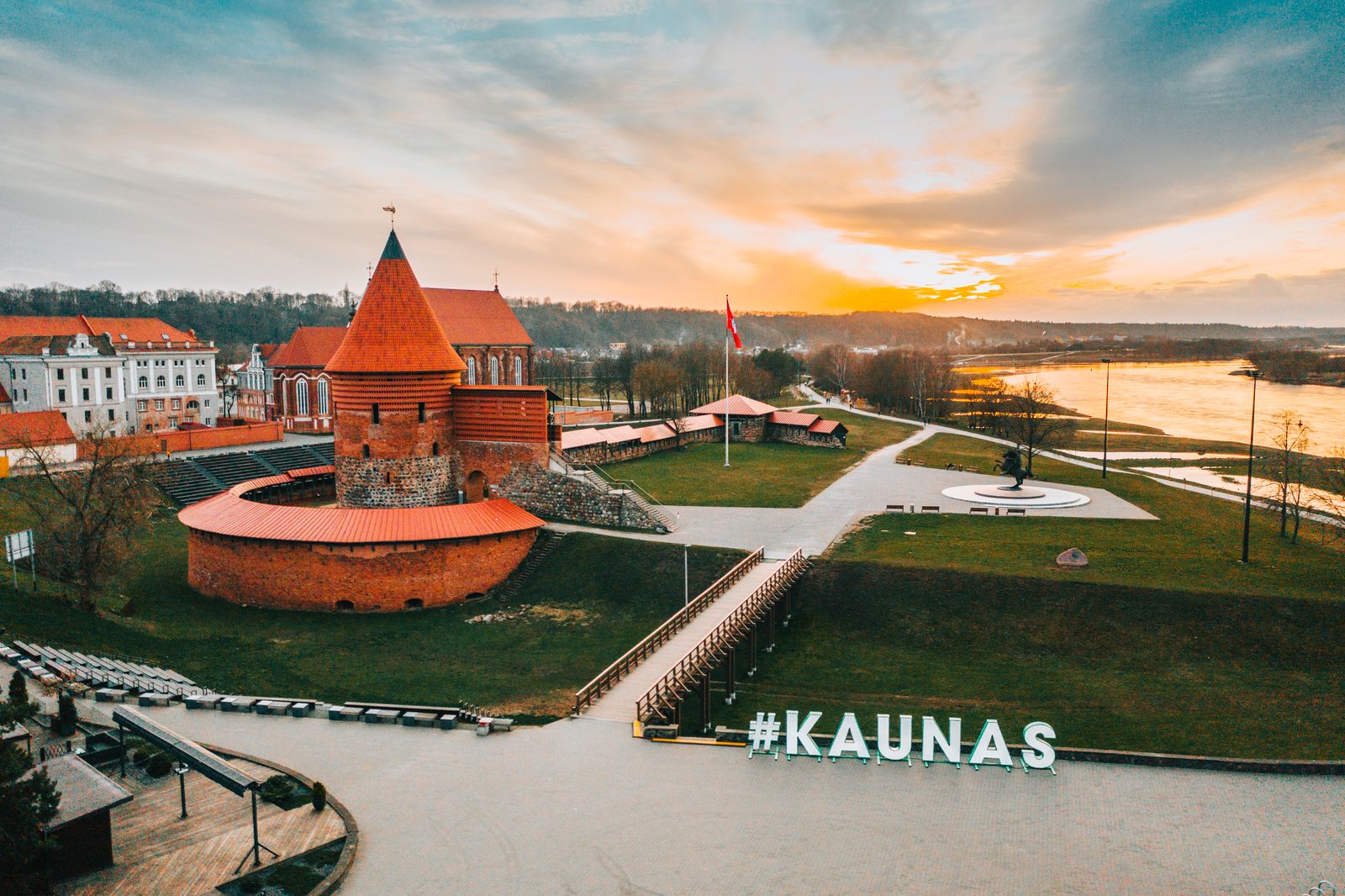
FreeFrom baroque Vilnius and UNESCO Kaunas to Trakai’s island castle, the Hill of Crosses, and the Baltic beaches of Palanga.
Lithuania sits within easy reach of several other destinations — each with a completely different character.


