BN
Brunei
Golden mosque, water village & pristine Borneo jungle
Golden mosque, water village & pristine Borneo jungle
Brunei is a tiny oil-rich sultanate on the northern coast of Borneo — one of Asia’s smallest and wealthiest countries, where the Sultan’s palace (the world’s largest residential palace) overlooks a capital of mosques and water villages. Bandar Seri Begawan’s Omar Ali Saifuddien Mosque, reflected in its lagoon, is among the most beautiful Islamic buildings in Southeast Asia. But Brunei’s greatest treasure is its rainforest: despite its small size, 70% of the country is covered by intact Bornean forest sheltering pygmy elephants, proboscis monkeys, clouded leopards and great biodiversity in one of the world’s most biodiverse ecosystems.
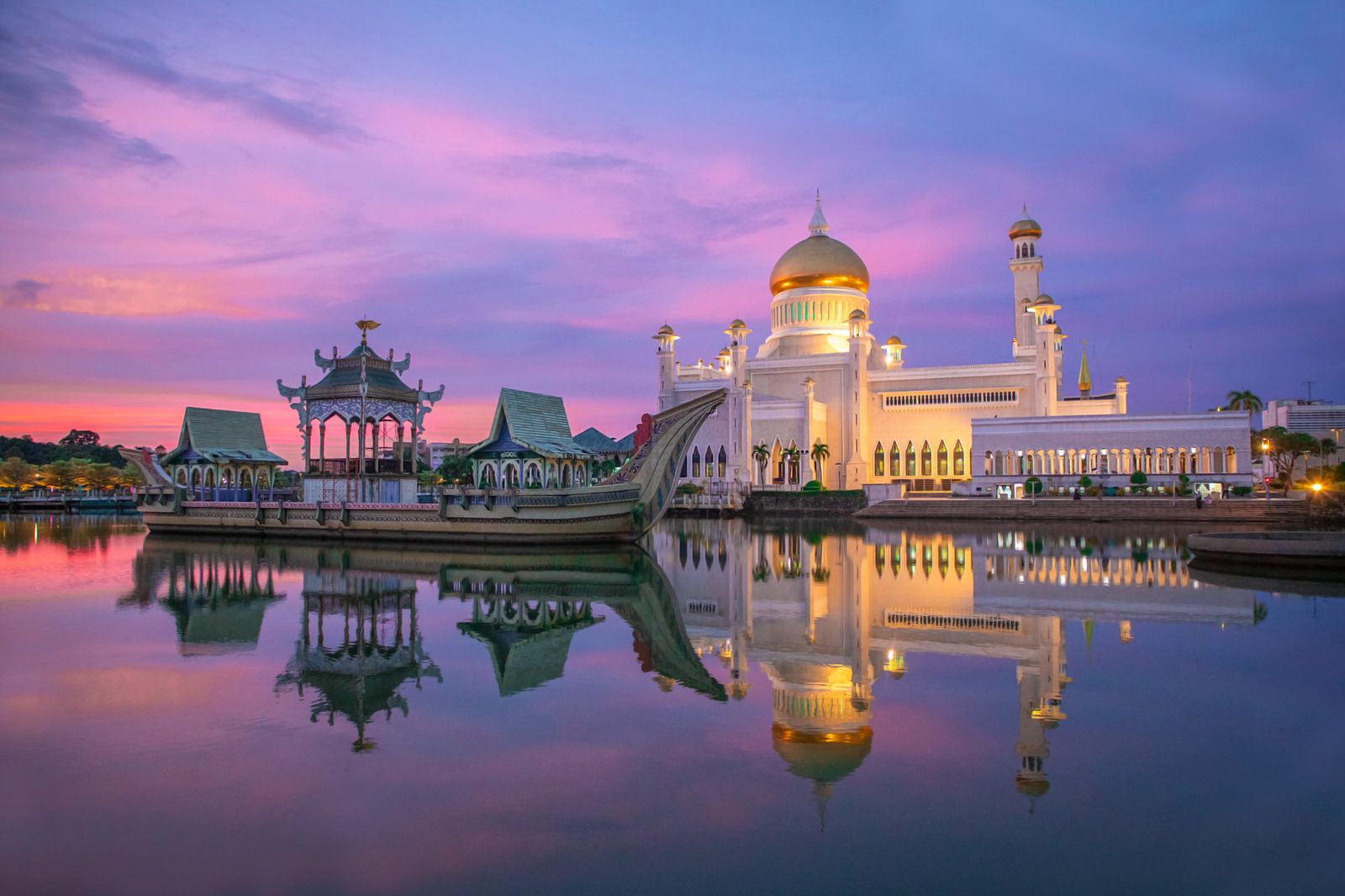
Considered the most beautiful mosque in Southeast Asia, the Omar Ali Saifuddien Mosque (1958) rises above its artificial lagoon with Italian marble walls, gold-leaf dome and English stained-glass windows. The surrounding ceremonial barge, a replica of a 16th-century royal vessel, adds drama. The mosque glows magnificently at sunset.
A floating settlement of 30,000 people built on stilts above Brunei River — one of the world’s largest water villages and inhabited for over 1,000 years. Schools, mosques, clinics and shops all float on this community. Water taxis ferry visitors between the village and the riverbank; the evening views of the Istana Nurul Iman palace from the river are magnificent.
Brunei’s intact primary rainforest, accessible only by speedboat through mangroves, is one of the best-protected segments of lowland Bornean rainforest remaining. A canopy walkway at 60 metres offers views across an intact forest canopy; the river and waterfall trails bring encounters with proboscis monkeys, hornbills and insects.
Brunei (Wikipedia) →A starchy paste made from sago palm pith, eaten by dipping with a bamboo fork into spicy sambal and sour fruit — the national dish of Brunei, eaten at traditional feasts.
Tiny egg sponge cakes baked in intricate fish or flower moulds — the traditional Bruneian festive sweet, made especially for Hari Raya.
Plain rice with fried chicken and sambal, sold in small packets — Brunei’s cheap everyday meal.
Sweet “pulled” milk tea. Brunei is dry, so tea and fresh juices are the drinks; Gadong night market is good for street food.
Brunei International (BWN) in Bandar Seri Begawan is the only airport. Royal Brunei Airlines is the national carrier connecting to London, Australia, the Middle East and Southeast Asia. For trip planning, see the official Brunei tourism portal.
Royal Brunei Airlines operates a direct Heathrow–Bandar Seri Begawan route — one of very few non-stop connections from Europe to a Southeast Asian country this small. The routing makes Brunei a genuine transit stop between the UK and Australia.
Brunei is easiest reached via Singapore (2h) or Kuala Lumpur (2h) — both cities have multiple daily connections. Royal Brunei uses BWN as its hub between London and Australia; this makes Brunei a natural stop-over on UK–Australia routings.
BSB is very walkable between the main sights; the Brunei Museum, Omar Ali Mosque and Royal Regalia are all within 2km. Public DART buses cover the main routes for BND 1.
Brunei is very small — the main territory is only 80km across. Car hire (BND 80–150/day) gives complete freedom; the roads are excellent, traffic light and petrol costs BND 0.53/litre. The exclave of Temburong is only accessible by speedboat.
The best time to visit is December to April — the northeast monsoon brings drier weather to the Brunei coast, temperatures pleasant (26–30°C), and the Omar Ali Saifuddien Mosque most photogenic in the clear dry-season light. May to November brings the southwest monsoon with heavy afternoon showers; the Ulu Temburong rainforest is impressive year-round.
📅 Brunei is in its best season in February, March, April. See where else is good to go in those months, or browse where to go by month.
Brunei is mid-range for Southeast Asia — food and local transport are affordable, but there are few budget accommodation options. The Brunei Dollar (BND) trades at par with the Singapore Dollar. Alcohol is prohibited for Muslims; non-Muslim visitors may bring a limited quantity.
Nasi katok — a serve of rice, fried chicken and sambal chilli sauce, wrapped in brown paper — is Brunei’s beloved cheap eat, sold at roadside stalls and tiny shops for BND 1 (approximately US$0.75).
Ambuyat — a sticky, translucent starchy paste made from the interior of the sago palm, eaten by dipping a fork-like implement (chandas) into the starch and twirling it into a ball, then dipping it into a sour-salty soup.
The Empire Hotel and Country Club (Jerudong, built in 1996 by Prince Jefri at an estimated cost of US&dollar)
Bandar Seri Begawan for two days, the Ulu Temburong National Park for two, Kampong Ayer for one, the Royal Regalia Museum for one, Seria for one. Brunei — one of the world’s wealthiest nations by GDP per capita — is a country of mosques, intact rainforest and almost no other tourists.
Bandar Seri Begawan (BSB) — a small, immaculate capital of 100,000 people, built on the proceeds of one of the world’s largest per-capita oil incomes — is centered on the Omar Ali Saifuddien Mosque (1958, Italian marble, Venetian glass mosaics, a golden dome reflected in a man-made lagoon, the most impressive mosque in Southeast Asia). Admission is free; dress modestly.
Brunei ranks in the top five nations globally by GDP per capita (approximately US$65,000–70,000) entirely from oil and gas revenues. All education, healthcare and housing are subsidised or free for Bruneian citizens; there is no income tax. Petrol costs BND 0.53/litre (approximately €0.35) — the cheapest in Southeast Asia.
The Royal Regalia Museum (1992, the finest collection of royal regalia in Southeast Asia — gold and silver ceremonial objects, carriages, jewellery and the ceremonial costume of the Sultan displayed in a gold-domed building, free admission) and Kampong Ayer (“Water Village” — a floating village of 30,000 people on the Brunei River, the largest water village in the world, with mosques, schools and a fire station all on stilts).
Kampong Ayer has been continuously inhabited for at least 1,000 years — Portuguese explorers in the 16th century described it as the “Venice of the East.” It has no roads; all movement is by water taxi. Approximately 30,000 people live in houses on stilts connected by 36km of raised wooden walkways.
1h30 by speedboat through mangroves to the Temburong district. Ulu Temburong National Park (50,000 hectares of primary Bornean rainforest, accessible only by water taxi and longboat — no road access) — the Canopy Walkway (45m above the rainforest floor, with proboscis monkeys, hornbills and gibbons in the canopy) and the most biodiverse primary forest in Southeast Asia.
Ulu Temburong is accessible only by a combination of speedboat, motorised longboat, and on foot — there is no road connection to the main Brunei territory. This isolation has preserved primary lowland dipterocarp rainforest in better condition than anywhere in Borneo outside the most protected areas.
A full day in the park — river trekking in the Temburong River (wading through clear mountain water between limestone boulders, with flying lizards, river kingfishers and the great biodiversity of intact Bornean forest). A night walk (torchlit, with a guide spotting flying squirrels, stick insects, Asian horned frog and slow loris).
Brunei’s primary forests are among the least-disturbed in Borneo — unlike Malaysian and Indonesian Borneo, Brunei banned commercial logging in 1997 and the country has retained 70% forest cover. The consequence is one of the highest densities of endemic Bornean species in any accessible area on the island.
A full day on the water — Kampong Ayer by water taxi (the 20-cent BND ride across the river) and walking the boardwalk network past stilted mosques, school children in boats and the daily rhythms of a community that has lived on water for a millennium. The Jame’Asr Hassanil Bolkiah Mosque (1992, the largest mosque in Brunei, gold-domed, with 29 golden cupolas representing the Sultan’s position as the 29th ruler of Brunei).
The Jame’Asr Hassanil Bolkiah Mosque was built to mark the 25th anniversary of the Sultan’s reign in 1992 — 29 golden cupolas representing each sultan in the dynasty, four minarets, Italian marble and capacity for 5,000 worshippers. The exterior is best seen from the Brunei River at dawn from a water taxi.
1h from BSB. Seria — the heart of Brunei’s oil industry, with the Billionth Barrel Monument (commemorating the billionth barrel of oil pumped from the Seria field in 1991), the oil pumps working offshore in the South China Sea, and the Seria Oil Town Museum documenting the discovery of oil in 1929 that transformed Brunei from a poor fishing community into one of the world’s richest states.
Brunei discovered oil at Seria on 5 April 1929 — the first well, drilled by the British Malayan Petroleum Company, changed the country’s trajectory entirely. By the 1950s, the Seria field was one of the largest in the British Empire. The current Sultan (Hassanal Bolkiah, the 29th Sultan, on the throne since 1967) is one of the wealthiest individuals on earth.
The Jerudong Park Playground — opened in 1994 by the Sultan as a free theme park for all Bruneians, with Michael Jackson performing at the opening concert, featuring full-size rollercoasters and carnival rides that operated free of charge until 2003. Now partially operational with an admission fee. Fly from BSB (BWN).
The Jerudong Park opening concert (1996) was headlined by Michael Jackson, Whitney Houston and Stevie Wonder — flown in by the Sultan as entertainment for the 50th birthday of his brother Prince Jefri. The show was free for all Bruneians. It remains the most extravagant private entertainment event ever staged, at an estimated cost of US$17 million.
Visa-free for 30 days for most nationalities including EU, UK, USA, Australia.
Brunei enforces Sharia law; alcohol consumption in public is illegal (non-Muslims can bring small amounts for private use). Dress conservatively. Ramadan requires respectful behaviour.
BSB airport has Royal Brunei Airlines connections to Kuala Lumpur, Singapore, Dubai and London. Singapore is 1h40 by air or 5h by bus through Malaysia.
The BND is interchangeable with the SGD at 1:1 by mutual agreement. Singapore dollars are accepted everywhere in Brunei.
Kampong Ayer (the world’s largest water village, 30,000 people on stilts) can be explored on foot via boardwalks or by water taxi. Free to walk; respectful attire required.
Sale and public consumption of alcohol is illegal; non-Muslim visitors may bring limited personal supplies. The country is entirely dry publicly.
Brunei lacks public transport outside the capital. Taxis and Dart ride-hailing are the main options.
Quick answers to the questions people most often ask before visiting Brunei.
The best time to visit is December to April — the northeast monsoon brings drier weather to the Brunei coast, temperatures pleasant (26–30°C), and the Omar Ali Saifuddien Mosque most photogenic in the clear dry-season light. May to November brings the southwest monsoon with heavy afternoon showers; the Ulu Temburong rainforest is impressive year-round.
Brunei International (BWN) in Bandar Seri Begawan is the only airport. Royal Brunei Airlines is the national carrier connecting to London, Australia, the Middle East and Southeast Asia.
Expect roughly BND 80–130 a day on a budget and BND 200–350 mid-range, or BND 500+ for a more luxurious trip, per person and excluding flights.
Brunei uses the Brunei Dollar (BND).
Plug types: Type G (UK three-pin, 240V).
Point your camera at menus, signs or street text for instant translation. Download the language pack offline before you arrive for full use without data.
FreeReal-time and offline exchange rates for all world currencies — converts prices instantly so you always know what you are paying in your home currency.
FreeFind and book hotels, guesthouses and apartments with free cancellation on most rates — one of the widest selections of accommodation worldwide.
FreeBrowse millions of traveller reviews for restaurants, attractions and hotels — helps identify the best local spots and avoid tourist traps.
FreeBrunei sits within easy reach of several other destinations — each with a completely different character.


