KY
Cayman Islands
Stingray City, Bloody Bay Wall & Seven Mile Beach
Stingray City, Bloody Bay Wall & Seven Mile Beach
The Cayman Islands is a British Overseas Territory of three islands in the western Caribbean that has produced two claims to fame: the finest beach in the Caribbean that most visitors have actually seen (Seven Mile Beach on Grand Cayman — an unbroken sweep of white sand and turquoise sea backed by the world’s most concentrated offshore finance industry), and Stingray City — a shallow sandbar in the North Sound where 50+ southern stingrays have been conditioned to approach boats and snorkellers for food, creating one of the Caribbean’s best-known wildlife interactions. Beneath the surface, the Caymans are an excellent diving destination: the walls of Grand Cayman, Little Cayman’s Bloody Bay Wall (consistently rated one of the world’s top five dive sites) and the sea turtles of Cayman Brac make this an underwater destination.
A shallow sandbar in Grand Cayman’s North Sound where southern stingrays aggregate around fishing boats — a tradition going back to the 1980s when fishermen cleaned fish here. Today 50+ rays interact with snorkellers in water 1–1.5 metres deep, gliding over, resting on laps and accepting hand-fed squid — one of the most accessible wildlife encounters in the Caribbean.
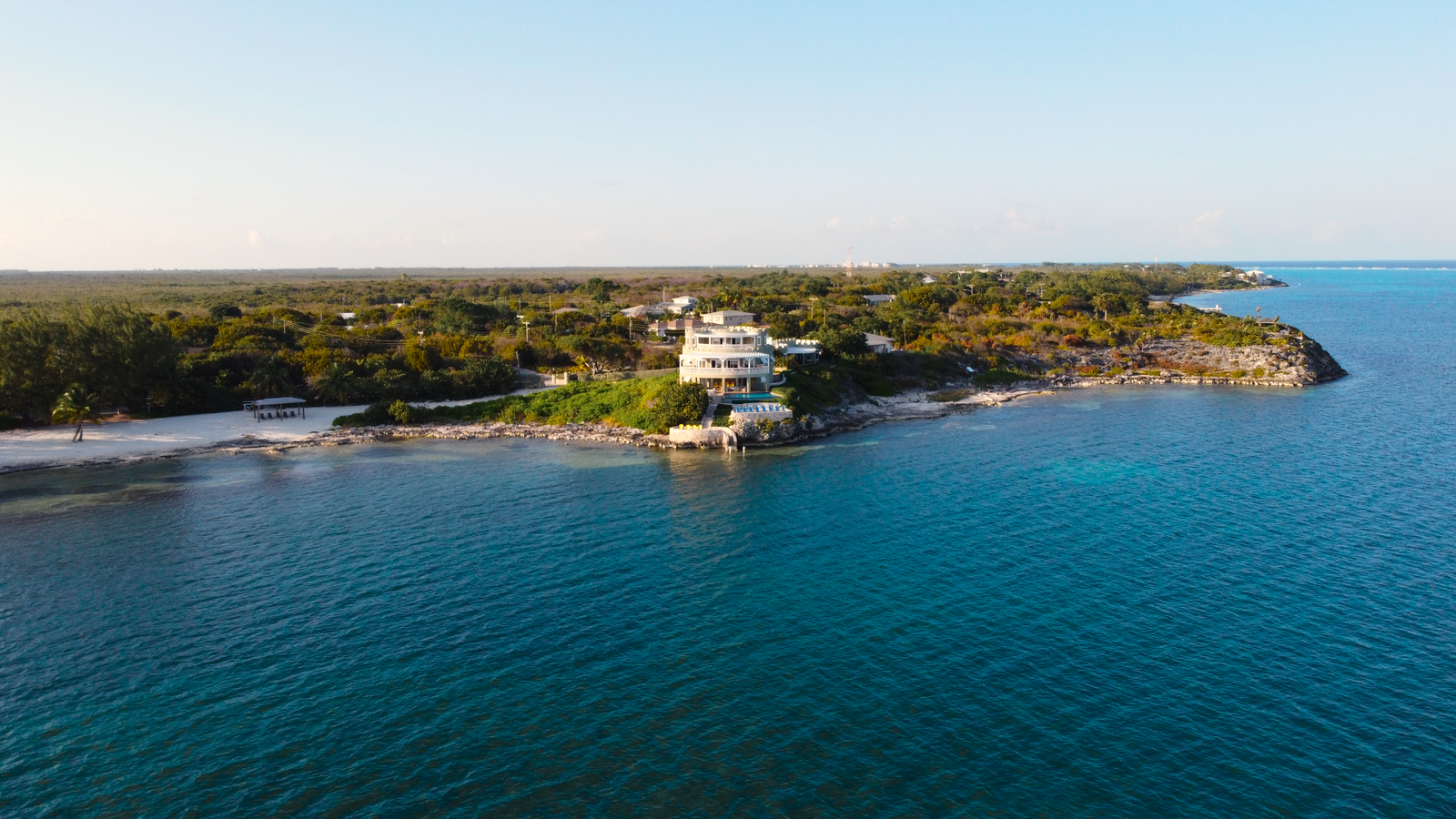
Grand Cayman’s west coast beach is one of the most famous in the Caribbean — 7 miles (actually 5.5) of white sand with turquoise water, parasailing, water sports and a range of excellent restaurants and bars along the beachfront road. The best sunsets in the Caribbean.
Consistently rated one of the world’s top five dive sites — a vertical coral wall that drops from 6 metres to 1,800 metres in a near-vertical plunge, with great visibility (30+ metres), tarpon, grouper, eagle rays and Nassau grouper so unafraid they rest on the reef beside divers. Little Cayman has 100 residents and 1,000 red-footed boobies in the Booby Pond Nature Reserve.
Cayman Islands (Wikipedia) →Farmed green sea turtle slow-cooked with tomato, onion and local spices — a traditional Caymanian dish with roots in the 17th-century turtle fishing heritage. Sea turtle is legally farmed at the Cayman Turtle Centre; wild harvest is prohibited. A culturally significant and controversial food.
Caribbean jerk (scotch bonnet, allspice, thyme) smoked over pimento wood, served with kidney bean rice and fried plantain — the everyday lunch across all three Cayman Islands.
Queen conch minced with flour, celery, Scotch bonnet and spices, deep-fried golden — the essential Cayman Islands appetiser, served at every waterfront restaurant and beach bar. Made from conch farmed or responsibly sourced in local waters.
Fresh mahi-mahi, wahoo or snapper fried and served with fried dumplings — Heritage Kitchen in West Bay is a well-known spot.
Cayman Spirits Co. ages this rum in barrels kept underwater at seven fathoms, where the motion of the sea is said to help the ageing.
Owen Roberts International (GCM) on Grand Cayman is the main hub. American Airlines, Delta, United, British Airways and Cayman Airways serve the main routes. For trip planning, see the official Cayman Islands tourism portal.
Miami (1h20) is the primary US gateway — American and Cayman Airways both operate multiple daily flights. The Cayman Islands sit directly between Cuba and Jamaica, 3h30 from New York.
British Airways operates a direct Gatwick–Grand Cayman service (9h30 direct) — the only direct UK route. Most Europeans connect through Miami.
Cayman Airways (the national carrier) connects all three islands with small turboprop aircraft. Book domestic flights in advance; capacity is limited and the service fills up.
Grand Cayman is flat and the roads good — car hire (KYD 35–65/day, drive on the left) is the most practical option. Little Cayman and Cayman Brac are tiny enough to explore by bicycle or golf cart.
November to April is peak — dry, clear and pleasantly warm (24–28°C), the diving at its best. December to March is most popular with US visitors. May to October is wetter and hotter (28–32°C) with hurricane risk August–September, but diving is still excellent and prices are lower.
📅 Cayman Islands is in its best season in January, February, March, April, December. See where else is good to go in those months, or browse where to go by month.
The Cayman Islands use the Cayman Islands Dollar (KYD, pegged at KYD 1 = US$1.20). They are expensive — among the priciest in the Caribbean, with no income tax but high import costs.
Conch fritters (a batter of ground conch meat, peppers, onion and thyme, deep-fried into small balls and served with a spicy dipping sauce)
Caymanian turtle steak.
Blue by Eric Ripert (at the Ritz-Carlton Grand Cayman — the Cayman outpost of the celebrated New York chef, consistently ranked the finest Caribbean restaurant, with a menu driven by the local catch of wahoo, mahi-mahi and lobster)
Grand Cayman for three days, Little Cayman for one, Cayman Brac for one. The Cayman Islands — three British Overseas Territory islands in the western Caribbean — have the finest wall diving in the hemisphere, Seven Mile Beach and the world’s most famous stingray encounter.
Grand Cayman — the largest island (35km long, 197km²) with Seven Mile Beach (one of the Caribbean’s finest beaches — actually 5.5 miles of unbroken white sand on the west coast, the financial and hotel district of Grand Cayman running along its entire length, calm Caribbean water of great clarity) and the capital Georgetown (the financial centre of the Caribbean, home to 600+ banks and the fifth-largest financial centre in the world by value of assets).
The Cayman Islands are the fifth-largest financial centre in the world by assets managed — over 600 banks, 100,000+ registered companies and 10,000 mutual funds are registered in these three islands of 80,000 people. The offshore financial system (developed from the 1960s, with no corporate tax, no capital gains tax and no income tax) means the Cayman Islands hold more US dollars on deposit than any place outside the US itself.
Stingray City — a sandbar in the North Sound of Grand Cayman at 1m depth, where approximately 30–50 southern stingrays (Hypanus americanus) have been conditioned since the 1980s to associate human boats with food, and now approach snorkellers to be fed, touched and photographed — the most visited snorkel and dive experience in the Caribbean, with 1 million visitors per year.
Stingray City developed accidentally from the 1970s when fishing boats from Georgetown cleaned their catch at this shallow sandbar and threw fish scraps overboard — the stingrays learned that boat engines meant food. By the 1980s scuba divers were exploiting this conditioning deliberately. Today the stingrays are fully habituated; they approach humans proactively, draping themselves over divers’ shoulders in an entirely natural-seeming interaction that was created by 50 years of accidental conditioning.
The USS Kittiwake (a decommissioned US Navy submarine rescue vessel deliberately sunk in 2011 as an artificial reef in 18–30m off Seven Mile Beach — one of the finest purpose-sunk dive wrecks in the Caribbean, with multiple entry points, the engine room, galley, crew quarters and decompression chambers all accessible) and the Cayman Wall (the vertical drop-off from the reef shelf at 18m to 2,000m — the finest wall dive in the western Caribbean).
The Cayman Wall (the edge of the Cayman Ridge — a submarine mountain range rising from 5,000m depth to within metres of the surface, creating a vertical wall that drops from 18m to over 2,000m in a single dive) is the defining dive site of Grand Cayman. The clarity (30m+ visibility) means the wall disappears into blue darkness below, creating a vertiginous sensation.
The Cayman Turtle Conservation and Education Centre (the only sea turtle farm in the world, which breeds green sea turtles for conservation release — an attempt to restore the once-abundant turtle population that was hunted to near-extinction in the Cayman Islands by 1800) with the Cayman Islands National Museum and the Rum Point beach (the finest quiet beach on the north coast, with hammocks, clear water and fresh coconut water).
The Cayman Islands were named by Christopher Columbus on 10 May 1503 — he called them Las Tortugas (The Turtles) after the vast numbers of green sea turtles he observed in the surrounding waters. The Cayman turtle fishery (15th–19th century) supplied ships across the Caribbean with fresh meat; by 1800 the original population of millions of turtles had been reduced to near-extinction. The turtles have not recovered to historical levels despite 50 years of protection.
30 min flight. Little Cayman (the smallest inhabited Cayman island, population 200 — one of the least disturbed coral reef ecosystems in the western Caribbean, with the Bloody Bay Wall — widely considered the finest wall dive in the Caribbean, dropping from 6m to over 1,000m in absolute clarity) and the Booby Pond Nature Reserve (the largest red-footed booby colony in the Western Hemisphere, 20,000 nesting pairs).
The Bloody Bay Wall on Little Cayman (a vertical wall beginning at just 6m depth, dropping immediately to 1,000m+ — the shallowest wall start of any major Caribbean wall dive) is consistently voted the finest wall dive in the Caribbean by dive magazines. The great clarity (35m+) and the abrupt transition from the shallow reef shelf to the vertical wall creates an experience of weightless suspension above an abyss.
30 min flight from Little Cayman. Cayman Brac (the middle island, named for the Gaelic word for bluff — a 37m limestone cliff that dominates the eastern half of the island) with the Peter Pan cemetery (the graves of victims of the 1932 hurricane, Cayman’s worst natural disaster, killing 109 people from a population of 1,400) and the Cayman Brac Parrot (a subspecies found only on this island, with 400 surviving individuals).
The 1932 Cayman Brac hurricane (November 8, 1932 — a Category 5 storm that struck Cayman Brac with no warning, killing 109 of the island’s 1,400 residents — a death rate of nearly 8% of the population) remains the deadliest natural disaster in Cayman Islands history. Survivors sheltered in the limestone caves in the Bluff; the graves of the victims in Peter Pan cemetery are still maintained by islanders.
A final morning in Georgetown — the Cayman Islands duty-free shopping area (the finest duty-free watches, jewellery and rum in the Caribbean — the island has no customs duty on many goods and Kirk Freeport is the largest duty-free retailer in the Caribbean) and a final seafood lunch at Camana Bay (the new-urbanist town centre development on Seven Mile Beach). Fly from Grand Cayman (GCM).
Cayman rum cake (a dense, dark rum-soaked fruitcake made with local Caribbean rum, often containing whole cashew nuts — sold in vacuum-packed tins in every Georgetown shop) is the defining edible souvenir of the Cayman Islands and is the most exported food product. The original recipe was developed by Tortuga Rum Company in the 1980s; it is now the most widely consumed rum cake in the Caribbean.
Visa-free for UK, USA, EU and most nationalities for up to 6 months.
Strong transatlantic and North American connections. Cayman is a British Overseas Territory; no visa for UK, US or EU citizens.
1 KYD = USD 1.20. Cards accepted everywhere. ATMs throughout Grand Cayman.
Seven Mile Beach is the resort zone; the North Sound (Stingray City, Rum Point) is where locals and water sports activity concentrate. East End and the Bluff have the authentic Caymanian fishing culture.
The Caymans are expensive — one of the pricier Caribbean destinations. Budget accordingly.
Short flights from Grand Cayman (30 min); the island has just 10 small lodges — book months in advance.
Quick answers to the questions people most often ask before visiting the Cayman Islands.
Fly into Owen Roberts International Airport (GCM) on Grand Cayman. It's about 1h20 from Miami and 2–3h30 from Houston, Atlanta and New York, with flights from London as well. Little Cayman and Cayman Brac are short hops from Grand Cayman.
British, American, EU and most other nationalities can visit without a visa. Check the rules for your passport before travelling.
November to April is peak season — dry and 24–28°C, with the best diving. May to October is hotter and wetter with hurricane risk (highest in August–September), but diving remains excellent and prices fall.
A shallow sandbar in Grand Cayman's North Sound where you can stand in waist-deep water among dozens of southern stingrays. It's one of the Caribbean's most famous wildlife experiences, reached on boat trips.
Yes — it is among the priciest Caribbean destinations. The Cayman Islands dollar is fixed at US$1.20, and US dollars are accepted everywhere. Expect around KYD 80–140 per day on a budget and KYD 200–350 mid-range.
Point your camera at menus, signs or street text for instant translation. Download the language pack offline before you arrive for full use without data.
FreeReal-time and offline exchange rates for all world currencies — converts prices instantly so you always know what you are paying in your home currency.
FreeFind and book hotels, guesthouses and apartments with free cancellation on most rates — one of the widest selections of accommodation worldwide.
FreeBrowse millions of traveller reviews for restaurants, attractions and hotels — helps identify the best local spots and avoid tourist traps.
FreeCayman Islands sits within easy reach of several other destinations — each with a completely different character.
Cayman Islands is one of the world’s least-visited places. See all 90 in our guide to the world’s least-visited countries & territories.


