TC
Turks and Caicos
World’s #1 beach, humpback whales & Caribbean wall diving
World’s #1 beach, humpback whales & Caribbean wall diving
The Turks and Caicos Islands is a British Overseas Territory of 40 low-lying coral islands in the northern Caribbean with the most exclusive beach real estate in the Atlantic. Grace Bay Beach on Providenciales — 12 kilometres of luminous white sand with water of an impossible electric turquoise, calm and shallow over a white sand seafloor — is consistently rated the world’s number one beach. The Turks and Caicos is also one of the world’s premier diving destinations: the Wall — a vertical coral wall dropping hundreds of metres from 15 metres depth just minutes offshore — has exceptional visibility and marine life including humpback whales migrating through the Columbus Passage (January–March). The islands are uninhabited except for Providenciales, Grand Turk, Salt Cay and a few others.
The world’s most consistently top-rated beach — 12 kilometres of powder-white sand on the protected Caribbean shore of Providenciales, with water so clear you can see the sand ripples in 5 metres depth. The beach is backed by luxury resorts at its ends but has long stretches of complete openness in the middle.
The Turks Islands Passage (Columbus Passage) is a deep-water channel where the continental shelf drops from 15 metres to hundreds of metres in a wall of coral. The wall dives at sites like Black Forest and The Crack are among the Caribbean’s finest; from January to March humpback whales migrate through the passage and can be encountered on boat trips from Grand Turk.
A tiny island of 100 people south of Grand Turk where 18th-century salt-raking heritage survives in windmills, salt pans and 200-year-old Bermudian architecture completely unchanged. The most authentic and historical island in the TCI, with excellent diving on the HMS Endymion wreck and resident humpbacks in season.
Turks and Caicos Islands (Wikipedia) →cracked, in salad, fritters and chowder — is the national staple; the TCI has some of the Caribbean’s largest remaining conch populations.
Raw queen conch marinated in lime juice, orange juice, scotch bonnet and diced tomato — prepared tableside at conch stands on Grace Bay beach. The most authentic Turks & Caicos food experience.
Caribbean spiny lobster grilled over charcoal with garlic butter and lime — the defining premium meal of the islands, caught fresh from October to April.
Caribbean spiny lobster caught fresh in the Turks & Caicos Bank — the most productive lobster fishing ground in the Caribbean. Grilled with garlic butter and lime, or stuffed and baked; served at every restaurant on the island. Season runs August to March.
are outstanding at local seafood shacks. The Da Conch Shack on Grace Bay is the most famous casual dining institution in the Caribbean.
The craft lager brewed in Providenciales by the Turk’s Head Brewery — named after the island’s landmark sea stack. A clean, light-hopped pale lager served ice-cold at Grace Bay’s beach bars and local restaurants.
Providenciales International (PLS) is the main gateway. American, Delta, United, British Airways and Cayman Airways serve it. Grand Turk (GDT) also has a small international terminal. For trip planning, see the official Turks and Caicos tourism portal.
Miami is the primary US hub (1h45, multiple daily American Airlines flights). New York (3h30) and Atlanta (3h) are well connected year-round.
British Airways operates a direct Gatwick–Providenciales service (9h30) — the only direct UK route. Most Europeans connect through Miami or New York.
The inter-island ferry to North Caicos (35 min) is the easiest day trip from Provo. North and Middle Caicos are connected by a road causeway, making it easy to visit both in one day with a rental car.
There are no public buses on Providenciales — car hire (US$60–90/day) is essential to reach the Grace Bay reef access points, the north shore and the ferry terminals. The island is flat and roads are good.
November to April is the prime season — dry, clear (26–28°C), the humpback whales passing through January–March. December and January are peak. May to October is hotter (28–31°C) with hurricane risk August–October, but Grace Bay stays glorious and prices drop sharply.
📅 Turks and Caicos is in its best season in January, February, March, April, December. See where else is good to go in those months, or browse where to go by month.
The US dollar (USD) is the official currency. TCI is among the most expensive Caribbean destinations — no budget accommodation on Providenciales, but middle islands offer cheaper options.
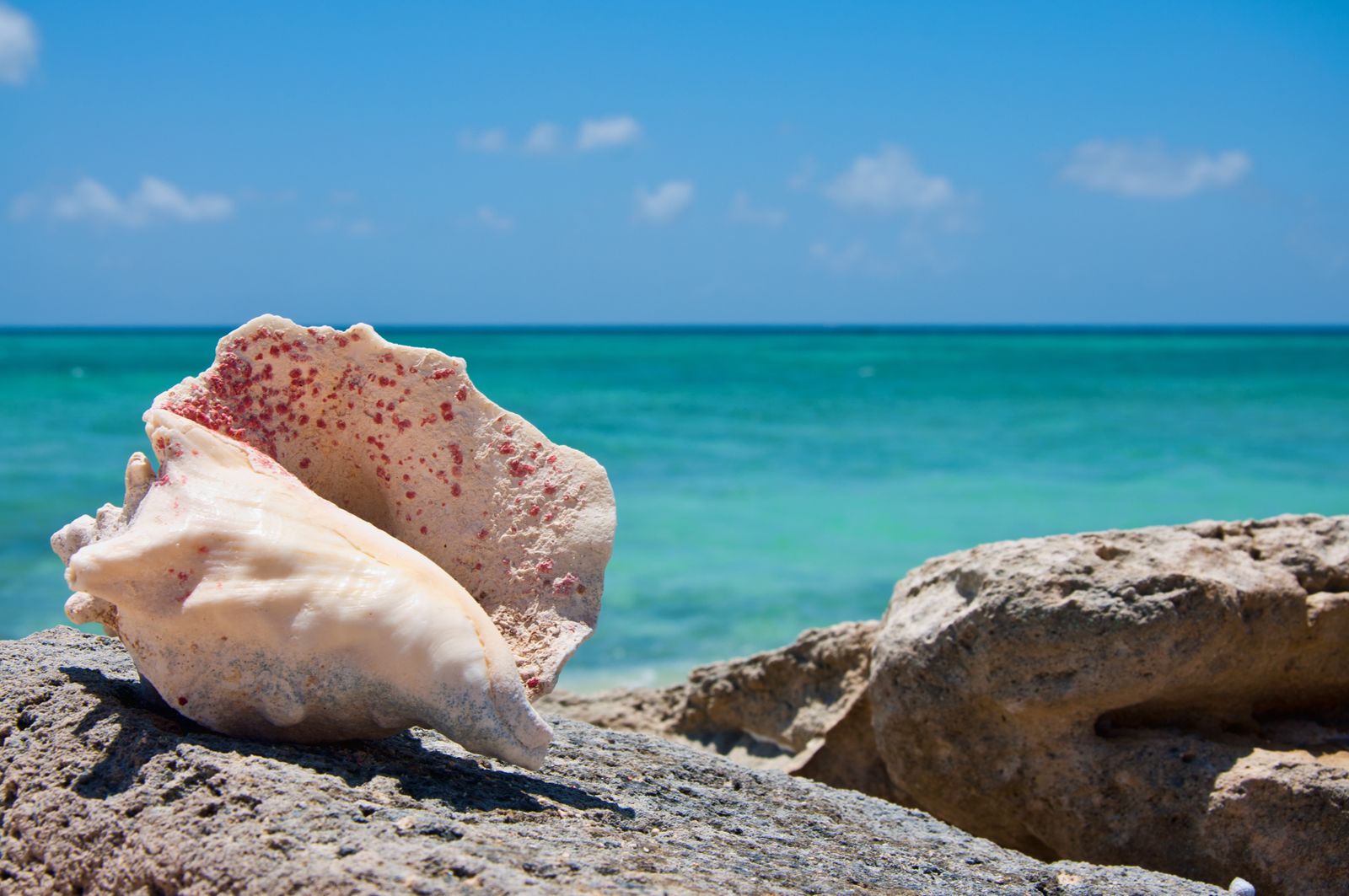
Conch (Queen conch — Strombus gigas, the large pink Caribbean sea snail harvested from the Caicos Bank for 1,000 years) is the defining food of Turks and Caicos — conch fritters, conch sal.
Turks and Caicos spiny lobster (Panulirus argus — in season August to March, larger and sweeter than the North Atlantic lobster, grilled with butter and garlic at beachfront restaurants for US$40–80) is the finest.
COMO Parrot Cay (a private island resort accessible only by boat, with the COMO Shambhala spa)
Providenciales for two days, Grand Turk for one, Salt Cay for one, Middle Caicos for one, North Caicos for one, Half Moon Bay for one. Turks and Caicos — a British Overseas Territory of 40 islands southeast of the Bahamas — has Grace Bay, consistently ranked the world’s finest beach, and the third-largest coral reef on earth.
Providenciales (Provo) — the main island (population 23,000, 98km²) with Grace Bay Beach (consistently ranked the finest beach in the world by TripAdvisor and travel surveys: 16km of bone-white sand backed by low-rise luxury resorts, the water a translucent turquoise layered from aquamarine to deep blue over the reef, with virtually no waves and no currents inshore) — the platonic ideal of a Caribbean beach.
Grace Bay is protected by the Caicos Barrier Reef — the third-largest coral reef system in the world (after the Great Barrier Reef and the Mesoamerican Barrier Reef), running along the entire northern edge of the Caicos platform and breaking the Atlantic swell before it reaches the beach. The result is water of great calmness and clarity, with visibility of 30–50m, and a beach entirely free of the surf that characterises exposed Atlantic-facing Caribbean shores.
The Caicos Barrier Reef snorkel and dive (the 220km barrier reef running along the northern face of the Caicos Bank — with schools of French grunts, sergeant majors, queen angelfish and hawksbill turtles on the coral heads accessible from the beach at Grace Bay in 2–5m) and the Bight Reef (a 2km fringing reef directly in front of the Grace Bay hotels, walkable in from the shore, one of the most accessible barrier reef snorkel sites in the Caribbean).
The Caicos Bank (the shallow underwater platform beneath the Turks and Caicos, 100km wide and averaging 5–15m deep) is one of the largest and least disturbed shallow-water marine ecosystems in the Atlantic. The combination of the barrier reef, the shallow warm bank and the total absence of industry or agriculture on the surrounding islands produces water clarity and marine biodiversity that rivals the Maldives.
35 min flight. Grand Turk — the original capital and historical heart of the Turks and Caicos (population 4,000, 18km²) with the Turks and Caicos National Museum (in the oldest stone building in the islands, the Guinep House — with the remains of a Spanish carrack wrecked on the Molasses Reef in approximately 1513, the oldest European shipwreck ever found in the Americas) and the Grand Turk Wall (a vertical drop from 7m to 2,000m).
The Molasses Reef Wreck (a Spanish exploration vessel wrecked circa 1513 on a reef off Grand Turk — the oldest European shipwreck ever excavated in the Americas, pre-dating the Mayflower by over 100 years) contained Spanish ceramics, anchors, cannons and navigational instruments from the early Age of Exploration. The wreck predates any documented European settlement in the Turks and Caicos.
15 min from Grand Turk. Salt Cay (population 70 — once the most important salt-producing island in the Caribbean, supplying salt throughout the New World from the 17th to 20th century, now almost abandoned, with 200-year-old salt pans and windmills still standing, the historic buildings intact and completely unchanged since the 1800s — the best-preserved example of a Caribbean salt industry town in existence).
Salt Cay was the economic engine of the Turks and Caicos for 300 years — the shallow salt ponds (salinas) produced Turks Island salt that was traded throughout the Caribbean and North America, used to preserve cod caught off Newfoundland. The Bermudan salt rakers who harvested it (from approximately 1670) established the permanent European settlement of the Turks Islands. At its peak in the 1800s, 50,000 bushels of salt per year were exported.
40 min ferry. Middle Caicos (the largest island in the Turks and Caicos at 144km², population 300 — largely undeveloped, with the Conch Bar Caves (the largest accessible cave system in the Caribbean, 15km of limestone passages with stalactites, stalagmites and the bones of Pre-Columbian Lucayan inhabitants) and the Dragon Cay beach (a crescent of sand entirely surrounded by mangrove creek, accessible only by kayak).
The Lucayan people (the indigenous Arawak-speaking people who inhabited the Bahamas and Turks and Caicos before European contact) were the first indigenous Americans encountered by Christopher Columbus on October 12, 1492, when he landed at San Salvador (possibly nearby in the Bahamas). By 1520, Spanish slavers had transported virtually the entire Lucayan population to Hispaniola to work the gold mines; the population of perhaps 40,000 was reduced to zero in 30 years.
30 min ferry from Providenciales. North Caicos (the greenest and most fertile of the Caicos Islands, with the Flamingo Pond Nature Reserve — the largest flamingo colony in the Turks and Caicos, 2,000+ West Indian flamingos visible from a roadside viewpoint — and the Three Mary Cays (a snorkel site with loggerhead and hawksbill turtle nesting on the sandy floor in 3–6m of water, easily reached by kayak from the beach).
West Indian flamingos (Phoenicopterus ruber — the American flamingo, the largest flamingo species, with the most vivid pink plumage of any flamingo, the colour derived from carotenoid pigments in the brine shrimp and blue-green algae they filter-feed from shallow salt ponds) roost in large numbers in the salt ponds of North Caicos and Providenciales. The Turks and Caicos flamingo population is one of the healthiest in the Caribbean.
Day trip to Half Moon Bay (a horseshoe of white sand connecting two uninhabited cays — Water Cay and Little Water Cay — east of Providenciales, accessible only by boat, with the Rock Iguana sanctuary on Little Water Cay: Turks and Caicos rock iguanas (Cyclura carinata), an endangered species found only in the Turks and Caicos, sunning on the beach at distances of 1–2m). Fly from Providenciales (PLS).
The Turks and Caicos rock iguana (Cyclura carinata — an endangered species found only in the Turks and Caicos, with a total wild population of approximately 50,000 — the most densely populated of all Cyclura iguana species) is found on Little Water Cay in large numbers. The iguanas are completely habituated to humans and will approach within metres; the island is a designated nature reserve with boardwalks to prevent disturbance.
Visa-free for EU, UK, USA and most nationalities for up to 90 days.
Most visitors arrive at PLS airport on Provo, where Grace Bay and the main resorts are. Grand Turk (GDT — 45 min domestic flight) is the capital with a coral wall dive site that begins just offshore.
No visa needed for UK, US and EU citizens. The USD is the official currency. A 12% government tax plus service charge is added to most bills.
A 12km arc of white-powder sand and warm turquoise water — extraordinary and one of the calmest, clearest beaches in the Caribbean outside the Exumas.
Among the most expensive destinations in the Caribbean. Budget, mid-range and luxury options exist but costs are high.
Taxis on Providenciales; small planes (TCI Ferry also) to outer islands.
Quick answers to the questions people most often ask before visiting Turks and Caicos.
Fly into Providenciales International Airport (PLS), the resort hub. It's about 1h45 from Miami and around 3 hours from New York, Atlanta and Charlotte, with flights from London too.
British, American, EU and most other nationalities can visit without a visa for up to 90 days. Check the rules for your passport before travel.
November to April is prime season — dry and 26–28°C, with humpback whales passing from January to March. May to October is hotter, with hurricane risk from August to October, but prices drop sharply.
It is regularly ranked among them: about 12 km of fine white sand and calm, clear turquoise water on Providenciales.
Yes — it's one of the most expensive Caribbean destinations, with little budget accommodation on Providenciales. Expect around US$120–200 per day at the budget end and US$350–600 mid-range. The currency is the US dollar.
Point your camera at menus, signs or street text for instant translation. Download the language pack offline before you arrive for full use without data.
FreeReal-time and offline exchange rates for all world currencies — converts prices instantly so you always know what you are paying in your home currency.
FreeFind and book hotels, guesthouses and apartments with free cancellation on most rates — one of the widest selections of accommodation worldwide.
FreeBrowse millions of traveller reviews for restaurants, attractions and hotels — helps identify the best local spots and avoid tourist traps.
FreeTurks and Caicos sits within easy reach of several other destinations — each with a completely different character.
Turks and Caicos is one of the world’s least-visited places. See all 90 in our guide to the world’s least-visited countries & territories.
