CX
Christmas Island
Where 50 million red crabs march to the sea
Where 50 million red crabs march to the sea
One of the greatest wildlife spectacles on earth — up to 50 million Gecarcoidea natalis red crabs emerge from the forest and march to the sea to spawn each year. Roads are closed; the island turns red. The migration is triggered by the first rains of the wet season and cannot be predicted more than a few days in advance.

A National Park covering almost two-thirds of the island — the most ecologically intact raised coral island in the Indian Ocean. The forest contains 12 endemic bird species, 16 endemic reptiles and flora found nowhere else on earth. Dozens of hermit crab species roam the forest floor.
The small capital and only port — a bayside settlement with a genuine frontier feel, interesting history of Chinese and Malay phosphate miners, and the best diving access on the island. The underwater drop-offs immediately below the cliffs at the cove are extraordinary.
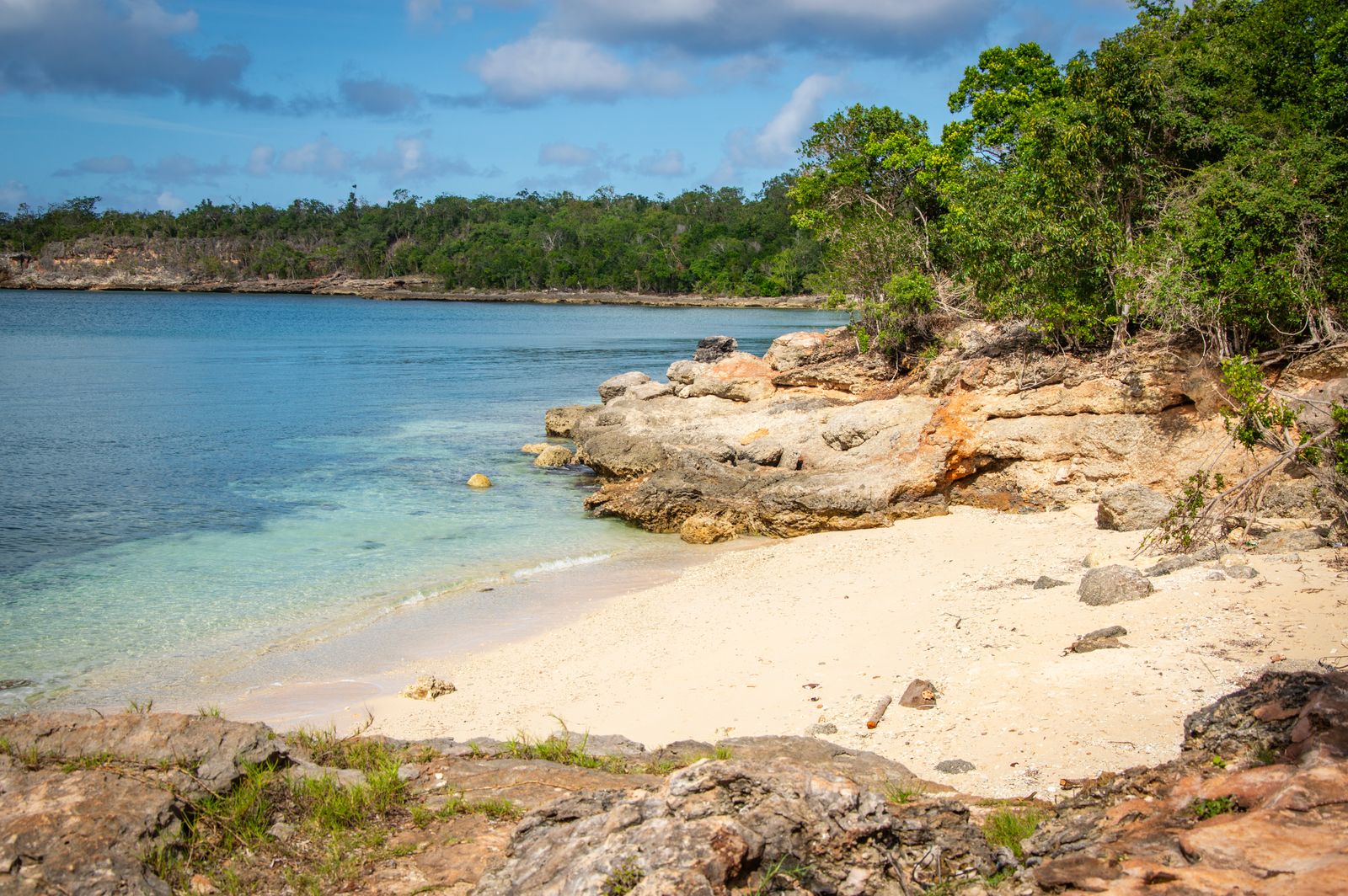
A pristine rainforest beach accessible only by a 3km jungle walk — hermit crabs in vast numbers on the beach, green turtles nesting from November to January, and powerful surf from the open Indian Ocean. One of the most remote and unspoiled beaches accessible on foot in Australia.

The Abbott’s booby and Christmas Island frigatebird are both endemic to this single island — the frigatebird colony in the Settlement forest is one of the most accessible large frigatebird colonies in the world, visible from the road between October and April.
A dramatic south coast of volcanic limestone cliffs with active blowholes that shoot seawater 20 metres into the air during swells — accessible via the island’s south coast walking track. The colours of the sea against the red cliffs are extraordinary in the afternoon light.
A Chinese-Malay stir-fried flat rice noodle dish from the island’s Malay and Chinese heritage — Christmas Island was settled primarily by Chinese and Malay phosphate workers in the 1890s, whose culinary traditions remain dominant. Char kway teow is fried over high heat with eggs, prawns, bean sprouts and sweet soy; found at the island’s Chinese restaurants.
Fried rice with egg, prawns, sambal, kecap manis and crispy shallots — the Malay cooking tradition is deeply embedded in island food culture. The Christmas Island version uses locally caught Indian Ocean seafood and a distinctly Indonesian-Malay spice palette.
The deep waters around Christmas Island produce exceptional pelagic fish — wahoo and mahi-mahi are caught daily and grilled simply at the island’s fishing club and the few local restaurants. The Indian Ocean fish quality is outstanding.
Reflecting the island’s Southeast Asian heritage — Tiger Beer from Singapore is the standard cold drink at bars and the fishing club. Christmas Island’s bar culture is distinctly Malaysian-Australian: a unique cultural fusion.
Coconut jam (kaya) spread on thick toasted bread — a Singapore and Malaysia breakfast staple fully adopted on Christmas Island. Served with soft-boiled eggs and strong kopi (local-style coffee); the definitive island breakfast.
Strong, dark robusta coffee brewed through a cloth filter and served with condensed milk — the standard morning drink of Singapore, Malaysia and Christmas Island’s Chinese-Malay community. Completely different from espresso; intensely sweet, rich and caffeinated.
Christmas Island Airport (XCH) is served by Virgin Australia from Perth. The remote location means flights are infrequent and book out early. For trip planning, see the official Christmas Island tourism portal.
💡 Virgin Australia operates twice-weekly direct flights from Perth (4h). The limited frequency means most visitors plan carefully around the schedule; crab migration period (October–December) books out 6+ months in advance.
💡 All mainland Australian cities connect through Perth. A Perth stopover (1–2 nights) is common and allows flexibility around the twice-weekly XCH schedule.
💡 Christmas Island airport is minutes from Flying Fish Cove. A car hire is essential for exploring the national park, the migration routes and the coastal viewpoints spread across the island.
💡 Car hire (AUD 40–70/day) is the most practical option — Christmas Island has 140km of road but no public transport. The national park trails are free; a car gives access to all trailheads.
October to April is the wet season when the famous red crab migration occurs (October–December) — the most spectacular wildlife event in Australia. May to September is the dry season (24–28°C), with the best snorkelling and hiking. Whale sharks visit November–May.
The Australian dollar (AUD) is the currency. Moderately priced for an Australian territory.
The Christmas Island Golf Club (the only golf course in the world where the fairways must be closed for several weeks each year to allow 120 million red crabs to pass through undisturbed &mdash)
Christmas Island’s Chinese New Year celebrations (the largest Chinese New Year in Australia outside Sydney and Melbourne, with dragon dances, firecrackers, communal feasts and traditional performances in Flying Fish Cove &mdash)
Christmas Island wildlife photography (the crab migration and whale shark encounters are among the most sought-after wildlife photography assignments in Australia &mdash)
Flying Fish Cove for one day, red crab migration for two days, national park for one, reef snorkelling for one, blowholes and forest for one, Egeria Point farewell for one. Christmas Island — the Australian territory famous for 120 million red crabs marching to the sea — has the world’s only rainforest-nesting Abbott’s booby, whale sharks off the west coast and the most spectacular synchronised animal migration on earth.
Flying Fish Cove — the only town on Christmas Island (an Australian territory of 135km² in the Indian Ocean, 2,600km northwest of Perth — famous primarily for its annual red crab migration, the largest land crab migration on earth, and the island’s offshore immigration detention facility which closed in 2018) with the island visitor centre and the Christmas Island National Park (covering 63% of the island).
💡 Christmas Island is inhabited by 120 million red crabs (Gecarcoidea natalis — the bright-red land crab endemic to Christmas Island, spending most of the year in the rainforest but migrating simultaneously to the coast each October–December to breed and release eggs into the ocean — the migration, a biblical-scale carpet of red across every road and beach, was described by David Attenborough as one of the great natural wonders of the world).
The red crab migration (October to December — triggered by the first wet season rain and the lunar cycle, 120 million red crabs emerge from the rainforest simultaneously and march to the coast in a river of red that covers roads, paths and beaches — Christmas Island National Park closes roads and builds crab bridges to protect the migration, and the island’s residents halt normal activities as the crabs pass for 2–3 weeks; the release of eggs at the shoreline produces a sea of baby crabs in an extraordinary natural spectacle).
💡 The Christmas Island red crab migration (the largest land crab migration on earth — 120 million individuals, the entire adult population of the island, marching synchronously to the coast each year with timing dictated by the lunar cycle) is one of the world’s great natural synchronised behaviours. The crabs have no leader; the timing is governed by a combination of rainfall threshold and lunar phase, causing the entire population to begin moving within hours of the trigger conditions being met.
Christmas Island National Park (covering 63% of the island — the most intact example of subtropical Indian Ocean island forest, with the Abbott’s booby (Papasula abbotti — the only remaining nesting population in the world, approximately 2,500 breeding pairs, nesting in the rainforest canopy — critically endangered and found nowhere else on earth), 8 endemic bird species, 12 endemic plant species and the yellow crazy ant invasion area where eradication is ongoing).
💡 Abbott’s booby (Papasula abbotti — the world’s only sulid seabird that nests in rainforest rather than on open ground or cliffs, critically endangered with the entire world population of approximately 2,500 breeding pairs nesting on Christmas Island — is the most conservation-significant seabird in the Indian Ocean. The species was once widespread across the central Indian Ocean but was eliminated from all other islands by human settlement; Christmas Island is its last refuge.
The Christmas Island marine environment (the coral reef surrounding the island — accessible from numerous points along the coast, with extraordinary water clarity (30m+ visibility), extremely high fish biomass due to the very light fishing pressure, hammerhead sharks, grey reef sharks, manta rays and whale sharks (November–May) — the finest snorkelling in the Indian Ocean accessible from an inhabited Australian territory) and the Hugh’s Dale waterfall.
💡 The Christmas Island reef (an oceanic island reef in the Indian Ocean with no continental shelf connection — the dramatic underwater topography of the island drops from the reef crest to hundreds of metres within a few hundred metres of shore, creating the classic oceanic island diving conditions of large pelagic species, extraordinary clarity and very high endemic reef fish diversity).
The yellow crazy ant super-colonies (Anoplolepis gracilipes — the invasive ant introduced sometime in the early 20th century, forming multi-queen super-colonies that spray formic acid into the eyes of red crabs, blinding and killing them, fundamentally disrupting the island ecosystem that the crabs maintain through their scavenging and seed dispersal activity — Parks Australia has been conducting aerial baiting programmes to reduce the ant population since 2002, with significant success in some areas).
💡 The yellow crazy ant (Anoplolepis gracilipes — the same species devastating Clipperton Island and dozens of other Pacific atolls — has been described as one of the world’s 100 worst invasive species. On Christmas Island it has killed an estimated 20 million red crabs (approximately 17% of the population), fundamentally changing the forest ecosystem. The Parks Australia eradication programme (helicopter-delivered poisoned bait) has reduced ant density in treated areas by 99%, allowing crab populations to recover.
The Blowholes (volcanic rock formations on the western coast where ocean swells compress through sea caves and erupt as spectacular jets of spray 20m into the air during heavy seas), the Dales rainforest walk (the finest rainforest trail on the island, with giant tree ferns, endemic birds and the full diversity of Christmas Island’s subtropical forest) and the island’s Chinese New Year celebrations (the island has a significant Chinese Malaysian community dating from 19th-century phosphate mining — the biggest Chinese New Year in Australia).
💡 Christmas Island was phosphate-mined from 1888 to 1987 (a total of 33 million tonnes of rock phosphate extracted over 99 years, the phosphate used as agricultural fertiliser in Australia and New Zealand — the mining transformed large areas of the island and created the Chinese Malaysian community that still forms approximately 70% of the island’s population of 2,000). The phosphate industry ended when economic deposits were exhausted; the island is now primarily a national park.
Egeria Point (the westernmost point of Christmas Island, with a viewpoint over the Indian Ocean and the most reliable whale shark aggregation site in the Australian Indian Ocean — whale sharks feed on the spawning products of the red crabs and other species November–May) and a final walk in the national park before flying from Christmas Island (XCH) to Perth.
💡 Christmas Island’s whale shark aggregation (November–May — whale sharks aggregate off Christmas Island to feed on the mass spawning events of red crabs and other marine organisms, accessible by snorkelling from the rocky points of the western coast — represents the most reliably accessible whale shark encounter in Australia, with encounters virtually guaranteed during the peak November–January period when crab spawning coincides with the whale shark feeding season.
Virgin Australia operates 2-3 flights per week from Perth to Christmas Island Airport (XCH). Book well in advance, particularly for the red crab migration (October-November) when flights fill months ahead.
Christmas Island is an Australian territory — entry rules mirror mainland Australia. Most non-Australian nationalities need an Australian tourist visa.
The migration is triggered by the first rains of the wet season (usually late October or November) but cannot be predicted precisely. Booking flexible dates around the October-November window gives the best chance.
A small hire car is the best way to reach the National Park beaches, blowholes and bird sites. The island has only 140km of sealed roads; fuel from the single petrol station.
Telstra provides the only mobile coverage on Christmas Island, which is limited. Internet access is available but slower than mainland Australia.
The Christmas Island National Park office in Flying Fish Cove provides trail maps, migration timing updates and guided tour recommendations — the rangers know exactly when and where wildlife activity is at its peak.
Christmas Island sits in the eastern Indian Ocean between Indonesia and Australia, with Malaysia, New Zealand and Fiji representing the broader Indo-Pacific neighbourhood surrounding this extraordinary wildlife island.