GT
Guatemala
Maya ruins wrapped in cloud forest mist
Maya ruins wrapped in cloud forest mist

The best-preserved Spanish colonial city in the Americas: the Santa Catalina arch, the yellow La Merced church facade and Agua Volcano visible from every rooftop terrace.
Photo: Rene Hernandez, CC BY-SA 2.0

Temple IV at dawn: the howler monkey calls through the jungle, toucans fly between the temple tops and the fog clears to reveal a Maya city emerging from the forest canopy.
Photo: Myotus, CC0

Three volcanoes and 12 Maya villages around a caldera lake: San Juan La Laguna’s natural dyes, San Marcos La Laguna’s spiritual retreats and the view from Panajachel.
Photo: Epiovesan: Emilio Piovesan, CC BY 3.0

Thursday and Sunday market: the largest and most atmospheric indigenous market in the Americas. Incense burners on the church steps, jade, textiles and food stalls from 5am.
Photo: Arian Zwegers from Brussels, Belgium, CC BY 2.0

A 2-day volcano climb: camp on Acatenango’s flank at 3,700m to watch Volcan de Fuego erupt throughout the night, lava fountaining 300m above the crater.
Photo: User:Stan Shebs, CC BY-SA 3.0
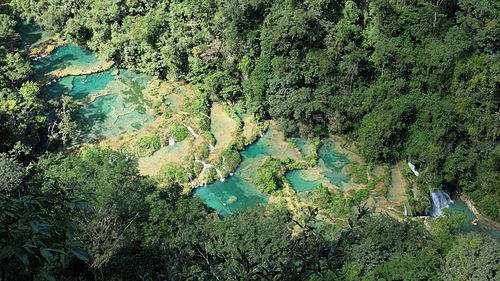
Tiered turquoise limestone pools in the Alta Verapaz jungle: the most beautiful natural swimming spot in Central America, above an underground river.
Photo: Christopher Crouzet, CC BY-SA 3.0

The Maya Quiche highlands’s second city: a working highland city without tourist polish. The Almolonga vegetable market and Zunil’s colourful huipil textiles.
Photo: Adam Jones from Kelowna, BC, Canada, CC BY-SA 2.0

A river journey through a jungle gorge from Lake Izabal to the Caribbean: the 16th-century Spanish fort at the lake’s outlet and the manatees in the estuary.
Photo: Adalberto.H.Vega, CC BY 3.0
A thick sauce of toasted pumpkin seeds, sesame, dried chillies and tomatoes over chicken: the national dish of Guatemala, ancient Maya in origin.
Corn masa in a tomato-chilli sauce with chicken, olives, capers and raisins, wrapped in banana leaves: eaten at Christmas, Sunday and celebrations.
A Kekchi Maya turkey soup of dried chillies, tomatoes and coriander: the most important ceremonial dish of the Alta Verapaz.
Mashed black beans coated in a sweet plantain dough, deep-fried and dusted with sugar: the street dessert of Guatemala.
Grown at 1,500-2,000m in Huehuetenango, Antigua and Atitlan: some of the finest washed Arabica in the world.
Guatemala’s national lager since 1896: cold and correct at any comedor (local restaurant).
Zacapa Centenario is Guatemala’s prestige rum: aged at 2,300m in a system of American oak barrels.
Small corn masa dumplings filled with spiced pork in tomato sauce: the everyday street food of Guatemala.
InDriver also works. Chicken buses and shuttles for tourist routes.
A comedor meal: GTQ 25-50 (EUR 3-6). Antigua hotel: USD 20-60.
The Maya communities are reserved but warm once trust is established.
Lake Atitlan (1,562m) and Xela (2,330m) can cause mild altitude effects.
Antigua to Atitlan: 2.5h shuttle. Guatemala City to Antigua: 45 minutes.
Both give good 4G coverage in highland towns.
Even a handful of Kiche Maya words are deeply appreciated in market towns.
The dawn entry requires a pre-booked guide. The jungle at first light is impressive.
La Aurora International (GUA) in Guatemala City is the main hub. Mundo Maya (FRS) in Flores serves Tikal. Avianca and LATAM serve regional routes; Copa Airlines connects through Panama. For trip planning, see the official Guatemala tourism portal.
Miami and Panama City are the primary US/Central American hubs for Guatemala. Copa Airlines via Panama has excellent frequency and reliability.
Miami is the closest US gateway to Guatemala — American and Copa both offer frequent direct service in 3 hours. Many US airlines connect through Panama (Copa) or Honduras.
Antigua is the practical base for Guatemala — tourist shuttles connect to all major destinations (Lake Atitlán 3h, Tikal flight from Guatemala City). The shuttle minivan network is reliable and inexpensive.
Guatemala’s main highways are paved and manageable in a standard car; rural roads are rougher. The CA-1 (Pan-American Highway) between Guatemala City and Quetzaltenango is fast and well-maintained.
November to April is the dry season — Antigua at its most atmospheric, Lake Atitlán calm, Tikal accessible. February and March are the driest and clearest. May to October brings heavy afternoon rains that make the Peten jungle roads challenging but keep the countryside brilliantly green.
📅 Guatemala is in its best season in January, February, March, April, November, December. See where else is good to go in those months, or browse where to go by month.
Antigua for two days, Lake Atitlán for two, Chichicastenango for one, Tikal for two. Guatemala is the cultural heart of the Maya world — more intact indigenous culture, more active volcanoes and more dramatic landscape per square kilometre than anywhere in Central America.
Antigua Guatemala (UNESCO World Heritage Site) — a 16th-century Spanish colonial grid with Baroque churches, cobblestone streets and three active volcanoes visible from the central park (Agua, Acatenango and Fuego — Fuego erupts approximately every 15 minutes). The Parque Central and the ruined cathedral.
Volcán Fuego (“Fire Volcano”) erupts visibly from Antigua every 15–45 minutes — a puff of smoke and ash, sometimes with a sonic boom, audible in the city. It has a permanent lava lake and major eruptions in 2018 killed 179 people. The 2018 event is the most deadly volcanic disaster in Central America since 1902.
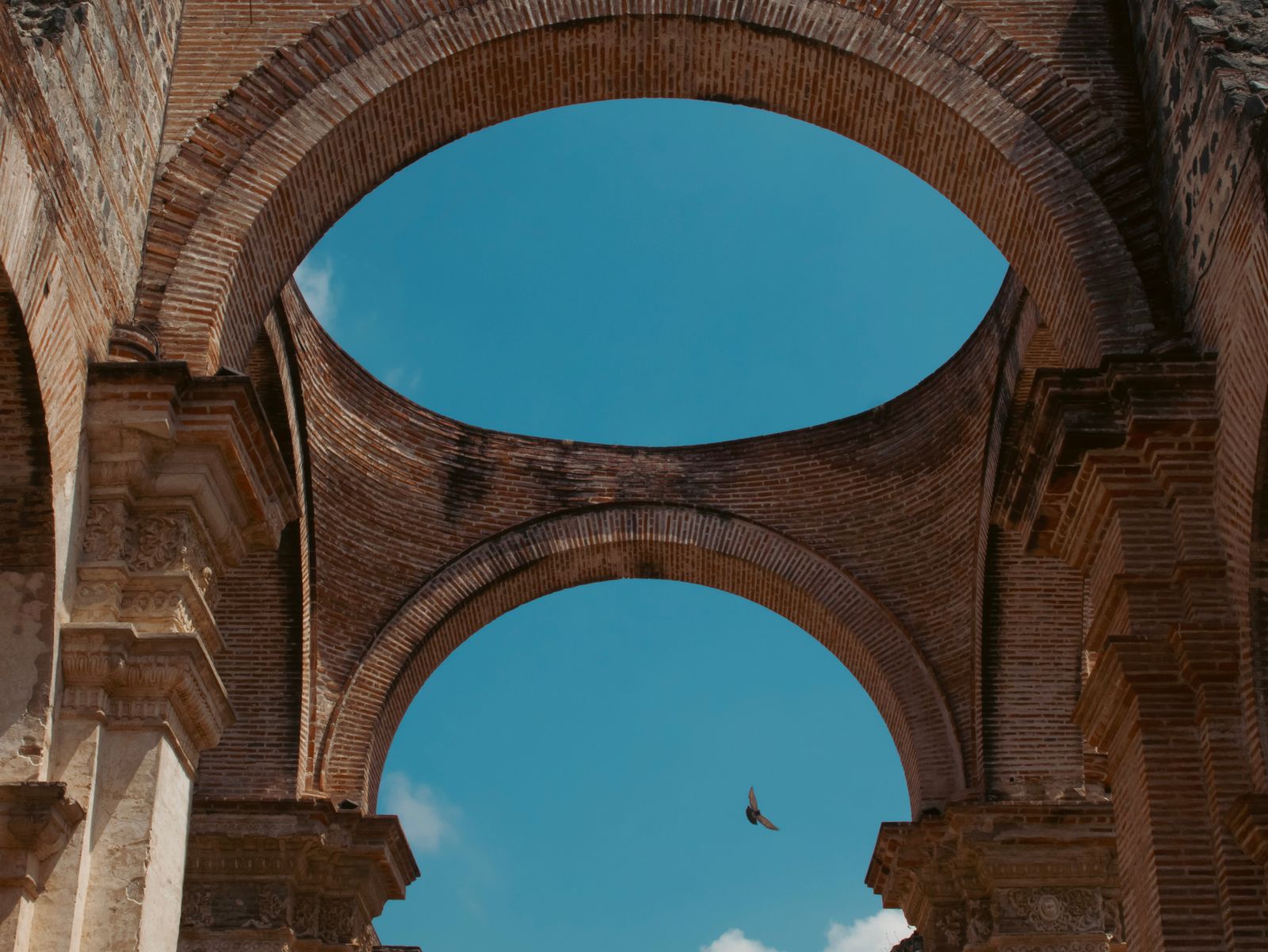
The ruined churches of Antigua — La Merced (1767 earthquake damage, the most photographed facade in Guatemala), Santo Domingo (a vast 17th-century convent, partially excavated and converted to a hotel-museum). The Acatenango overnight hike (2-day camp on the volcano rim at 3,976m, with front-row views of Fuego’s eruptions at night, 1m away across a saddle).
Camping on Acatenango (Guatemala’s third-highest peak) in front of Fuego’s active lava flows is one of the most dramatic accessible overnight hikes in the world — the volcano erupts every 20 minutes, visible from 200m across. The guides from Antigua charge US$40–60 all-in.
2h from Antigua. Lake Atitlán — a volcanic caldera lake at 1,562m surrounded by three perfectly conical volcanoes and 12 indigenous Maya villages, each with a distinct textile tradition — has been called the most beautiful lake in the world (Aldous Huxley’s phrase, and not obviously wrong). The villages of Santiago Atitlán (Tz’utujil Maya) and San Juan La Laguna (weavers’ cooperative).
Each of the 12 villages on Lake Atitlán has a distinct textile design tradition inherited from pre-Columbian times — the patterns, colours and motifs are specific to each community. Women weave on backstrap looms in every village; the textiles are among the finest indigenous handicraft in the Americas.
San Pedro La Laguna (the most bohemian village, with coffee grown on the volcano slopes above), Santa Cruz La Laguna (accessible only by boat, a cliff-side village with views), and the traditional kayak to Tzununá (the “hummingbird” village, the most traditional on the western shore).
The Lake Atitlán ferry lanchas (small speedboats connecting all 12 villages) are the primary transport — they leave from the main dock when full, departing approximately every 30 minutes. The fare between any two villages is Q5–20 (US$0.70–2.70).
1h30 from Lake Atitlán. Chichicastenango (“Chichi”) — the largest indigenous market in Central America, held every Thursday and Sunday, with the Santo Tomás church (Catholic on the outside, Maya rituals happening simultaneously on the outdoor altar steps and inside). Copal smoke, flower offerings, traditional K’iche’ textiles and wooden masks.
The Santo Tomás church steps in Chichi are the most visible example of the syncretism between Maya and Catholic religion — Maya priests burn copal and make blood offerings on the church steps while Mass is being celebrated inside. Neither tradition considers this contradictory.
1h flight from Guatemala City to Flores. Tikal National Park (UNESCO, 576km² of Peten jungle) — 3,000 structures, 200 dated from 600 BCE to 900 CE, including Temple I (47m pyramid, the icon of Guatemala) and Temple IV (65m, the tallest pre-Columbian structure in the western hemisphere) rising above the jungle canopy.
The sunrise tour of Tikal (enter the park at 4am for Temple IV summit by dawn) gives 30 minutes of silence — only howler monkeys and the jungle waking up, before day visitors arrive. The view from Temple IV of Temple I and II rising above the tree canopy is the defining image of Mesoamerican archaeology.
A full morning exploring Tikal’s central ceremonial complex — the Great Plaza, the Lost World pyramid, the Temple of Inscriptions and the spider monkeys that live in the ceiba trees above. Fly back to Guatemala City (GUA) for international connections.
Tikal was occupied continuously from 800 BCE to 900 CE. At its peak (600–800 CE) it had a population of 50,000–120,000 in a metropolitan area of 65km². The “Classic Maya collapse” abandoned the city in 100 years for reasons still debated — drought, warfare, deforestation and soil exhaustion are all proposed.
Guatemala is excellent value — one of the cheapest countries in Central America, with outstanding colonial architecture, Maya markets and volcanoes all at budget prices. The Guatemalan Quetzal (GTQ) is the local currency.
Chicken buses — retired US school buses painted in vivid colours, with extra passengers on the roof rack and bags hanging from every surface — are the primary intercity transport in Guatemala.
Ron Zacapa — the Guatemalan rum aged in the Sistema Solera at 2,300m altitude (the cold slows fermentation, producing exceptional complexity) — is one of the world’s most decorated spirits.
Casa Santo Domingo (a 17th-century Dominican convent in Antigua, converted to a 128-room hotel-museum with excavated colonial ruins in the garden) and Atitlá.
Quick answers to the questions people most often ask before visiting Guatemala.
Fly into La Aurora International Airport (GUA) in Guatemala City, with direct flights from the US and connections via Miami, Mexico City or Panama. For Tikal, fly on to Flores (FRS).
November to April, the dry season, with February and March the driest and clearest. May to October brings heavy afternoon rains but lush landscapes.
Tourist shuttles are the easiest option: Guatemala City or the airport to Antigua takes about an hour, and Antigua to Lake Atitlán about 2h30. Ride-hailing apps also work in Guatemala City and Antigua.
Some people notice mild effects in the highlands — Lake Atitlán is at about 1,560 m and Quetzaltenango at over 2,300 m. Take it easy for the first day and stay hydrated.
Yes — it's one of the best-value countries in Central America. Expect around GTQ 150–280 per day on a budget and GTQ 500–900 mid-range. The currency is the quetzal (GTQ).
Ride-hailing in Guatemala City — safer and more transparent than street taxis in the capital.
FreeAlternative ride-hailing across Guatemala — popular in cities beyond the capital.
FreeBook Tikal ruins day trips, Lake Atitlán tours, Antigua coffee farm visits and Guatemalan experiences.
FreeGuatemala’s primary messaging platform — contact shuttle buses, guides and guesthouses.
FreeUNESCO Antigua’s colonial grandeur, Tikal’s jungle pyramids, Lake Atitlán surrounded by volcanoes, and the living Maya market of Chichicastenango.
Guatemala sits within easy reach of several other destinations — each with a completely different character.


