NI
Nicaragua
The Central American gem still off the beaten path
The Central American gem still off the beaten path
⚠️ Travel advisory: check before you go
The US asks travellers to reconsider travel to Nicaragua because of arbitrary enforcement of laws and the risk of detention, and entry can be refused without explanation. Check the latest advice before booking.
Latest official advice: UK FCDO · US State Department · Reviewed September 2026

The oldest continuously inhabited colonial city in Central America (1524): the brightly painted colonial architecture around Parque Central, the horse-carriage tours and the Isletas de Granada boat trips.
Photo: José Luis Filpo Cabana, CC BY-SA 4.0

A twin-volcano island in Lake Nicaragua: Concepcion (1,610m, active) and Maderas (1,394m), connected by a narrow isthmus. The world’s largest freshwater island with an active volcano.
Photo: Adam Jones from Kelowna, BC, Canada, CC BY-SA 2.0

The world’s youngest active volcano (1850): sandboarding down the steep black ash slope at 50km/h is the definitive Nicaraguan adventure activity.
Photo: Adam Jones from Kelowna, BC, Canada, CC BY-SA 2.0

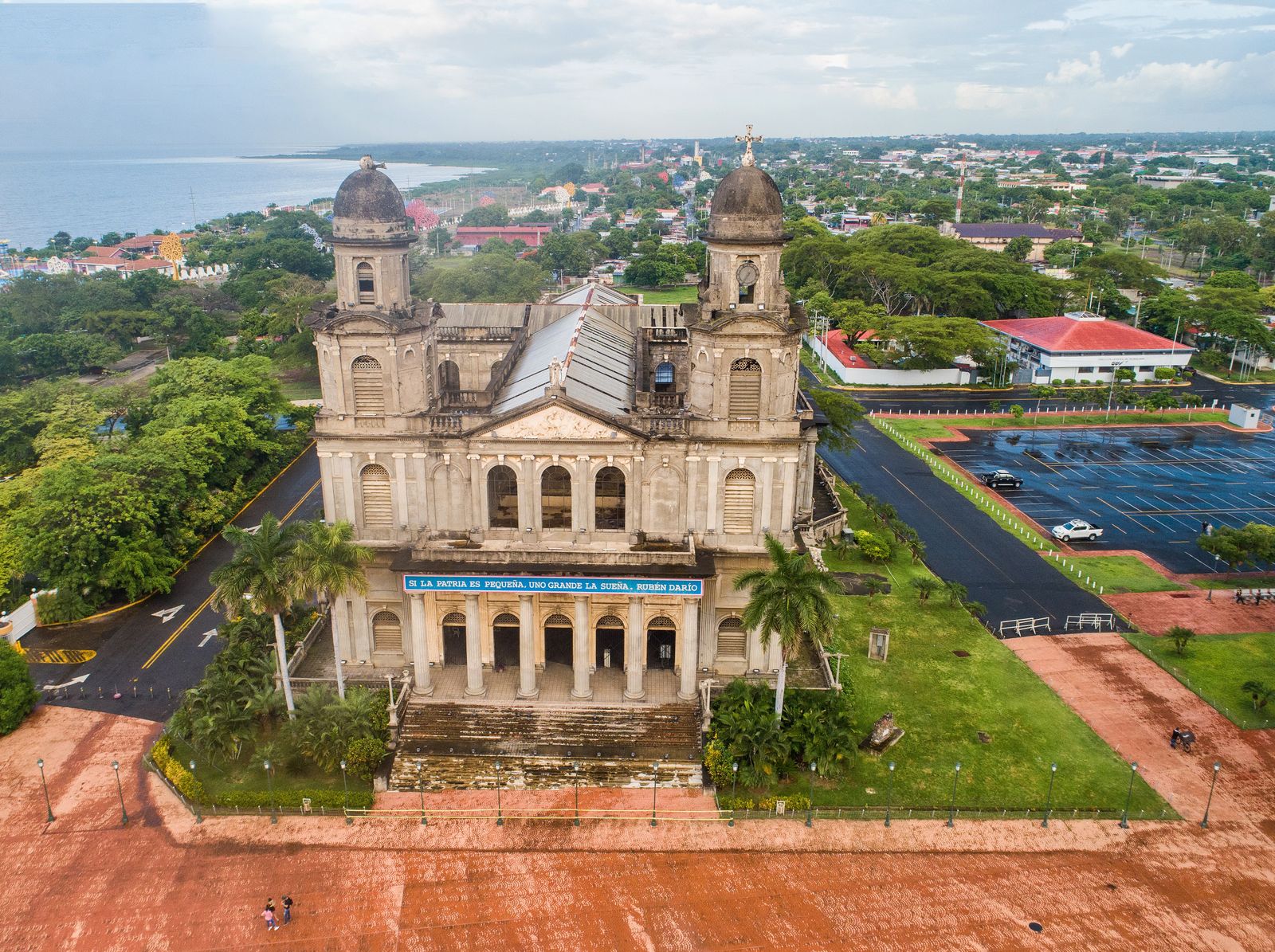
The largest cathedral in Central America (18th century): climb to the white rooftop for a view of seven volcanoes. The revolutionary murals of the Sandinista movement on every corner.
Photo: Byralaal, CC BY-SA 4.0

A car-free Caribbean island of turquoise water and lobster: reachable by panga (boat) from Big Corn Island. No roads, no banks, one ATM.
Photo: Ridiculopathy, CC0
An active volcano with a lava lake visible from the crater rim at night: the Mouth of Hell (Boca del Infierno) glows orange in the dark.
Photo: Txo, Public domain

The Pacific surf town: weekly Sunday Funday party hostel culture, accessible surf breaks and the Cristo de la Misericordia hilltop Christ statue above the bay.
Photo: Curtis Foreman, CC BY 2.0

A river that flows into the Caribbean through the San Juan Fortress: the Solentiname Archipelago’s primitivist naif painting community (the Ernesto Cardenal tradition).
Photo: Hobbitschuster, CC BY-SA 4.0
Rice and black beans cooked together with onion, garlic and Worcestershire sauce: the national dish of Nicaragua, eaten at every meal from breakfast to dinner.
Chicharron (crispy pork skin) on yuca with a cabbage and tomato curtido: the street food of Granada, eaten on the Parque Central benches.
A thick stew of shredded beef with masa (cornmeal), tomatoes, onion and mint: the most distinctively Nicaraguan main course.
A large corn masa tamale filled with pork, rice, potatoes, chilli and mint, wrapped in banana leaves: the Sunday breakfast of Nicaragua.
Two Nicaraguan lagers: Tona (from Managua) and Victoria (from Granada). Cold and correct.
One of the world’s most awarded rums: aged 7, 12, 18 and 25 years in a volcanic climate in Chichigalpa. The pride of Nicaragua.
Toasted corn and cocoa ground into a powder, mixed with water or milk: the most distinctively Nicaraguan drink. Drunk cold with ice.
A warm tortilla wrapped around a cylinder of fresh cheese, cream and pickled onion: the roadside snack of the Leon-Managua highway.
Augusto C. Sandino International (MGA) in Managua is the main hub. Copa Airlines via Panama and American via Miami serve the main routes. The domestic carrier La Costeña connects Managua to the Corn Islands and the Caribbean coast.
Miami and Panama City are the two main gateways for Nicaragua. Copa Airlines via Panama has the highest frequency and connects MGA to 50+ destinations throughout the Americas.
Nicaragua combines naturally with Costa Rica (1h, and the overland Penas Blancas crossing is 4h from Granada) and the Central America circuit via Guatemala and El Salvador. The overland Pan-American Highway runs the length of the Pacific coast.
Granada is the practical base for Nicaragua — skip Managua (little of interest) and head directly to Granada (1h from airport). From Granada, everything — Masaya, León, Ometepe and the Corn Islands — is accessible within 2h.
Nicaragua is compact and bus-friendly: express buses connect the main cities for US$1–5. Tourist shuttles (US$8–15) between Granada, León and San Juan del Sur are reliable and used by most travellers.
November to April is the dry season — Granada and León at their best, the Corn Islands perfect, the Mombacho and Masaya volcanoes accessible. January to March is the driest and coolest (24–28°C). May to October brings heavy rains that fill the Pacific lowland rivers and make the Caribbean coast even more lush.
📅 Nicaragua is in its best season in January, February, March, April, November, December. See where else is good to go in those months, or browse where to go by month.
Nicaragua is the cheapest country in Central America — significantly less expensive than Costa Rica, with comparable natural landscapes and superior colonial architecture.
Gallo pinto — white rice cooked with black beans, sweet peppers, onion, coriander and a dash of Worcestershire sauce — is the national dish, eaten at breakfast, lunch and dinner by most Nicaraguans.
Flor de Caña rum (produced in Chichigalpa since 1890, the most awarded rum in Central America, available in aged variants from 4–25 years) costs US$3–8 per glass at Granadan bars and represents one of the best.
The Hotel Plaza Colon (Granada, directly on the main plaza, colonial-style) and the Hacienda Puerta del Cielo (in the Mombacho foothills, with infinity pool overlooking Lake Nicaragua and the Mombacho cloud forest) are Nicaragua’s finest addresses.
Granada for two days, the Masaya Volcano for one, León for one, Ometepe Island for two, the Corn Islands for one. Nicaragua is Central America’s largest and most undervisited country — cheaper than Costa Rica, with more volcanoes and the finest colonial cities in the region.
Granada — founded 1524 by Francisco Hernández de Córdoba (the same expedition that founded León on the same day — one of the first European cities on the American mainland) — has the most completely intact Spanish colonial centre in Central America: yellow-and-white cathedral, cobblestone plazas, bougainvillea-draped mansions.
Granada was sacked and burned by American filibuster William Walker in 1856 as he retreated — Walker had seized the presidency of Nicaragua and held it for 14 months before being driven out by a Central American coalition. He burned Granada on departure; the sign he left read “Aquí fue Granada” (Here was Granada). Most of the colonial city was subsequently rebuilt.
Las Isletas — 365 small islands in Lake Nicaragua (Lago Cocibolca — the only freshwater lake in the world with shark populations, created when a Pacific bay was separated from the sea by volcanic activity) formed by an ancient Mombacho eruption, reached by kayak or lancha. The Mombacho Volcano cloud forest (1,344m, zip-line through primary cloud forest).
Lake Nicaragua contains bull sharks (Carcharhinus leucas) — one of the only freshwater shark populations on earth, discovered by early Spanish explorers who could not understand how saltwater sharks reached a freshwater lake. The sharks entered from the Caribbean via the San Juan River and adapted over centuries.
1h from Granada. Masaya Volcano National Park — Nicaragua’s most active volcano, with a permanent lava lake visible from the crater rim at night (one of only 6 permanent lava lakes in the world), accessible by car to within 200m of the active Santiago crater. The Spanish called it “the mouth of hell.”
Masaya’s Santiago crater has a lava lake that has been continuously active since 1965. At night, the glow from the lava is visible from 50km. The Spanish Inquisition placed a large cross at the crater rim in 1529 to exorcise the volcano, which they believed was literally a portal to hell. The cross is still there.
1h30 from Masaya. León — Nicaragua’s intellectual capital, seat of the Sandinista revolution (the murals of the FSLN cover entire city blocks, and the Mausoleum of Heroes documents the 1979 insurrection), the León Cathedral (the largest cathedral in Central America, with a rooftop you can walk across for views of the volcanoes to the south).
León Cathedral took 113 years to build (1747–1860) and was designed with a fortress-like solidity to withstand earthquake — the walls are 2.5m thick. The poet Rubén Darío (the most important literary figure in Latin American history, the founder of the Modernismo movement) is buried below the cathedral altar, under a stone lion.
2h30 drive + 1h45 ferry from Granada. Ometepe Island (UNESCO Biosphere Reserve) — two volcanoes (Concepción, 1,610m, still active; Maderas, 1,394m, dormant) rising from Lake Nicaragua, connected by a low isthmus, with petroglyphs, howler monkeys and one of the most photogenic island profiles in Central America.
Ometepe means “two mountains” in the Nahuatl language of the pre-Columbian Nicarao people. The island has 1,500+ pre-Columbian petroglyphs carved into the volcanic rock by the Nahuatl-speaking cultures who occupied the island from approximately 300 CE. The Punta Jesús María headland at sunset — with Concepción reflected in the lake — is one of the finest views in Central America.
Hike Volcán Maderas (dormant, a 6h round trip through coffee plantations, cloud forest, howler monkey colonies and to a summit crater lake with water the colour of jade). The Charco Verde lagoon for the afternoon (a lagoon surrounded by fig trees full of white-face capuchin monkeys).
The howler monkey (Alouatta palliata) population on Ometepe is one of the healthiest in Central America — they are most vocal at dawn and dusk, and the sound carries 3km across the lake water. The Maderas cloud forest has a population of approximately 400 monkeys visible from the trail.
1h30 flight from Managua. The Corn Islands (Big Corn and Little Corn) — two small Caribbean islands off the Mosquito Coast with white sand, clear green water, lobster at US$15 and almost no development. Little Corn is accessible only by panga (20-min motorboat from Big Corn) and has no motorised vehicles. Fly back to Managua (MGA).
Little Corn Island has no cars, no motorcycles and no roads in the conventional sense — only sandy paths through coconut groves. The island is 2.7km long. Fresh lobster (Panulirus argus, the Caribbean spiny lobster) costs US$10–18 for a full grilled plate at any of the beach restaurants.
Local taxis elsewhere by negotiation.
A gallo pinto breakfast: NIO 40-60 (EUR 1-1.50). A hostel dorm: USD 8-15.
Away from the politics, ordinary Nicaraguans are open and hospitable.
The political situation requires checking your government’s current advice before travel.
The painted US school buses: cheap, slow and entertaining.
Both available at Managua airport.
The factory in Chichigalpa sells 25-year-aged rum for less than USD 25.
A full greeting with eye contact is culturally important.
Quick answers to the questions people most often ask before visiting Nicaragua.
Fly into Augusto C. Sandino International Airport (MGA) in Managua, usually via Miami, Houston or Panama City. Domestic flights connect Managua with the Corn Islands.
Many travellers visit Granada, León and the Pacific coast without problems, but the political situation means some governments advise caution or restrict travel. Check your government's current advice before booking.
November to April, the dry season, with January to March the driest and coolest (24–28°C). May to October brings heavy rain.
Take a domestic flight from Managua to Big Corn Island (about 1h30), then a small boat to Little Corn Island.
Yes — it's the cheapest country in Central America. Expect around US$30–55 per day on a budget and US$90–160 mid-range. The currency is the córdoba (NIO).
The most widely used ride-hailing app across Managua and Nicaraguan cities — negotiate fares directly.
FreeRide-hailing available in Managua — limited coverage but reliable in the capital.
FreeBook Masaya Volcano night tours, León colonial walks, Ometepe Island trips and Nicaraguan adventures.
FreeNicaragua’s primary messaging platform — contact guesthouses, tour operators and local transport.
FreeBook hotels in Granada, León and Managua — a small but growing accommodation market.
FreeTrack NIO (Nicaraguan Córdoba) rates — USD is also widely accepted across Nicaragua.
FreeColonial Granada, revolutionary Leon, the twin volcanoes of Ometepe, surf town San Juan del Sur and the castaway Corn Islands — Nicaragua at its best.
Nicaragua sits within easy reach of several other destinations — each with a completely different character.

