ME
Montenegro
Adriatic jewel of rugged mountain beauty
Adriatic jewel of rugged mountain beauty

A UNESCO bay enclosed by mountains: the medieval old town of Kotor on the water’s edge, the Byzantine Church of St Tryphon (1166 AD) and the 4.5km city wall climbing to the hilltop fortress.
Photo: Gzzz, CC BY-SA 4.0

A 2,500-year-old walled city on the Adriatic: the Citadel’s view of the coast, Sveti Stefan (the luxury island-hotel visible from the road) and Montenegro’s busiest beach resort.
Photo: Daniya.Mostovaya, CC BY-SA 4.0

A mountain plateau (UNESCO) of 48 glacial lakes, the Black Lake and Bobotov Kuk (2,523m): the finest hiking in Montenegro, and a ski resort in winter.
Photo: Pudelek, CC BY-SA 4.0
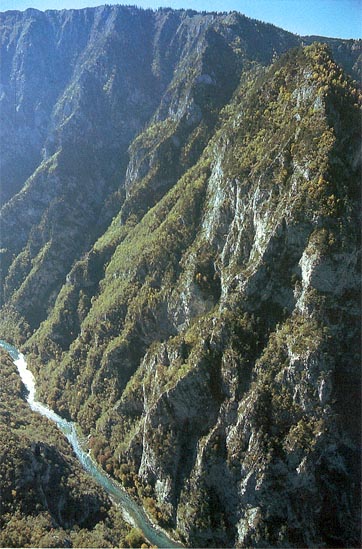
The second-deepest canyon in the world after the Grand Canyon: the Tara River rafting through 78km of 1,300m-deep canyon, and the Djurdjevica Tara Bridge (1940, one of the most beautiful concrete arch bridges in Europe).
Photo: Milan B., CC BY-SA 3.0

A 17th-century Serbian Orthodox monastery carved into a near-vertical cliff: the holiest site in Montenegro, built on two levels of white limestone almost invisible against the rock face.
Photo: Diego Delso, CC BY-SA 3.0

A 15th-century fortified fishing village converted into a luxury resort on an island connected by a causeway: the most photographed view on the Adriatic.
Photo: Diego Delso, CC BY-SA 4.0

460 steps to the Njegos Mausoleum (1974) on Jezerski vrh (1,657m): the tomb of Montenegro’s poet-prince, with a 360-degree panorama of the Adriatic, Bay of Kotor and Albanian Alps.
Photo: Ingo Mehling, CC BY-SA 4.0

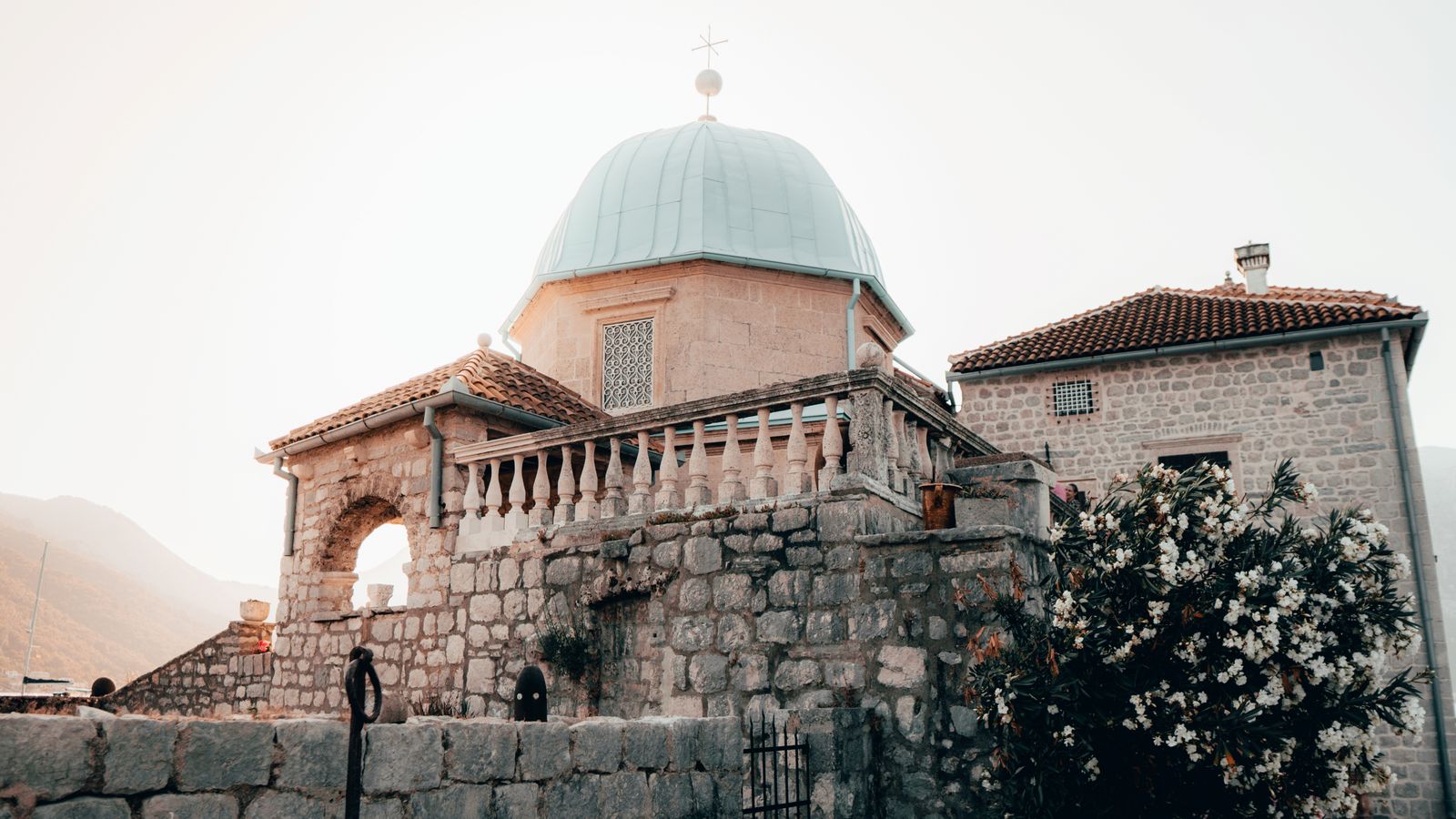
A Baroque maritime town with 16 churches and 17 towers: the Our Lady of the Rocks island church (artificial, built by sailors over centuries on a reef) accessible by short boat trip.
Photo: Jocelyn Erskine-Kellie, CC BY-SA 4.0
Air-dried smoked ham from the Njeguski village above Kotor (similar to prosciutto): served with Njeguski cheese (semi-hard, slightly pungent) at every restaurant in Montenegro.
Small skinless beef and lamb sausages served with flatbread, raw onion and sour cream: the Balkan street food found throughout the former Yugoslavia.
A simple fish stew with tomatoes, onion and garlic: the definitive coastal Montenegro dish, made with Adriatic fish and eaten at every konoba (traditional restaurant) on the bay.
A polenta-like dish of buckwheat or maize flour with potato, cheese and cream: the mountain comfort food of northern Montenegro.
Montenegro’s indigenous red grape variety: full-bodied, deeply coloured, with plum and tobacco notes. Plantaze (the largest winery in the Balkans) produces the benchmark.
Montenegro’s national lager since 1896: clean, malt-forward and the correct beer at a Bay of Kotor konoba.
A grape marc spirit similar to grappa or rakija: 45-50% alcohol, home-distilled throughout Montenegro. Every family recipe is different.
Strong Turkish-style coffee in a small cup with a glass of water: drunk at every social occasion.
Podgorica (TGD) is the main airport; Tivat (TIV) serves the coast and is more convenient for Kotor. Montenegro Airlines suspended operations in 2021; routes are served by Air Serbia, easyJet, Ryanair and charter airlines. For trip planning, see the official Montenegro tourism portal.
Tivat (TIV) is the most convenient airport for Kotor and the coast — 30 minutes from Kotor old town. easyJet flies direct from Gatwick and Bristol.
Montenegro is easily combined with Dubrovnik (2h), Sarajevo (3h30) or Tirana (2h) for a western Balkans circuit. The coast road between Herceg Novi and Kotor is among the most beautiful drives in the region.
Car hire is essential for exploring Montenegro beyond the coast — public buses are infrequent and slow to inland destinations like Durmitor. Book at TIV or TGD from €25–40/day.
The Lepetane–Kamenari ferry saves 25km of driving around the inner bay — runs continuously 24 hours, costs €4.50 per car and is the most useful shortcut in Montenegro.
May to June and September to October are ideal — Kotor Bay before the summer cruise ship peak, the beaches warm but not overcrowded, the Durmitor mountains accessible. July–August the coast becomes extremely busy and expensive.
📅 Montenegro is in its best season in June, July, August, September. See where else is good to go in those months, or browse where to go by month.
Montenegro uses the euro despite not being in the EU. The coast (Kotor, Budva) has become significantly more expensive in recent years — comparable to Croatia — while the interior remains very affordable.
Njeguski prsut — air-dried ham from the Njeguski village in the Lovcen foothills, smoked over beech and made from black pigs — is Montenegro’s most prized cured meat.
Vranac is Montenegro’s indigenous red grape variety — a full-bodied, tannic red with plum and tobacco notes, produced primarily in the Podgorica region.
Aman Sveti Stefan — the entire island village converted to an Aman resort, 50 rooms — is one of the most striking hotel settings in the Mediterranean. From €1,200/night. The viewpoint above is free and nearly as good.
Kotor for two days, the Bay of Kotor for one, Budva and the coast for one, the Durmitor National Park for two, Podgorica to close. Montenegro is tiny — the entire country can be crossed in 3 hours.
Kotor — a Venetian walled city at the end of a fjord-like bay, UNESCO World Heritage Site — is the finest medieval town on the Adriatic coast south of Dubrovnik. The city walls climb 1,355 steps to the fortress of St John above — the view over the bay justifies every one.
The Kotor city walls (climb starts inside the Sea Gate) take 1h30 to the fortress and back. Go at 6am before the cruise ships arrive and before the heat. The view improves with every 100 steps.
The Bay of Kotor (Boka Kotorska) is the southernmost fjord in Europe — steep limestone mountains dropping vertically into calm dark blue water. Our Lady of the Rocks (Gospa od krpjela) — a man-made island with a baroque church, reached by taxi boat from Perast.
Perast is a former Venetian merchant town of 17 palaces and 17 churches on the bay, population 300 — it seems impossible that such a place exists and is barely visited. The baroque palaces are largely intact from the 17th century.
1h drive up to Lovcen National Park — the “Black Mountain” that gives Montenegro its name. The Njegos Mausoleum at 1,657m: the tomb of the poet-prince Petar II Petrovic-Njegos, with a 28-tonne golden sculpture and a view over the entire country from the Adriatic to Albania.
The Njegos Mausoleum was designed by Ivan Mestrovic (the greatest sculptor of the former Yugoslavia) and built into the highest peak of Lovcen in 1970. The final 461 steps from the car park are worth it for the scale of the view.
1h from Kotor. Budva’s old town (a smaller walled city on a peninsula, Venetian towers, churches, a beach at the foot of the walls) and Sveti Stefan — a 15th-century island village connected to the mainland by a causeway, converted to a luxury resort but still visually striking from the viewpoint above.
The viewpoint above Sveti Stefan (free, 5-min walk from the road) gives the photograph that defines the Montenegrin coast — the coral-pink island village with mountains behind. Sveti Stefan itself is hotel-only, but the view costs nothing.
2h30 from Budva. Durmitor National Park is Montenegro’s wildest landscape — the Tara Canyon (the deepest river canyon in Europe, 1,300m), 48 glacial lakes, and the highest peaks in the country (Bobotov Kuk, 2,523m). The Black Lake (Crno Jezero) at 1,416m is the most accessible.
The Tara Canyon is 82km long and up to 1,300m deep — the second deepest river canyon in the world after the Grand Canyon. The Djurdjevica Tara Bridge (1940, 172m high) is the highest arch bridge in the world at its time of construction.
White-water rafting on the Tara River (18km class 3–4 rapids through the canyon, full day) is the most popular adventure activity in Montenegro. The highland Zabljak village at 1,456m — the highest town in the former Yugoslavia — for dinner and overnight.
Tara Canyon rafting departs from camps near Splaviste (30 min from Zabljak) at 9am — a full-day trip through 18km of rapids, with lunch on the riverbank. Cost: €35–50pp. No experience required for the standard route.
2h from Durmitor. Podgorica — one of Europe’s least visited capitals — is not a tourist city but has the Millennium Bridge (a striking cable-stay bridge), the Ribnica confluence and a pleasant walkable centre. Podgorica Airport (TGD) for international connections.
Podgorica was almost entirely destroyed during World War II and rebuilt in a communist-era brutalist style. It is functional rather than beautiful, which makes the occasional Ottoman-era remnant in the old Stara Varos quarter feel entirely unexpected.
Negotiate taxi fares before getting in. The Bay of Kotor and Durmitor are best by rental car.
A konoba meal: EUR 8-15. A hotel on the Bay of Kotor: EUR 60-120.
The culture has a philosophical ease that is characteristic of the southern Balkans.
The north of Montenegro (Tara Canyon, Durmitor) is not accessible by public transport.
Kotor to Durmitor: 3h by car. One trip can include both coast and mountain.
July-August is very busy; good rooms sell out by May.
The bay in early morning mist, before the cruise ships arrive, is one of the finest sights in the Adriatic.
Named for the Lovcen mountain’s dark appearance in clouds.
Quick answers to the questions people most often ask before visiting Montenegro.
May to June and September to October are ideal — Kotor Bay before the summer cruise ship peak, the beaches warm but not overcrowded, the Durmitor mountains accessible. July–August the coast becomes extremely busy and expensive.
Podgorica (TGD) is the main airport; Tivat (TIV) serves the coast and is more convenient for Kotor. Montenegro Airlines suspended operations in 2021; routes are served by Air Serbia, easyJet, Ryanair and charter airlines.
Expect roughly €45–75 a day on a budget and €120–200 mid-range, or €300+ for a more luxurious trip, per person and excluding flights.
Montenegro uses the euro (€).
Plug types: Type C / F (two-pin, 230V).
Book Bay of Kotor boat tours, Durmitor National Park hikes, Lovćen day trips and Montenegrin experiences.
FreeMontenegro’s widely used messaging platform — contact guesthouses and local tour operators.
FreeBook accommodation across Montenegro’s coast and mountains — Kotor books up fast in summer.
FreeFrom the medieval bay of Kotor to the 13km beaches of Ulcinj — Montenegro’s six finest destinations, each with its own distinct character.
Montenegro sits within easy reach of several other destinations — each with a completely different character.


