MK
North Macedonia
Lake Ohrid, Byzantine churches & Balkan flavours
Lake Ohrid, Byzantine churches & Balkan flavours
North Macedonia is one of the Balkans’ best-kept secrets — a small, landlocked republic whose ancient capital Skopje underwent a dramatic baroque-kitsch makeover, but whose real treasure is the sublime lake town of Ohrid. One of Europe’s oldest lakes and one of the deepest in the world, Ohrid is flanked by a UNESCO-listed old town of Byzantine churches, medieval fortresses and 19th-century Macedonian-style houses stacked above clear blue water. Elsewhere, elegant Bitola charms with its consular boulevard, Matka Canyon offers a dramatic gorge minutes from the capital, and Mavrovo brings skiing and hiking in the highest mountains in the land. North Macedonia was the birthplace of Alexander the Great and Mother Teresa, and carries an ancient civilisation from which the entire Orthodox world takes its alphabet.
A UNESCO World Heritage Site of both natural and cultural significance, Ohrid is one of Europe’s most beautiful lakes — ancient, crystalline and ringed by mountains. The old town above the lake contains over 365 churches (one for each day of the year), the medieval Samuil’s Fortress, the Plaosnik monastery complex and the 5th-century Church of Saint Sophia with its intact Byzantine frescoes. Swimming in the lake beneath the old town walls is one of the great pleasures of Balkan travel.
Despite the controversial and theatrical Skopje 2014 neoclassical redevelopment of the city centre, Skopje’s Ottoman Old Bazaar (Stara Carsija) remains one of the Balkans’ finest — a genuine working market with hans (caravanserais), mosques, hammams and craftspeople’s workshops that trade today as they have for 500 years.
Twenty minutes from Skopje centre, the Matka Canyon cuts through dramatic limestone gorges to a chain of emerald-green dammed lakes. Kayaking the canyon, exploring the medieval cliff-face monastery of St Andrew and swimming in crystal-clear water make Matka one of the most accessible and rewarding day trips in the Balkans.
Beans baked in a clay pot with onion, peppers and paprika — the national dish, often eaten on Fridays.
The Macedonian fruit brandy — quince (dunjovica) and grape (lozova) are the most common. Every family distils its own; accepting a glass is a ritual of hospitality.
Roasted red pepper relish, made at home in large batches every autumn.
Tomato, cucumber, peppers and grated white cheese. Macedonian wine, especially Vranec from the Tikveš region, is good value.
Skopje Alexander the Great (SKP) and Ohrid (OHD) are the two airports. Wizz Air, easyJet and Turkish Airlines serve the main routes. North Macedonia is not in the EU but is a candidate country. For trip planning, see the official North Macedonia tourism portal.
Wizz Air operates direct London–Skopje flights year-round and seasonal London–Ohrid routes in summer. Turkish Airlines via Istanbul has the most connections.
North Macedonia combines naturally with Kosovo (2h from Skopje), Albania (3h to Ohrid) and Serbia (4h to Skopje) for a western Balkans circuit. Thessaloniki in Greece is the nearest major international airport (3h from Skopje).
The Skopje–Ohrid bus runs multiple times daily in 2h30 for MKD 400 and is the most used tourist route in the country.
Car hire in Skopje (MKD 1,000–2,500/day) is the best option for Mavrovo and Matka Canyon. The Skopje–Ohrid road is well-maintained and scenic through the mountains.
April to October is the best window — Ohrid’s lake at its finest, the Mavrovo mountains hikeable, Skopje’s cafe terraces full. June and July are warm (28–32°C). Winter brings snow to the mountains (Mavrovo ski resort) and Skopje in a quieter but atmospheric mood.
📅 North Macedonia is in its best season in May, June, July, August, September. See where else is good to go in those months, or browse where to go by month.
North Macedonia is one of the cheapest countries in Europe — comparable to Kosovo and Albania, with outstanding lake scenery, Byzantine art and excellent rakija (plum brandy) at prices that barely register.
Tavche gravche — white beans slow-baked in an earthenware pot with onion, peppers, tomato and paprika, served with fresh bread — is the national dish of North Macedonia.
Vranec — the native Macedonian red grape, producing a deeply coloured, tannic wine with cherry and leather character — is North Macedonia’s finest wine.
Villa Ohrid (a boutique hotel in a restored 19th-century Ottoman mansion in Ohrid’s old town) and the Hotel International (directly on the lakeshore) are North Macedonia’s finest addresses.
Skopje for two days, Ohrid for three, Mavrovo National Park for one, Matka Canyon for one. North Macedonia is one of the most undervisited and rewarding destinations in the Balkans.
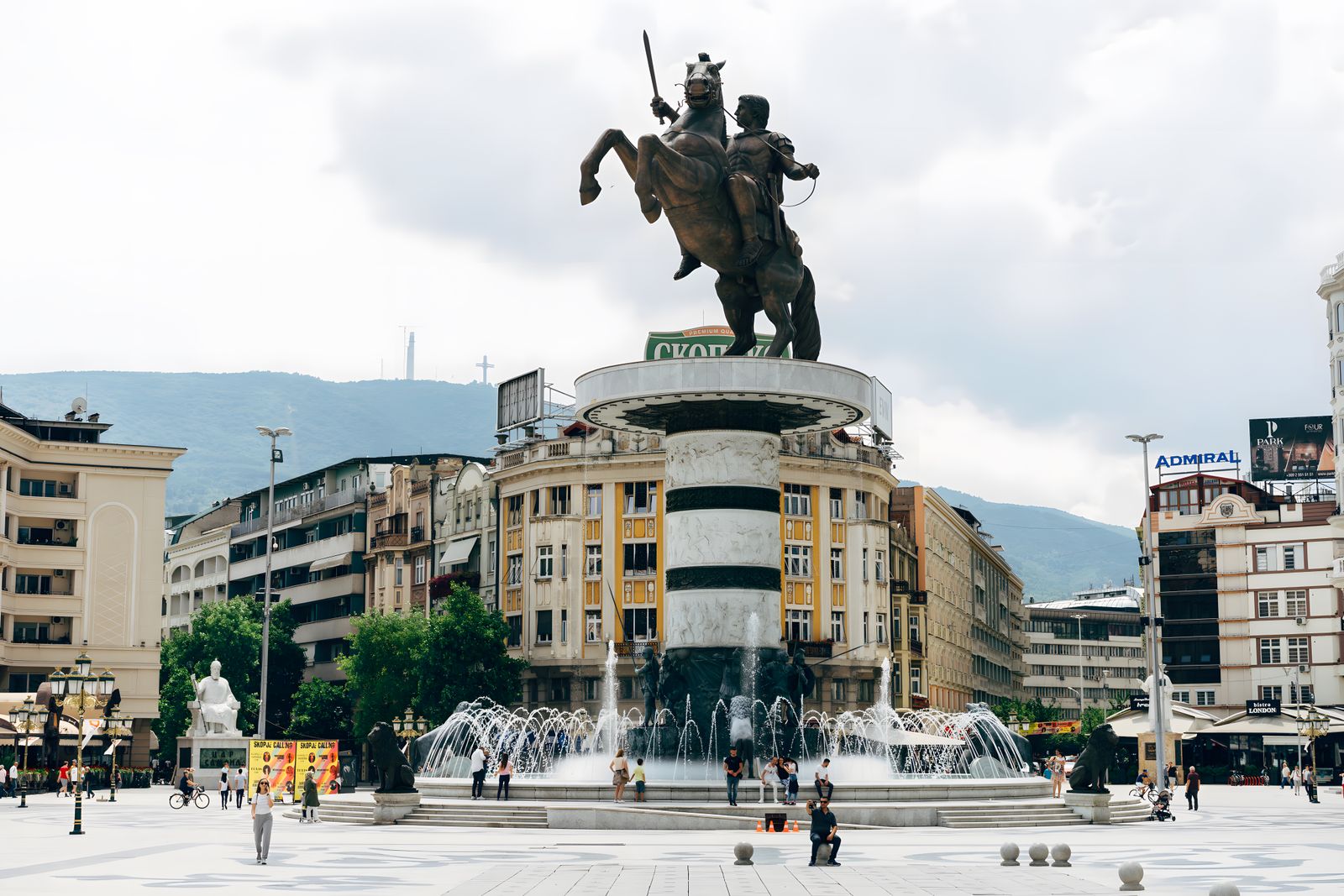
Skopje — the capital of North Macedonia, rebuilt after the 1963 earthquake that destroyed 80% of the city — is simultaneously one of the most architecturally unusual cities in the Balkans. The Skopje 2014 project (a government initiative that placed 100+ neoclassical statues, triumphal arches and fountains in the city centre between 2010 and 2014) sits alongside the Ottoman Old Bazaar (one of the largest and most intact bazaars in the Balkans).
The Skopje 2014 project spent approximately €500 million on statues, fountains and neoclassical public buildings — including a 22m equestrian statue of Alexander the Great on a column in the main square and a 14m statue of Alexander’s mother Olympias. The project was designed to create a “Greek aesthetic” for a country whose name, language and ethnicity were disputed with Greece for 27 years (the dispute was resolved by the Prespa Agreement in 2018).
The Old Bazaar (Čaršija) — a 15th-century Ottoman commercial district with caravanserais, mosques and craft workshops still in active use — is the finest intact Ottoman bazaar in the Balkans outside Istanbul. The Mother Teresa House (the memorial to the Albanian-Macedonian Catholic nun born in Skopje in 1910, Nobel Peace Prize 1979, beatified 2003, canonised 2016).
Agnes Gonxhe Bojāxhiu — Mother Teresa — was born at 12 Sts. Cyril and Methodius Street in Skopje on 26 August 1910, the daughter of an Albanian merchant. She left Skopje at 18 and never returned for more than a brief visit. The house where she was born was demolished in the 1963 earthquake; the memorial house is built on the site.
2h30 from Skopje. Ohrid (UNESCO World Heritage Site, both the town and the lake — one of the oldest tectonic lakes in the world, 3–5 million years old, with 200 endemic species found nowhere else on earth) — the most sacred site in Orthodox Christianity for Slavic peoples, with 365 churches (one for every day of the year), a Byzantine fortress and an amphitheatre.
Lake Ohrid is one of the oldest lakes in the world — formed 2–5 million years ago in a tectonic depression. This age has produced 200+ endemic species found nowhere else: Lake Ohrid trout (Salmo letnica), the Ohrid sponge (Ochridospongia rotunda, a freshwater sponge existing since the Pliocene) and 17 endemic snail species. The depth reaches 288m.
The Church of St. John at Kaneo (1280, perched on a cliff above the lake, the most photographed church in North Macedonia — Byzantine frescoes above an azure lake and distant Albanian mountains), the Church of St. Sophia (9th century, the oldest church in Ohrid, with 11th-century frescoes including the finest Byzantine art in the country), and swimming in Lake Ohrid from the Old Town beach.
The Ohrid pearl industry is unique — a technique for producing freshwater pearls from fish scales (of the Ohrid bleak, a small endemic fish) was developed here in the 1930s. Genuine Ohrid pearls (luster, nacre-like appearance, made from 80+ coats of organic varnish over a glass bead) are sold throughout the Old Town bazaar.
1h from Ohrid. Matka Canyon — the Treska River gorge 15km from Skopje centre, with a medieval fortress, 14 Byzantine cave churches carved into the cliffs (St. Andrew, 1389, with the oldest frescoes in the canyon), kayaking through the canyon and the deepest underwater cave in the world (Vrelo Cave, at least 212m deep — divers have not reached the bottom).
Vrelo Cave (Matka Canyon) is one of the deepest underwater caves in the world — speleodiving expeditions have descended to 212m without finding the bottom. The cave system is fed by springs from the surrounding limestone mountains. The entrance is at water level inside the canyon; boat access only.
1h30 from Skopje. Mavrovo National Park (73,000 hectares, the largest national park in North Macedonia, with the Radika River gorge, the partially submerged Church of St. Nicholas — visible at the edge of the Mavrovo reservoir when water is low — and the Bistra ski resort) and the village of Jance (traditional Macedonian stone houses, Vrelo spring).
The Church of St. Nicholas at Mavrovo (built in the 19th century) was partially submerged when the Mavrovo reservoir was created in 1952. At low water in summer, the upper portion of the church emerges from the surface — the dome and the highest courses of the stonework visible above the waterline. It is considered one of the most poignant images in Macedonian photography.
A final morning in Ohrid — a row boat across the lake to the Church of St. Naum (a 9th-century monastery on the Albanian border, with peacocks in the gardens and the clearest water in Lake Ohrid in the springs at the church foundation). Fly from Ohrid (OHD) or drive to Skopje (SKP).
The springs at St. Naum monastery (where the Ohrid trout can be seen in crystal-clear water at depths of 2–3m from the bank) are fed by the River Crni Drim in Albania percolating through the limestone and emerging 17km away at the Macedonian side — dye experiments confirmed the connection in the 1930s.
EU/UK/US/Australian citizens enter visa-free for up to 90 days. No visa required for most Western visitors.
Skopje Alexander the Great Airport (SKP) handles international flights. Minibuses connect to the old bazaar area. Car hire is useful for Ohrid (3h) and wine regions.
The MKD is the currency. Cards accepted in Skopje and tourist areas; carry cash in Ohrid and rural areas. Very affordable by European standards.
North Macedonia shares borders with Kosovo, Serbia, Bulgaria, Greece and Albania. Land crossings are generally straightforward but can have queues in summer.
The Macedonian denar is not widely exchangeable outside the country — exchange at local banks or ATMs on arrival.
Buses connect major towns; hiring a car is best for Lake Ohrid and national parks.
Quick answers to the questions people most often ask before visiting North Macedonia.
April to October is the best window — Ohrid's lake at its finest, the Mavrovo mountains hikeable, Skopje's cafe terraces full. June and July are warm (28–32°C).
Skopje Alexander the Great (SKP) and Ohrid (OHD) are the two airports. Wizz Air, easyJet and Turkish Airlines serve the main routes. North Macedonia is not in the EU but is a candidate country.
Expect roughly MKD 1,200–2,000 a day on a budget and MKD 3,500–6,000 mid-range, or MKD 9,000+ for a more luxurious trip, per person and excluding flights.
North Macedonia uses the Macedonian Denar (MKD).
Plug types: Type C / F (two-pin, 230V).
Point your camera at menus, signs or street text for instant translation. Download the language pack offline before you arrive for full use without data.
FreeReal-time and offline exchange rates for all world currencies — converts prices instantly so you always know what you are paying in your home currency.
FreeBrowse millions of traveller reviews for restaurants, attractions and hotels — helps identify the best local spots and avoid tourist traps.
FreeNorth Macedonia sits within easy reach of several other destinations — each with a completely different character.


