BA
Bosnia
Mostar bridges and Ottoman bazaars
Mostar bridges and Ottoman bazaars

The 16th-century Ottoman arch bridge (rebuilt 2004 after destruction in 1993): young men dive 21m into the Neretva River below for tips from tourists. The Kujundziluk bazaar cobblestones and the view from the bridge at dusk.
Photo: BáthoryPéter (talk), CC BY-SA 3.0

The UNESCO Bascarsija Ottoman quarter: the Sebilj fountain, the Gazi Husrev-beg Mosque (1531) and the Sarajevo Tunnel (the 800m underground lifeline dug under the airport during the 1992-1995 siege).
Photo: Yukof, CC BY-SA 4.0

A 120m-wide horseshoe waterfall dropping 26m into an emerald pool: swimming in the pool beneath the falls, 40km from Mostar.
Photo: Shiraz Chakera, CC BY-SA 2.0

A national park containing Perucica (one of Europe’s last two virgin forests) and Maglic (2,386m, the highest peak in Bosnia): primeval beech and fir forest unchanged since before human settlement.
Photo: Hasan Zulic, CC BY 3.0

A 16th-century dervish monastery (tekke) built at the source of the Buna River: the river emerges from a cliff at 43m³/second, turquoise and ice-cold.
Photo: Minja Klarić, CC0

The Una River’s series of waterfalls (Martin Brod’s 20m multi-step cascade) and emerald pools: kayaking through a national park of great clarity.
Photo: Julian Nyča, CC BY-SA 3.0

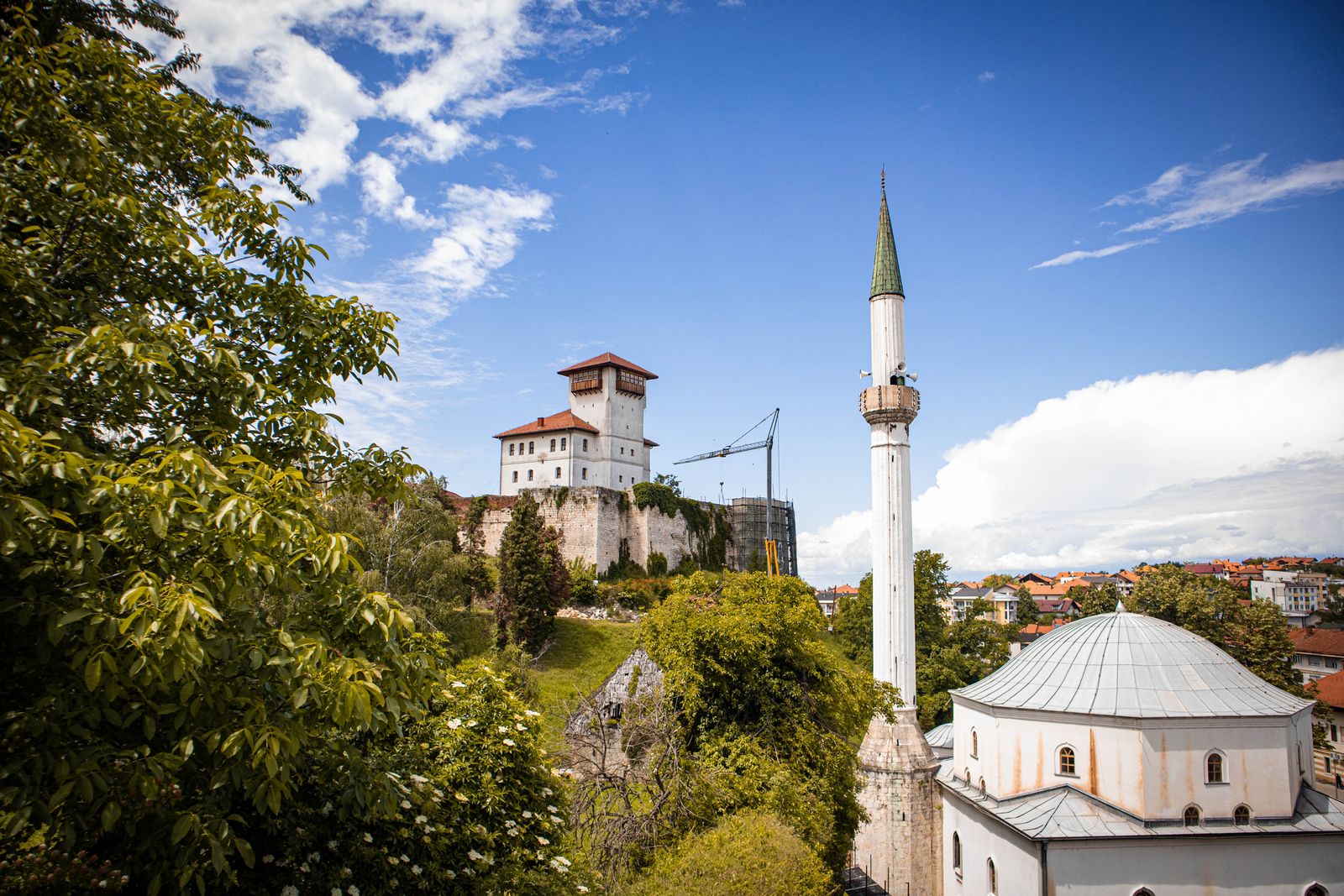
A waterfall within a town: the Pliva River’s 21m cascade at the edge of Jajce’s medieval walled town, and the Bogomil tombstones (stecak) in the surrounding landscape.
Photo: Jocelyn Erskine-Kellie, CC BY-SA 2.0
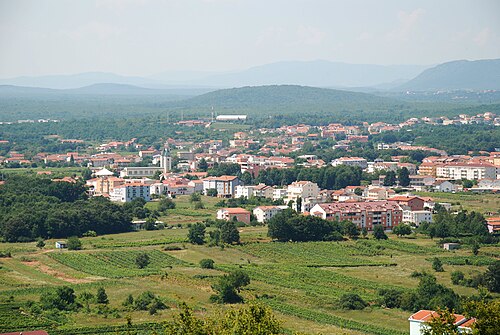
A Catholic pilgrimage site where six teenagers reported Marian apparitions in 1981: 30 million pilgrims have visited since, making it one of the world’s most visited pilgrimage destinations.
Photo: Janmad, CC BY 3.0
Small skinless grilled beef and lamb sausages in a flatbread (somun) with raw onion and kajmak (clotted cream): Bosnia’s national street food. Sarajevo’s Zeljo restaurant is the benchmark.
A spiral coil of filo pastry filled with minced meat (burek) or cheese (sirnica): eaten for breakfast from a tepsija (baking tray), cut into portions and served with yogurt.
A slow-cooked pot stew of alternating layers of beef, lamb, pork, vegetables and spices: cooked for 8+ hours in a sealed clay pot.
Small filled dumplings of minced meat in a tomato-garlic sauce, topped with kajmak: the Bosnian answer to ravioli.
Two indigenous Herzegovinian grape varieties: Zilavka (white, dry and acidic) and Blatina (red, full-bodied). Grown in the Neretva Valley near Mostar.
The Sarajevo brewery (est. 1864): the city’s lager, the correct beer at a kafana (traditional tavern).
Grape, plum or quince brandy: 40-55% alcohol, drunk at every table in the Balkans.
Coffee ground fresh in a dzezva (small copper pot), poured slowly into a small cup with a sugar cube: drunk over 20 minutes. Distinct from Turkish coffee.
Sarajevo Butmir (SJJ) is the only significant international airport. Direct flights from UK and European cities operate on a seasonal basis. Bus connections to Split, Dubrovnik, Belgrade and Zagreb are excellent.
Vienna is the most convenient European hub for Sarajevo — Austrian Airlines connects daily in 2h and Vienna is itself a major international hub.
Dubrovnik to Mostar (3h) and then Sarajevo (further 2h30) is the classic western Balkans circuit — Croatia’s coast to Bosnia’s interior in one easy progression.
Sarajevo’s tram network is one of the oldest in the Balkans (since 1885) and covers the main tourist corridor from Bascarsija to Ilidza. A single journey costs BAM 1.80 with a ticket from the driver.
Bosnian roads outside the main corridors are narrow and sometimes unmaintained — factor 30–50% extra time compared to Google Maps estimates on mountain routes. The views compensate.
May to September is best for Sarajevo, Mostar and the outdoor sites. Summer is warm and lively; spring brings green mountains and waterfalls in full force. December–February is cold but Sarajevo has a distinct winter character and good skiing in the surrounding mountains.
📅 Bosnia is in its best season in May, June, July, August, September. See where else is good to go in those months, or browse where to go by month.
Bosnia is one of the cheapest countries in Europe — good value for food, accommodation and local transport. The Bosnian convertible mark (BAM) is pegged 2:1 to the euro.
Cevapi — small skinless grilled sausages made from beef and lamb, served in a somun (round flatbread) with kajmak (clotted cream) and chopped raw onion — is Bosnia’s national fast food.
Bosnian coffee (kafa) is served in a small copper dzezva with sugar cubes and a piece of rahat lokum (Turkish delight) — a ritual of decanting, waiting and drinking that takes 20 minutes and costs BAM 1.50–2.50.
Hotel Pansion Nur in Bascarsija (restored Ottoman merchant house, 10 rooms) and the Swissotel Sarajevo are the finest addresses in the city — from BAM 150 and BAM 300 per night respectively.
Sarajevo for three days, Mostar for two, the Kravice waterfalls and Herzegovina for two. Bosnia is a small country but dense with history and natural beauty.
Sarajevo is the city where Archduke Franz Ferdinand was assassinated on 28 June 1914, triggering World War I. The Latin Bridge where the shots were fired, the Sarajevo Museum 1878–1918. The Bascarsija — the 15th-century Ottoman bazaar quarter, with the Gazi Husrev-beg Mosque (1531) and the old craftsmen’s streets.
The Sarajevo assassination site (the Latin Bridge) is one of the most important locations in modern history — the spot where Gavrilo Princip stood and fired two shots that directly caused 17 million deaths. The marker on the pavement is deliberately understated.
The Tunnel of Hope (Tunel spasa) — the 800m tunnel dug under the airport runway in 1993 to supply besieged Sarajevo during the longest siege of a capital city in modern warfare (44 months, 1992–1996). The Yellow Fortress above the city for the view over the Ottoman rooftops and minarets. The Vijec0nica National Library — rebuilt after being burned in 1992.
During the siege of Sarajevo (1992–1996), 11,000 people were killed by Bosnian Serb snipers and artillery — more than in the entire first two years of WWI on the Western Front. The Sarajevo Rose (red resin fills shrapnel craters in the pavement) marks where people were killed.
The War Childhood Museum (personal objects and testimony from children who survived the siege) is one of the most affecting small museums in Europe. The Trebevic mountain cable car (restored) above Sarajevo to the 1984 Winter Olympics bobsled track, now overgrown and graffiti-covered in the forest.
The 1984 Winter Olympics bobsled track on Trebevic mountain was destroyed by artillery fire during the siege and has been slowly reclaimed by vegetation and graffiti artists. Walking the 1.3km abandoned concrete track through the forest is one of the most surreal experiences in the Balkans.
2h30 from Sarajevo. The Stari Most (Old Bridge) in Mostar — a single arch of white limestone spanning the Neretva River, rebuilt in 2004 after being deliberately destroyed in 1993 — is the most recognised symbol of Bosnia. The Ottoman old town on both banks, with the minarets of Koski Mehmed Pasha Mosque above.
The Stari Most was built in 1566 by the Ottoman architect Mimar Hayruddin and stood for 427 years until Croatian forces deliberately destroyed it with tank fire in 1993. The rebuilt bridge uses stone from the same quarry and the same medieval construction techniques.
Pocitel — a medieval fortified village 30km south of Mostar on the Neretva, with a 15th-century fortress, Ottoman hammam and mosque on a rocky hillside above the green river — is the finest example of the layered history of Herzegovina. The Blagaj tekke (a Dervish monastery built into a cliff face above the Buna spring).
The Blagaj Tekke (Blagaj Dervish House) is built at the base of a 200m limestone cliff at the exact point where the Buna River emerges from the rock — fully formed, ice cold and crystal blue. The building is 16th century and still in use as a Sufi meeting place.
1h from Mostar. The Kravice Waterfalls — a 25m-wide, 10m-high horseshoe of travertine waterfalls on the Trebizat River, with a turquoise swimming pool at the base — are completely unknown outside the Balkans and extraordinary. Swimming is permitted and the water is warm in summer.
Kravice has limited parking and a simple entry fee (5 BAM). The falls are most dramatic in spring after snowmelt. In August the swimming hole fills with local families. Almost no international tourists come here, which is entirely inexplicable given the beauty.
3h from Mostar or return to Sarajevo. Bihac on the Una River — an emerald-green river with travertine falls, clean enough to swim, flowing through a canyon on the Croatian border. The Una National Park has some of the finest river scenery in the western Balkans. Return via Sarajevo for international flights.
The Una River is one of the cleanest rivers in Europe — Category I water quality for its entire length. The large waterfalls at Martin Brod (12m high) and Strbacki Buk (24m wide) are entirely free to visit and largely unknown outside Bosnia.
Uber and Bolt don't operate here. Taxi apps such as Moj Taxi work in Sarajevo; elsewhere agree fares and carry cash in BAM.
A cevapi portion: BAM 5 (EUR 2.50). A guesthouse in Mostar: BAM 40-80 (EUR 20-40).
The post-war generation is open, self-deprecating and proud. The coffee culture is the social glue.
Bullet holes remain on many Sarajevo buildings. Bosnians discuss it with unexpected openness.
Public transport doesn’t reach the national parks, waterfalls or mountain villages.
BH Telecom has the best coverage nationwide.
Thank you and good day in Bosnian. Always appreciated.
Never leave marked paths in Sutjeska or remote mountain regions. Maps at hut.ba.
Quick answers to the questions people most often ask before visiting Bosnia.
May to September is best for Sarajevo, Mostar and the outdoor sites. Summer is warm and lively; spring brings green mountains and waterfalls in full force.
Sarajevo Butmir (SJJ) is the only significant international airport. Direct flights from UK and European cities operate on a seasonal basis. Bus connections to Split, Dubrovnik, Belgrade and Zagreb are excellent.
Expect roughly BAM 35–55 a day on a budget and BAM 100–160 mid-range, or BAM 300+ for a more luxurious trip, per person and excluding flights.
Bosnia uses the BAM.
Plug types: Type C / F (two-pin, 230V).
Negotiate ride fares directly with drivers — the most popular ride-hailing option across Bosnian cities.
FreeBook Mostar Old Bridge tours, Sarajevo city walks, Kravice Waterfalls trips and Bosnian experiences.
FreeBosnia’s primary messaging platform — contact accommodation, guides and local transport.
FreeA layered capital, the famous old bridge, a green second city, a wine-country town and a waterfall in the town centre — five sides of Bosnia.
Bosnia sits within easy reach of several other destinations — each with a completely different character.


