KR
Jeju Island
Korea's volcanic honeymoon island
Korea's volcanic honeymoon island

Seongsan Ilchulbong is a UNESCO World Heritage tuff cone on Jeju’s eastern tip — a volcanic crater filled with 99 rocky pinnacles and a green meadow, rising 182m from the sea. The sunrise from the crater rim over the East Sea and Udo Island is the most famous view in Jeju and one of the finest in Korea.
Seongsan Ilchulbong sunrise: arrive at the base by 4:30am (ticket office opens at 5am; the 20-minute climb puts you on the crater rim as the sun rises over Udo Island).

Hallasan (1,950m) is a shield volcano that forms the entire interior of Jeju Island — the highest mountain in Korea. The Seongpanak Trail (9.6km; 4–5h up) leads to the Baekrokdam crater lake at the summit. The Yeongsil Trail does not reach the summit but has the finest landscape and geology.
Hallasan’s Seongpanak Trail requires a 5am start to reach the summit by the 12:30pm ranger cutoff. Check the forecast the night before — the Baekrokdam crater lake is invisible in cloud.
Hallasan National Park →
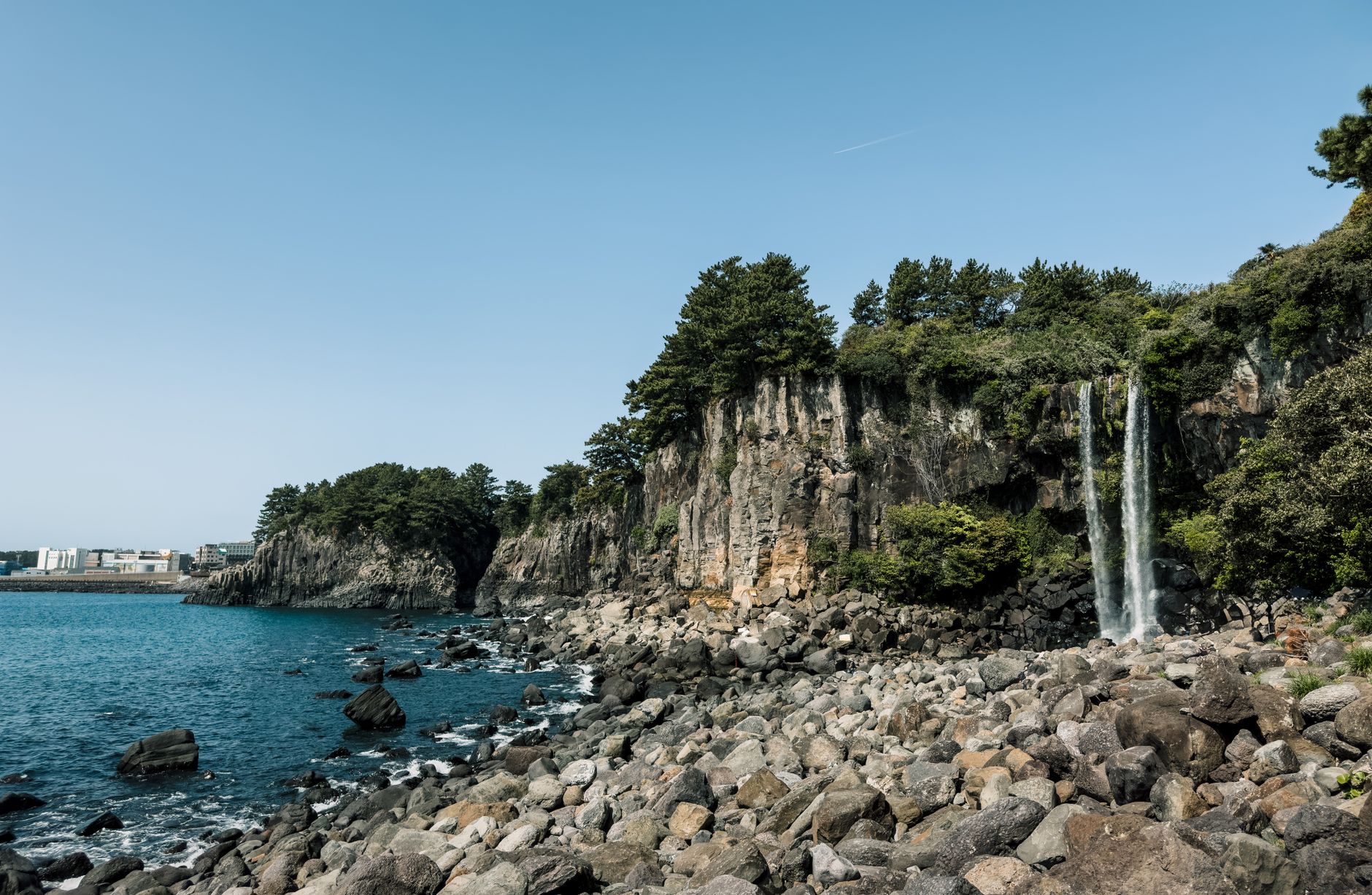
Jusangjeolli Cliff (₩2,000; Jungmun; south coast) is a 500m stretch of hexagonal basalt columns — the columnar jointing formed as lava cooled from a vent above. The columns range from 30cm to 1m in diameter and stack 20m high above the sea, the waves breaking at their base.
Manjanggul lava tube is 11°C inside year-round — bring a layer regardless of the season. The lava column at the far end is the world’s largest; the 1km section takes 45 minutes.

Jeju’s hallabong tangerine orchards cover the lower slopes of Hallasan — the fruit is available November to March and sold at roadside stalls for ₩5,000–10,000 per bag. The rural landscape between the orchards, the stone field walls (batdam), and the cinder cone oreum is the most unhurried part of Jeju.
Jusangjeolli Cliff is best at low tide and in afternoon light (3–5pm) when the sun catches the hexagonal columns from the south. The ₩2,000 entry includes the full coastal walkway to the headland.
The Jeju heukdwaeji (the black pig; the native Jeju breed characterised by its black coat; the most celebrated Korean BBQ animal; the meat fatter and more intensely flavoured than the standard Korean white pig; KRW 15,000–25,000 per 200g portion; grilled at the table over charcoal; the Dongmun Market area in Jeju City and the Eohwa-ro Black Pork Street in Jeju City are the two main heukdwaeji restaurant clusters; the most specifically Jeju meal) is the island’s definitive food experience. The galchi jorim (the braised Jeju scabbardfish in gochujang; the silver elongated fish with the most intensely salty flavour; KRW 15,000–25,000 at the Seogwipo seafood restaurants; the most Jeju-specific fish dish), the haenyeo-caught abalone (the jeonbokjuk abalone porridge; KRW 20,000–30,000; the most delicate Jeju breakfast), the hallabong tangerine fresh juice (from any roadside stall; KRW 5,000; the sweetest fruit in Korea), and the udo peanut soft serve ice cream (KRW 4,000 on Udo Island; the peanuts grown in the red clay volcanic soil of Udo; the most specific island snack) together constitute the Jeju food passport.
A rental car (KRW 40,000–80,000/day from any of the 50+ car rental companies at Jeju Airport; the Hyundai or Kia compact models are the standard; the island roads are well-paved and traffic is moderate outside summer peak; GPS in Korean or English included; the most practical way to visit all Jeju sights in 3 days) is the correct Jeju transport. The intercity bus network (Routes 201 and 202 along the coastal perimeter road; KRW 1,200–1,400 per trip with T-money; the 600 bus series for the Jungmun south coast; frequency every 20–60 min; practical if you have time and patience) covers most major sights. Kakao T taxi (KRW 5,000–30,000 for the city-to-site journeys; the most practical for the Seongsan to Manjanggul run and the Jeju City to Jungmun resort; the app works on Jeju) is the best alternative to the rental car for those who prefer not to drive. Udo Island cycling (rent at the Udo ferry terminal: KRW 8,000–15,000/day for a standard bike; KRW 15,000–25,000 for an electric bike; the 17km island circuit; 1.5h by electric bike; the most enjoyable 2h on Jeju).
Seongsan Ilchulbong sunrise requires arriving at the base by 4:30am.
Jeju black pork (heukdwaeji) — the heritage pig breed with darker, more intensely flavoured meat — is the most specifically Jeju experience.
Book the Jeju rental car before booking the flight — prices triple in peak season (April cherry blossom, July–August beach, October foliage) and the cheapest cars sell out weeks ahead.
The Seongpanak Trail (Hallasan summit; 9.6km one-way) requires a 5am start to reach the summit by 12:30pm before the ranger cutoff.
The haenyeo of Jeju still free-dive to 20m without equipment for abalone, sea urchin, and conch — the freshest urchin is bought directly from haenyeo women selling at the seafront stalls in Seongsan.
The Manjanggul lava tube (₩4,000; 1km open section of a 7.4km UNESCO system) is 11°C inside year-round regardless of the season — the lava column at the far end is the world’s largest.
Sep–Nov is the clearest and most comfortable (12–25°C; Hallasan autumn foliage; best sunrise visibility). Apr is the rapeseed mustard season. Jul–Aug is beach season (warm sea; very crowded; book flights and cars months ahead). Jan–Feb: quiet; snow on Hallasan; the haenyeo season.
Three days by rental car: Ilchulbong sunrise, Manjanggul Cave, the east coast, Hallasan hike, Jusangjeolli, the south coast, and Udo Island.
East coast circuit (rental car): Ilchulbong sunrise (4:30am start), Manjanggul lava tube, Udo Island ferry (15 min; electric cart), Seongsan hoe (raw fish) lunch.
Jeju’s best itinerary: east coast day 1 (Ilchulbong + Manjanggul + Udo), south coast day 2 (Hallasan + Seogwipo + Jusangjeolli), west coast day 3 (Bijarim Forest + Biyangdo + Hyeopjae Beach).
Hallasan summit hike via Seongpanak (5am start; 9.6km up; 4–5h; Baekrokdam crater lake). Return by 3pm. Heukdwaeji black pork on Eohwa-ro for dinner.
The haenyeo in Seongsan sell freshly dived sea urchin (₩5,000 per shell) at the seafront stalls below Ilchulbong — the best single bite in Jeju, eaten standing with a wooden spoon.
South coast: Jusangjeolli basalt cliff (Jungmun). Cheonjeyeon waterfall. Jeju Haenyeo Museum. Seogwipo for fresh Jeju abalone.
Jeju’s speed cameras are frequent — the island-wide limit is 80km/h on national roads, 60km/h in most areas. Navigation apps show camera locations.
Jeju is mid-range for Korea. The rental car (KRW 50,000/day) is the largest daily cost. The heukdwaeji black pig BBQ (KRW 30,000 pp), the Hallasan hike (free) and the Udo Island day (KRW 25,000 all in) make the essential experiences affordable. Per person per day.
The Udo Island day (KRW 7,000 ferry + KRW 15,000 electric bike + KRW 4,000 peanut ice cream = KRW 26,000)
The Seogwipo raw fish hoe (the cutlassfish galchi and the sea bream at the Seogwipo Maeil Olle Market)
The private haenyeo sea experience (a retired haenyeo master leading a shallow free-dive to observe the abalone and the reef fish at 3&ndash)
Jeju domestic flight booking and real-time Gimpo–Jeju seat availability.
Free
Jeju restaurant discovery with heukdwaeji black pork and haenyeo abalone filtering.
Free
Download the Jeju Island offline map before arrival — the rural oreum roads have no consistent signal.
Free
Download the Korean offline pack and use camera mode for menus and signs.
Free
Quick answers to the questions travellers most often ask before visiting Jeju Island.
Spring (April-June), with its canola blossoms, and autumn (September-November) are the most beautiful. Summer is hot, humid and the rainy peak season, while winter is mild, with snow possible on Hallasan.
Three to four days to climb or admire Hallasan, watch sunrise from Seongsan Ilchulbong, explore the lava-tube caves, waterfalls and beaches, and enjoy the coastal drives.
A rental car is by far the best way, as public transport is limited; buses and taxis are alternatives. Frequent flights connect the island with Seoul and Busan.
South Korea’s volcanic holiday island — Hallasan, the country’s highest peak, the UNESCO “Sunrise Peak” of Seongsan Ilchulbong, lava-tube caves, waterfalls and beaches, the famous haenyeo free-diving women, and a mild, resort-like escape.
Explore more of South Korea’s extraordinary cities and landscapes.
Planning a wider trip? Our South Korea travel guide covers getting there, costs, when to go and more.