SH
Saint Helena
Napoleon’s exile, world’s oldest tortoise & sustainable South Atlantic tuna
Napoleon’s exile, world’s oldest tortoise & sustainable South Atlantic tuna
Saint Helena is one of the most remote inhabited islands on earth — a British Overseas Territory of 122 square kilometres in the South Atlantic, 1,950 kilometres west of Angola and 4,000 kilometres from South America, accessible for most of its history only by ship. Napoleon Bonaparte spent his final six years here in exile after Waterloo, dying at Longwood House in 1821; his original grave is on the island. The opening of the St Helena Airport in 2016 transformed the island from a 5-day ship journey to a 5-hour flight from Johannesburg, making it suddenly accessible. The island has extraordinary biodiversity for its size, dramatic volcanic landscapes, the world’s oldest living tortoise (Jonathan, born c. 1832), a small, warm community of 4,500 St Helenians, and the haunting Napoleonic heritage that has made it famous since 1821.
The house where Napoleon Bonaparte spent his final six years in British captivity (1815–1821), preserved exactly as it was at his death by the French government (which owns and maintains it), is the island’s most visited attraction — his billiard room, bedroom, study and garden create a deeply intimate portrait of the greatest general of the age in his final, powerless years.
The world’s oldest known living land animal — Jonathan, a Seychelles giant tortoise born approximately 1832, still roams the grounds of Plantation House (the Governor’s residence). At nearly 200 years old, Jonathan has outlived every human on the island, survived two world wars and multiple governors. His daily feeding is one of Saint Helena’s gentlest rituals.
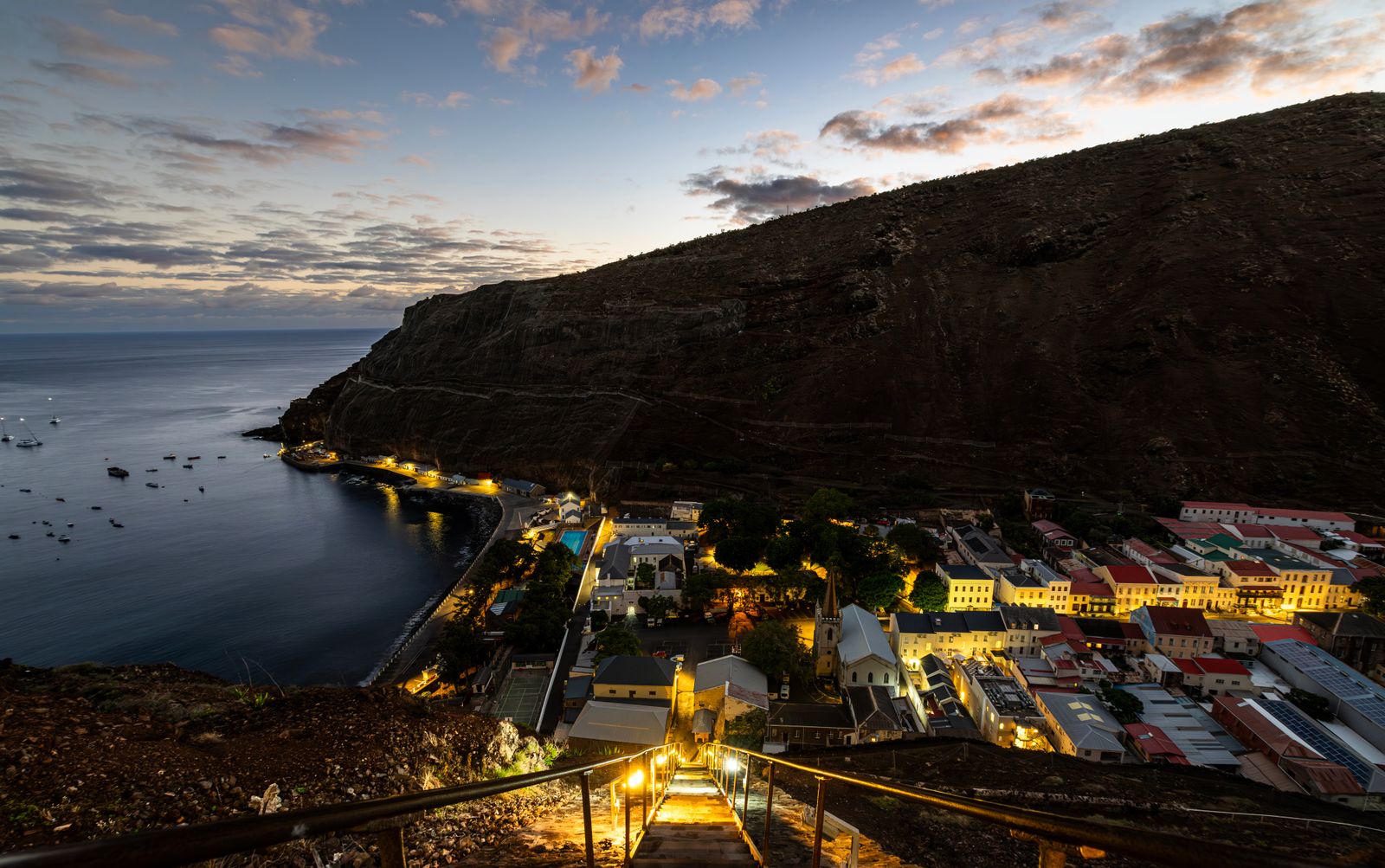
Jacob’s Ladder — 699 steps rising at 45 degrees from Jamestown to the ridge above — is one of the world’s steepest staircases and a daily exercise challenge for the island’s residents. Jamestown below, the island’s only town, is a Georgian colonial settlement in a dramatic valley, virtually unchanged since the 18th century.
Saint Helena (Wikipedia) →Yellowfin tuna caught by local boats with rod and line — the island’s main fishery and best food product.
Fresh tuna patties mixed with breadcrumbs, spring onion and chilli, pan-fried — the everyday street food and home cooking staple of Saint Helena, reflecting the island’s position on the tuna migration route.
A one-pot dish of mutton or chicken with rice, turmeric, cinnamon and coriander — reflecting Saint Helena’s position on the East India Company’s trade route, where Asian spice ingredients became a natural part of the island’s isolated food culture.
A thick slice of grilled local tuna in a bread roll, served at Jamestown’s cafés.
A spirit distilled from the fruit of the prickly pear (tungi) by the St Helena Distillery.
Saint Helena Airport (HLE) opened in 2016 after decades of debate. Airlink (South Africa) and occasional charter services connect the island. For trip planning, see the official Saint Helena tourism portal.
Airlink operates the only scheduled service — a once-weekly Saturday flight from Johannesburg (6h30) and Cape Town (5h30). The limited frequency means most visitors stay a minimum of 7 nights.
UK visitors connect through Johannesburg or Cape Town. The total journey from London is approximately 18–20 hours; the remote location is integral to the experience.
Saint Helena Airport is on the windward (east) coast; most accommodation and attractions are in or near Jamestown on the west coast, 35 minutes away. Car hire at the airport is strongly recommended.
Car hire (£30–55/day) is the most practical option — Saint Helena has 160km of road and a car gives the freedom to explore the entire island independently. Roads are good but very steep and narrow in places.
October to April is the warmest period (22–26°C) and the whale shark season (November–January). May to September is cooler (16–20°C) with rougher seas but the island is still entirely accessible. Saint Helena is pleasant year-round; rain falls mainly in the highlands.
📅 Saint Helena is in its best season in January, February, March, April, October, November, December. See where else is good to go in those months, or browse where to go by month.
The Saint Helena pound (SHP, at parity with GBP) is the currency. Modestly priced for a British territory.
Tungi (the cactus pear liqueur and cider made from the fruit of the prickly pear cactus that covers large areas of Saint Helena)
The Saint Helena tuna (yellowfin and skipjack tuna caught daily in the South Atlantic by Saint Helena fishing boats)
The RMS Saint Helena (the supply vessel serving Saint Helena, Ascension Island and Tristan da Cunha)
Jamestown for one day, Napoleon’s Longwood for one, whale shark snorkelling for one, Diana’s Peak for one, Boer War history for one, Sandy Bay for one, Jonathan the tortoise for one. Saint Helena — Napoleon’s prison island in the South Atlantic — has the world’s finest Atlantic whale shark encounters, a critically endangered national bird and Jonathan, the oldest known living land animal.
Jamestown — the capital of Saint Helena (a British Overseas Territory of 122km² in the South Atlantic, 2,000km from the nearest continent, population 4,500 — one of the most isolated inhabited islands on earth, famous primarily as the place of Napoleon Bonaparte’s final exile) — a complete Georgian colonial town preserved in a steep valley, with the Ladder Hill Fort, Jacob’s Ladder (699 steps cut into the cliff) and the Castle and Government House.
Saint Helena was the place of Napoleon Bonaparte’s final exile (1815–1821 — after his defeat at Waterloo, the British government chose Saint Helena specifically for its extreme isolation as the most secure prison in the world — no island is further from any continent — where he died on 5 May 1821 at age 51 and was buried at Longwood until his remains were repatriated to Les Invalides in Paris in 1840). Saint Helena has been French sovereign territory during the transportation of his remains and is the most historically significant British island in the Atlantic outside Britain itself.
Longwood House (Napoleon’s residence during his 6-year exile — the house where he lived, complained about the damp and the British governor, wrote his memoirs and died — maintained by the French government as French sovereign territory (the only French soil outside France itself), meticulously restored to its 1821 appearance with period furniture and Napoleon’s personal effects) and Sane Valley (where Napoleon was originally buried before repatriation to Paris).
Longwood House and its garden (officially French sovereign territory since 1858, maintained and managed by the French government through the French Consul on Saint Helena — the only example of French extra-territorial sovereignty in the British Atlantic — is preserved exactly as it appeared during Napoleon’s residence. The house contains his original furniture, personal effects including his hat and coat, and the camp bed on which he died.
Whale shark snorkelling (November to January — Saint Helena has the highest density of whale sharks accessible from shore in the Atlantic, with 100–200 individuals congregating in the waters off the island each season, accessible by boat from Jamestown in 30 minutes — these are juvenile males (5–8m), the most approachable in the world, habituated to snorkellers and swimming slowly in the warm surface water — the finest Atlantic whale shark encounter by a wide margin).
Saint Helena’s whale shark population (100–200 individuals November–January — the highest density of whale sharks in the Atlantic, discovered only in 2010 by visiting divers and not scientifically described until 2015) aggregates around the island in the South Atlantic summer, apparently feeding on tuna egg masses. The individuals are all juvenile males of 5–8m; no adults or females have been recorded at Saint Helena, suggesting it is a specific juvenile feeding ground.
Diana’s Peak (823m — the highest point in Saint Helena, in the National Park covering the island’s interior cloud forest — a hike through the most striking oceanic island flora in the Atlantic: tree ferns, black cabbage trees, bastard gumwood and the indigenous Saint Helena wirebird (Charadrius sanctaehelenae — the island’s national bird, critically endangered with fewer than 500 individuals) in the foggy moorland of the summit plateau) and the Millennium Forest restoration project.
The Saint Helena wirebird (Charadrius sanctaehelenae — a small plover found only on Saint Helena, descended from a colonial-era introduction of a bird that evolved in total isolation for millions of years into a distinct species) was reduced to approximately 200 individuals in the late 1990s by cat and rat predation. An intensive predator control programme (trapping cats and rats in the wirebird habitat) has recovered the population to approximately 500 individuals, still one of the rarest birds in the Atlantic.
The Boer War prisoner of war camp sites (1900–1902 — Saint Helena held 5,000 Boer prisoners from South Africa during the Anglo-Boer War, the second time the island was used as a strategic prison after Napoleon — the Deadwood Plain camp site with the Boer POW cemetery is the largest foreign military cemetery in the South Atlantic) and the Castle (the 17th-century British military complex in Jamestown with the Museum of Saint Helena).
Saint Helena was used as a British prison island three times: the East India Company imprisoned 3,000+ enslaved Africans rescued from slave ships there (1840–1872); Napoleon (1815–1821); and 5,000 Boer War prisoners (1900–1902). Each episode left a significant physical and genealogical legacy — the liberated enslaved Africans’s descendants form a large part of the current population.
Sandy Bay (a beach of black volcanic sand on the south coast — the most dramatic coastal scenery in Saint Helena, with 200m vertical cliffs of ancient volcanic rock, the pounding South Atlantic swell and the nesting colonies of masked boobies and Saint Helena plovers) and the Harpers Valley (the deepest valley on the island, with the most intact examples of original Saint Helena gumwood forest — the national tree, once covering the island before the East India Company goats stripped it in the 17th century).
The East India Company goats (introduced to Saint Helena in the 1500s as a food source for passing ships — by 1600 the entire island was covered by thousands of feral goats that stripped every native plant on the lower slopes, destroying the original gumwood and ebony forest in under 100 years — represent the first recorded case of invasive species destruction of an oceanic island ecosystem. The current restoration project has planted 30,000+ native trees in the last decade.
Jonathan (Aldabra giant tortoise, estimated born c. 1832 — approximately 190+ years old, the oldest known living land animal on earth, resident at Government House garden since 1882 — still active, grazing on the lawn, participating in guided tours and acknowledged as one of the most striking living beings on the planet) and the restored Jamestown market and craft shops before flying from Saint Helena (HLE).
Jonathan the tortoise (officially documented as the oldest known living land animal — Guinness World Record holder — estimated born approximately 1832 based on his arrival at Saint Helena as a mature adult in 1882. He was alive during the reign of Queen Victoria, the US Civil War, both World Wars and every subsequent world event. He is blind in one eye, has lost his sense of smell but eats, moves and socialises normally on the Government House grounds.
SA Airlink operates flights from Johannesburg (5h) twice weekly, and a seasonal service from Cape Town. The RMS St Helena now operates cruises rather than the regular ship service discontinued in 2018.
Opened in 2016; prior to that, the RMS St Helena was the only transport (5-day voyage from Cape Town). The flight is 6h from Johannesburg.
Napoleon Bonaparte was exiled here 1815-1821 after Waterloo and died at Longwood House. His original tomb (empty since 1840) and Longwood House are the island’s primary historical attractions.
The island has a small number of guesthouses and holiday cottages. Book far in advance; the island receives only around 3,000 visitors per year.
Most nationalities including EU, UK, USA enter visa-free.
Quick answers to the questions people most often ask before visiting Saint Helena.
Fly to Saint Helena Airport (HLE) from Johannesburg, with seasonal services from Cape Town. Flights are limited to a few a week at most, so trips usually run to a week or more; book well in advance.
It is where Napoleon Bonaparte was exiled after Waterloo, from 1815 until his death in 1821. You can visit Longwood House, where he lived, and his original tomb.
October to April is the warmest period (22–26°C), and November to January is whale shark season. May to September is cooler with rougher seas, but the island is pleasant all year.
The Saint Helena pound, which is at parity with the British pound. Expect around £50–90 per day on a budget and £120–200 mid-range.
Very little — a small number of guesthouses and holiday cottages. Because flights are infrequent, book your accommodation at the same time as your flights.
Point your camera at menus, signs or street text for instant translation. Download the language pack offline before you arrive for full use without data.
FreeReal-time and offline exchange rates for all world currencies — converts prices instantly so you always know what you are paying in your home currency.
FreeFind and book hotels, guesthouses and apartments with free cancellation on most rates — one of the widest selections of accommodation worldwide.
FreeBrowse millions of traveller reviews for restaurants, attractions and hotels — helps identify the best local spots and avoid tourist traps.
FreeSaint Helena sits within easy reach of several other destinations — each with a completely different character.
Saint Helena is one of the world’s least-visited places. See all 90 in our guide to the world’s least-visited countries & territories.


